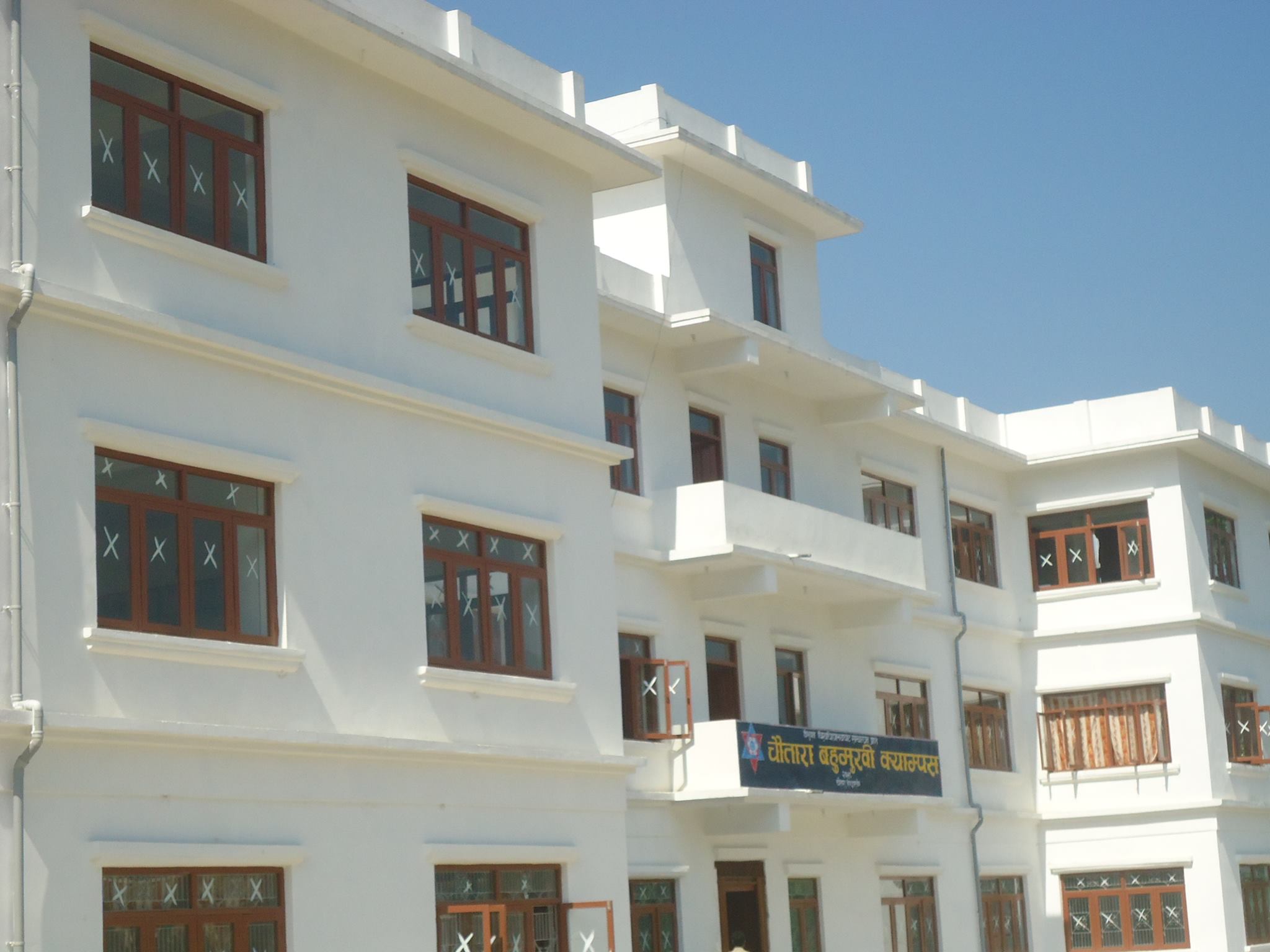
Chautara Multiple Campus (चाैतारा बहुमुखी क्याम्पस, सिन्धुपाल्चाेक) is a non-profit, community-based higher education institution in Chautara, Sindhupalchok, Nepal. Established in 2001 AD (2058 BS) under the leadership of Shree Krishna Ratna Ganga Higher Secondary School, it began with the goal of widening access to higher education in the district, especially for rural, underprivileged, and socially diverse communities.
It is recognized as the first public campus in Sindhupalchok and has grown from a single bachelor-level offering into a multi-faculty institution affiliated with Tribhuvan University. Today, the campus runs bachelor-level study in Education (B.Ed.), Management (BBS), and Science (BSc), along with a Master of Education (M.Ed.) program.
Its academic profile, community roots, and steady institutional growth have made it an important higher education center for students from Sindhupalchok and nearby districts.
Established: 2001 AD (2058 BS)
Institution Type: Non-profit, community-based public campus
Location: Chautara Sangachokgadhi Municipality-5, Chautara, Sindhupalchok, Bagmati Province, Nepal
Affiliation: Tribhuvan University (TU)
Status: First public campus in Sindhupalchok district
Programs: B.Ed., BBS, B.Sc. General, and M.Ed.
Academic System: Annual system for bachelor-level programs; semester system for M.Ed.
M.Ed. Specializations: English and Nepali
B.Ed. Subject Areas: English, Nepali, Economics, Mathematics, Population, and Health
Institutional Recognition: Selected for UGC Scheme D; QAA certified in 2024; linked with NEHEP until 2026
Facilities: Classrooms, library, e-library, science lab, computer lab, multimedia hall, projectors, playground, cafeteria, and conference hall
Contact: +977-11-620442, +977-11-620342 | chautaramultiplecampus@gmail.com | chautaracampus@yahoo.com | www.cmccampus.edu.np
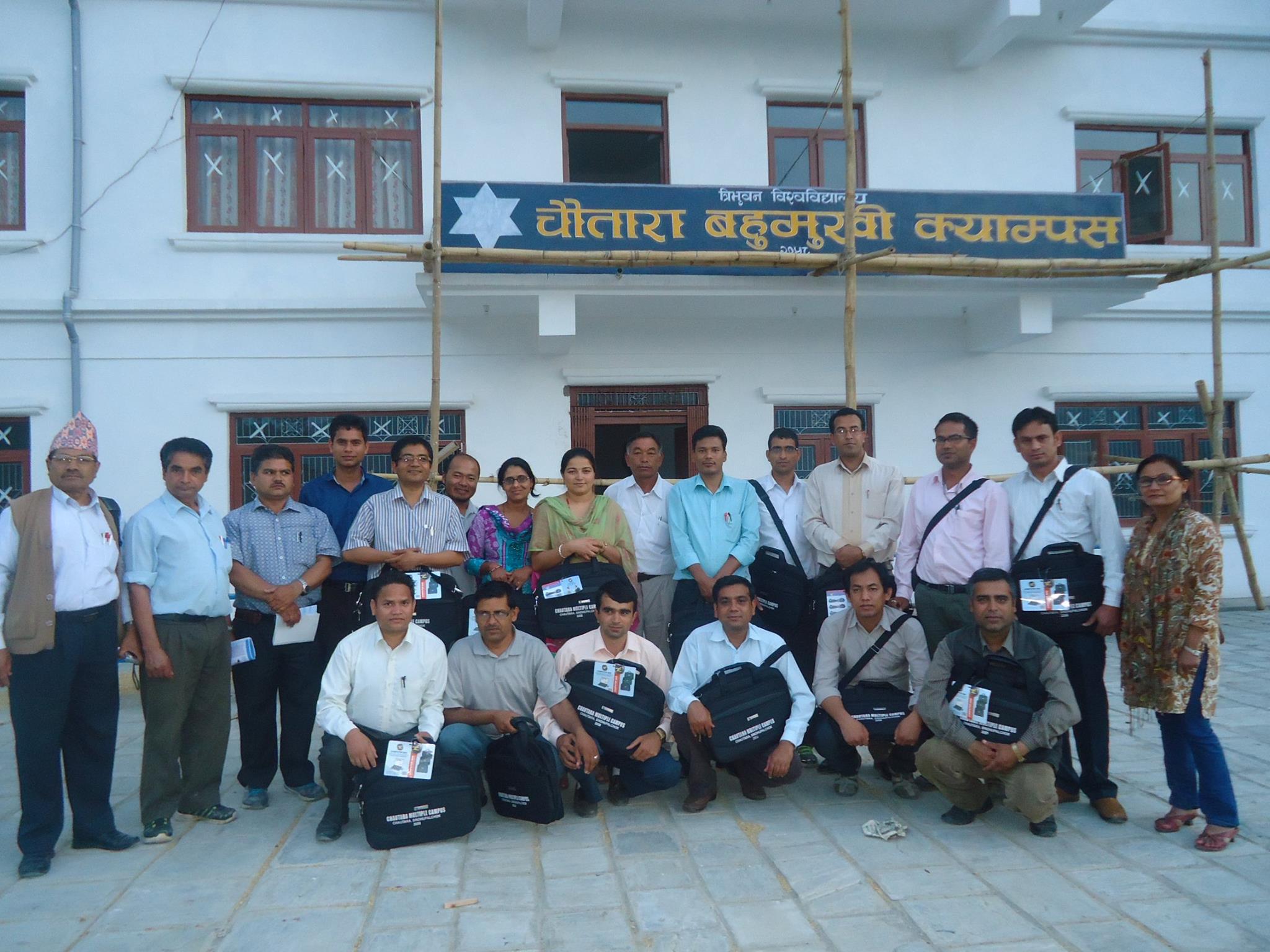
The foundation of Chautara Multiple Campus came from a local need for accessible higher education in Sindhupalchok. The campus started with 30 students and 3 lecturers, operating from three rooms of Krishna Ratna Ganga Higher Secondary School. Krishna Raj Shrestha served as the founding chairperson. From those early years, the campus was shaped by community participation and by a long-term interest in building educational opportunity within the district.
The institution was established with a social purpose as well as an academic one. It has aimed to serve ethnic minorities, marginalized groups, women, underprivileged learners, and students from rural areas who might otherwise have had fewer opportunities to continue higher studies. Over time, its reach has extended beyond Sindhupalchok, drawing students from neighboring districts such as Kavre, Nuwakot, and Ilam.
Academic growth at the campus has taken place in stages. The first program was the Bachelor of Education. The Bachelor of Business Studies was added in 2063 BS, the Bachelor of Science in 2069 BS, and the Master of Education in 2075 BS (2018 AD). This gradual expansion created a broader academic base while keeping the institution closely tied to local educational needs.
The campus has also recorded important institutional progress. It received Quality Assurance and Accreditation certification from the University Grants Commission on 3rd Falgun 2080 BS (2024 AD). It has also been selected for UGC Scheme D and is associated with the Nurturing Excellency in Higher Education Program until 2026 AD. These developments indicate an institutional focus on academic standards, internal strengthening, and long-term growth.
Chautara Multiple Campus runs academic programs under Tribhuvan University through three main faculties and one master’s-level stream.
Bachelor of Education (B.Ed.) – 4 years, annual system, Faculty of Education
Bachelor of Business Studies (BBS) – 4 years, annual system, Faculty of Management
Bachelor of Science (B.Sc.) General – 4 years, annual system, Institute of Science and Technology
Master of Education (M.Ed.) – 2 years, 4 semesters, Faculty of Education
B.Ed.
Offered as a four-year annual program
Designed as both a professional and academic degree for teacher preparation
Includes communication skills, professional core courses, specialization major courses, specialization minor courses, and teaching practicum
At Chautara Multiple Campus, subject areas include English, Nepali, Economics, Mathematics, Population, and Health
BBS
Offered as a four-year annual program
Covers foundation courses, core management studies, concentration courses, business research methods, and a final project
The fourth year includes concentration study and project work
Finance is listed under the management stream at the campus
B.Sc. General
Offered as a four-year annual program under TU’s Institute of Science and Technology
The first two years follow core subject study with compulsory papers
The third and fourth years include advanced core courses, elective study, research methodology, project or field work, and compulsory computational and interdisciplinary components
Admission follows the IoST entrance process
M.Ed.
Offered in English and Nepali
Runs under the semester system over two years and four semesters
The program carries 69 credit hours, including core courses, specialization courses, teaching practice, and thesis writing
Study includes assignments, seminar work, case studies, project work, and field-based learning
Semester-end examinations are conducted through the Dean’s Office
The academic mix gives the campus a broad scope within a district setting. Students can study teacher education, management, science, and master’s-level education in one institution under TU affiliation.
Admission at Chautara Multiple Campus follows the rules of Tribhuvan University, the concerned faculty, and campus procedures.
Admission notices are published by the campus or concerned authority
Eligible applicants submit the prescribed application form with required academic documents
Admission may include merit-based selection, entrance examination, or both, depending on the program
Selected applicants complete admission by submitting documents and paying the required fees
Registration, examinations, and result procedures follow TU rules and the academic calendar
B.Ed.: Open to students who have completed Grade 12, Higher Secondary, or an equivalent qualification
BBS: Applicants must have completed 10+2 in business or commerce, or an equivalent course recognized by TU, or must have studied Mathematics or Economics as a full paper at the 10+2 level
B.Sc. General: Eligibility depends on the biological or physical group; applicants must have completed +2 Science, I.Sc., A-Level, or an equivalent qualification recognized by TU with the required science subjects
M.Ed.: Applicants must have completed B.Ed. or PGDE from TU or a TU-recognized university in the relevant specialization area and must pass the Faculty of Education entrance examination
For annual-system bachelor programs, final examinations are conducted by TU through the Office of the Controller of Examinations. For the semester-based M.Ed., semester-end examinations are conducted by the respective Dean’s Office.
Applicants generally need to submit the prescribed academic and identity documents at the time of admission.
Academic transcript or grade sheet of Class 12 / +2 or equivalent
Character certificate from the previous institution
Migration certificate, if applicable
Transfer certificate
Citizenship certificate or birth certificate copy
Passport-size photographs
Entrance examination scorecard, if required
Completed admission or application form
Admission fee payment receipt
Equivalence certificate, if applicable
Bachelor’s degree transcript or marksheet
Bachelor’s degree certificate or provisional certificate
Character certificate from the bachelor-level institution
Migration certificate, if applicable
Transfer certificate
Citizenship certificate or birth certificate copy
Passport-size photographs
Entrance examination scorecard, if required
Completed admission form
Admission fee payment receipt
Equivalence certificate, if applicable
Teaching and learning at Chautara Multiple Campus combine regular classroom instruction with guided academic support. The lecture method is used along with assignments, directed study, audio-visual presentations, Wi-Fi-supported learning, and classroom feedback practices. Internal examinations are part of the academic process, and answer sheets are returned after results so students can review their performance. Remedial classes and handouts are also used to support students who need additional academic help.
The campus uses multimedia in teaching and maintains annual lesson plans. Teachers are evaluated through classroom presentation, student responses, and outcomes in internal and final examinations. Faculty members are also encouraged to take part in seminars, conferences, and workshops for professional development. This gives the campus a structured teaching environment with attention to classroom practice, feedback, and academic continuity.
The campus has expanded its physical and academic infrastructure over time. Its learning facilities include both basic and technology-supported resources.
Modern campus building with 20 rooms and 4 meeting rooms
Well-furnished classrooms
Science laboratory
Computer lab with twenty computers
Library and e-library facilities
Department-wise mini-libraries
Department-wise computers
Multimedia hall with internet access
Five projectors installed for classroom use
Multimedia projectors in classrooms
CCTV in campus premises
Conference hall
Spacious playgrounds
Cafeteria
Sports facilities
Counseling support
Journal and academic materials
Database system being added to modernize library access
The campus building was developed with support from the Indian Embassy. It also occupies a substantial land area and has separate departments, which supports academic organization and subject-based study.
Student life at Chautara Multiple Campus is shaped by both academics and community engagement. The campus is situated in a comparatively calm academic environment and has played a visible role in the development of Chautara as an education center. Students study within a community institution where academic work, local participation, and social responsibility are closely linked.
The campus encourages involvement in public and civic activities. Students take part in programs organized by local bodies on occasions such as World Environment Day and Republican Day, and the campus community also joins rallies and public awareness events. Through the Youth Red Cross circle, students are mobilized in sanitation activities in market areas. The institution also shares vacancy notices from NGOs and INGOs and encourages students to apply when openings arise.
The social base of the campus is also strong. Lifetime and general membership are part of its public character, and the institution has grown with support from local contributors, including land and cash donations. This community setting gives student life a local connection that goes beyond classroom study.
Sports activities
Dance and music programs
Educational tours
Counseling support
Sanitation campaigns through the Youth Red Cross circle
Participation in World Environment Day programs
Participation in Republican Day programs
Involvement in rallies and local public events
Campus-based ECA activities linked to student engagement
Scholarships are included among the campus support services
The campus has been selected for UGC Scheme D
It is associated with NEHEP until 2026 AD
Community contributions, including land and financial support, have played an important role in institutional development
Public participation through events such as Mahayana Saptaha helped support campus operations and expansion
Established as the first public campus in Sindhupalchok district
Started with 30 students and 3 lecturers
Expanded from B.Ed. to BBS, B.Sc., and M.Ed.
Received QAA certification from the University Grants Commission in 2024
Selected for UGC Scheme D
Linked with NEHEP until 2026 AD
Runs M.Ed. in English and Nepali in a district context where such access is limited
More than 600 students have graduated from the campus
The campus records 11 master’s graduates in English and Nepali streams
Formed an Inter Campus Network with its own initiation
Community-based public campus with a long local education role
Tribhuvan University affiliation
Bachelor and master-level study available on one campus
Programs in Education, Management, and Science
Teacher education options at both bachelor and master level
Classroom teaching supported by multimedia, labs, internet, and library resources
Academic environment connected to local community life
Student engagement in social, cultural, and civic activities
Institutional progress marked by QAA certification and UGC support
The message from Chairman Er. Gambhir Lal Shrestha centers on trust, purposeful learning, and student commitment. It presents the campus as a place where learning should be active, thoughtful, and connected to each student’s own effort. The emphasis is on building an academic journey through cooperation between teachers and learners.
The message from Campus Chief Mr. Nagendra Prasad Dangal highlights institutional progress over the campus’s first two decades. It links the campus’s growth to dedicated staff, community support, student participation, and management continuity. It also points to academic expansion, QAA-related progress, and plans for further institutional strengthening, including land acquisition for hostel development.
Chautara Multiple Campus has grown from a small community initiative into a multi-faculty higher education institution with TU affiliation and a clear district-level role. Its academic offerings, public character, community support base, and institutional milestones show a campus that has developed steadily over time. For students seeking bachelor or master-level study in Chautara, especially in Education, Management, and Science, it stands as an established option with both academic and social relevance.
Contact Chautara Multiple Campus's administrative office for detailed information on the course, admissions, location, fees, scholarships, facilities, counseling or eligibility.
Chautara Multiple Campus
Email Address: chautaramultiplecampus@gmail.com / chautaracampus@yahoo.com
Website: www.cmccampus.edu.np.
Phone Number: +977-11-620442, +977-11-620342
Location: Chautara, Sindhupalchok, Nepal
The campus offers Bachelor of Education (B.Ed.), Bachelor of Business Studies (BBS), Bachelor of Science (B.Sc.) General, and Master of Education (M.Ed.).
Yes. Chautara Multiple Campus is affiliated with Tribhuvan University.
The Master of Education program is available in English and Nepali.
The bachelor-level programs run under the annual system, while the M.Ed. program runs under the semester system with four semesters over two years.
The campus has classrooms, a library, e-library support, a science lab, a computer lab, a multimedia hall, projectors, departmental mini-libraries, internet access, a playground, a cafeteria, and conference and counseling facilities.
Applicants for BBS must have completed 10+2 in business or commerce, or an equivalent qualification recognized by TU, or must have studied Mathematics or Economics as a full paper at the 10+2 level.