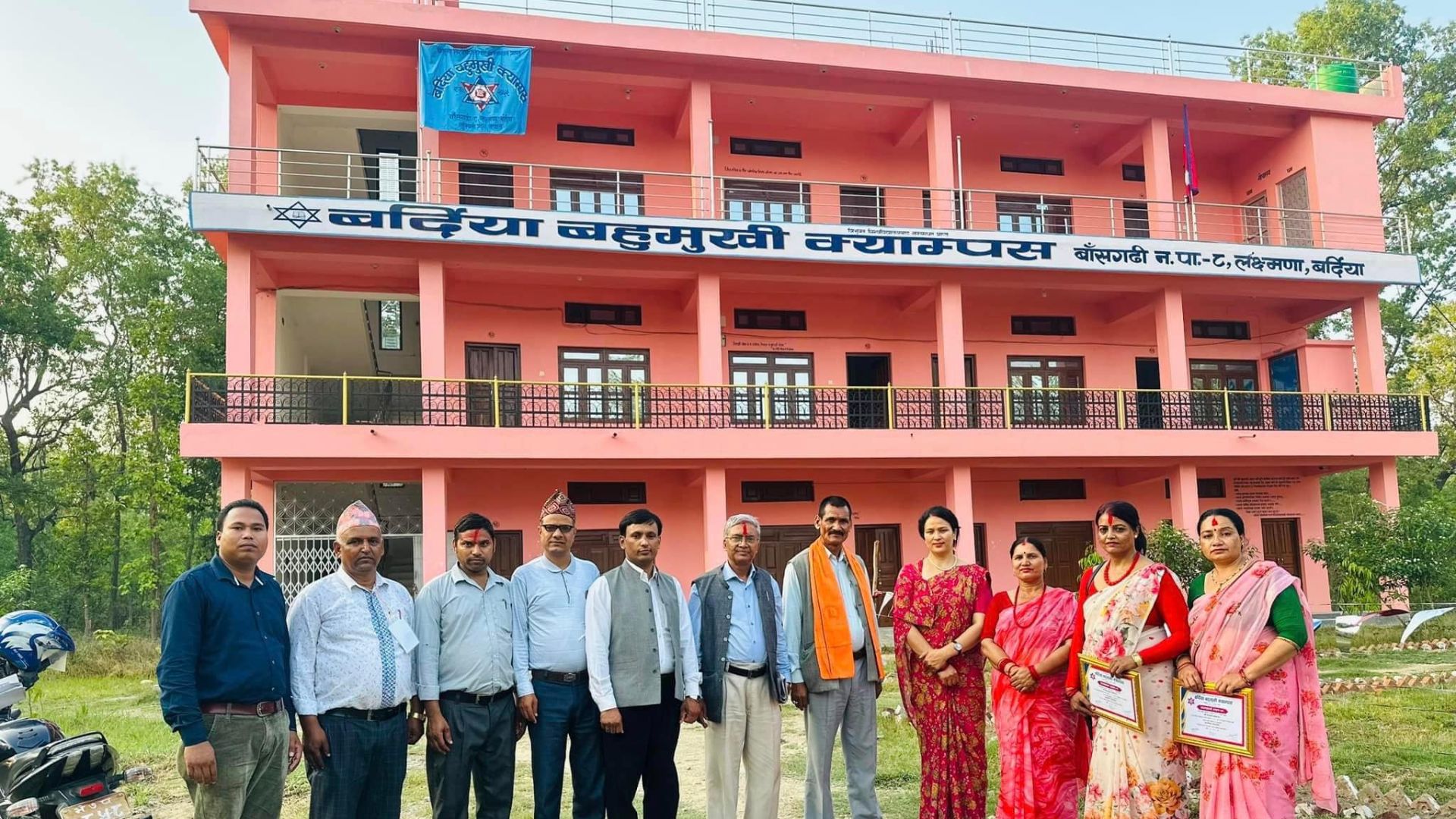
Bardiya Multiple Campus (बर्दिया बहुमुखी क्याम्पस) is a community-based bachelor-level campus in Bansgadhi Municipality, Ward No. 8, Laxmana, Bardiya, Lumbini Province, Nepal. Established in 2065 BS (2008 AD), the campus runs under the affiliation of Tribhuvan University and offers two undergraduate programs: Bachelor of Education (B.Ed.) and Bachelor of Business Studies (BBS). It was founded through the joint efforts of the public, parents, government bodies, and non-government institutions.
The campus has built its role around local access to higher education, with a stated focus on students from marginalized and socially disadvantaged communities in the surrounding area.
Established in 2065 BS (2008 AD)
Community-based, non-profit campus
Located at Bansgadhi Municipality-8, Laxmana, Bardiya, Lumbini Province
Affiliated with Tribhuvan University
Offers bachelor-level programs only
Runs two undergraduate programs: Bachelor of Education (B.Ed) and Bachelor of Business Studies (BBS)
Education faculty began from the campus’s early phase; management faculty received TU affiliation in 2070 BS (2014 AD)
Campus land area: 8-00-00 bighas
Physical infrastructure includes 5 buildings, library, ICT lab, playground, Wi-Fi routers, desktops, laptops, projectors, and CCTV
Scholarship support is available for deserving students
Bardiya Multiple Campus was established as a community initiative to expand bachelor-level study opportunities in Bardiya. Its foundation came from collective local support, including contributions from parents, the public, government bodies, and non-government institutions. That community link remains one of the campus’s defining features.
The campus is chaired by Sundar Kumar Dhakal, and Chandra Prasad Jaisi serves as Campus Chief. Its academic affiliation with Tribhuvan University places it within Nepal’s established public university framework for examinations, registration, and academic administration.
The institution also carries a local social role. It was set up in an area with significant Janajati and socially disadvantaged populations, including Tharu communities as well as Freed-Kamaiya, Mukta Kamlahari, Dalit, Badi, and Muslim groups. The campus links its purpose to wider educational access in this setting. More than 350 parents have contributed financially and hold life-long membership in the campus assembly, which shows the depth of community involvement behind its growth.
Bardiya Multiple Campus offers two TU-affiliated four-year annual-system bachelor programs.
Bachelor of Education (B.Ed)
Bachelor level, Faculty of Education
Bachelor of Business Studies (BBS)
Bachelor level, Faculty of Management
The B.Ed program follows TU’s four-year annual structure. It includes communication skills, professional core courses, specialization major and minor subject areas, and teaching internship or practicum. The program is structured for students preparing for teaching-related academic and professional pathways.
The BBS program also follows TU’s four-year annual system. It includes compulsory and core management courses in the early years, followed by concentration courses in the fourth year. The final year also includes business research methods and a final project.
Admission is opened through campus notice under TU and faculty rules.
Eligible applicants submit the prescribed application form with the required academic documents.
Admission may include an entrance examination, merit-based selection, or both, depending on the program or campus requirement.
Selected applicants complete admission by submitting documents and paying the prescribed fees.
Academic registration, examinations, and results follow TU rules and the applicable annual academic calendar.
Final examinations for annual-system bachelor programs are conducted by TU through the Office of the Controller of Examinations.
Academic Transcript (Grade Sheet) of Class 12 / +2 or equivalent
Character Certificate from the previous institution
Migration Certificate, if the previous board or university is different
Transfer Certificate (TC) from the previous school or college
Citizenship Certificate or Birth Certificate copy
Passport-size photographs
Entrance Examination Scorecard, if required by the program or campus
Completed campus admission or application form
Admission fee payment receipt
Equivalence Certificate, if the qualification is from a foreign board or university
The campus identifies experienced and qualified teachers as one of its institutional strengths. The academic environment is described as friendly and student-centered, with programs delivered through existing classroom and ICT resources.
At the program level, the TU structure shapes how learning is organized. In B.Ed, the curriculum includes professional core areas, subject specialization, and teaching internship or practicum. In BBS, the curriculum includes compulsory and core courses, concentration options in the fourth year, and final project work. The BBS framework also supports lecture-based teaching along with group discussion, problem-solving work, practical work, guest lectures, and project-based learning.
Campus land area of 8-00-00 bighas
5 buildings: 1 administrative building and 4 academic buildings
Classrooms arranged according to student numbers
Library
ICT lab
Playground
Motorcycle stand and bicycle stand
Separate toilets for boys and girls
Drinking water shade
150 sets of desks and benches
8 desktop computers and 3 laptops
2 printers
2 multi-projectors
2 Wi-Fi routers
CCTV installed on campus premises
The campus experience at Bardiya Multiple Campus is closely tied to its community setting. It is located slightly away from the main locality in a calm area of Bardiya, while still remaining accessible through the East-West Highway and the Hulaki Highway. That road access makes it reachable for students from nearby areas.
The social composition of the surrounding area also shapes campus life. The institution has grown in a municipality with Janajati and marginalized populations, and its stated purpose includes educational inclusion for those groups. Community participation is visible not only in campus history but also in ongoing institutional support through parent donors and assembly membership.
The campus offers scholarship support for deserving students.
Source material also notes moderate fee structures for B.Ed and BBS.
Scholarship distribution is included among the campus’s planned development areas.
Student fees are the main source of income, with institutional grants and bank interest noted as additional sources.
The campus identifies University Grants Commission (UGC) as a key support body in its broader institutional development.
Established in 2065 BS (2008 AD) as a community-based campus
Began with education studies in its early phase
Management faculty received TU affiliation in 2070 BS (2014 AD)
Built on 8-00-00 bighas of land with permanent physical infrastructure
More than 350 parents have contributed financially and hold life-long membership in the campus assembly
Bardiya Multiple Campus is a bachelor-level community campus built around local participation and access to higher education in Bardiya. Its present identity rests on two TU-affiliated undergraduate programs, a defined physical campus, and a strong link with the surrounding community. For students seeking B.Ed or BBS study in Bansgadhi Municipality, it stands as a local institution with established academic affiliation, basic learning facilities, scholarship support, and a long record of public involvement in its development.
College Name: Bardiya Multiple Campus
Location: Bansgadhi Municipality-8, Laxmana, Bardiya, Lumbini Province, Nepal
Affiliation: Tribhuvan University
Chairperson: Sundar Kumar Dhakal
Campus Chief: Chandra Prasad Jaisi
Phone No.: +977-9858070805, +977-9858026960, +977-9848717429
Email: bardiyamc2065@gmail.com
Website: bardiyamc.edu.np
Bardiya Multiple Campus offers two bachelor-level programs: Bachelor of Education (B.Ed) and Bachelor of Business Studies (BBS).
The campus is located at Bansgadhi Municipality-8, Laxmana, Bardiya, in Lumbini Province, Nepal.
The campus is affiliated with Tribhuvan University.
Both B.Ed and BBS are four-year annual-system bachelor programs under Tribhuvan University.
Admission follows campus notice and TU faculty procedures. Applicants submit the prescribed form and academic documents, and the process may include entrance examination, merit-based selection, or both, depending on the program or campus requirement.
Applicants generally need their Class 12 or equivalent transcript, character certificate, migration certificate if applicable, transfer certificate, citizenship or birth certificate copy, passport-size photographs, admission form, fee receipt, and other documents required by TU or the campus.
Yes. The campus has a scholarship scheme for deserving students.
The campus has academic and administrative buildings, classrooms, a library, ICT lab, playground, separate toilets, drinking water facilities, computers, laptops, printers, projectors, Wi-Fi routers, and CCTV.