Kathmandu Model Hospital School of Nursing (KAMHSON), now identified as Phect Institute of Health Sciences (Former-KAMHSON), is a nursing education institution in Kathmandu. It was established in 2058 B.S. (2002 A.D.) and has developed its academic work around certificate and bachelor-level nursing education.
The institution offers nursing programs connected with the Council for Technical Education and Vocational Training (CTEVT) and Purbanchal University. Its academic portfolio covers entry-level nursing education as well as undergraduate study for students entering nursing after higher secondary education and for nurses continuing from an earlier professional qualification.
The current contact address is Swoyambhu, Kathmandu, Nepal. Purbanchal University program records also identify Kathmandu Model Hospital School of Nursing in Swoyambhu, Kathmandu, for PBNS and BSc Nursing.
Institution: Phect Institute of Health Sciences (Former-Kathmandu Model Hospital School of Nursing – KAMHSON)
Established: 2058 B.S. (2002 A.D.)
Location: Swoyambhu, Kathmandu, Nepal
Academic Focus: Nursing education
Affiliations: Council for Technical Education and Vocational Training (CTEVT) and Purbanchal University
Programs Offered: PCL Nursing, Bachelor of Science in Nursing (BSN), and Post-Basic Bachelor of Nursing Science (PBNS)
PCL Nursing Duration: 3 years
BSN Duration: 4 years
PBNS Duration: 3 years
Learning Components: Classroom instruction, practical training, clinical exposure, community-based nursing, and subject-specific laboratory work
Admission Framework: Nursing admission follows the prevailing Medical Education Commission (MEC) rules, including MECEE-BL, applicable scholarship provisions, seat allocation, fees, and admission procedures.
Seat Allocation: Seats are determined for the relevant academic year and may change according to MEC decisions.
Professional Licensing: Graduates must meet the applicable Nepal Nursing Council licensing and registration requirements before entering professional nursing practice.
KAMHSON began its nursing education activities in 2058 B.S. Its institutional identity is also presented as Phect Institute of Health Sciences (Former-KAMHSON). The school has maintained a specific focus on nursing rather than a broad mix of unrelated academic disciplines.
Its programs cover different stages of nursing education. PCL Nursing provides certificate-level preparation, Bachelor of Science in Nursing is a four-year undergraduate program, and Post-Basic Bachelor of Nursing Science is designed for students who already hold nursing qualifications and are continuing their professional education.
This structure gives the institution three distinct academic entry routes rather than treating nursing education as a single course pathway.
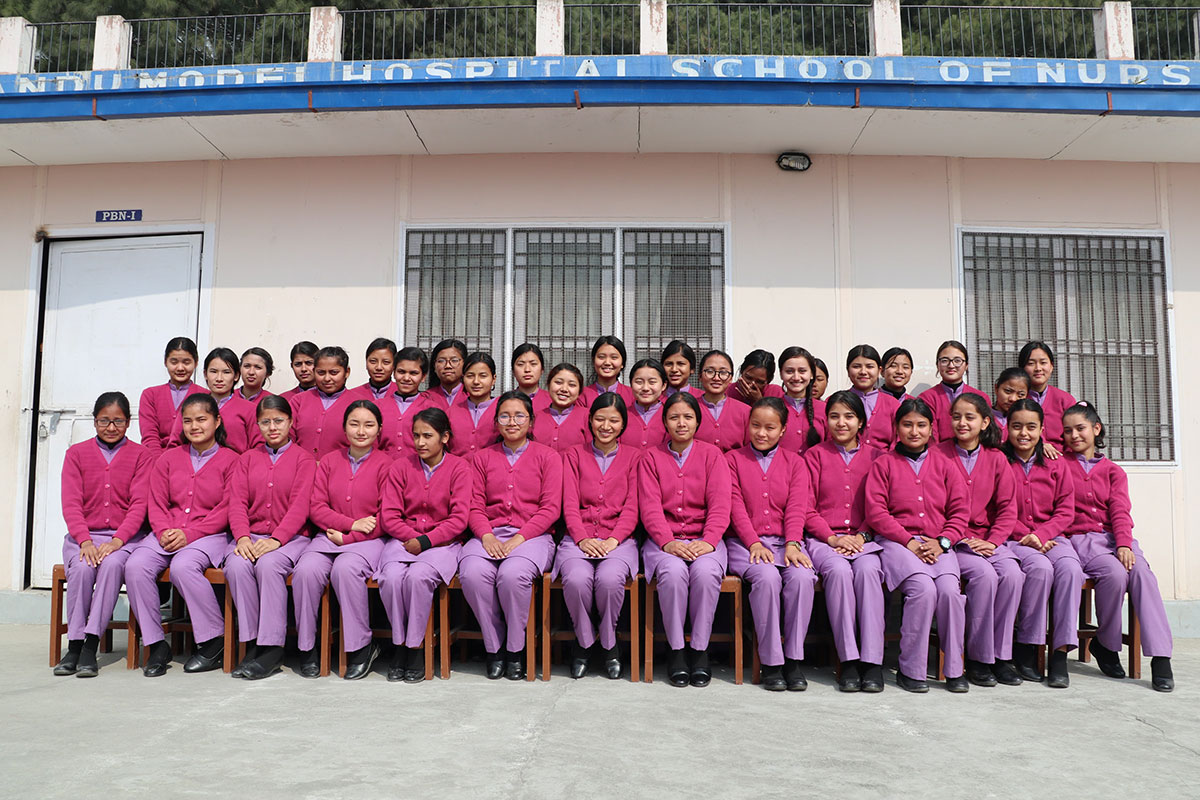
The Proficiency Certificate Level in Nursing is affiliated with CTEVT. The institutional information also identifies the program in connection with the Nepal Nursing Council. The CTEVT curriculum defines PCL Nursing as a three-year yearly-system program intended to prepare nursing personnel for work in hospital and community settings.
The Bachelor of Science in Nursing and Post-Basic Bachelor of Nursing Science programs are affiliated with Purbanchal University. The university's revised 2019 curricula specify four years for BSN and three years for PBNS.
Students considering the university-affiliated programs can read more about the institution through the Kathmandu Model Hospital School of Nursing college page.
Professional nursing education also operates within national admission and professional-regulation systems. Bachelor-level medical and nursing admissions covered by the Medical Education Commission are based on MECEE-BL and follow the prevailing MEC rules, guidelines, code of conduct, scholarship provisions, seat allocation system, fee structure, and admission procedures.
MEC decisions and its official academic calendar can change seat numbers, fees, scholarship arrangements, examination provisions, and admission procedures from one academic year to another. College-specific seat numbers therefore need to be read in the context of the allocation approved for the relevant admission cycle.
After completion of the applicable nursing qualification, graduates must meet the professional licensing requirements of the Nepal Nursing Council before entering professional nursing practice.
| Program | Affiliation | Duration |
|---|---|---|
| Proficiency Certificate Level in Nursing (PCL Nursing) | CTEVT | 3 years |
| Bachelor of Science in Nursing (BSN) | Purbanchal University | 4 years |
| Post-Basic Bachelor of Nursing Science (PBNS) | Purbanchal University | 3 years |
The PCL Nursing (Staff Nurse) program is a three-year certificate-level nursing course under CTEVT.
The CTEVT curriculum uses a yearly academic system. Each academic year can extend to 40 weeks, with an academic week of up to 40 hours excluding the evaluation period. The medium of instruction may be English and/or Nepali, and the curriculum requires at least 90 percent attendance in each subject for students to appear in the respective final examination.
The program starts with foundational nursing knowledge and progresses through hospital, community, adult, elderly, mental health, maternal, child health, gynecological, leadership, and management areas.
First-year study includes Fundamental of Nursing, Community Health Nursing I, Anatomy and Physiology, Basic Science Applied to Nursing, English, and Nepali. Second-year study includes Medical and Surgical Nursing, Geriatric Nursing, Behavioral Science and Mental Health Nursing, Community Health Nursing II, and Social Studies. Third-year study moves into Midwifery, Gynecological Nursing, Child Health Nursing, and Leadership and Management.
The curriculum combines theoretical and practical education and is framed around the responsibilities expected of a staff nurse in different levels of Nepal's health-care system.
Eligibility: The CTEVT curriculum accepts SLC with second division (45 percent) including English, Science, and Mathematics, or SEE with a minimum GPA of 2.0 and at least C grade in compulsory Mathematics, English, and Science. It also includes an entry route for SLC graduates holding TSLC in Auxiliary Nurse Midwife with at least 68.33 percent. Applicants must pass the entrance examination administered by CTEVT, with admission based on merit among eligible applicants.
The curriculum sets a maximum group size of 40 students in a batch. This curricular group-size provision should not be treated as a fixed annual college seat allocation because approved intake can be governed separately for a particular admission year.
The Bachelor of Science in Nursing (BSN) is a four-year Purbanchal University program. The revised university curriculum dates from 2019 (2076) and is administered under the Faculty of Medical and Allied Sciences.
The course begins with the biological and clinical sciences required for nursing study. First-year subjects include Anatomy and Physiology, Biochemistry, Microbiology/Parasitology, Pathophysiology, Pharmacology, Nutrition and Dietetics, Foundation of Nursing, and Community Health Nursing I.
Second-year study includes Nursing Concepts and Theories, Medical-Surgical Nursing I and II, Psychiatric Nursing, Community Health Nursing II, Medical Sociology/Anthropology, and Geriatric Nursing.
The third year moves into Pediatric Nursing, three Midwifery courses, Community Health Nursing III, Basic Epidemiology, and Gynaecology Nursing. In the fourth year, students study Research and Biostatistics in Nursing, Educational Science, Leadership and Management, and advanced Medical-Surgical Nursing.
This sequence gives BSN students exposure to foundational sciences, nursing practice, community health, maternal and child health, mental health, research, teaching, and nursing management across the four-year curriculum.
For admission, bachelor-level nursing applicants come under the prevailing MEC admission framework, including MECEE-BL, merit and matching procedures, scholarship arrangements, seat allocation, and applicable fee provisions. These rules are tied to the relevant MEC admission cycle rather than being permanently fixed at college level.
The Post-Basic Bachelor of Nursing program, identified in Purbanchal University's curriculum as Post-Basic Bachelor of Nursing Science (PBNS), is a three-year program for nurses progressing to bachelor-level study. The revised curriculum was issued in 2019 (2076).
Institutional admission criteria include a PCL Nursing certificate from a recognized institute, at least one year of work experience from a recognized health institution, and Nepal Nursing Council registration.
The first year includes Anatomy and Physiology, Pharmacology, Pathophysiology, Microbiology/Parasitology, Biochemistry, Nutrition and Dietetics, Medical-Surgical Nursing I, Nursing Concepts and Theories, Pediatric Nursing, Medical Sociology/Anthropology, and Professional English.
Second-year study includes Midwifery I, Community Health Nursing I, Psychiatric Nursing I, Educational Science, Epidemiology, Geriatric Nursing, and Applied Computer Technology.
The third year includes Leadership and Management, Research and Biostatistics in Nursing, Oncology Nursing, and an elective component. The university curriculum identifies Community Health Nursing II, Midwifery II, Medical-Surgical Nursing II, and Psychiatric Nursing II among the elective areas.
PBNS therefore builds on prior nursing education rather than repeating the same entry pathway as BSN. Its subjects move from advanced clinical and health-science study into education, research, leadership, management, oncology, and a selected nursing field.
The academic programs combine classroom study with practical nursing components. The CTEVT PCL curriculum contains separate theory and practical or clinical components across subjects such as Fundamental of Nursing, Community Health Nursing, Medical and Surgical Nursing, Mental Health Nursing, Midwifery, Gynecological Nursing, Child Health Nursing, and Leadership and Management.
The Purbanchal University BSN curriculum similarly integrates theory and practical study in major areas including anatomy and physiology, microbiology, pharmacology, foundation of nursing, community health, medical-surgical nursing, psychiatric nursing, pediatric nursing, midwifery, research, and leadership.
The PBNS curriculum follows the same academic principle at post-basic level, combining nursing theory with practical study in areas such as pharmacology, microbiology, medical-surgical nursing, pediatric nursing, midwifery, community health, psychiatric nursing, education, research, oncology, and electives.
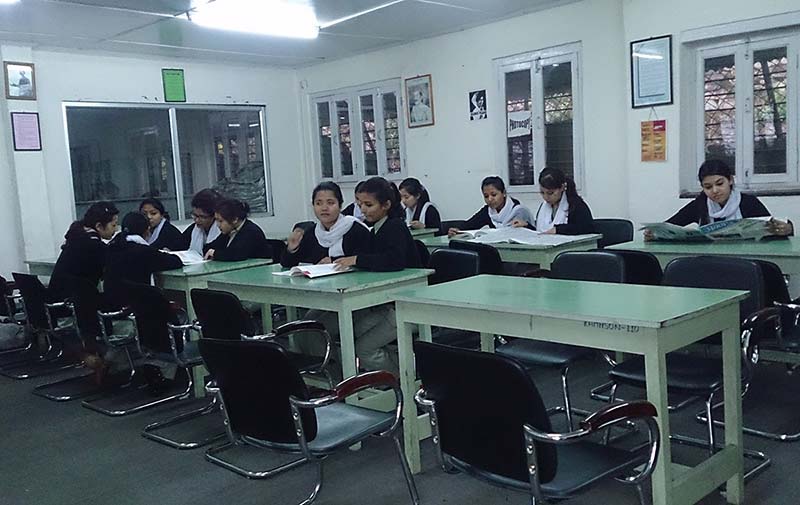
The institution identifies nursing laboratories and clinical equipment, a reference library with medical texts, computer facilities, digital resources, hospital rounds, guided case discussions, mentoring, and academic support as parts of its learning setting.
These resources are relevant to the way nursing curricula are structured because the programs require students to work through both academic subjects and practical or clinical components rather than classroom theory alone.
Admission requirements differ by academic level. PCL Nursing follows the CTEVT entry framework stated in its curriculum, including academic eligibility, the CTEVT entrance examination, and merit-based selection.
Bachelor-level nursing admission is governed through the prevailing MEC system. MECEE-BL, admission and matching rules, code of conduct, scholarship provisions, seat distribution, fee structure, and related procedures follow MEC decisions and the official admission calendar.
The number of seats should be treated as admission-cycle specific. MEC may revise seat determination from one academic year to another. The same caution applies to fee schedules, scholarship distribution, examination-related provisions, and admission procedures.
For this reason, an intake figure associated with an earlier year should not automatically be carried forward as the seat total for a new admission cycle.
Completing an academic nursing program is one stage of becoming eligible for professional practice. Graduates must also satisfy the licensing requirements of the respective professional council.
For nursing graduates, this means passing the applicable Nepal Nursing Council licensing examination and completing the required professional registration process before entering the profession.
Academic completion, professional licensing, and registration should therefore be understood as related but separate requirements.
Institution: Phect Institute of Health Sciences (Former-KAMHSON)
Location: Swoyambhu, Kathmandu, Nepal
Telephone: +977 1-5372163
Email: kamhson14@gmail.com
The institution serves students at three different stages of nursing education. SEE/SLC-level applicants who meet the CTEVT requirements can consider the PCL Nursing route. Students seeking a four-year undergraduate nursing degree can consider BSN subject to the prevailing bachelor-level admission rules. Nurses who already hold the required nursing qualification, work experience, and professional registration can consider PBNS as a continuation to bachelor-level nursing study.
This distinction matters because the three programs are not interchangeable. They differ in entry qualification, academic level, duration, curriculum, admission system, and the point at which a student enters nursing education.
Kathmandu Model Hospital School of Nursing, also identified as Phect Institute of Health Sciences (Former-KAMHSON), has been providing nursing education since 2058 B.S. Its academic offering consists of PCL Nursing under CTEVT and BSN and PBNS under Purbanchal University.
The programs cover three stages of nursing education: certificate-level preparation, direct bachelor-level nursing education, and post-basic bachelor-level study for qualified nurses. Their curricula include nursing foundations, medical-surgical nursing, community health, mental health, maternal and child health, research, education, and leadership according to the level of study.
Admission, seats, scholarships, fees, and related rules for MEC-governed bachelor-level nursing education remain tied to the prevailing MEC admission cycle. Professional entry after graduation also requires the applicable Nepal Nursing Council licensing and registration process.