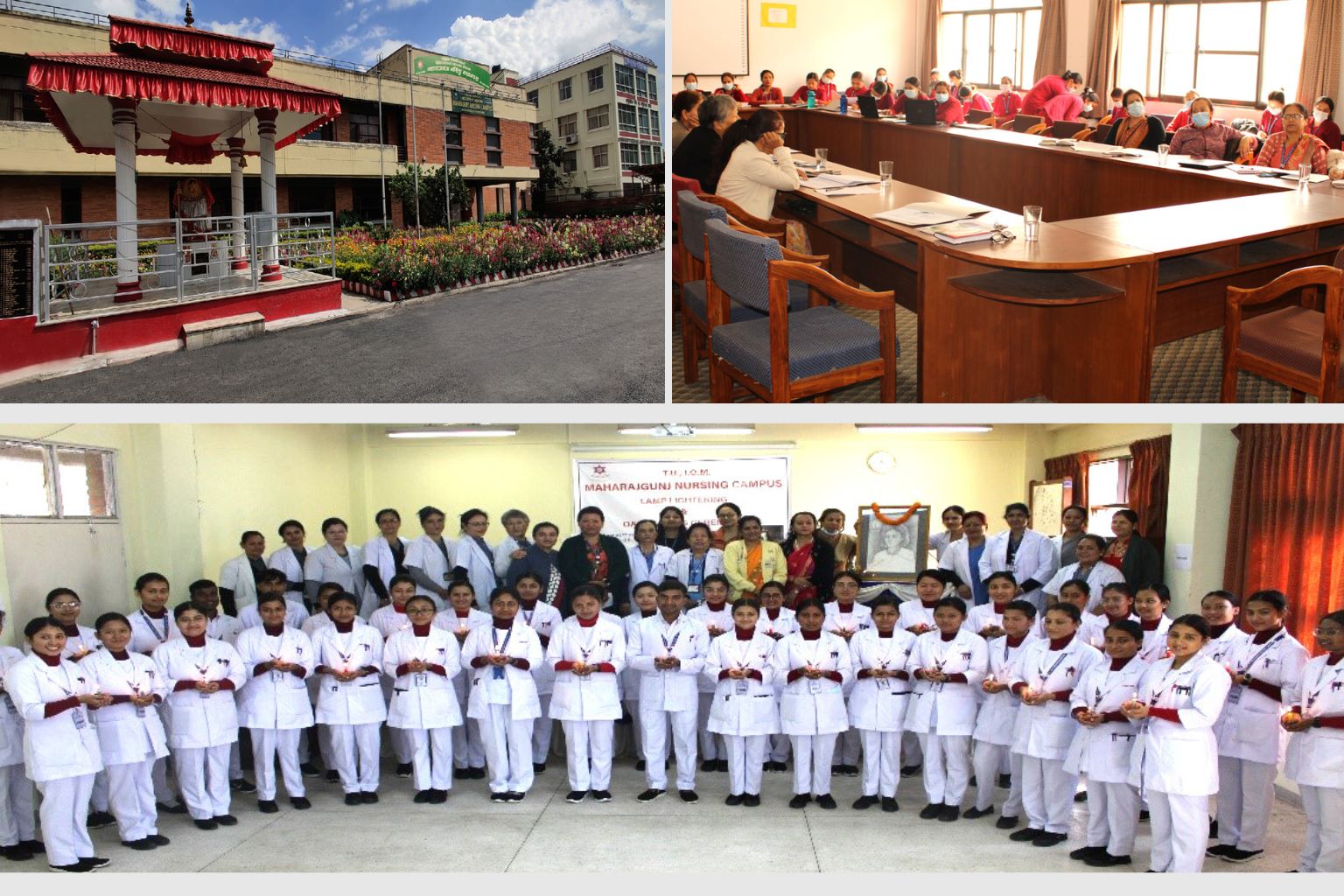
Maharajgunj Nursing Campus is a constituent nursing campus of the Institute of Medicine, Tribhuvan University, located in Maharajgunj, Kathmandu, Nepal. Its institutional lineage dates to 1956 AD (2013 BS), when nursing education began under the government health-service structure. The institution later became part of the Institute of Medicine and subsequently moved to Maharajgunj.
The campus provides undergraduate, postgraduate, and doctoral education in nursing and midwifery. Academic study combines classroom learning with nursing skills practice, clinical education, community-based learning, research, management, and professional preparation. Its programs operate within the academic framework of Tribhuvan University, while admission to applicable medical education programs follows the national system administered by the Medical Education Commission.
| Particular | Details |
|---|---|
| Official Name | Maharajgunj Nursing Campus |
| Nepali Name | महाराजगंज नर्सिङ्ग क्याम्पस |
| Location | Maharajgunj, Kathmandu, Nepal |
| Institutional Lineage | 1956 AD / 2013 BS |
| Institution Type | Constituent campus of Institute of Medicine, Tribhuvan University |
| Academic Field | Nursing and midwifery education |
| Academic Levels | Bachelor, Master, and PhD |
| Quality Assurance | QAA-accredited by UGC Nepal |
| Academic Setting | Classroom, skills laboratory, clinical, community, research, and field-based learning |
| Professional Regulation | Nursing and midwifery practice falls under applicable Nepal Nursing Council requirements |
The history of Maharajgunj Nursing Campus is closely connected with the development of formal nursing education in Nepal. Its institutional lineage begins in 1956 AD, corresponding to 2013 BS, when nursing education started under the government health-service structure.
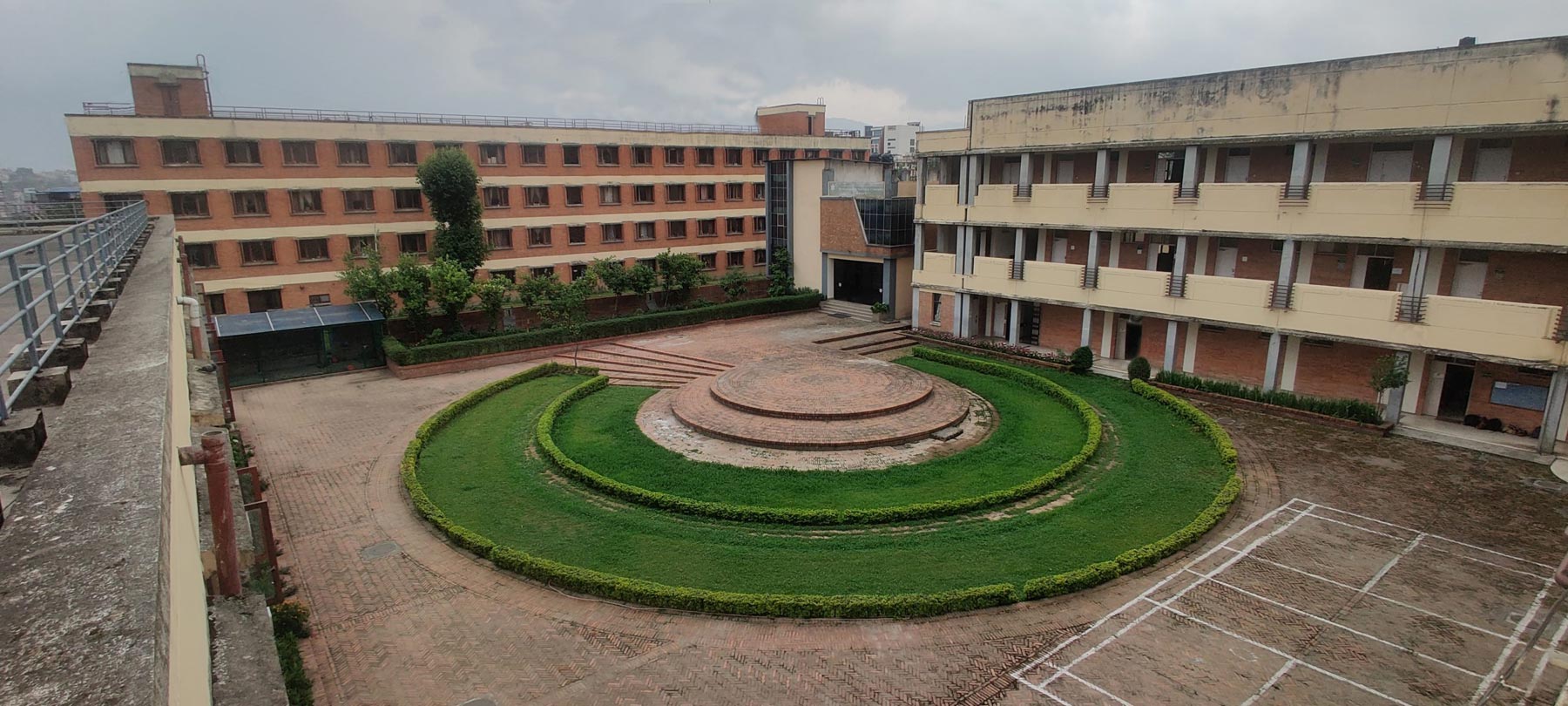
With the introduction of the New Education System, the nursing institution came under Tribhuvan University through the Institute of Medicine. It operated as Mahaboudha Nursing Campus before moving to Maharajgunj.
The campus moved to Maharajgunj in 2042 BS. The building at Maharajgunj was developed with support from the Government of Japan. Following the relocation, the institution became known as Maharajgunj Nursing Campus.
Its academic scope expanded gradually from certificate-level nursing education to higher academic programs. Important stages included bachelor-level nursing education, postgraduate nursing education, the four-year B.Sc. Nursing program, and doctoral study in nursing.
Campus academic history associates bachelor-level nursing education with 2033 BS, postgraduate nursing education with 2051 BS, the four-year B.Sc. Nursing program with 2062 BS, and PhD-level nursing education with 2068 BS. New admissions to the earlier Proficiency Certificate Level nursing program were later discontinued as the campus concentrated on higher-level nursing and midwifery education.
This development created a multi-level academic structure through which nursing education extends from undergraduate study to postgraduate specialization and doctoral research.
Maharajgunj Nursing Campus functions within the Institute of Medicine under Tribhuvan University. It is therefore part of the wider TU-IOM academic structure rather than an independent university.
Responsibilities within this structure are distributed across different bodies:
For students, these roles are connected but distinct. Campus teaching, admission, university examination, degree administration, and professional licensing do not fall under a single authority.
The academic direction of Maharajgunj Nursing Campus centers on preparing nursing and midwifery graduates for health-service, education, management, community, and research settings.
Its educational structure combines theoretical knowledge with practical and professional preparation. Depending on the program, students encounter laboratory work, clinical practice, community exposure, health education, management, research, and specialty-based nursing study.
Major areas represented across its academic activities include:
The academic structure supports progression from initial professional preparation to specialty-focused postgraduate education and research-oriented doctoral study.
Maharajgunj Nursing Campus provides nursing and midwifery education at undergraduate, postgraduate, and doctoral levels.
| Level | Program | Academic Structure |
|---|---|---|
| Bachelor | B.Sc. Nursing | Four-year nursing degree |
| Bachelor | Bachelor of Nursing Science (BNS) | Three-year post-certificate/diploma nursing pathway |
| Bachelor | Bachelor in Midwifery Sciences | Four-year bachelor-level midwifery pathway |
| Master | Master in Nursing | Postgraduate nursing study with specialty areas |
| Master | Master's in Community Health Nursing | Community health specialization |
| Master | Master's in Psychiatric Nursing | Psychiatric nursing specialization |
| Master | Master's in Critical Care Nursing | Critical care specialization |
| Master | MN in Women Health and Development | Women Health and Development specialization |
| Master | MN in Paediatric Nursing | Child and paediatric nursing specialization |
| Doctoral | PhD Nursing | Advanced nursing research |
Adult Nursing is also represented among the postgraduate nursing specialty areas associated with the campus.
The Bachelor of Science in Nursing is a four-year undergraduate nursing program. It prepares graduate nurses through study in nursing care, teaching, management, research, health sciences, and professional practice.
The curriculum progresses from foundational sciences and nursing subjects toward specialized clinical and professional areas.
Early study includes:
Later stages include Adult Nursing, Geriatric Nursing, Psychiatric Nursing, Nursing Concepts, and Social and Behavioural Science.
The third-year structure covers Midwifery, Child Health Nursing, and Family and Reproductive Health Nursing together with practical components.
Fourth-year study includes Management and Health Economics, Management Practicum, Educational Science, Education Practicum, Research and Biostatistics, and Research Practicum.
This progression combines clinical nursing education with community health, education, management, and research.
For applicants entering through the science route, eligibility includes 10+2 Science or equivalent with Physics, Chemistry, and Biology and the required academic performance under the applicable admission framework. Certain health-science diploma holders may also qualify when the required science subjects, equivalence conditions, academic standards, and relevant professional registration requirements are satisfied.
Admission follows the prevailing MEC undergraduate medical education framework rather than a separate campus-only entrance system.
The Bachelor of Nursing Science is a three-year nursing program for applicants who already hold the required nursing certificate or diploma qualification and professional registration.
The program has four major specialization areas:
BNS differs from the four-year B.Sc. Nursing route because students enter with previous nursing education. The program builds on that foundation and provides further study in nursing care, management, education, research, and a selected specialty area.
Eligibility includes Nursing Proficiency Certificate Level or Diploma Level with the required academic standard and registration with the Nepal Nursing Council under the applicable admission framework.
The three-year structure and specialty options make BNS a distinct undergraduate nursing pathway within the campus.
Midwifery forms a separate academic area within Maharajgunj Nursing Campus. The bachelor-level midwifery pathway is focused on maternal, reproductive, and midwifery care.
Its academic scope includes areas connected with pregnancy, childbirth, the postnatal period, reproductive health, and related maternal-health services. Clinical learning forms an essential part of the program because professional midwifery preparation combines theoretical understanding with supervised practice.
The campus's broader academic structure also connects midwifery with women's health and development at postgraduate level.
Admission to applicable bachelor-level medical education programs follows the national undergraduate entrance and matching framework.
Postgraduate nursing education has been part of Maharajgunj Nursing Campus since 2051 BS. The Master in Nursing pathway provides specialty-based education for nurses progressing beyond bachelor-level study.
Postgraduate areas associated with the campus include:
Master's-level nursing study combines advanced specialty knowledge with research, education, leadership, management, and professional nursing practice.
Applicants must satisfy the applicable academic and professional eligibility criteria and compete through the national postgraduate medical education entrance system.
Because postgraduate admission, matching, seats, scholarship arrangements, and related conditions operate under national regulations, figures from one admission cycle should not be treated as permanent for later intakes.
PhD Nursing represents the doctoral level of nursing education at Maharajgunj Nursing Campus. The campus's academic history places PhD-level nursing education from 2068 BS.
Doctoral nursing study extends the academic pathway into advanced research and scholarly inquiry. It differs from undergraduate professional preparation and specialty-based master's education by placing greater emphasis on research questions, systematic investigation, and contribution to nursing knowledge.
Within the overall academic pathway, PhD Nursing follows undergraduate preparation and postgraduate specialization with a stronger research orientation.
Academic work at Maharajgunj Nursing Campus is organized around major nursing and midwifery disciplines.
Subject and departmental areas represented across its academic structure include:
These areas correspond with different stages and responsibilities in nursing education.
Fundamental Nursing establishes core nursing concepts and practice. Adult, child, psychiatric, community, and maternal-health subjects introduce population-specific and specialty-focused care. Management and education prepare students for responsibilities beyond direct clinical nursing, while research supports systematic academic inquiry.
This organization explains why clinical, community, management, education, and research components appear across several programs rather than being confined to a single degree.
Admission to nursing and other applicable medical education programs operates under the prevailing framework of the Medical Education Commission.
Bachelor-level admission follows the applicable MECEE-BL common entrance framework.
Master's-level admission follows the applicable MECEE-PG framework.
Admission is governed by the prevailing MEC rules, guidelines, code of conduct, scholarship provisions, seat-allocation arrangements, fee structure, merit procedures, matching system, and admission calendar.
Important points for applicants include:
Historical seat figures may appear in earlier academic information, but seats for medical education programs are subject to MEC determination and may vary from one year to another.
Scholarship arrangements for nursing and other applicable medical education programs are connected with the national medical education framework.
Undergraduate scholarship distribution includes open and reserved-category mechanisms under the applicable medical education provisions. Scholarship seats, categories, eligibility requirements, matching, and allocation are handled within the relevant national process.
Seat numbers also require the same care. A figure associated with one intake should not be treated as the permanent intake capacity for future years.
Accordingly:
Maharajgunj Nursing Campus has also had institution-linked scholarship and memorial scholarship arrangements in its academic history. These are separate from the national statutory medical education scholarship framework.
Nursing education at Maharajgunj Nursing Campus combines theoretical study with practical preparation. Students progress through classroom teaching, skills laboratory work, clinical learning, community exposure, assignments, research-related study, and professional practice components according to their program.
Skills may first be practiced in a controlled laboratory environment before being applied in clinical settings. This allows students to develop nursing procedures, communication, observation, equipment handling, documentation, and professional routines as part of structured learning.
The B.Sc. Nursing curriculum demonstrates this progression. Integrated Health Sciences provide scientific foundations, followed by Fundamentals of Nursing, Community Health Nursing, Adult Nursing, Psychiatric Nursing, Geriatric Nursing, Child Health Nursing, Midwifery, and Family and Reproductive Health Nursing. Management, education, research, and biostatistics extend the curriculum beyond direct clinical care.
BNS follows a different model because students enter with prior nursing preparation. Its structure allows concentration in Community Health Nursing, Adult Health Nursing, Child Health Nursing, or Psychiatric Nursing.
Master's study provides a further level of specialization, while PhD Nursing focuses more strongly on research.
Clinical learning forms a central part of nursing and midwifery education at the campus.
Students receive specialized exposure across settings connected with teaching-hospital care, pediatric services, mental-health care, maternity and women's health, cancer care, renal care, geriatric services, hospice care, rehabilitation, and other health-service environments.
Community learning is also important, particularly in Community Health Nursing and areas where prevention, health promotion, family health, public health, and health education are part of the curriculum.
Hospital and community practice serve different educational purposes. Clinical settings expose students to direct patient care and specialty services, while community learning places nursing within preventive, family, public-health, and health-education contexts.
Together, these components support preparation for nursing roles across hospital, community, education, management, maternal and child health, mental-health, specialty, and research-related settings.
The campus has skills-based laboratory facilities used for practical preparation before clinical exposure.
These facilities allow students to practice nursing procedures and related clinical techniques in a controlled learning environment. Practical preparation is particularly important during the earlier stages of professional study, when students need repeated practice before moving into more complex clinical settings.
Practical work is not confined to one stage of the curriculum. It appears through nursing practicums, clinical learning, community assignments, management practice, educational practice, and research-related work.
This structure connects classroom knowledge with the practical responsibilities required in nursing and midwifery education.
The campus maintains a library supporting nursing and health-science study. Students use academic references across nursing subjects and have access to online scholarly resources.
Library use supports different academic needs across the programs. Undergraduate students require material related to health sciences, nursing concepts, care planning, community health, specialty nursing, and research assignments. Postgraduate and doctoral students require greater engagement with research literature, evidence, academic writing, and scholarly analysis.
The campus also uses internet-based academic access and electronic information systems as part of its learning environment.
These resources support classroom teaching, practical learning, independent study, and research activity.
Maharajgunj Nursing Campus has academic, residential, and student-support facilities connected with nursing and midwifery education.
Facilities associated with the campus include:
Hostel facilities provide an on-campus residential option. Academic buildings support classroom teaching, while laboratory spaces are used for skills preparation and practical nursing education.
The combination of academic, residential, library, and activity spaces reflects the varied requirements of nursing education, where students move between lectures, practical sessions, clinical assignments, community work, study, and other academic responsibilities.
Maharajgunj Nursing Campus is QAA-accredited by the University Grants Commission Nepal.
Campus-level administration also includes structures concerned with quality assurance, academic review, planning, student welfare, research, and institutional services.
Organizational bodies associated with the campus include areas such as:
These structures distribute responsibility across different parts of campus life. Nursing education involves teaching, clinical coordination, research, residential services, student support, information management, library access, and quality-review functions in addition to classroom instruction.
Research is incorporated across the campus's academic structure, particularly at postgraduate and doctoral levels, while undergraduate students are also introduced to research-related study.
The B.Sc. Nursing curriculum includes Research and Biostatistics together with a Research Practicum. Master's-level nursing education includes research-oriented components, while PhD Nursing places advanced research at the center of doctoral study.
The campus has also maintained institutional structures concerned with research management and journal publication.
Research in nursing can address areas such as clinical care, community health, maternal and child health, mental health, nursing education, management, specialty nursing, and professional practice. Within the campus's academic structure, research therefore complements teaching and practical education.
Student support at Maharajgunj Nursing Campus is distributed across several campus structures.
These cover areas such as:
Such support accompanies the academic responsibilities of nursing students, who may need to manage classroom study, practical assignments, clinical rotations, community work, examinations, projects, and independent study within the same program.
Residential facilities, library access, laboratory preparation, counseling structures, and administrative support therefore form separate but connected parts of the campus environment.
Completion of an academic nursing or midwifery program is distinct from professional licensing and registration.
The Nepal Nursing Council is associated with nursing and midwifery education standards, professional licensing, and registration.
After completing the applicable nursing or midwifery course, graduates seeking to enter professional practice must satisfy the licensing and registration requirements applicable to their qualification. This includes passing the respective professional council licensing examination where required.
Academic completion and professional registration should therefore be understood as separate stages. A university qualification establishes completion of the academic program, while entry into regulated professional practice depends on fulfillment of the applicable council requirements.
The range of programs at Maharajgunj Nursing Campus supports several stages of nursing education.
Students entering B.Sc. Nursing follow a four-year undergraduate route combining basic sciences, nursing practice, specialty nursing, community health, management, education, and research.
Qualified nurses entering BNS follow a three-year pathway with specialization in Community Health Nursing, Adult Health Nursing, Child Health Nursing, or Psychiatric Nursing.
Bachelor-level midwifery education focuses on maternal, reproductive, and midwifery practice.
Nurses progressing to Master in Nursing may continue into specialty areas including Adult Nursing, Community Health Nursing, Child Health or Paediatric Nursing, Psychiatric Nursing, Women Health and Development, and Critical Care Nursing.
PhD Nursing provides the doctoral research pathway.
Depending on qualification, professional registration, experience, and the requirements of individual positions, nursing graduates may work across clinical nursing, community and public-health services, nursing education, nursing administration, maternal and midwifery services, specialty nursing, and research. Employment and professional practice remain subject to the requirements of the concerned employer and regulatory body.
Maharajgunj Nursing Campus is located in Maharajgunj, Kathmandu, Nepal, within the Tribhuvan University Institute of Medicine academic environment.
Address: Maharajgunj, Kathmandu, Nepal
Website: www.mnc.tu.edu.np
Email: info@mnc.tu.edu.np
IOM-linked Email: nsgcampus@iom.edu.np

Yes. Maharajgunj Nursing Campus is a constituent campus within the Institute of Medicine under Tribhuvan University. Its nursing and midwifery programs operate within the TU-IOM academic structure.
The institution traces its nursing-education lineage to 1956 AD, corresponding to 2013 BS. It later operated as Mahaboudha Nursing Campus under the Institute of Medicine before moving to Maharajgunj.
The principal undergraduate pathways include B.Sc. Nursing, Bachelor of Nursing Science, and bachelor-level midwifery education. B.Sc. Nursing is a four-year program, while BNS is a three-year program.
Bachelor of Nursing Science includes four specialization areas: Community Health Nursing, Adult Health Nursing, Child Health Nursing, and Psychiatric Nursing.
B.Sc. Nursing is a four-year undergraduate program. Its curriculum includes integrated health sciences, nursing theory, practical nursing, community health, adult and geriatric nursing, psychiatric nursing, midwifery, child health, management, education, research, and related practicums.
Yes. Master in Nursing study includes specialty areas such as Adult Nursing, Community Health Nursing, Child Health or Paediatric Nursing, Psychiatric Nursing, Women Health and Development, and Critical Care Nursing.
Yes. PhD Nursing forms part of the campus's doctoral academic pathway, with PhD-level nursing education associated with the campus from 2068 BS.
Bachelor-level medical education admission follows the applicable MECEE-BL common entrance framework administered under the Medical Education Commission system. Candidates must also satisfy the eligibility requirements of the concerned program.
Master's-level medical education admission follows the applicable MECEE-PG framework. Selection, matching, seats, scholarship arrangements, and other admission conditions operate under the prevailing MEC rules and procedures.
No fixed intake figure should be treated as permanent. Seats are determined through the applicable Medical Education Commission process and may vary between admission cycles.
Medical education scholarship and reservation arrangements are governed through the prevailing national medical education framework. The campus has also had institution-linked and memorial scholarship arrangements.
Academic completion and professional licensing are separate. Graduates intending to enter regulated nursing or midwifery practice must satisfy the applicable Nepal Nursing Council licensing and registration requirements, including the relevant professional licensing examination where required.
The campus has academic buildings, library facilities, hostel accommodation, nursing skills and simulation-based laboratory space, internet and electronic information systems, a canteen, transportation support, open areas, meeting and seminar facilities, and arrangements for clinical and community learning.
Yes. B.Sc. Nursing includes Research and Biostatistics and a Research Practicum, postgraduate study includes research-oriented components, and PhD Nursing has a stronger research focus.




.png)