Nepal Adarsha Multiple Campus (नेपाल आदर्श बहुमुखी क्याम्पस, शिवपुर, कपिलवस्तु) is a community campus established in 2064 BS (2007/08 AD) in Kapilvastu, Lumbini Province, Nepal. It is affiliated with Tribhuvan University and approved by the University Grants Commission (UGC). The campus was founded as a non-profit higher education institution to expand access to bachelor-level study in a part of Kapilvastu where many families faced financial and geographic barriers to continuing education after Grade 12.
The campus grew out of a local effort to bring higher education closer to students from surrounding communities, including poor and marginalized groups. Its current academic focus is on bachelor-level education in Education and Management through B.Ed. and BBS. Alongside academics, the campus has developed hostel, transportation, library, sports, and scholarship support systems that reflect its community-based mission and rural service area.
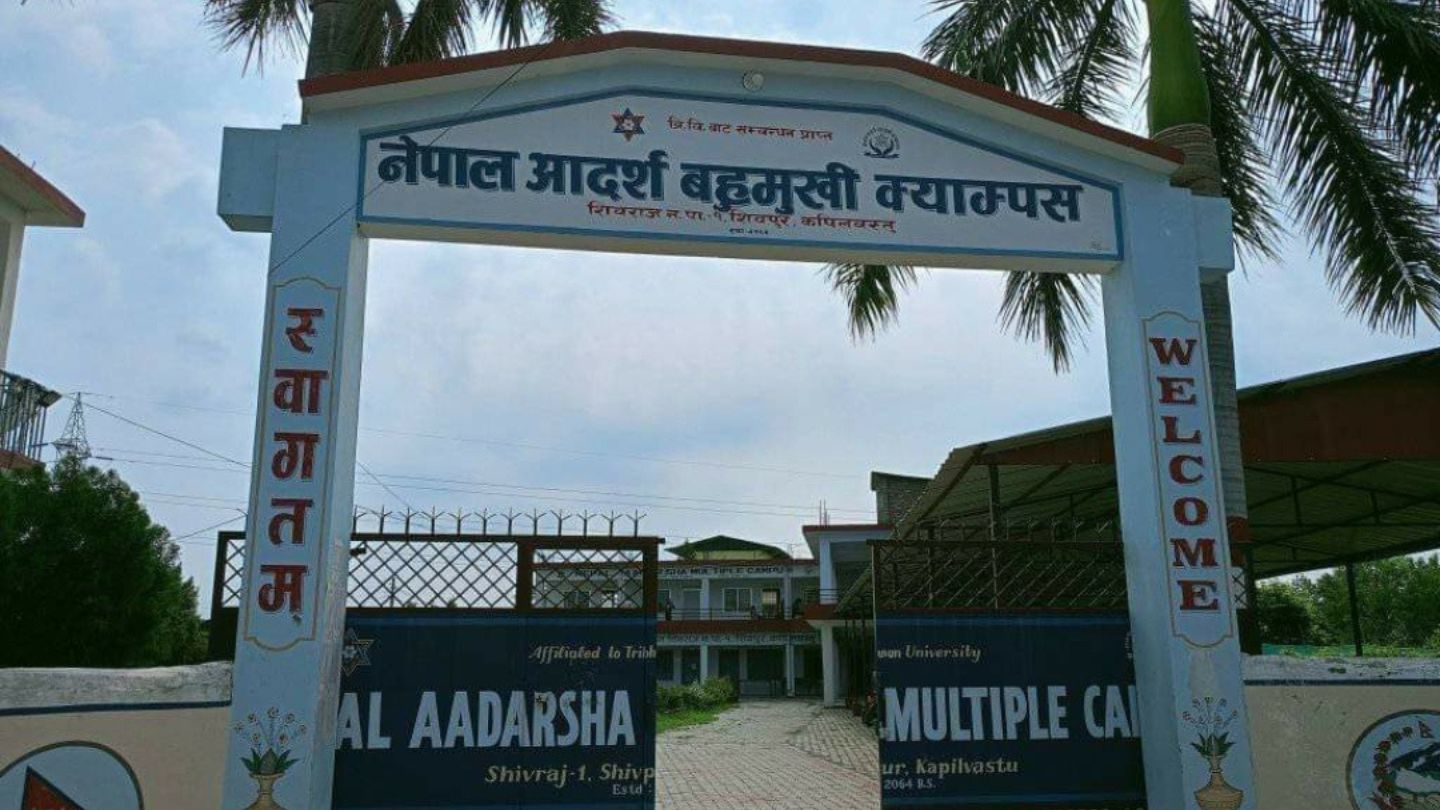
Community campus established in 2064 BS (2007/08 AD)
Location: Shivapur Municipality-1, Kapilvastu, Lumbini Province, Nepal
Affiliation: Tribhuvan University
Approval: UGC Nepal
Bachelor-level programs currently in operation in Education and Management
Courses offered:
Morning session classes
English and Nepali medium
Scholarship support for poor, meritorious, and socially backward students
Fee-waiving facility for students who rank first in their faculty each year
Hostel facility in operation
Campus bus service in operation
Library, reading room, and e-library development plan
Sports grounds and indoor game facilities
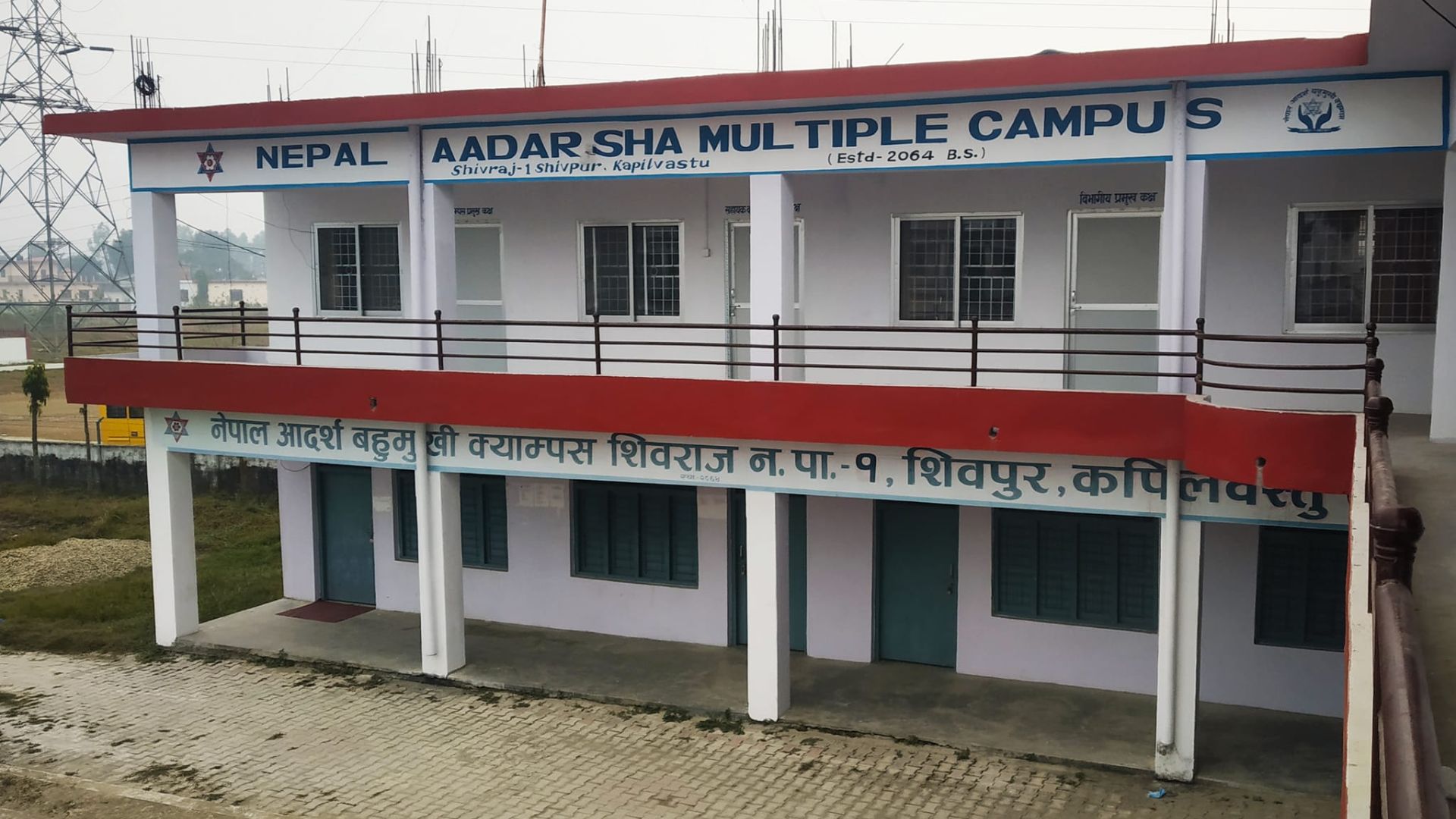
Nepal Adarsha Multiple Campus was founded through the collective effort of social workers, educationists, teachers, intellectuals, political workers, and local residents from different parts of Kapilvastu. The institution was set up with a clear public purpose: to make higher education accessible and affordable for students who could not easily leave home for study in larger cities.
Its background is closely linked with Nepal Adarsha Secondary School, which had already been serving the area and had introduced 10+2 level study in 2055 BS. For many students completing higher secondary education there, continuing to bachelor level remained difficult because of cost, travel distance, and limited local options. The establishment of the campus in 2064 BS responded directly to that gap.
In its founding year, the campus began bachelor-level teaching under Tribhuvan University in the Faculties of Humanities and Education. It started with 43 students in total, including 10 in Humanities and 24 in Education. Over time, student numbers increased, academic activities expanded, and the campus secured permission for the BBS program in 2070 BS. The institution has also received permission to operate postgraduate-level programs and has begun classes at that level.
The campus has a stated objective of contributing to national development by producing skilled human resources and promoting knowledge, language, literature, development, and vocational capacity. Its role is closely tied to the needs of lower-income families and communities that had limited access to higher education in the western part of Kapilvastu.
Nepal Adarsha Multiple Campus currently operates bachelor-level classes in the Faculties of Education and Management under Tribhuvan University.
Bachelor of Education (B.Ed.) – TU Faculty of Education, 4 years, annual system
Bachelor of Business Studies (BBS) – TU Faculty of Management, 4 years, annual system
The B.Ed. program follows TU’s four-year annual system. The structure includes communication skills, professional core areas, specialization major courses, specialization minor courses, and teaching internship or practicum. The general entry base for the four-year B.Ed. is Grade 12 or equivalent. For some subject specializations, TU sets additional subject-based requirements.
The BBS program follows TU’s four-year annual system under the Faculty of Management. The structure combines compulsory foundation courses, core business courses, concentration courses, business research methods, and a final project. In the fourth year, students choose a concentration area such as Accounting, Finance, Management, or Marketing. The BBS curriculum also includes field-based project work and annual examinations under TU rules.
For BBS admission, TU’s curriculum-based eligibility requires successful completion of 10+2 in business or commerce, or an equivalent qualification recognized by TU, or study of Mathematics or Economics as a full paper at the 10+2 level. For B.Ed., the general TU eligibility base is completion of Grade 12 or an equivalent qualification, while subject specialization rules apply according to the chosen area.
Academic registration, examinations, and results for these annual-system bachelor programs follow TU rules, guidelines, and the applicable academic calendar. Final examinations under the annual system are conducted by Tribhuvan University through the Office of the Controller of Examinations.
Admission to bachelor-level programs at the campus follows the general framework used for TU-affiliated programs.
The campus publishes an admission notice for the relevant program
Eligible applicants submit the prescribed application form
Applicants submit required academic and personal documents
Admission may include entrance procedures or merit-based selection if applicable to the program or campus process
Selected students complete admission by paying the prescribed fees
Academic registration, examinations, and results follow TU rules and the annual academic calendar
For B.Ed. and BBS, students should apply according to the program, faculty rules, and campus notice.
The standard document set for TU bachelor-level admission includes the following:
Academic transcript or grade sheet of Class 12 / +2 or equivalent
Character certificate from the previous institution
Migration certificate if the previous board or university is different
Transfer certificate from the previous school or college
Citizenship certificate or birth certificate copy
Passport-size photographs
Entrance examination scorecard if required
Completed admission or application form
Admission fee payment receipt
Equivalence certificate if the qualification is from a foreign board or university
Program-specific or campus-specific submission steps may be applied within the TU framework.
The campus presents its faculty as experienced and trained, and its academic setting as disciplined and peaceful. Teaching is carried out in both English and Nepali medium, which supports students coming from varied educational backgrounds.
At the campus level, teaching methods are described as lecture-based and inquiry-based. Theoretical and practical classes are both in operation. Research-oriented teaching has also been introduced in the teaching process of respective subjects. In some classes, projector-based teaching is used, and laptops and computers are assigned by subject area.
The broader TU structure of the BBS program supports a mixed learning model that includes lecture, group discussion, problem-solving exercise, guest lecture, practical work, project work, and case-based instruction where appropriate. This fits well with the campus’s use of practical and inquiry-based methods.
The academic environment also reflects the needs of students in a rural service area. Morning classes, bilingual teaching, project-based activities, and research-related class practice indicate a model shaped by access, flexibility, and applied learning rather than a purely classroom-bound format.
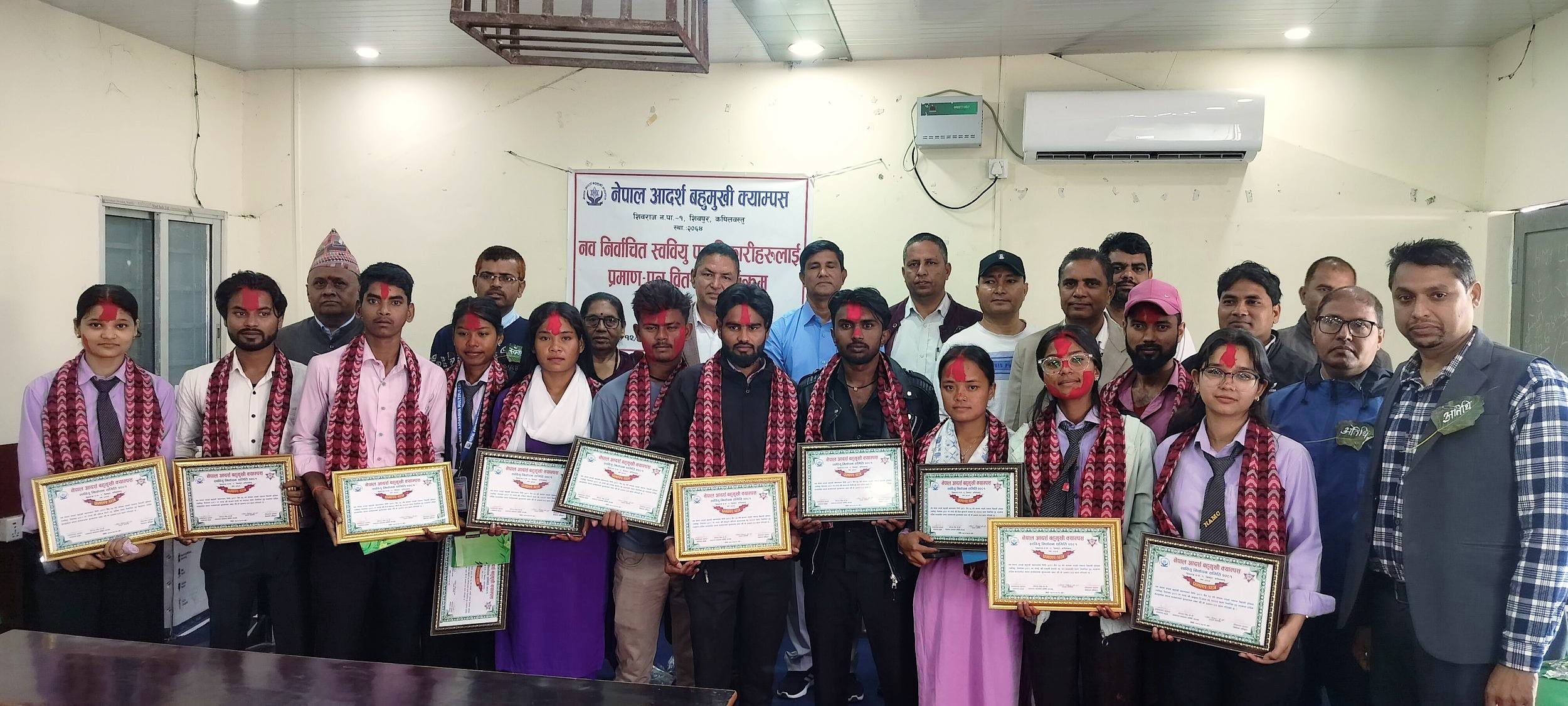
The campus has developed its facilities over time through community effort, institutional support, and grants. Major infrastructure and learning facilities include:
Academic operation on land and buildings linked to Nepal Adarsha Secondary School, with its own use rights secured
Two-storey academic building and additional rooms for the campus chief’s office, staff room, accounts section, and library
Seven-room upper-floor building completed with support from the Ministry of Social Development of Lumbini Province
Eight-room student hostel built with UGC support
Campus land in use for buildings, sports, and future development
Permanent compound wall around the main campus building area
Separate toilets for students, female students, professors, and staff
Attached toilets in hostel rooms
Safe drinking water from a deep pump connected to a Euro Guard filter
Hot drinking water arrangement in winter
Library with reading room facilities
5,834 books including textbooks and reference books for BBS, B.Ed., and BA areas
Newspapers and periodicals including Kantipur, Naya Patrika, and Gorkhapatra
Plan for a better organized e-library linked with other libraries and university campuses
Educational equipment including 5 laptops, 3 desktop computers, a photocopy machine, 2 projectors, and 3 printers
Playground space and sports facilities for volleyball, badminton, table tennis, and basketball-related development
Campus bus service for student transportation
Student life at Nepal Adarsha Multiple Campus is shaped by its community character and rural catchment area. Many students come from Shivapur and surrounding municipalities and rural areas. Some travel long distances each morning, and some try to continue bachelor-level study while also working from home. The campus bus service has been important in making regular attendance more practical for students who would otherwise face transportation barriers.
The campus environment is presented as peaceful and suitable for study. Morning sessions and bilingual instruction support a student body that includes learners from different academic, economic, and social backgrounds. The presence of hostel facilities also adds an option for students who need accommodation close to campus.
The local context matters in student experience. The campus serves communities where economic hardship has historically limited access to higher education. Female participation is also part of this setting, and transportation has been recognized as an important factor in continuing education for students who cannot stay away from home. In this sense, campus life is not separated from the social realities around it; it is built around access, continuity, and local educational need.
The available material points to a student environment that includes both academic and non-academic engagement.
Participation in extra-curricular activities each year
Games and sports facilities on campus
Volleyball, badminton, table tennis, and related sports use
Trainings and seminars for students
Educational tours
Group work activities
Peer teaching capacity development
Research-related practical reports and small research work through a research activities operation committee
The campus provides student support in several forms.
Scholarship schemes for economically poor and socially backward students
Scholarship provision for poor and meritorious students
Fee-waiving facility for students who rank first in their faculty each year
Community-campus fee structure supported mainly through admission and monthly fees
Regular grants and physical infrastructure support from the UGC
Plans to mobilize donor-based scholarship support in the future
These support mechanisms are closely tied to the campus’s role in serving lower-income and marginalized communities.
Established in 2064 BS (2007/08 AD) as a community, non-profit campus
Started bachelor-level teaching under Tribhuvan University in its founding year
Began with 43 students in the first year of operation
Expanded from the early Education and Humanities phase to include BBS after receiving permission in 2070 BS
Separated school and campus operation structure after the 2067 BS decision
Developed new building space with local and provincial support
Brought an eight-room hostel into operation with UGC support
Purchased and operated a campus bus in FY 2019/20
Expanded library and equipment resources through grant support
Received permission to operate postgraduate-level programs and began classes at that level
Community-based institution created to widen access to higher education in Kapilvastu
TU affiliation and UGC approval
Bachelor-level study in B.Ed. and BBS under the annual system
Morning session classes
English and Nepali medium
Experienced and trained faculty
Lecture-based, inquiry-based, practical, and projector-supported teaching
Hostel, transportation, library, and sports support
Scholarship and fee-waiver provisions for selected students
Strong connection to local educational need and student access
Campus Chief Sant Prasad Bhusal presents the campus as an institution built through coordination among stakeholders and sustained by committed staff, experienced faculty members, and a management committee with a long-term educational vision. His message places emphasis on the campus environment, extra-curricular participation, and continued institutional growth since 2064 BS.
The message also reflects an expectation of continued cooperation from concerned individuals, authorities, and institutions. It presents the campus as a place intended to strengthen students’ educational direction through a stable academic setting and collective institutional effort.
Nepal Adarsha Multiple Campus has grown from a local educational need into a functioning community campus with TU affiliation, UGC approval, and bachelor-level programs in Education and Management. Its development has been tied to public effort, local support, and the need to bring higher education closer to students in Kapilvastu who might otherwise face distance and cost barriers.
The campus combines academic delivery with hostel, library, transport, sports, scholarship, and practical learning support. For students seeking local access to TU-affiliated bachelor-level study, the institution holds a clear place within the educational landscape of Kapilvastu. Further institutional details can also be explored through the campus page for Nepal Adarsha Multiple Campus.
Contact Nepal Adarsha Multiple Campus's administrative office for detailed information on the course, admissions, location, fees, scholarships, facilities, counseling or eligibility.
Email: nepalaadarshmultipalcampus@gmail.com
Phone: +977-9857027763, +977-9846871013, +977-9847042522, +977-9857014731, +977-9847512160, +977-9847084092
Nepal Adarsha Multiple Campus is a community campus established in 2064 BS (2007/08 AD) in Kapilvastu, Lumbini Province, Nepal. It is affiliated with Tribhuvan University and approved by UGC Nepal.
The campus is located in Shivapur Municipality-1, Kapilvastu, Lumbini Province, Nepal.
The campus currently operates bachelor-level programs in Bachelor of Education (B.Ed.) and Bachelor of Business Studies (BBS) under Tribhuvan University.
Yes. Both B.Ed. and BBS are offered as four-year annual-system programs under Tribhuvan University.
Yes. The campus provides scholarship support for economically poor, socially backward, poor, and meritorious students. It also has a fee-waiving facility for students who rank first in their faculty each year.
The campus has classrooms, office and staff spaces, a library and reading room, hostel facilities, safe drinking water, toilets, projectors, laptops, desktop computers, printers, a photocopy machine, playground space, and a campus bus service.
The campus uses lecture-based and inquiry-based methods. It also runs theoretical and practical classes and uses projectors, laptops, computers, and research-oriented teaching practices in some subjects.
Yes. The campus has an eight-room hostel in operation and a campus bus service to support students from a wide service area.