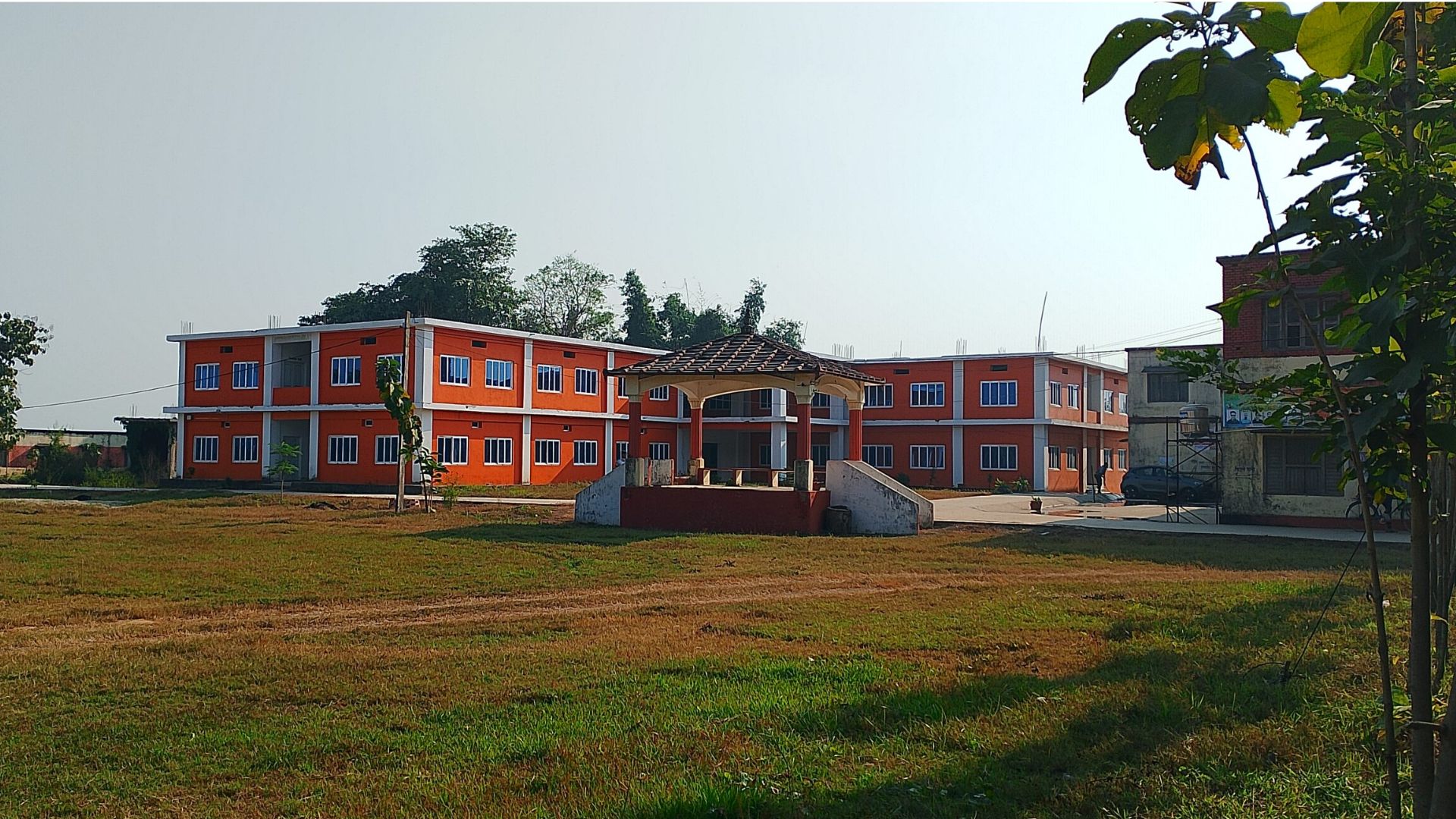
Kapilvastu Multiple Campus is a community-based campus established in 1980 AD (2037 BS) in Taulihawa, under Kapilvastu Municipality, Nepal. The campus serves students from Kapilvastu and nearby areas through academic programs that range from secondary level to postgraduate study. Its institutional affiliations include Tribhuvan University, Nepal Sanskrit University, and the National Examinations Board (NEB).
The campus has developed as a local center for higher education in a district with strong historical, cultural, and religious importance. Alongside regular classroom teaching, it runs academic support activities such as entrance evaluation, class tests, internal examinations, group assignments, remedial classes, seminars, and educational tours. The campus also holds QAA certification from the University Grants Commission (UGC), reflecting its formal quality assurance status. With programs in humanities, education, management, and science-related study areas, Kapilvastu Multiple Campus offers a broad academic base for students at different levels.
Established: 1980 AD (2037 BS)
Institution Type: Community-based campus
Location: Taulihawa, Kapilvastu, Nepal
Affiliation: Tribhuvan University, Nepal Sanskrit University, and NEB
QAA Status: QAA certified by UGC
Academic Range: Ten Plus Two (+2) to master’s level
NEB Programs: Ten Plus Two in Science, Ten Plus Two in Education, Ten Plus Two in Management, and Ten Plus Two in Humanities
Bachelor’s Programs: BA, B.Ed., B.Ed. Science, BBS, and One-Year B.Ed.
Teaching Shifts: Morning and evening shifts, depending on program
Major Facilities: Library, science lab, computer lab, ICT lab, multimedia classes, conference hall, counseling, sports, and classrooms
Contact: kmckpl@gmail.com | www.kmctlw.edu.np | +977-76-560181, +977-76-560329, 9857050808, 9857050329
Kapilvastu Multiple Campus was established to expand access to higher education in Kapilvastu district. The campus grew from local efforts to create a stable educational institution for students who otherwise had to travel outside the district for advanced study. Its community-based character remains central to its identity, with the campus assembly, management committee, local stakeholders, and education-focused individuals contributing to its growth and continuity.
The campus operates within a district known for its historical and cultural significance. Over time, it has developed academic and physical infrastructure to serve both local and surrounding communities. It has expanded from early bachelor-level offerings to postgraduate study, while also running NEB-affiliated secondary education. This progression shows a steady movement from access-based provision to broader institutional development.
Kapilvastu Multiple Campus also functions as a social campus. Its management structure includes a campus chief, assistant leadership roles, academic departments, and administrative units. Different committees support academic delivery, evaluation, campus quality, and institutional coordination. This structure reflects the campus’s dual role as an educational institution and a community-managed public academic space.
The campus’s QAA certification under UGC adds another layer to its institutional background. It signals the campus’s effort to strengthen academic administration, physical resources, and long-term planning. Strategic priorities identified by the campus include curriculum improvement, faculty development, student support, research activity, infrastructure growth, community engagement, and institutional sustainability.
Kapilvastu Multiple Campus runs programs under NEB, Tribhuvan University, and Nepal Sanskrit University. The academic range covers secondary-level study, bachelor’s education, and postgraduate study. Program structure varies by level and affiliation, with annual and semester systems both in use.
The campus offers NEB-affiliated Ten Plus Two programs as two-year full-time courses under the annual system. These programs support students moving from SEE to higher secondary education.
Ten Plus Two in Science
Ten Plus Two in Education
Ten Plus Two in Management
Ten Plus Two in Humanities
The +2 Education stream gives students a foundation in educational thought, curriculum, administration, guidance, counseling, and education in Nepal. The +2 Management stream is designed to build a basic academic foundation in management, accountancy, finance, office practice, and marketing. The +2 Humanities stream functions as a two-year foundation course for students interested in areas such as sociology, English, mass communication, psychology, and related social science fields. All NEB programs follow NEB rules, the annual academic calendar, and final board examination procedures.
Bachelor-level programs at the campus are affiliated with Tribhuvan University and follow the structure applicable to their faculties.
Bachelor of Arts (BA)
4 years, morning shift
Specialization areas include English, Nepali, Economics, Rural Development, Sociology, and Political Science.
Bachelor of Education (B.Ed.)
4 years, morning shift
Specialization areas include English, Nepali, Health, and Math.
B.Ed. Science
4-year course
Seat capacity: 40
Applicants should have studied Physics, Chemistry, and Biology in Classes 11 and 12.
Bachelor of Business Studies (BBS)
4 years, morning shift
Specialization areas include Account, Finance, and Marketing.
One-Year B.Ed.
Affiliated with Nepal Sanskrit University.
The BA program under TU’s four-year structure combines compulsory subjects with major and elective choices. The B.Ed. program is a four-year annual-system professional and academic program built around communication skills, professional core courses, specialization major and minor courses, and teaching practice. The BBS program is a four-year annual-system management degree that combines foundation courses, core business study, concentration areas, and final project work.
The campus also offers postgraduate study through Tribhuvan University.
Master of Education (M.Ed.)
2 years, 4 semesters, evening shift
Specialization areas include English, Nepali, EPM, and Health.
Master of Business Studies (MBS)
2 years, 4 semesters, morning shift
Specialization areas include Account, Finance, and Marketing.
The M.Ed. program follows the semester system and includes core professional courses, specialization courses, teaching practice, and thesis writing. The MBS program also follows the semester system, with course work built around business and management study across multiple semesters.
Taken together, these programs show that the campus serves students from early higher secondary preparation through postgraduate academic specialization. The presence of humanities, education, management, and science-related pathways gives the campus a broad academic spread within its district setting.
Admission procedures at Kapilvastu Multiple Campus differ by academic level and affiliation, but the process generally follows the rules of NEB, Tribhuvan University, the concerned faculty, and campus administration. The campus also arranges an entrance evaluation examination for students so that academic placement and support can be managed according to their capacity and level. The campus has also taken steps toward completing admission through online methods.
For NEB Class 11, admission usually starts after SEE results are published.
Students submit the required application form, academic records, photographs, and related documents.
Depending on the stream and campus process, admission may include an entrance examination, interview, or merit-based selection.
After selection and fee payment, students are enrolled in Grade 11 and subject registration is completed under the NEB system.
For TU bachelor’s programs, the campus publishes an admission notice for eligible applicants.
Students submit the prescribed application form along with academic documents.
Depending on the program, the process may include an entrance examination, merit-based selection, or both.
Selected applicants complete admission by submitting final documents and paying the required fees.
Academic registration, examinations, and result processes follow TU rules and the relevant academic calendar.
For TU master’s programs, admission notice is published by the concerned campus or academic authority.
Eligible applicants submit the prescribed application form.
Admission may include an entrance examination depending on the program.
A merit list or selection result may be published.
Selected students complete enrollment through document submission and admission fee payment.
Program-specific eligibility varies. NEB streams such as +2 Education, +2 Management, and +2 Humanities use a minimum SEE GPA threshold of 1.6 in the materials available. For TU programs, eligibility depends on the relevant faculty and program structure. BA and B.Ed. are open to students who have completed Grade 12 or an equivalent qualification under TU-recognized systems. BBS requires 10+2 in business or commerce, or an equivalent recognized qualification, subject to faculty and campus rules. M.Ed. requires a relevant B.Ed. or PGDE background, while MBS is open to students with a bachelor’s degree and follows the admission procedure applicable to the program.
For NEB Class 11 admission:
SEE marksheet / grade sheet
SEE character certificate or school leaving certificate
Transfer Certificate (TC) from the previous school
Migration certificate, if applicable
Citizenship certificate or birth certificate copy
Passport-size photographs
NEB Class 11 registration or subject registration form
For NEB Class 12 board examination process:
NEB registration card or registration number issued in Class 11
Class 11 marksheet or transcript
Class 12 board examination application form
Passport-size photographs
Examination fee receipt
Admit card issued before the examination
For TU bachelor’s admission:
Academic transcript of Class 12 / +2 or equivalent
Character certificate from the previous institution
Migration certificate, if the previous board or university is different
Transfer Certificate (TC)
Citizenship certificate or birth certificate copy
Passport-size photographs
Entrance examination scorecard, if required
Completed admission or application form
Admission fee payment receipt
Equivalence certificate, if the qualification is from a foreign board or university
For TU master’s admission:
Bachelor’s degree transcript or marksheet
Bachelor’s degree certificate or provisional certificate
Character certificate from the bachelor-level institution
Migration certificate, if the bachelor’s degree is from another university
Transfer Certificate (TC)
Citizenship certificate or birth certificate copy
Passport-size photographs
Entrance examination scorecard, if required
Completed admission or application form
Admission fee payment receipt
Equivalence certificate, if the bachelor’s degree is from a foreign university
Kapilvastu Multiple Campus presents its academic environment as one shaped by experienced faculty and regular teaching activity across humanities, education, management, and other study areas. The teaching approach described in the campus materials includes student-centered classroom practice, with attention to critical thinking, subject understanding, and regular academic evaluation. The campus also links classroom instruction with assignments, internal examination, and follow-up academic support.
Regular class tests, group assignments, and internal examinations form part of the academic process. The campus has arranged two internal examinations for students across faculties, with evaluation and result analysis used for academic improvement. Remedial classes are also arranged to support students who need additional academic help. This indicates an ongoing teaching process that does not depend only on final examinations.
Across different programs, the learning methodology includes a mix of lectures and practical or participatory activities. In the BBS framework, instruction includes lectures, group discussion, problem-solving exercises, guest lectures, practical work, project work, and case-based teaching where possible. In the M.Ed. framework, teaching includes lecture sessions, project work, assignments, seminars, case studies, and field studies. These methods suggest that classroom learning is combined with subject application and academic writing.
The campus also conducts seminars, interaction programs, orientation activities, and training participation for teachers and staff. Experts are invited for academic sessions, and the campus joins training or workshop opportunities conducted by universities, campus associations, UGC, and related bodies. Educational and industrial tours are also used as learning tools, with students required to prepare reports and presentations after visits. This gives the teaching process a wider academic context beyond routine classroom periods.
Library and reading support facilities
Science laboratory
Computer lab
ICT lab
Multimedia classes
EMIS support
Classrooms for regular teaching
Conference hall
Journal-related academic support
Counseling services
Sports facilities
Dance and music activities
Educational tour support
Extra-curricular activity support
Canteen facility
Laboratories for practical learning
Internet access
Main campus building with 17 rooms
Additional 7 rooms added from campus resources
One-storey administrative building
Furniture and maintenance arrangements
Campus land totaling 3 bighas 19 katthas 11 dhur
The campus’s physical growth has taken place over time through public support, institutional assistance, and campus resources. Land acquisition and building construction have strengthened the base for regular academic operation. The presence of academic labs, library facilities, multimedia support, and conference use shows that the campus has moved beyond a minimal teaching setup and now supports multiple forms of instruction.
Student life at Kapilvastu Multiple Campus is closely tied to its identity as a community campus. The institution is operated through a management and assembly structure that links academic work with local participation. This creates a campus environment where education is connected to public responsibility, district-level educational needs, and community presence.
The campus runs more than routine classroom teaching. Parent gatherings are organized to inform families about campus and student progress. Social awareness campaigns, cleanliness-related activities, social reform efforts, and outreach programs are also part of campus life. Students are encouraged to take part in events connected to society as well as campus-based academic work.
The internal academic system also shapes the student experience. Entrance evaluation, regular class tests, internal examinations, assignments, and remedial classes mean that students remain in continuous academic contact with departments and teachers. Separate departments and committees support the running, evaluation, and coordination of academic work. This structure gives students an organized academic setting rather than a purely examination-based environment.
Educational and industrial tours add another layer to campus experience. These tours are designed to connect subject study with real situations, and students are expected to submit reports and presentations after participation. Together with sports, seminars, interaction programs, and cultural activities, these practices give student life both academic and extracurricular dimensions.
Sports programs
Dance and music activities
Educational and industrial tours
Student presentations and tour reports
Seminars and interaction programs
Orientation and workshop participation
Community-organized event participation
Cleanliness and social awareness campaigns
Outreach and participation programs linked to social institutions
Parent gatherings and campus-community activities
Scholarships are included among the campus support features.
Scholarship funds are part of the campus’s financial management structure.
The campus receives support from student tuition fees, public support, donations, and internal resources.
Financial support has also come from the University Grants Commission.
Support has been received from local level bodies, the Government of Nepal, the provincial government, and Kapilvastu Municipality.
Student inclusion and accessibility are part of the campus’s strategic priorities.
Established in 1980 AD (2037 BS) as a community-based campus in Taulihawa
Built academic continuity in Kapilvastu by expanding local access to higher education
BA affiliation date: 2050.03.21
BBS affiliation date: 2050.03.21
B.Ed. affiliation date: 2062.06.03
M.Ed. affiliation date: 2067.04.09
MBS affiliation date: 2079.09.20
Received QAA certification from UGC on 2079 Poush 19
Expanded from bachelor-level teaching to postgraduate education
Secured campus land totaling 3 bighas 19 katthas 11 dhur
Constructed a 17-room main campus building and added 7 more rooms from campus resources
Completed an administrative building with university support
Continued academic and physical development through local and institutional cooperation
It offers academic pathways from +2 to master’s level within one institution.
It is affiliated with TU, NEB, and Nepal Sanskrit University.
It is located in Taulihawa, making higher education more accessible for students in Kapilvastu and nearby areas.
It holds QAA certification under UGC.
It runs morning and evening shifts depending on the program.
It combines humanities, education, management, and science-related options.
It includes internal academic support such as class tests, internal exams, assignments, and remedial classes.
It provides library, lab, multimedia, sports, counseling, and conference facilities.
It functions as a community campus with active links to local society and public institutions.
It includes tours, seminars, and campus-community activities as part of student experience.
A message from Campus Chief Hota Raj Khanal presents Kapilvastu Multiple Campus as an institution focused on accessible and quality higher education in the district. The message highlights academic diversity across humanities, management, science, and education; the role of experienced faculty; student-centered teaching practice; and the need to keep curricula aligned with changing academic and social needs. It also places emphasis on infrastructure development, inclusion, academic collaboration, and a campus culture that supports learning and community engagement.
A message from President Ramdas Gupta reflects on the campus’s growth since its establishment in 2037 BS. The message frames the institution as a long-running community effort that has expanded its programs over time while continuing to serve students from Kapilvastu and beyond. It also connects the campus’s history with its ongoing responsibility to maintain educational continuity and support future generations of students.
Kapilvastu Multiple Campus occupies an important place in the educational landscape of Kapilvastu district. From its start as a community-based institution in 1980 AD, it has grown into a campus that serves students at NEB, bachelor’s, and master’s levels. Its affiliations with Tribhuvan University, Nepal Sanskrit University, and NEB allow it to run programs across multiple academic levels and disciplines.
The campus combines regular teaching with internal academic support, extracurricular activity, and gradual infrastructure development. QAA certification, program expansion, local support, and a broad academic range show a campus that has built its role through continuity and public relevance. For students seeking study options in Taulihawa and the wider district, Kapilvastu Multiple Campus remains a structured and locally rooted academic institution.
Contact Kapilvastu Multiple Campus's administrative office for detailed information on the course, admissions, location, fees, scholarships, facilities, counseling, or eligibility.
Kapilvastu Multiple Campus
Email Address: kmckpl@gmail.com
Website: www.kmctlw.edu.np
Phone Number: +977-76-560181, +977-76-560329, 9857050808, 9857050329
Location: Taulihawa, Kapilvastu, Nepal
Kapilvastu Multiple Campus is a community-based campus established in 1980 AD (2037 BS) in Taulihawa, Kapilvastu. It offers programs from Ten Plus Two to master’s level.
The campus is affiliated with Tribhuvan University, Nepal Sanskrit University, and the National Examinations Board (NEB).
The campus offers Ten Plus Two in Science, Education, Management, and Humanities. At bachelor’s level, it offers BA, B.Ed., B.Ed. Science, BBS, and One-Year B.Ed. At master’s level, it offers M.Ed. and MBS.
Yes. The campus received QAA certification from the University Grants Commission on 2079 Poush 19.
The campus has a library, science lab, computer lab, ICT lab, multimedia classes, classrooms, conference hall, counseling services, sports facilities, laboratories, internet access, and canteen support.
Admission depends on the level and affiliation. NEB Class 11 admission usually begins after SEE results. TU bachelor’s and master’s admission follows the relevant faculty, campus, and academic rules, and may include application, document submission, entrance process, merit-based selection, and fee payment.
Yes. The campus runs class tests, group assignments, two internal examinations, and remedial classes to support academic progress.
Different programs run in different shifts. BA, B.Ed., and BBS are offered in the morning shift. MBS is also in the morning shift, while M.Ed. runs in the evening shift.