Waling Multiple Campus is a community-based public campus in Waling Municipality, Syangja, Gandaki Province, Nepal. Established in 2037 B.S. (1980 A.D.), the campus began with Proficiency Certificate Level study in Humanities and later expanded to secondary, bachelor’s, and postgraduate education. It serves students from Syangja and nearby areas of Gulmi, Tanahun, Parbat, and Palpa.
The campus runs programs under the affiliation of Tribhuvan University and the National Examinations Board (NEB). Its academic range extends from Grade 11 and 12 to master’s level, with programs in Humanities and Social Sciences, Management, Education, and Information Communication Technology in Education. The campus has also received QAA accreditation from the University Grants Commission (UGC) in 2021.
Waling Multiple Campus combines long-running general education programs with a newer technical offering in BICTE. Alongside classroom teaching, it maintains library services, computer facilities, sports infrastructure, student transport, scholarship schemes, counselling support, and a range of co-curricular and social-engagement activities.
Community-based public campus established on 18 December 1980 (2037 Poush 4)
Located in Waling, Syangja, Gandaki Province, Nepal
Affiliated with Tribhuvan University and NEB
QAA accredited by University Grants Commission (UGC) in 2021
Offers study from Grade 11 and 12 to postgraduate level
Academic areas include Management, Education, Humanities and Social Sciences, and ICT Education
More than 1,500 students are enrolled across different levels and programs
Catchment area includes parts of Syangja, Gulmi, Tanahun, Parbat, and Palpa
Governance structure includes a General Assembly, Campus Management Committee, Campus Chief, faculty heads, subject departments, and sub-committees
Scholarship schemes include merit-based, need-based, and inclusiveness-focused support
Facilities include a library, e-library, computer lab, seminar hall, canteen, sports grounds, parking, internet, intercom, CCTV, and transport service
The campus has its own land and multiple academic and administrative blocks
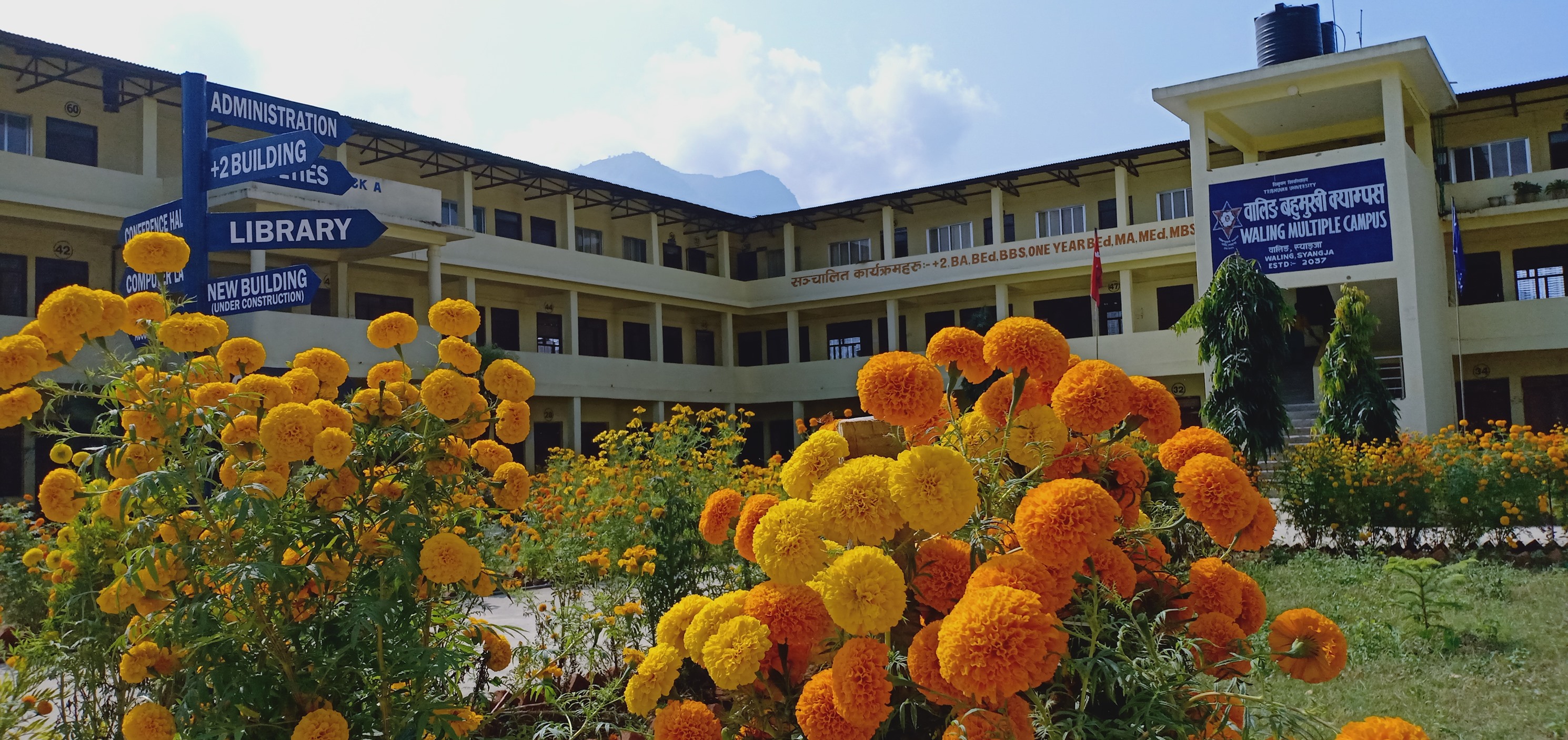
Waling Multiple Campus (वालिङ बहुमुखी क्याम्पस) was established as a public campus in 2037 B.S. and grew from an initial Proficiency Certificate Level program in Humanities into a multi-level institution. Over time, it expanded into Education and Management, then into postgraduate study, and later added a technical bachelor’s program in ICT Education. This phase-wise academic growth reflects the campus’s role as a higher education institution for students from Waling and surrounding districts.
The campus is located in Waling, a municipal center in Syangja district. Its setting has helped it draw students not only from the immediate locality but also from nearby areas in Gulmi, Tanahun, Parbat, and Palpa. The campus materials identify a wide educational catchment, including feeder schools for Grade 11 and 12, secondary institutions for bachelor’s progression, and other campuses that feed into postgraduate enrollment.
Institutionally, the campus operates as a community-governed academic institution. Its governance framework includes a General Assembly of life members, a Campus Management Committee, the Campus Chief, an Assistant Campus Chief, faculty heads or program coordinators, subject department heads, teaching staff, non-teaching staff, and assistants. Several committees and sub-committees support administration, recruitment, accounts, examinations, the library, and related academic functions.
The campus presents itself as a non-profit academic institution with a community mandate. Its internal objectives include academic access, institutional development, counselling support, and broader service to society through education. This community connection is also visible in its endowment support, donor-backed scholarship mechanisms, and local participation in governance.
Another important part of its institutional journey is quality assurance. In 2021, Waling Multiple Campus received QAA accreditation from the University Grants Commission. The same period also marks the start of its BICTE program, linking quality assurance efforts with academic diversification. The campus has also pursued new program development, with proposals noted for additional courses such as BBA and BCA.
Waling Multiple Campus offers programs at secondary, bachelor’s, and master’s levels. The campus runs +2 programs under NEB and higher education programs under Tribhuvan University.
Ten Plus Two (+2) Education – 2 years
Ten Plus Two (+2) Humanities – 2 years
Ten Plus Two (+2) Management – 2 years
The +2 streams include subject combinations aligned with their respective areas.
Management includes Mathematics, Economics, Accountancy, Business Studies, Marketing, Business Mathematics, and Computer Science.
Education includes Nepali, English, Health and Physical Education, Mathematics, Economics, Population Studies, Geography, Mass Communication, Introduction to Education, Child Development and Learning, Instructional Pedagogy, and History.
Humanities includes English, Nepali, Health and Physical Education, Mathematics, Economics, Population Studies, Geography, Mass Communication, Social Studies, History, and Political Science.
Bachelor of Business Studies (BBS) – 4 years
Bachelor of Education (B.Ed.) – 4 years
Bachelor of Arts (BA) – 4 years
BEd Information Communication Technology (BICTE) – 4 years, 8 semesters
The BBS program includes specialization areas such as Finance, Account, and Marketing groups.
The B.Ed. program includes subjects such as Mathematics Education, English Education, Nepali Education, Geography Education, Economics Education, Health Education, Population Education, Political Science Education, and History Education.
The BA program includes English, Nepali, Mathematics, Economics, Population Studies, Geography, History, Political Science, and in some campus references also Mass Communication and Social Studies.
The One Year B.Ed. includes Nepali Education, English Education, Mathematics Education, Economics Education, and Educational Administration.
BICTE is the campus’s technical undergraduate offering under the Faculty of Education. It is a semester-based program of 138 credit hours spread across eight semesters. The course combines education study with ICT and computing areas such as programming, database systems, data communication, web technology, computer graphics, artificial intelligence, digital pedagogy, research, and teaching practicum in ICT. The campus records describe it as a program designed both for ICT teaching and for broader computing-related skills.
Master of Business Studies (MBS) – 4 semesters
M.Ed. Nepali Language Education – 4 semesters
M.Ed. English Language Education – 4 semesters
MA Population Studies – 4 semesters
The postgraduate level includes Management, Education, and Humanities and Social Sciences. The M.Ed. offerings are available in Nepali Education and English Education, while the MA program is available in Population Studies.
The campus records include affiliation dates for major university programs:
BA – 2047/04/08 B.S.
BBS – 2057/09/04 B.S.
B.Ed. – 2059/03/30 B.S.
One Year B.Ed. – 2060/05/30 B.S.
MA Population Studies – 2064/05/19 B.S.
M.Ed. Nepali – 2067/02/30 B.S.
M.Ed. English – 2067/02/30 B.S.
MBS – 2070/10/14 B.S.
BICTE – 2078/10/17 B.S.
Admission forms are available through the campus account section.
Applicants are required to submit the completed form with the prescribed admission fee.
Students are asked to submit passport-size photographs and academic documents from the previous level at the time of application.
Bachelor’s level applicants must have passed +2 from HSEB/NEB, PCL from a recognized university, or an equivalent qualification.
Master’s level applicants for MA and MBS must have completed a bachelor’s degree.
Applicants to M.Ed. English and M.Ed. Nepali must have completed B.Ed. or One Year B.Ed.
Applicants to One Year B.Ed. must have completed a bachelor’s degree in the relevant discipline.
Applicants to +2 programs must have passed the SLC examination or an equivalent qualification.
Applicants to BICTE must have passed 10+2 or equivalent in any stream with at least a C+ grade in aggregate.
Students are expected to follow campus rules and code of conduct after admission.
Campus materials also note a uniform requirement after the initial admission period.
Admission form obtained from the campus
Two passport-size photographs for general admission
Previous-level academic documents
SLC/SEE mark sheet
SLC/SEE character certificate
+2 transcript
+2 provisional certificate
+2 character certificate
Original migration certificate
Supplementary certificate, if applicable
Equivalence certificate from the Curriculum Development authority for students coming from abroad
Copy of citizenship certificate or passport for foreign students
One color stamp-size photograph for the ID card and two color passport-size photographs for campus records in the case of BICTE admission
The campus highlights its qualified, experienced, and trained lecturers as one of its core academic features. It also places repeated emphasis on instructional pedagogy and the use of varied teaching methods across programs. Rather than relying on a single classroom format, the campus materials point to a mix of lecture-based teaching, discussion, demonstration, case study, project work, field visit, research-based learning, and problem-solving approaches.
Across secondary, bachelor’s, and master’s levels, the campus presents teaching as an interactive process supported by different pedagogical techniques. These include questionnaire method, experimental method, discovery learning, cooperative learning, peer learning, self-learning, values clarification, supervision, and virtual or online learning. The range of methods suggests that the academic delivery model is designed to support both theoretical study and applied classroom engagement.
BICTE shows this applied orientation most clearly. The program combines conventional class sessions with practical work and project-based learning. Its course structure includes communication skills, educational core subjects, specialization majors, minor subjects, research projects, capstone work, and teaching practicum in ICT. This makes it the campus’s most structured bridge between education and technology.
The campus also maintains educational aids to support teaching. These include whiteboards, projectors, pictures, flash cards, radio, audio-visual tools, computers, internet access, and digital devices. These resources are presented as part of the everyday teaching-learning environment rather than as separate add-ons.
Campus land recorded at 35-12-0-3 ropanis in total
Multiple campus blocks for bachelor’s classes, +2 classes, administration, academic use, and student services
Block A used for bachelor-level classes
Block C includes the library on the ground floor and master’s classrooms on the upper floor
Block D is used for Grade 11 and 12 classes in the day shift
Block G serves as the administrative building
Block H, built with matching grants from University Grants Commission (UGC), is used as an academic building
Block E is a five-storey building with 35 rooms, planned for future academic use, seminar hall functions, and hostel-related use
Central playground within the campus premises
Separate football ground outside the campus premises
Library with a computerized bar-code system
Library holdings include 10,910 registered books, 1,530 reference materials, 14 journals, and 2 newspapers
Separate reference, journal, and dissertation sections in the library
E-library with 14 computers
Reading room, reading tables, benches, issue desk, and steel bookshelves
Library service runs 9 hours per day, from 6:30 AM to 3:30 PM
Separate computer lab with 20 computers and internet service
Computer lab is open 6 days per week and 8 hours per day
Separate canteen block within the premises
Seminar hall for interaction and discussion
Parking space for two-wheelers and four-wheelers
Internet, intercom, and CCTV services for academic and administrative support
Transport or shuttle service for students travelling from peripheral areas
Student life at Waling Multiple Campus is shaped by a mix of classroom learning, student support, sports, health services, and community participation. The campus highlights a peaceful and active environment, with academic programs running alongside support systems that are meant to make campus life manageable for students from both the municipality and surrounding areas.
Transport service is one of the practical features of daily student life, especially for those who live farther from campus. The campus also notes the use of additional vehicles based on student demand. On campus, library and computer access support regular study, while seminar facilities create room for academic interaction beyond standard lectures.
Counselling and guidance form another part of the student experience. The campus runs a career counselling service through a dedicated sub-committee. This support includes group workshops, such as resume writing and interview preparation, as well as one-to-one guidance for students who are unsure about subject choice, future study, or initial work experience. This is especially relevant for final-year students preparing for transition after graduation.
The campus also links student life with health and social responsibility. It maintains a Health and Sports Department and conducts regular health camps for students, faculty members, and non-teaching staff. It also mentions sub-committees related to sanitation, drinking water, environmental promotion, and premises management. Alongside campus-level services, students are encouraged to take part in emergency support and community welfare activities.
A Youth Red Cross Circle operates at the campus level and takes part in first aid, safety workshops, training activities, and rescue support during emergencies. The campus has also been involved in blood donation programs, awareness campaigns, and social-service initiatives. This gives student life a wider civic dimension beyond routine coursework.
Separate Health and Sports Department and an Extra-Curricular Activities Sub-committee
Volleyball, football, and cricket activities
Poem recitation programs
Speech contests
Singing competitions
Dancing competitions
Recreational and social activities beyond the regular curriculum
Sports programs conducted on a regular schedule
Scholarships and cash prizes for outstanding sports persons and artists
Awareness programs related to drug addiction, traffic rules, human rights, gender equality, social equity, environment preservation, and financial saving
Student participation in rescue and relief support during emergency periods
Scholarship and free-ship support for poor, Dalit, genuine, helpless, deprived, disabled, and martyrs’ family students
Class-wise special scholarships
25% scholarship for first division holders
100% scholarship for distinction holders
100% discount for faculty topper students at bachelor’s and +2 levels
Internal Trust Fund scholarship support established through donors
5% of annual income allocated for scholarship support
Scholarship consideration includes academic, artistic, athletic, and community-service performance
Socio-economic background, geographical remoteness, inclusiveness, and social equity are part of scholarship consideration
If more than three students from one family are admitted, one student may receive full fee support
Scholarships provided by TU, NEB, or other institutions are also made available to eligible talented students
Established in 2037 B.S. as a public, community-based campus
Started academic service with Proficiency Certificate Level study in Humanities
Expanded from intermediate study to bachelor’s and postgraduate programs
Runs programs under both Tribhuvan University and NEB
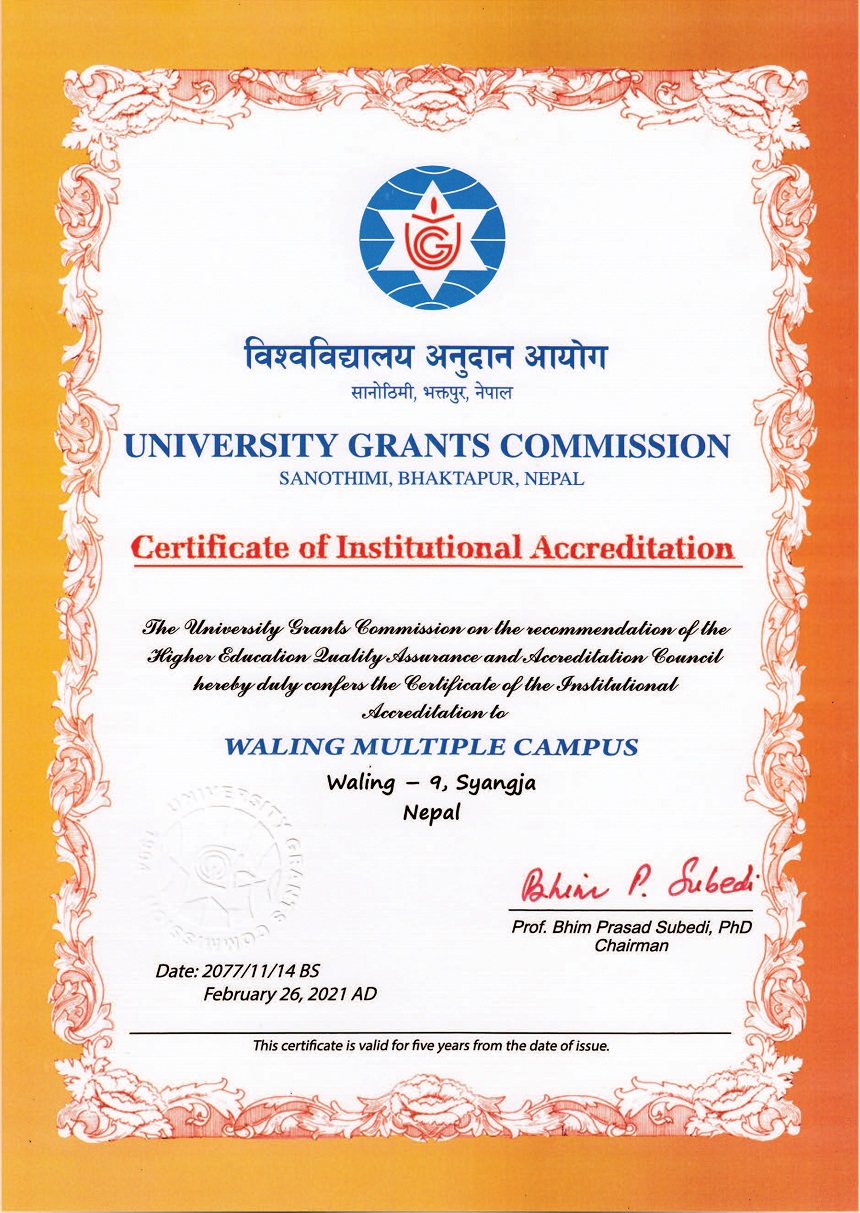
Received QAA accreditation from University Grants Commission (UGC) in 2021
Started the BICTE program in 2021 as a technical undergraduate offering
Maintains enrollment of more than 1,500 students across different levels and programs
Developed a five-storey academic block for future expansion and student services
Raised relief support for Jajarkot earthquake victims through campus-led action
Maintains a Youth Red Cross Circle for safety, training, and emergency support work
The Chairperson’s message presents Waling Multiple Campus as a non-profit academic institution established to respond to changing educational and social needs. It places emphasis on access, community service, and the goal of preparing capable human resources with social and national responsibility. The message also connects campus growth with collective effort from students, guardians, and the wider community.
The Campus Chief’s message focuses on institutional development, academic planning, and the effort to strengthen teaching, research, and information technology within the campus. It also points to the role of qualified resource persons and the importance of sustained collective work in moving the campus toward its longer-term academic goals.
Waling Multiple Campus has developed from a single-faculty beginning into a multi-level institution serving students from Waling and nearby districts. Its present structure includes +2, bachelor’s, and master’s study, with programs in Education, Management, Humanities and Social Sciences, and ICT Education. Its community-based governance, scholarship provisions, student support services, and physical growth show a campus that has expanded steadily over time.
For students comparing institutions in Syangja and the surrounding region, Waling Multiple Campus stands out for the breadth of its academic levels, the combination of general and technical study, and the range of support facilities attached to its programs. Its affiliation base, QAA accreditation, and continuing expansion make it a significant higher education institution within its service area.
College Name: Waling Multiple Campus (वालिङ बहुमुखी क्याम्पस, स्याङ्जा)
Location: Waling, Syangja, Gandaki Province, Nepal
Phone No.: +977-63-441224, +977-63-441587
Email: info@wmc.edu.np
Website: www.wmc.edu.np
Waling Multiple Campus is located in Waling, Syangja district, Gandaki Province, Nepal.
The campus runs programs under Tribhuvan University and the National Examinations Board (NEB).
The campus offers Grade 11 and 12 programs, bachelor’s programs, and master’s programs.
The +2 level includes Education, Humanities, and Management.
The campus offers BBS, B.Ed., BA, One Year B.Ed., and BICTE.
The master’s level includes MBS, M.Ed. in Nepali Education, M.Ed. in English Education, and MA in Population Studies.
Bachelor’s applicants must have passed +2 from HSEB/NEB, PCL from a recognized university, or an equivalent qualification.
Applicants to MA and MBS must have completed a bachelor’s degree. Applicants to M.Ed. English and M.Ed. Nepali must have completed B.Ed. or One Year B.Ed.
The campus provides a library, e-library, computer lab, seminar hall, canteen, sports facilities, parking, transport service, internet, intercom, and CCTV service.
Yes. The campus provides merit-based, need-based, class-wise, and inclusiveness-focused scholarships, including support for first division holders, distinction holders, economically challenged students, and selected students from large enrolled families.