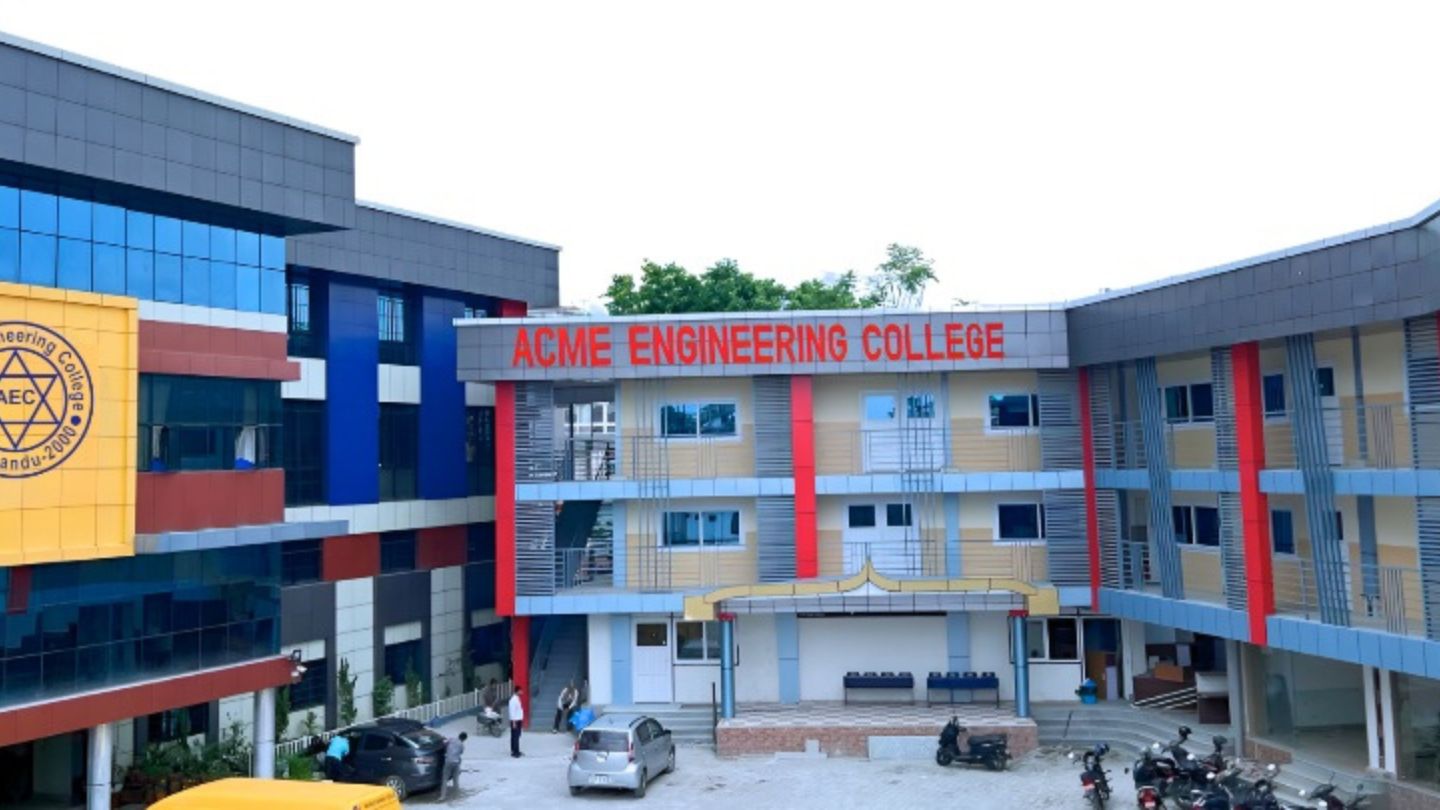
Bachelor in Information Technology (BIT) at Acme Engineering College is a bachelor’s degree program affiliated with Purbanchal University. The college is located in Basundhara, Kathmandu, and offers BIT in the morning shift with 48 seats.
The curriculum runs from Year I to Year IV across eight semesters. It starts with mathematics, computing fundamentals, communication, electrical systems, management, and C programming before moving into object-oriented programming, data structures, databases, web technology, networking, operating systems, data mining, artificial intelligence, software engineering, and software project management. Project work is included throughout the program, with a separate project component in every semester.
Course: Bachelor in Information Technology (BIT)
College: Acme Engineering College
Location: Basundhara, Kathmandu, Nepal
Affiliation: Purbanchal University
Level: Bachelor’s
Duration: 4 years
Academic Structure: 8 semesters
Seats: 48
Shift: Morning
Study Components: Theory, tutorials, practical work, laboratories, projects, and electives
The BIT curriculum combines computing subjects with mathematics, communication, management, electronics, and applied project work. The first semester carries 19 credits and introduces Mathematics-I, Fundamentals of Information Technology, Technical Communication (English), Basic Electrical System & Circuit, Principles of Management, Computer Programming-I, and Project-I.
Semester II moves into Mathematics-II, Electronics Devices & Circuits, Digital Logic, Object Oriented Programming in C++, Project-II, and Financial Management & Accounting. The semester carries 17 credits.
By the second academic year, students study System Analysis & Design, Microprocessor & Assembly Language, Data Structure & Algorithm, User Interface Design, Numerical Methods, Communication System, Computer Organization, Web Technology-I, Database Management System, Discrete Mathematics, Marketing Management, and project courses.
The third year shifts further into information technology applications. Semester V includes Probability & Statistics, Society & Ethics in IT, Data Communication, Web Technology-II, Computer Graphics, Operating System, and Project-V. Semester VI covers Embedded System Programming, Computer Network, Data Mining & Data Warehousing, Advance Object-Oriented Programming, Project-VI, and Research Methodology.
In Year IV, the curriculum includes Artificial Intelligence, Network Programming, Software Engineering, Management Information System, an elective, and Project-VII. The final semester covers E-commerce, Wireless Communication System, Software Project Management, a second elective, and App. Project.
Project work is a continuous part of the BIT curriculum rather than a single final-semester requirement.
Project-I introduces software development using C programming. Project-II continues with object-oriented programming in C++, while Project-III involves software development using a visual programming tool or API. Later projects move into web-based applications, software engineering practices, database systems, object-oriented programming, and professional application development.
The seventh-semester project requires students to develop an application, submit written documentation, and give an oral presentation. The final semester concludes with the four-credit App. Project.
Many technical subjects also contain laboratory components. Examples include programming, digital logic, web technology, databases, operating systems, computer networks, embedded systems, data mining, artificial intelligence, and wireless communication.
The minimum eligibility criteria effective from the new intake of 2082-2083 provide several entry routes for BIT applicants.
Eligibility:
Passed +2 or equivalent with at least a D grade in each subject, D+ under the old grading system, and an aggregate GPA of at least 2.0; or
Passed Intermediate with at least 45% marks and 100 marks in Mathematics or Computer Science; or
Completed a three-year diploma in any stream.
For A Level, applicants must have at least an E grade in each subject or an aggregate of 45%.
Acme Engineering College was established in 2000 and is located in Basundhara, Kathmandu. Its undergraduate teaching approach uses lectures alongside tutorials, seminars, laboratory activities, and field study where required. Audiovisual media is used for lectures, and guest lectures are also part of the college’s academic activities.
The college library has more than 20,000 books, and textbooks are provided at a stated 1:1 ratio. Students may also participate in seminars, workshops, exhibitions, educational tours, and domestic or overseas internships.
These college-level resources sit alongside the BIT curriculum’s regular laboratory and project requirements.
The college has scholarship provisions linked to admission performance and classified categories. The top 5% of admitted students in each faculty based on entrance examination performance are included under the merit-based scholarship provision, while another 5% of admitted students receive classified scholarships.
BIT stands for Bachelor in Information Technology. It is a bachelor’s degree program offered by Acme Engineering College under Purbanchal University.
The curriculum is structured across four academic years and eight semesters.
Acme Engineering College has 48 seats for the BIT program.
BIT is offered in the morning shift.
Applicants may qualify through +2 or equivalent with the specified grade and GPA requirements, Intermediate with the stated marks and Mathematics or Computer Science requirement, or a three-year diploma. Separate A Level criteria also apply.
Yes. Project work appears in every semester, beginning with Project-I in Semester I and continuing through Project-VII before the App. Project in Semester VIII.
The curriculum includes programming, mathematics, data structures, system analysis and design, databases, web technology, computer networks, operating systems, data mining, artificial intelligence, software engineering, management information systems, e-commerce, wireless communication, and software project management.





-9075.jpg)