Master of Business Administration (MBA) at Kasthamandap College of Management (KCM), Kalanki, Kathmandu, is a two-year graduate management program under Purbanchal University (PU). The course runs in four semesters and carries 70 credit hours with 26 course components, including internship or thesis, as per the official MBA structure of Purbanchal University and the college syllabus.
The program prepares students for middle-level and senior-level roles in business and non-business sectors. You study advanced management concepts, work with real organisational cases, participate in seminar courses and complete an internship or thesis in the final semester. The college conducts the MBA as a full-time program, with classes and co-curricular activities scheduled to maintain regular engagement with faculty and visiting professionals.
Kasthamandap College of Management runs this course in Kalanki, a transport hub of Kathmandu connected by frequent public vehicles, which makes it accessible for students from different parts of the valley.
MBA affiliated to Purbanchal University, recognised by the Government of Nepal.
Two-year, four-semester structure with 70 credit hours and 26 course components.
Four academic components: preparation courses (non-credit), foundation courses, core courses, capstone courses, seminar series and specialisation courses.
Specialisation options in Finance, Marketing, Human Resource Management, International Business and Production & Supply Chain Management.
Internship or thesis of 5 credit hours in the final semester for business exposure and research experience.
Non-credit preparation courses for students from non-management backgrounds before the start of the main program.
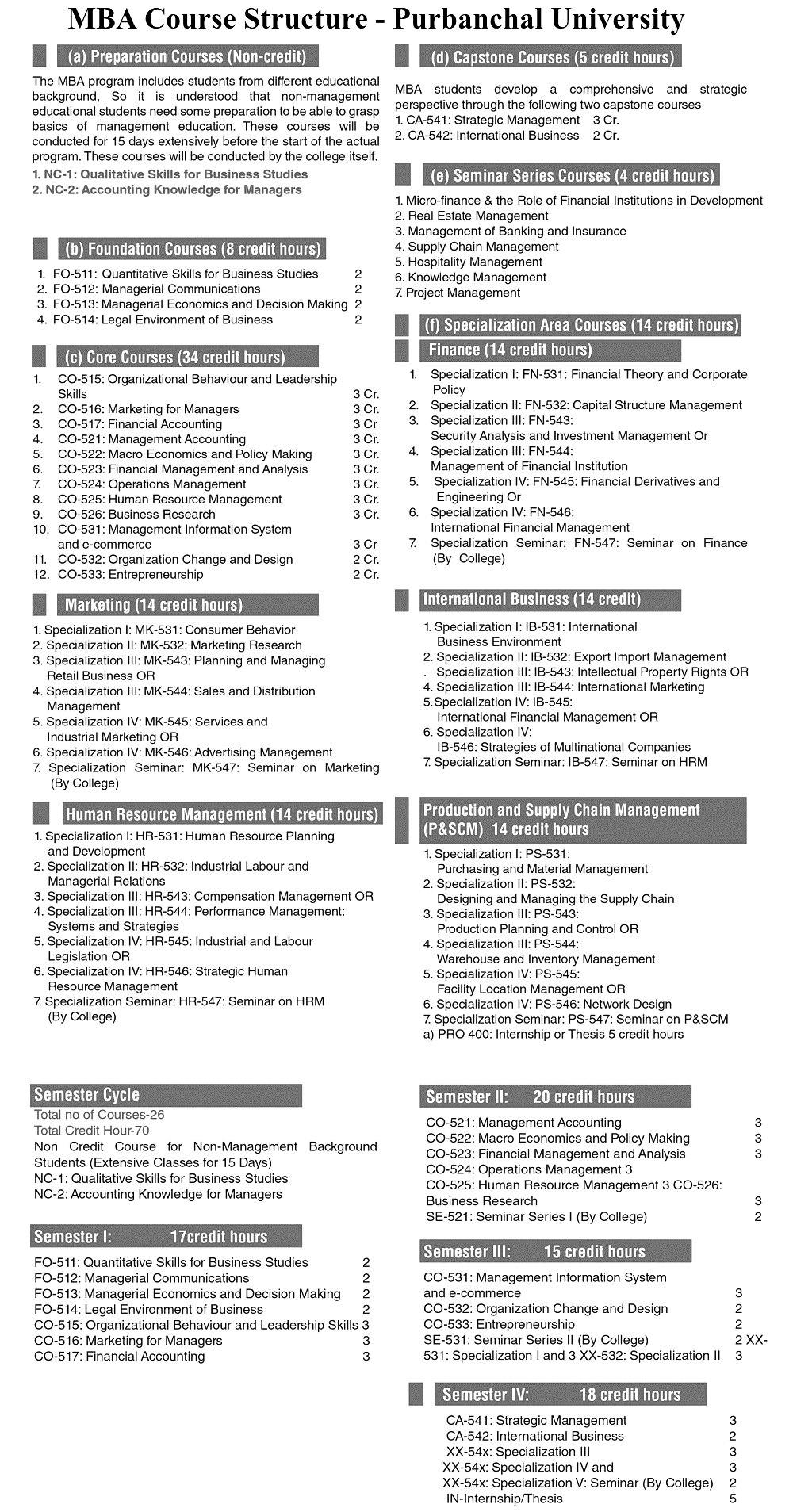
The MBA curriculum at Kasthamandap College of Management follows the standard structure of Purbanchal University. The college uses the official syllabus and delivers it through four semesters.
Preparation (Non-credit courses for non-management graduates)
Qualitative Skills for Business Studies
Accounting Knowledge for Managers
These short, intensive classes run for about fifteen days and help students from non-management backgrounds adjust to quantitative and accounting requirements at the graduate level.
Foundation Courses (8 credit hours)
Quantitative Skills for Business Studies
Managerial Communications
Managerial Economics and Decision Making
Legal Environment of Business
These subjects strengthen mathematical, legal and communication skills, which you need across all management fields.
Core Courses (34 credit hours)
Core subjects cover organisational behaviour and leadership, marketing for managers, financial and management accounting, macro-economics and policy making, financial management and analysis, operations management, human resource management, business research, management information systems, organisation change and entrepreneurship.
These components help students understand how organisations function, how decisions are made and how information, people and money are managed inside a firm.
Capstone Courses (5 credit hours)
Strategic Management
International Business
These subjects integrate knowledge from earlier courses and help students examine organisations and markets from a wider, cross-border perspective.
Seminar Series Courses (4 credit hours)
Seminar courses focus on topics such as micro-finance, banking and insurance management, real estate, project management, supply chain management, hospitality management and knowledge management. These sessions generally involve presentations, guest speakers and discussion of current issues.
Specialisation Area Courses (14 credit hours)
Students choose one specialisation in:
Finance
Marketing
Human Resource Management
International Business
Production & Supply Chain Management
Each stream carries four subject-based components and one seminar course, usually spread over the third and fourth semesters.
The MBA at Kasthamandap College of Management aims to:
Prepare professional managers for business and non-business sectors within Nepal and abroad.
Develop graduates who can interpret data, understand markets and make informed decisions.
Build entrepreneurial thinking so that students can identify opportunities and handle risk in changing business environments.
Encourage socially responsible and ethically aware management practice.
These objectives match the broader goals of Purbanchal University’s Faculty of Management while reflecting the college’s own focus on practical exposure and responsible leadership.
MBA graduates from a Purbanchal University affiliated college such as Kasthamandap can work in commercial banks, development banks, insurance companies, manufacturing firms, trading houses, service organisations, NGOs, INGOs and government-linked agencies. PU documents and tracer studies from similar programs show MBA graduates moving into supervisory, analytical and managerial roles in finance, marketing, HR, operations and project management. (davbusinessschool.edu.np)
If you complete this MBA along with an internship or thesis, you also build a platform for research-oriented paths, teaching roles in management colleges and further study at MPhil or PhD level, depending on your academic performance and research interest.
After finishing the MBA at Kasthamandap College of Management, students are expected to be able to:
Analyse organisational problems using financial, quantitative and qualitative tools.
Interpret economic and policy conditions that affect firms in Nepal and abroad.
Prepare and present structured business reports and research projects.
Handle teamwork and leadership situations in project groups and organisational settings.
Apply management concepts to functional areas such as marketing, HR, finance, international business or supply chain management.
Recognise ethical dimensions in business decisions and respond in line with legal and social expectations.
These outcomes follow directly from the course structure, which combines foundation knowledge, analytical subjects, seminar exposure and a compulsory internship or thesis.
Kasthamandap College of Management uses various academic and co-curricular activities to support skill development for MBA students. The institution’s own documents highlight:
Regular presentations and classroom seminars
Case study sessions and group assignments
Guest lectures from bankers, entrepreneurs and senior managers
Industrial visits and field interactions
Personality development sessions
Seminar-series courses delivered with active student participation
These activities are integrated into the semesters and help you practise public speaking, report preparation, negotiation in teams and interaction with professionals who work in relevant industries.
Teaching in the MBA program combines lectures, case discussions, group work, seminar presentations and field-based tasks. Faculty members follow the official Purbanchal University syllabus and often relate topics to current business events in Nepal and the region.
The college environment supports continuous learning through:
Structured semester plans with clearly defined subjects and credit hours
Regular internal assessments, presentations and project submissions
Use of information systems and e-commerce topics to link management work with technology
Encouragement for students to read research articles, policy documents and sector reports
If you join this program, you study alongside peers from different academic and regional backgrounds, which adds diversity to classroom discussions and group tasks.
The eligibility criteria for admission to the MBA program at Kasthamandap College of Management follow Purbanchal University rules and the college’s own notice. Applicants must:
Hold a bachelor’s degree in any discipline from a recognised university.
Have at least CGPA 2.0 or 45% marks in the bachelor’s level.
Purbanchal University also requires an entrance test and further selection steps, which may include a group discussion and personal interview, depending on the college and intake. Kasthamandap publishes detailed admission notices, deadlines and fee-related information each academic year through its official website and social media channels.
If you plan to apply, it is sensible to check the latest notice rather than relying on previous years’ information.
MBA graduates from Kasthamandap College of Management usually target roles such as:
Banking and financial officers
Marketing and brand officers
Business development executives
Human resource officers and HR coordinators
Operations and supply-chain supervisors
Project officers in NGOs, INGOs or development projects
Entrepreneurs managing their own ventures
The college follows national rules and Purbanchal University guidelines for its MBA program. Details on tuition fees, scholarships and any concession schemes are published through official notices.
Students seeking financial aid should:
Visit the college administration office or contact through official channels.
Review current scholarship categories, if available, such as merit-based support or need-based assistance.
Confirm required documents and application timelines before admission.
This approach helps you plan realistically and avoids misunderstanding based on informal information.
MBA at Kasthamandap College of Management offers a structured graduate management program backed by Purbanchal University’s syllabus and assessment system.
If you enrol in this course:
You study in a Kathmandu-based campus connected by reliable public transport.
You follow a clear curriculum with preparation courses, foundation subjects, core and capstone courses, seminar series and specialisation.
You choose one specialisation stream that matches your career interest.
You participate in seminar sessions, guest talks and case-based learning activities that reflect current management practice.
You complete a 5-credit internship or thesis that connects classroom learning with real organisational work.
For many Nepali graduates, especially those living or working around Kathmandu, this combination of university-recognised degree, structured curriculum and local industry exposure offers a practical route into management positions.
Master of Business Administration (MBA) at Kasthamandap College of Management is a full-time graduate program that follows the official Purbanchal University structure while using the college’s own teaching practices, seminar activities and internship support.
If you are looking for a management course that connects theory, research and workplace engagement inside a Nepalese context, this MBA provides a clear framework. The program helps you move from bachelor-level study or early work experience into more responsible decision-making roles in banking, corporate organisations, development projects or entrepreneurial ventures.
The MBA program runs for two academic years, divided into four semesters, and carries 70 credit hours as per Purbanchal University’s syllabus.
Kasthamandap College of Management offers its MBA under the affiliation of Purbanchal University, a public university of Nepal.
Students can specialise in Finance, Marketing, Human Resource Management, International Business or Production & Supply Chain Management. Each specialisation carries 14 credit hours, including a seminar course handled by the college.
Yes. The final semester includes a 5-credit internship or thesis. Students are assigned to firms or organisations for about eight weeks, then prepare an internship report or thesis based on Purbanchal University guidelines.
The MBA degree is awarded by Purbanchal University, which is recognised by the Government of Nepal. Acceptance of the degree abroad depends on the policies of foreign universities, employers and credential assessment bodies. Many Nepali MBA graduates from PU-affiliated colleges have pursued further study or employment overseas, but you should check specific country or institution requirements when planning.