Kantipur International College (KIC) is a private higher education institution established in 2000 A.D. and affiliated with Purbanchal University. Its academic portfolio spans hospitality, management, engineering, architecture, interior design, artificial intelligence, construction management, and earthquake engineering.
KIC operates from two locations in the Kathmandu Valley. The College of Management is located at Buddhanagar, New Baneshwor, while the College of Science & Technology and the College of Liberal Arts operate from Lubhu, Lalitpur. This arrangement places management and hospitality-related study alongside a separate academic setting for science, technology, engineering, architecture, and design disciplines.
The college has expanded its academic range over time. Bachelor of Hotel Management began in 2000, Bachelor of Interior Design in 2003, and Bachelor of Hospitality and Catering Management in 2006. Master of Hotel and Hospitality Management and Bachelor of Business Administration were added in 2009, followed by MBA, BE Civil, and Bachelor of Architecture in 2010. Its broader program portfolio now also includes B.Tech in AI, Masters in Construction Management, and Master in Earthquake Engineering.
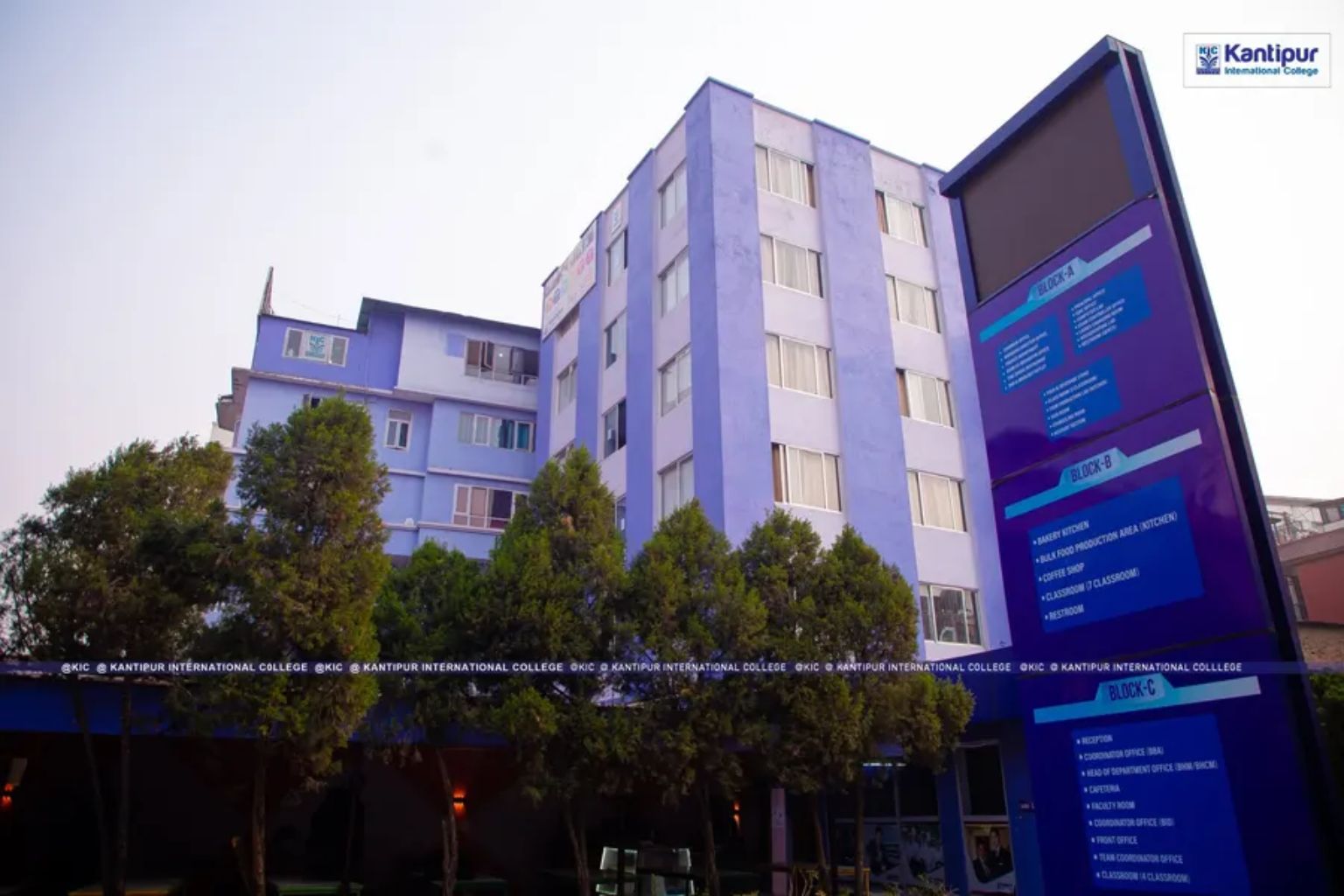
Established in 2000 A.D. as a private higher education institution affiliated with Purbanchal University.
Operates academic activities from Buddhanagar, New Baneshwor, and Lubhu, Lalitpur, within the Kathmandu Valley.
Offers undergraduate and postgraduate programs in management, hospitality, engineering, architecture, interior design, artificial intelligence, construction management, and earthquake engineering.
Academic programs include B.Tech in AI, BID, BE Civil, B.Arch., BBA, BHM, BHCM, MBA, MHHM, Masters in Construction Management, and Master in Earthquake Engineering.
Offers 192 seats each in BHM and BHCM, 96 seats each in BBA, BID, BE Civil, and B.Arch., and 48 seats in B.Tech in AI.
Postgraduate seat allocations include 20 seats each in Masters in Construction Management and Master in Earthquake Engineering, 33 seats in MHHM, and 33 seats each for MBA Fall and Spring intakes.
Provides practical learning facilities including computer labs, workshops, training kitchens, model bars and restaurants, reception areas, and libraries.
Hospitality programs combine classroom study with operational subjects such as food production, food and beverage service, housekeeping, front office operations, and internship/report writing.
Engineering and technology programs incorporate laboratory, practical, project, tutorial, and research components according to their respective Purbanchal University curricula.
B.Tech in AI is structured across eight semesters, while BBA and BHM are four-year programs with eight-semester academic structures.
Postgraduate study at KIC includes management, hospitality, construction management, and earthquake engineering pathways.
Hospitality students have undertaken internship placements in Nepal and overseas locations including Malaysia, Singapore, Hong Kong, and India.
KIC's programs are connected through its affiliation with Purbanchal University. The academic mix is unusually broad for a single college because it brings together management, hospitality, engineering, architecture, design, and technology rather than concentrating on one professional field.
For students, this means KIC can be considered from several different academic directions. A student interested in hotel operations may enter through BHM or BHCM, while a management student can consider BBA or MBA. Engineering-oriented options include BE Civil, Masters in Construction Management, and Master in Earthquake Engineering. Architecture and interior design form another group, and B.Tech in AI adds a technology-focused undergraduate route.
The college's academic approach also gives practical work a visible place. Facilities associated with its programs include computer labs, workshops, model bars and restaurants, training kitchens, reception areas, and libraries. Hospitality training, in particular, combines classroom study with operational subjects and internship components.
KIC's program portfolio covers undergraduate and postgraduate study. The seat records associated with its Purbanchal University programs include the following quotas.
| Program | Level/Code | Seats |
|---|---|---|
| Bachelor of Technology in AI | B.Tech AI | 48 |
| Bachelor of Interior Design | BID | 96 |
| Bachelor of Engineering in Civil | BE Civil | 96 |
| Bachelor of Architecture | B.Arch. | 96 |
| Masters in Construction Management | MCM / M.Sc. CM | 20 |
| Master in Earthquake Engineering | MEQ | 20 |
| Bachelor of Business Administration | BBA | 96 |
| Bachelor of Hotel Management | BHM | 192 |
| Bachelor of Hospitality & Catering Management | BHCM | 192 |
| Master of Hotel and Hospitality Management | MHHM | 33 |
| Master of Business Administration | MBA | 33 Fall / 33 Spring |
The distribution shows the scale of KIC's academic areas. Hospitality has comparatively larger undergraduate quotas through BHM and BHCM, while postgraduate engineering programs operate with smaller groups. Management includes both undergraduate and postgraduate study, and architecture, interior design, civil engineering, and artificial intelligence add further professional pathways.
Civil engineering is one of KIC's established technical programs. The B.E. in Civil Engineering follows the Purbanchal University engineering structure. The curriculum effective from the 2021 batch begins with Mathematics-I, Chemistry, Applied Mechanics-I, Civil Engineering Materials, Basic Electrical Engineering, Engineering Drawing-I, and Workshop Technology.
The second semester moves into Mathematics-II, Physics, Applied Mechanics-II, Building Technology, Fundamentals of Thermodynamics and Heat Transfer, and Engineering Drawing-II. Later study extends into subjects such as Strength of Materials, Fluid Mechanics, Survey, Engineering Geology, Probability and Statistics, Hydraulics, structural study, and other civil engineering areas. The combination of theory, tutorials, drawing, laboratory work, and practical components reflects the technical structure of the degree.
Architecture is available through the Bachelor of Architecture (B.Arch.). The program sits alongside civil engineering within KIC's built-environment academic group. Its focus connects architectural design with the planning and development of buildings and structures, including consideration of construction and environmental aspects.
Students whose interest is more closely connected with interior space can consider the Bachelor of Interior Design (BID). Interior design study at KIC is associated with areas including space planning, furniture, lighting, materials, and other elements involved in developing interior environments.
At postgraduate level, the Masters in Construction Management is a two-year program intended for graduates seeking further study in the planning, coordination, supervision, and management of construction work.
Construction management brings together engineering considerations with scheduling, cost control, contracts, procurement, site operations, quality, people management, and project coordination. Its orientation is therefore different from a purely design- or calculation-based engineering program. It is directed toward the management processes that influence how construction projects are planned, organized, monitored, and delivered.
KIC also offers the Master in Earthquake Engineering. Its academic structure moves from advanced structural analysis, engineering seismology, solid mechanics, structural dynamics, and research methodology into earthquake-resistant design, finite element methods, geotechnical earthquake engineering, and seismic design of masonry structures.
The later stages include seismic evaluation and retrofitting of structures, seismic vulnerability and risk analysis, a thesis proposal seminar, and a thesis. Elective areas include advanced structural dynamics, nonlinear structural analysis, structural health monitoring, earthquake-resistant design of bridges and dams, and earthquake disaster mitigation and management.
The B.Tech in AI is a four-year, eight-semester Bachelor of Technology program under Purbanchal University.
The program regulations place practical project work within the degree from the second semester onward. Students work with theory and principles from their courses while developing semester projects involving planning, research, teamwork, implementation, assessment, report writing, and presentation.
English is the medium of instruction and examination. The regulations also require at least 80 percent attendance in lectures, tests, and tutorial classes for eligibility to sit the final examination of a subject.
Admission eligibility for the program includes twelve years of schooling in the science stream. The stated academic threshold is a minimum D+ grade in each 10+2 subject with a CGPA of 2.0 or above, or at least second division with 45 percent marks in 10+2, PCL, or an equivalent science qualification. Applicants are also required to pass the entrance examination conducted by Purbanchal University.
KIC's management portfolio includes undergraduate and postgraduate programs.
The Bachelor of Business Administration (BBA) is a four-year, eight-semester Purbanchal University program carrying 120 credit hours. Its curriculum combines foundation, core, specialization, capstone, and internship components.
Foundation study includes Business Mathematics, English, Business Economics, Business Communications, Macro Economic Analysis and Policy, and Business Statistics. Core subjects extend across accounting, finance, marketing, human resource management, business law, taxation and auditing, project management, organizational behavior, management information systems, public finance, tourism management, quality management, and entrepreneurship.
The program also provides specialization areas in Finance, Marketing, Human Resource Management, Accounting, and International Business. International Business and Strategic Management serve as capstone subjects, while internship work connects academic study with an organizational setting.
At postgraduate level, the Master of Business Administration (MBA) Fall follows a 69-credit Purbanchal University curriculum structured across four semesters in the syllabus effective from the Fall 2022 session.
The first semester includes Marketing for Managers, Communication for Managers, Accounting for Managers-I, Legal Framework of Business, Decision Sciences, and an elective. Subsequent semesters cover Human Resource Management and Organizational Behavior, Economics for Managers, Financial Management, Operations Management, Entrepreneurship and Social Enterprises, Research Methodology and Thesis Proposal, Information Technology Management, International Business, Strategic Management, corporate governance, corporate social responsibility, seminars, and thesis work.
MBA specialization areas include Marketing, Finance, Human Resource Management, and Operations and Supply Chain Management. Students select courses within their specialization while completing the wider management curriculum.
Hospitality has been part of KIC since the college's establishment period and remains one of its largest academic areas by seat allocation.
The Bachelor of Hotel Management (BHM) is a four-year program divided into eight semesters. Its structure combines hotel operations, management subjects, food production, service training, accounting, marketing, research, and extended internship work.
The first semester introduces Front Office Operation-I, Food & Beverage Service-I, Housekeeping-I, Food Production-I, English for Hospitality, and Principles of Management. The second semester continues the principal operational subjects while adding Personality Development and Fundamentals of Travel & Tourism.
As students progress, the curriculum moves into Food Science & Nutrition, Principles of Accounting, Hotel French, Economics of Tourism and Hospitality, Customer Safety & Security Management, Hotel Accounting, Bartending & Beverage Management, Organizational Behavior, Hospitality Law, Bakery & Confectionary, Entrepreneurship Development, Hospitality Management Information, and Human Resources Development.
Sixth-semester study includes Hospitality Marketing, Food & Beverage Management, Rooms Division Management, Food Production Operation, Research Methodology, and Strategic Management. The seventh and eighth semesters are devoted to Internship / Report Writing. The extended internship arrangement gives workplace exposure a substantial place within the academic structure.
KIC also offers the Bachelor of Hospitality and Catering Management (BHCM). The program is directed toward hospitality operations and catering-related study, including hotel operations, food and beverage management, customer service, and associated management areas.
At postgraduate level, the Master of Hotel and Hospitality Management (MHHM) extends study into managerial and strategic areas of hospitality.
Its subjects include Tourism and Hospitality Management, Hospitality Logistic Management, Management Information System, Hospitality Facility Planning and Development, Entrepreneurship Development, Managerial Accounting for Hospitality, Hospitality Sales & Marketing Management, Tourism Economics, Hospitality & Business Law, Research Methodology, Leadership Management in Hospitality, Planning & Policy in Tourism & Hospitality, Hospitality Human Resource Management, and Strategic Management.
Later components also cover Total Quality Management in Hospitality, Resort & Destination Development, Hotel Maintenance & Property Management, thesis or internship work, and contemporary hospitality issues. Foundation courses include Front Office Management, Housekeeping Management, Food & Beverage Service, and Food Production.
KIC's physical facilities reflect the different requirements of its academic disciplines. Computer labs support technology and management-related learning, while workshops serve programs that require technical practice. Hospitality students have access to model bars and restaurants, training kitchens, and reception areas that correspond with the operational areas covered in BHM, BHCM, and postgraduate hospitality study.
Libraries support the wider academic programs, and practical sessions are used alongside classroom instruction. This matters particularly in hospitality, design, engineering, and technology subjects, where students need to connect concepts with operational, technical, studio, laboratory, or project-based work.
Hospitality students have also taken internship placements in hotels in Nepal and overseas locations including Malaysia, Singapore, Hong Kong, and India. Internship and report-writing requirements are built directly into the BHM curriculum, making workplace exposure part of the degree structure rather than an unrelated activity.
KIC's program history shows a gradual movement from hospitality into design, management, engineering, postgraduate study, and technology.
The sequence includes:
BHM from 2000
BID from 2003
BHCM from 2006
MHHM and BBA from 2009
MBA, BE Civil, and B.Arch. from 2010
More recent program offerings broaden the portfolio further through B.Tech in AI, Masters in Construction Management, and Master in Earthquake Engineering.
Rather than placing all of these subjects under one academic stream, KIC organizes study through its management, science and technology, and liberal arts settings across Buddhanagar and Lubhu. Students can therefore examine the college according to the discipline they intend to pursue rather than treating every KIC program as having the same academic format.
Admission requirements depend on the academic program and the applicable Purbanchal University structure. Some programs have clearly defined university entrance and academic eligibility provisions, while curriculum, credit, internship, and evaluation patterns also differ across disciplines.
Students considering KIC should pay particular attention to the exact program title, level, campus location, entry qualification, entrance requirement, and academic structure that applies to their intended degree. Current admission dates, fees, scholarships, required documents, intake procedures, and administrative requirements can be discussed with the college's administrative office.
For a student comparing several KIC programs, the main distinction is disciplinary. BBA and MBA are management programs; BHM, BHCM, and MHHM concentrate on hospitality; BE Civil, construction management, and earthquake engineering follow engineering and project-related directions; B.Arch. and BID focus on the built and designed environment; and B.Tech in AI belongs to the technology stream.
Readers looking specifically for legal education should note that Collegenp maintains a separate listing for Kantipur International College of Law. Its law-specific course information can be viewed through the BALLB course page.
Kantipur International College is a Purbanchal University-affiliated private college established in 2000 A.D. with academic operations in Buddhanagar, New Baneshwor and Lubhu, Lalitpur. Its programs cover hospitality, business administration, civil engineering, architecture, interior design, artificial intelligence, construction management, and earthquake engineering.
The college's academic structure combines undergraduate and postgraduate options with facilities and practical components suited to different disciplines. Its program range, seat allocations, internships, projects, laboratories, workshops, training kitchens, model hospitality facilities, and postgraduate research components give prospective students several distinct academic routes within the same institution.
Kantipur International College (KIC) is a private higher education institution established in 2000 A.D. It offers undergraduate and postgraduate programs across management, hospitality, engineering, architecture, interior design, artificial intelligence, construction management, and earthquake engineering.
Kantipur International College is affiliated with Purbanchal University. Its academic programs follow the applicable university curriculum and academic requirements.
KIC operates from two locations in the Kathmandu Valley. The College of Management is located at Buddhanagar, New Baneshwor, while the College of Science & Technology and the College of Liberal Arts are located at Lubhu, Lalitpur.
KIC offers B.Tech in AI, Bachelor of Interior Design, BE Civil, Bachelor of Architecture, BBA, BHM, BHCM, MBA, Master of Hotel and Hospitality Management, Masters in Construction Management, and Master in Earthquake Engineering.
The available seat allocations are 48 for B.Tech in AI; 96 each for BID, BE Civil, B.Arch., and BBA; and 192 each for BHM and BHCM.
Masters in Construction Management and Master in Earthquake Engineering have 20 seats each. MHHM has 33 seats, while MBA has 33 seats for the Fall intake and 33 seats for the Spring intake.
Yes. KIC offers Bachelor of Hotel Management (BHM), Bachelor of Hospitality and Catering Management (BHCM), and Master of Hotel and Hospitality Management (MHHM).
Yes. Engineering-related study at KIC includes BE in Civil Engineering, Masters in Construction Management, and Master in Earthquake Engineering. The college also offers Bachelor of Architecture.
Yes. KIC offers the Bachelor of Technology in Artificial Intelligence (B.Tech in AI), a four-year program structured across eight semesters under Purbanchal University.
Available learning facilities include computer labs, workshops, training kitchens, model bars and restaurants, reception areas, and libraries. Practical requirements vary according to the academic program.
Yes. The BHM curriculum includes Internship / Report Writing in the seventh and eighth semesters, giving students an extended practical component toward the later stage of the program.
Students should review the requirements of their intended program, including academic eligibility, entrance provisions where applicable, course structure, campus location, and intake. Current admission schedules, fees, scholarships, and required documents can be obtained from the college administration.