The Certificate in Medical Laboratory Technology (CMLT) at NPI Narayani Samudayik Nursing College, Chitwan is a three-year technical health program under the Council for Technical Education and Vocational Training (CTEVT).
The program prepares middle-level medical laboratory personnel to handle specimens, conduct laboratory investigations, maintain laboratory equipment, prepare reagents, support quality control, and work within clinical laboratory procedures.
The first year covers basic science and foundational study, the second year moves into core laboratory disciplines, and the third year combines advanced laboratory subjects with clinical practice.
| Area | Details |
|---|---|
| Course: | Certificate in Medical Laboratory Technology (CMLT) |
| Duration: | 3 academic years |
| Study System: | Yearly system |
| Affiliation: | CTEVT |
| Stated Intake: | 30 seats |
| Entrance: | CTEVT entrance examination |
| Professional Council: | Nepal Health Professional Council |
The CTEVT curriculum allows a maximum group size of 30 students in a batch.
Applicants must meet the prescribed CTEVT entry criteria for the Certificate in Medical Laboratory Technology.
Eligibility:
SLC, SEE, or equivalent pass with a minimum GPA of 2.0 and grades in Compulsory Mathematics, English, and Science; or
TSLC in Medical Laboratory Technology with a minimum of 68.33%.
Applicants must pass the entrance examination administered by CTEVT.
The course follows a yearly academic structure. Students are expected to maintain the required attendance in their subjects and clinical postings as part of eligibility for final assessment. Clinical-practice sections require at least 90% attendance in the allotted posting days.
CMLT combines laboratory science with repeated practical work rather than treating laboratory procedures as a separate final-stage component.
The first academic year concentrates on basic science and foundational subjects. In the second year, students study six major areas:
Clinical Microbiology and Immunology
Hematology and Blood Banking
Clinical Biochemistry
Medical Parasitology
Clinical Pathology
Public Health and First Aid
These subjects include both theory and practical components. Students learn the principles behind laboratory investigations alongside specimen-related procedures, testing methods, interpretation, laboratory safety, and routine technical work.
Third-year academic study includes Histopathology and Cytopathology, Automation in Clinical Laboratory, and Clinical Laboratory Management. The year also includes clinical practicums covering Microbiology and Parasitology, Hematology and Blood Banking, and Biochemistry, Histopathology and Cytopathology.
Practical training covers several branches of diagnostic laboratory work. In microbiology and parasitology practice, students work with specimen collection, microscopy, staining, culture-related procedures, serological testing, urine examination, stool examination, and other laboratory investigations.
Hematology and blood banking practice covers procedures such as blood counts, hemoglobin estimation, coagulation-related tests, blood grouping, Rh typing, cross-matching, and other routine hematology work.
Biochemistry, histopathology, and cytopathology practice includes preparation of reagents, biochemical estimations, microscopy, fixation of tissue, specimen processing, section preparation, and staining procedures.
Students maintain practical records or logbooks during clinical postings, with work carried out under supervision as they develop accuracy and consistency in laboratory procedures.
CMLT also addresses the organization and operation of a clinical laboratory. Clinical Laboratory Management covers laboratory workflow, quality assurance, laboratory design, specimen handling, reporting, inventory, record keeping, equipment maintenance, biosafety, waste management, and standard operating procedures.
By the end of the program, students are expected to develop skills in routine and selected special laboratory investigations, reagent preparation, result interpretation, laboratory quality control, reporting, supervision, and laboratory management.
Assessment is built into both theory and practical study, with internal assessment, final assessment, and continuous assessment used across relevant subjects and practical components.
The grading categories are:
Distinction: 80% and above
First Division: 65% to below 80%
Second Division: 50% to below 65%
Pass Division: pass marks to below 50%
Students who pass all required components across the three academic years receive the Certificate in Medical Laboratory Technology.
Possible work settings for CMLT graduates include hospitals, diagnostic laboratories, clinics, blood banks, research centers, industry, physicians' offices, and other laboratory-related settings.
Graduates are also identified as eligible for positions equivalent to Non-Gazetted First Class/Level 5 (Technical), as prescribed by the Public Service Commission of Nepal and related agencies.
Professional practice is connected with the Nepal Health Professional Council (NHPC). After completing CMLT, graduates must meet the applicable professional licensing requirements before entering the profession.
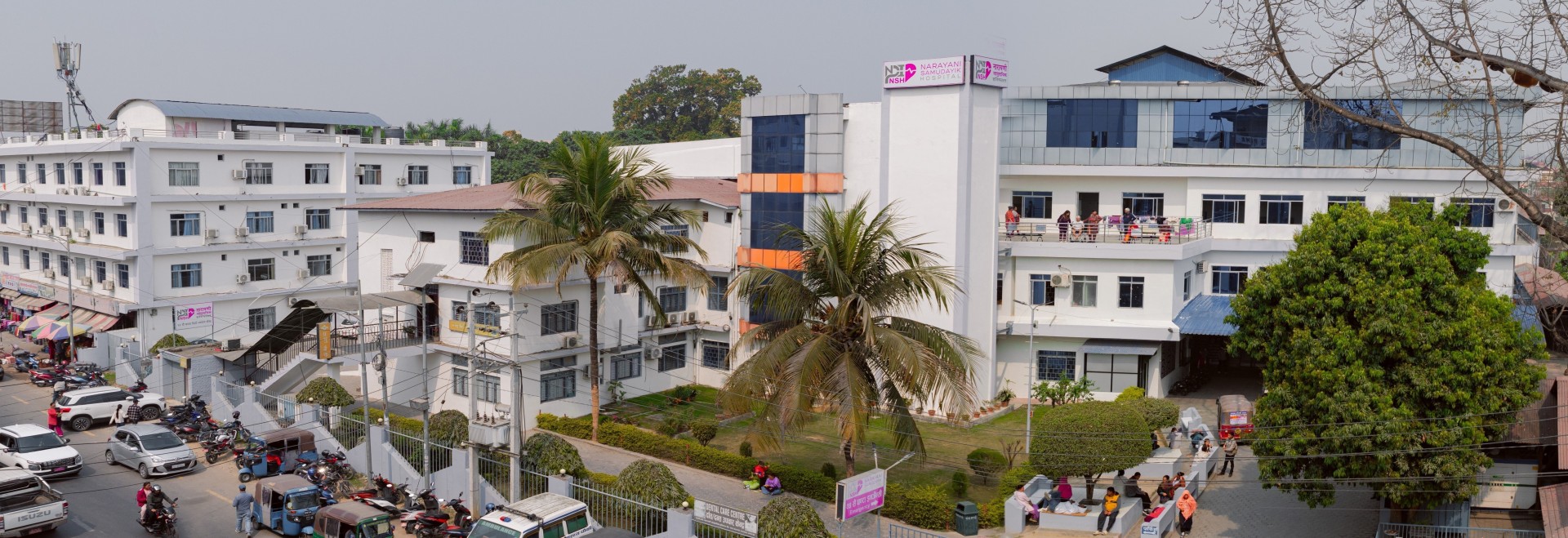
NPI Narayani Samudayik Nursing College is associated with the NPI Narayani Samudayik healthcare setting in Bharatpur, Chitwan. The hospital setting includes pathology services alongside medical, surgical, emergency, intensive care, pediatric, obstetric, psychiatric, and other health-service areas.