The Post-Basic Bachelor of Nursing Science (PBNS) at NPI Narayani Samudayik Nursing College, Chitwan is a three-year bachelor's-level nursing program under Purbanchal University. It is intended for nurses who have already completed PCL Nursing and gained professional experience after obtaining a Nepal Nursing Council license.
The program develops nursing knowledge beyond the proficiency certificate level through advanced nursing subjects, clinical practice, management, research, health education, and specialty study. Its four elective areas are Midwifery, Community Health Nursing, Medical-Surgical Nursing, and Psychiatric Nursing.
| Area | Details |
|---|---|
| Course: | Post-Basic Bachelor of Nursing Science (PBNS) |
| Duration: | 3 academic years |
| University: | Purbanchal University |
| College: | NPI Narayani Samudayik Nursing College, Chitwan |
| Entry Background: | PCL Nursing with required nursing experience |
| Specialty Areas: | Midwifery, Community Health, Medical-Surgical, Psychiatric Nursing |
| Learning Components: | Theory, clinical practice, management, research, and specialty practicum |
Candidates are required to have passed PCL Nursing from a recognized institute. The Purbanchal University curriculum also requires at least one year of working experience in a recognized health institution after obtaining a Nepal Nursing Council license.
Eligibility:
Passed PCL Nursing from a recognized institute.
At least one year of work experience in a recognized health institution after NNC licensing.
The professional nursing background required for entry distinguishes PBNS from an undergraduate nursing program intended for students entering nursing directly from higher secondary education.
Admission to nursing education follows the prevailing framework of the Medical Education Commission (MEC), Nepal. Admission is based on MECEE-BL and is governed by applicable MEC rules covering admission procedures, code of conduct, scholarship provisions, seat allocation, fee structure, and the official admission calendar.
Seat numbers are determined by MEC and may change from one admission year to another. Fees, scholarship arrangements, seat distribution, and related admission provisions also remain subject to MEC decisions for the applicable intake.
The PBNS curriculum runs for three academic years and combines classroom study with practical and clinical learning.
The first year establishes the scientific and nursing foundation for advanced study. Subjects include Anatomy and Physiology, Pharmacology, Pathophysiology, Microbiology/Parasitology, Biochemistry, Nutrition and Dietetics, Medical-Surgical Nursing-I, Nursing Concept and Theories, Pediatric Nursing, Medical Sociology/Anthropology, and Professional English. Practical components accompany basic science, nutrition, medical-surgical nursing, and pediatric nursing.
The second year moves further into specialist and community-oriented nursing. Students study Midwifery-I, Community Health Nursing-I, Psychiatric Nursing-I, Educational Science, Epidemiology, Geriatric Nursing, and Applied Computer Technology, with practical work integrated into several subjects.
Third-year study focuses on Leadership and Management, Research and Biostatistics in Nursing, Oncology Nursing, and an elective specialty. Students select from:
Community Health Nursing-II
Midwifery-II
Medical-Surgical Nursing-II
Psychiatric Nursing-II
The selected elective also includes an extended practicum.
Clinical practice is distributed across the three years. First-year practice includes general and children's hospital settings along with basic science and nutrition laboratory work.
Second-year practice covers maternity, specialty and mental health settings, geriatric care, educational institutions, and community health locations such as health offices and primary healthcare facilities.
Third-year practical work includes management practice, oncology-related clinical exposure, research activities, and practicum connected with the selected specialty. Research practice covers proposal writing, conducting research, and report writing.
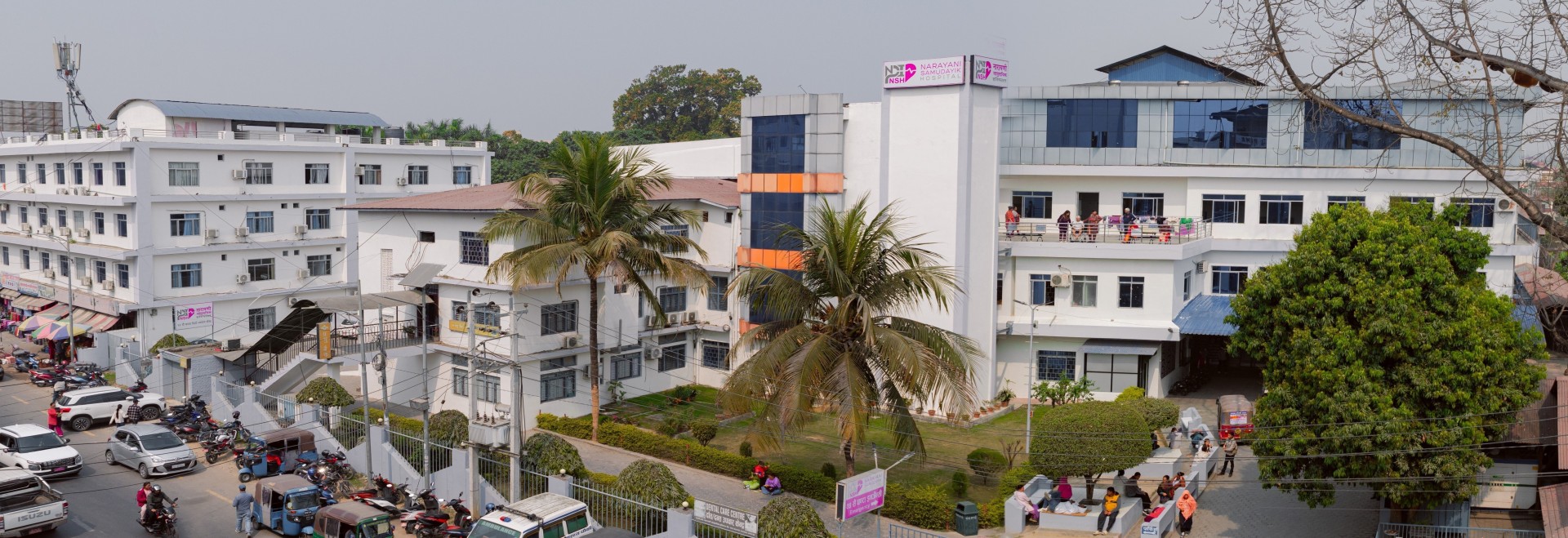
NPI Narayani Samudayik Nursing College is associated with the NPI Narayani Samudayik healthcare setting in Bharatpur, Chitwan. The hospital environment includes general medicine, pediatrics, obstetrics and gynaecology, psychiatry, surgery, oncology, pathology, emergency care, ICU, NICU, and other clinical services, giving the college a healthcare-focused institutional setting.
PBNS uses classroom teaching alongside discussion, observation, demonstration, assignments, presentations, practical work, self-directed learning, and problem-based learning.
The evaluation system combines internal assessment and final examinations:
Theory: 20% internal assessment and 80% final examination.
Practical: 80% internal assessment and 20% final examination in the major elective subject.
The curriculum prepares nurses for responsibilities connected with clinical nursing, community health, health education, nursing management, research, and the selected specialty area. Its academic structure also develops experience in problem identification, planning, implementation, evaluation, and professional nursing practice.
Professional nursing practice remains subject to the applicable requirements of the Nepal Nursing Council.