The Bachelor of Science (BSc) in Nursing at NPI Narayani Samudayik Nursing College, Chitwan is a four-year undergraduate nursing program under Purbanchal University. The university uses the academic title Bachelor of Science in Nursing (BSN) for the program.
The course combines nursing science, basic health sciences, hospital nursing, community health, midwifery, research, education, and management. Theory is supported by practical, field, skill-lab, and clinical learning across the four academic years. The academic focus moves from nursing foundations and basic sciences to medical-surgical care, psychiatric and community health nursing, midwifery, pediatric nursing, research, and nursing management.
| Area | Details |
|---|---|
| Course: | Bachelor of Science in Nursing (BSN/BSc Nursing) |
| Duration: | 4 academic years |
| University: | Purbanchal University |
| College: | NPI Narayani Samudayik Nursing College, Chitwan |
| Academic Level: | Bachelor's degree |
| Admission: | MECEE-BL under prevailing MEC provisions |
| Main Study Areas: | Nursing science, community health, midwifery, clinical nursing, research and management |
| Professional Council: | Nepal Nursing Council |
Applicants must meet the prevailing eligibility requirements applicable to the relevant MECEE-BL admission cycle. The Purbanchal University BSN academic structure identifies Intermediate Science, 10+2, or A Level with Biology, with equivalent to C+ or 50% in aggregate as per the National Examination Board, Nepal, as the academic entry background.
Eligibility for each intake remains subject to the current rules applied by the Medical Education Commission.
Admission to BSc Nursing follows the prevailing framework of the Medical Education Commission (MEC), Nepal. Applicants enter the admission process through MECEE-BL and must follow the applicable MEC rules, guidelines, code of conduct, seat allocation system, scholarship provisions, fee structure, and admission procedures.
Seats are determined by MEC and may vary between admission years. Fees, scholarships, seat distribution, and examination-related admission provisions may also be revised according to MEC decisions and the official admission calendar.
The four-year structure gives students progressively broader responsibility in nursing study and practice.
First-year study establishes the scientific and nursing foundation through:
Anatomy and Physiology
Biochemistry
Microbiology/Parasitology
Pathophysiology
Pharmacology
Nutrition and Dietetics
Foundation of Nursing
Community Health Nursing-I
Practical components are integrated into basic sciences, nutrition, Foundation of Nursing, and Community Health Nursing-I.
The second year moves into nursing concepts and major clinical areas. Subjects include Nursing Concept and Theories, Medical-Surgical Nursing-I, Medical-Surgical Nursing-II, Psychiatric Nursing, Community Health Nursing-II, Medical Sociology/Anthropology, and Geriatric Nursing.
Third-year study centers on Pediatric Nursing, Midwifery-I, Midwifery-II, Midwifery-III, Community Health Nursing-III, Basic Epidemiology, and Gynaecology Nursing. Practical study accompanies pediatric, midwifery, community health, and gynaecology nursing.
The final year brings together research, education, management, and advanced clinical nursing through:
Research and Biostatistics in Nursing
Educational Science
Leadership and Management
Medical-Surgical Nursing-III covering Cardiopulmonary, Oncology, Nephrology, and Neurology
Each of these areas includes a practical component.
Teaching methods include lectures, discussions, demonstrations, self-directed and problem-based learning, observation, skill-lab simulation, clinical and field practice, written assignments, project work, and group presentations.
Theory assessment consists of 20% internal assessment and 80% final assessment. Practical evaluation is divided equally between internal and final evaluation. Practical assessment methods include performance evaluation, case presentations, client and student teaching, nursing care plans, procedure evaluation, documentation, logbooks, OSPE/OSCE or simulation, and viva.
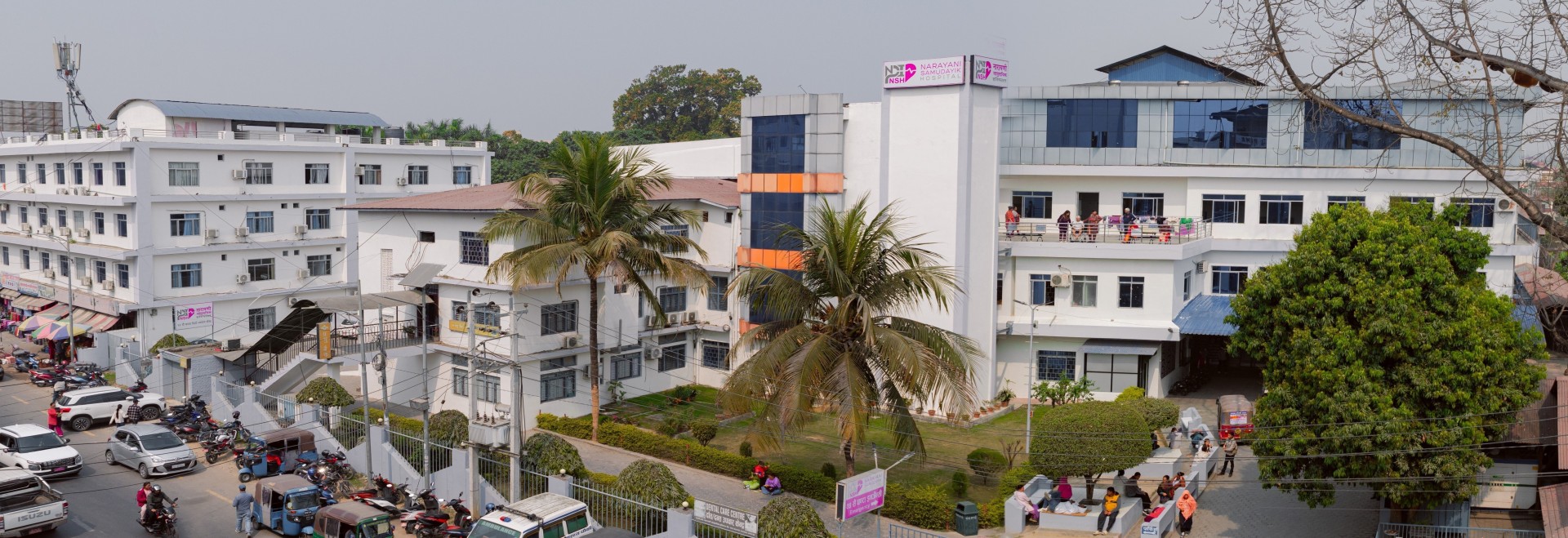
NPI Narayani Samudayik Nursing College is associated with the NPI Narayani Samudayik healthcare setting in Bharatpur, Chitwan. The hospital environment includes general medicine, pediatrics, obstetrics and gynaecology, psychiatry, surgery, oncology, emergency care, ICU, NICU, pathology, and other clinical services.
The BSN program develops nursing knowledge and practice across hospital care, community health, reproductive health, midwifery, education, management, and research. Its academic objectives include nursing-process application, health assessment, communication, health education, community health planning, research, leadership, and nursing and midwifery care.
The program can prepare graduates for responsibilities related to nursing care, nursing administration, education, and basic-level research in different health-service settings. Professional entry after completing the degree requires meeting the applicable licensing requirements, including the licensing examination of the Nepal Nursing Council.