



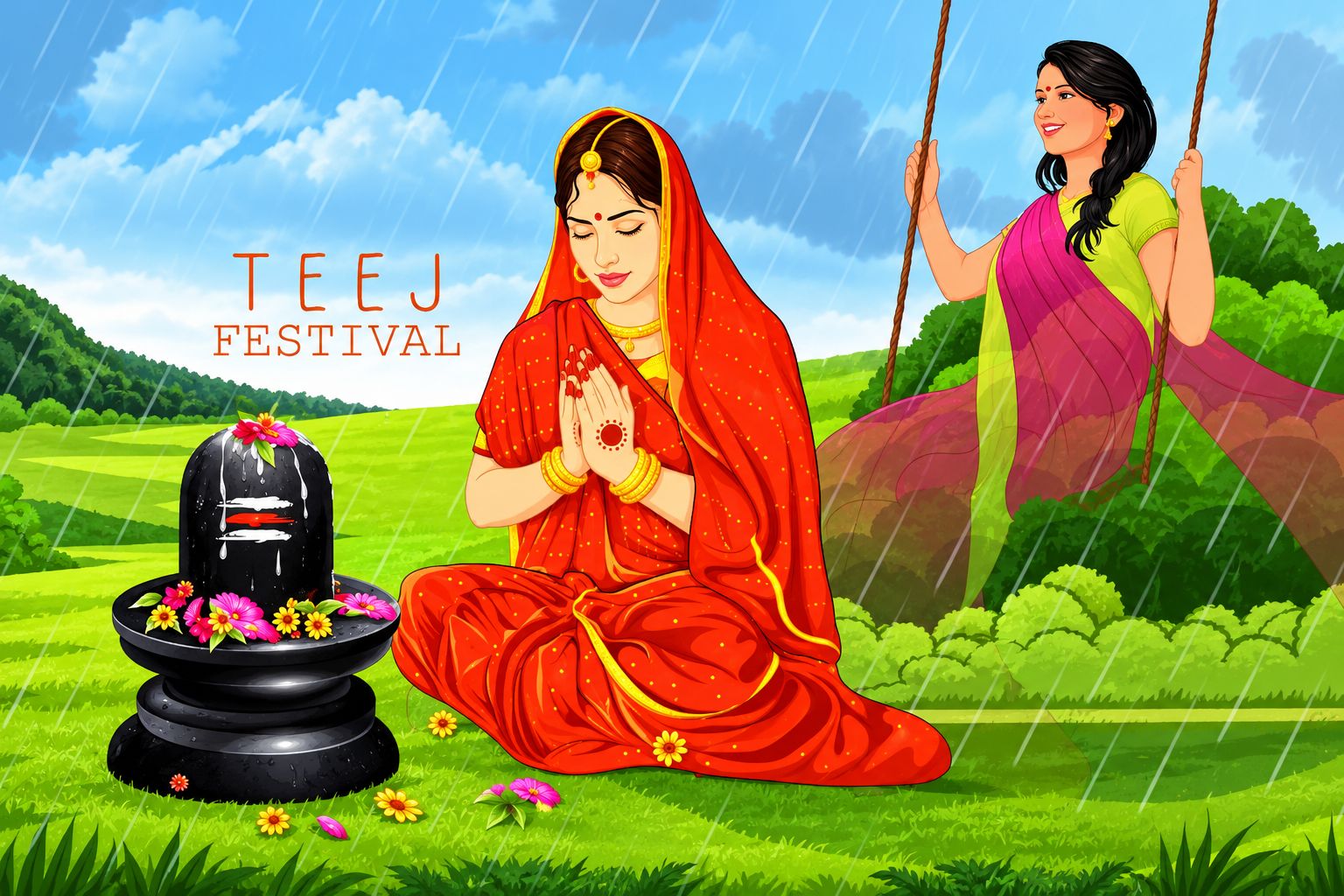
Haritalika Teej: A Cultural Journey of Faith, Resistance, and Women’s Identity
As the monsoon season draws to an end in Nepali society, the mud and rain subside, nature wraps itself in a veil of greenery, and the color red begins to appear everywhere. Celebrated for four days from Bhadra Shukla Dwitiya to Panchami, Haritalika Teej is not merely a religious fast.
It is a distinctive festival of family reunion, cultural beauty, women’s identity, and social transformation. In Nepali life, it reflects the joys, sorrows, faith, and collective solidarity of women all at once.
Naming and Historical and Philosophical Foundations
The etymology of the word “Haritalika” and its mythological context are both fascinating and meaningful. The word is formed from two Sanskrit terms—“Harita” (abducted or taken away) and “Alika” (female friend or companions).
According to mythology, Goddess Parvati had already chosen Lord Shiva in her heart as her husband. However, on the advice of Sage Narada, her father, Himalaya, arranged her marriage to Lord Vishnu.
To save Parvati from a marriage that was being arranged against her wishes, her female companions secretly took her away from her father’s sight and hid her in a dense forest. Because she was taken away by her companions and brought to a safe place, the fast observed on this lunar date came to be known as “Haritalika.”
From a modern perspective, this story can also be interpreted as an early peaceful act of resistance by a woman seeking marital freedom and the right to choose her life partner—her agency and consent—within a patriarchal structure.
After reaching the forest, Parvati established a Shiva Linga made of sand and undertook severe penance, renouncing food and water for 108 lifetimes. Finally, on Bhadra Shukla Tritiya, Lord Shiva was pleased with her devotion and accepted her as his consort.
In Sanatan belief, the festival celebrates the philosophical union of Shiva, representing the masculine principle or consciousness, and Shakti, representing nature or energy.
In Vedic philosophy, women are regarded as the foundation of creation. Traditionally, married women observe the fast for their husbands’ longevity, good health, and lasting marital well-being, while unmarried young women observe it in the hope of finding a suitable and virtuous husband.
Four Days of Rituals and Observances
Teej is traditionally observed over four days through different religious and cultural practices:
First Day (Bhadra Shukla Dwitiya – Dar Khane Din)
This is a day of reunion between married daughters and their maternal families. After spending the day in celebration, women eat delicious and nutritious foods such as kheer, ghee, dhakane, and fruits before midnight.
The main scientific reason given for this practice is to store physical energy for the strict fast observed the following day.
Second Day (Bhadra Shukla Tritiya – Haritalika Fast)
This is the main day of Teej. Women take a ritual bath early in the morning, dress in red, and observe either a nirjala fast, without even drinking water, or a fruit-based fast.
Visiting Shiva temples, including Pashupatinath, offering incense and lamps, making and worshipping a Shiva Linga from sand, and remaining awake through the night are among the principal observances of the day.
Third Day (Bhadra Shukla Chaturthi – Parana and Ganesh Chaturthi)
After bathing in the morning, devotees worship Lord Ganesh, the remover of obstacles. They then offer arghya to the Sun, formally conclude the fast through parana, and traditionally eat sattvic food.
Fourth Day (Bhadra Shukla Panchami – Rishi Panchami)
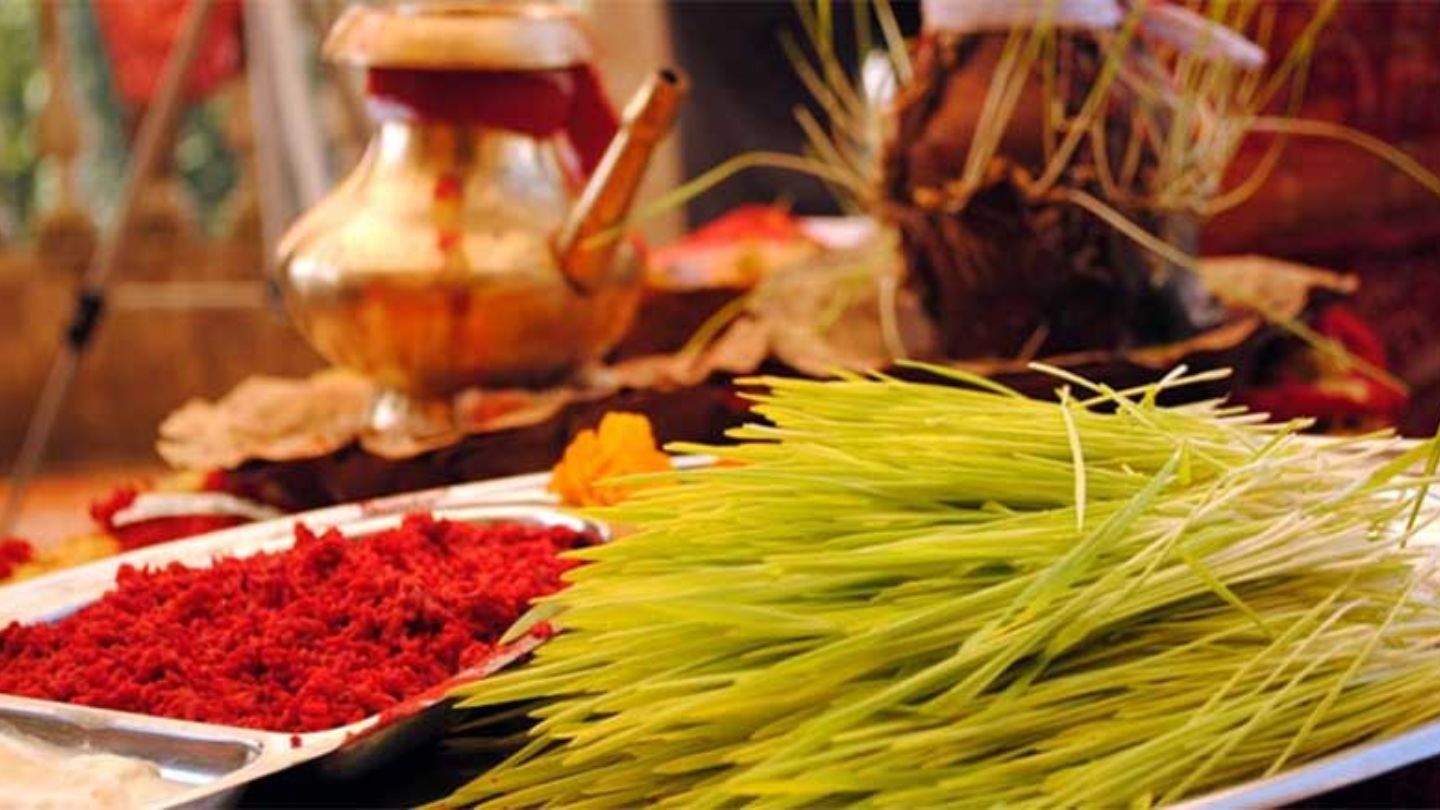
This day is associated with physical and spiritual purification. Women traditionally brush their teeth using 365 stems of datiwan, bathe using apamarga and panchagavya, and worship the Saptarishis and Arundhati. Foods traditionally eaten on this day include karkalo and rice made from anadi grain, along with other grains grown without ploughing.
Datiwan (Achyranthes aspera) is believed to help eliminate germs from the teeth and mouth, while bathing practices involving applications of soil and cow dung are described as helping reduce skin infections and allergies, giving these customs what the tradition regards as a deeper scientific dimension.
Cultural Symbols and Aesthetics
The clothing and adornments worn by women during Teej are not merely decorative; they carry their own aesthetic and symbolic meanings.
Red saris, blouses, and chunaris are regarded as universal symbols of strength, courage, love, energy, and marital good fortune. Green and yellow pote bead necklaces and red and green glass bangles symbolize closeness to nature, peace, fertility, and marital harmony.
Similarly, popular belief holds that the red tika worn on the forehead and the sindoor applied along the hair parting represent the radiance of the Sun and the protection of marital good fortune. Mehendi applied to the palms is regarded as a symbol of the depth of love, coolness, and beauty.
Social Dimension: A Bridge Between Maternal Families, Married Daughters, and Relationships
Nepal is predominantly an agricultural country. Teej arrives in Bhadau after the physically demanding work of planting rice, removing weeds, and working in the fields during the rainy months of Asar and Shrawan has largely ended.
It gives women who have spent the year occupied with household and family responsibilities a few days of complete rest and recreation.
There is a longstanding tradition in which brothers or fathers themselves go to bring married daughters back to their maternal homes. A mother’s affection, closeness with sisters, and reunions with childhood friends help women feel mentally refreshed and relieved of stress.
Gathering at village squares, chautaris, and temple courtyards to perform traditional Sangini dances and enjoy linge swings also strengthens social solidarity within the community.
Teej Songs: From Bundles of Tears to Calls for Rights
Teej melodies are among the richest oral records of Nepali folk literature. In the past, when communication and transportation facilities were limited and women lived under strict in-laws and traditional family restrictions, they expressed their tears and hardships through songs.
Recurring lines such as “Even during the once-a-year Teej, my brother did not come to take me home…” and “The harsh words spoken by my mother-in-law…” reflected the realities of family life in the society of that time.
Over time, however, Teej songs underwent a major ideological transformation. From the decades of the 2030s and 2040s BS onward, during democratic movements and the rise of women’s awareness, these melodies became a medium for political discourse, opposition to gender discrimination, and calls for rights.
Collectively sung to the rhythm of madal, mujura, and handclaps in forms such as the chutka of western Nepal and the Sangini and Khyali melodies of the mid-hills, these songs played a major role in women’s empowerment and the wider discussion of women’s rights and gender equality in Nepal.
Modernity, Distortions, and the Challenge of Preservation
The culturally significant journey of Teej now faces several modern distortions and challenges.
The first challenge is extravagance and conspicuous consumption. A growing practice of organizing expensive Dar feasts in hotels and party palaces as early as a month before the festival, along with ostentatious displays of jewelry and clothing, has created serious financial and psychological pressure on middle- and low-income groups.
Second, traditional originality in music and songs has declined. Traditional folk melodies and meaningful lyrics have increasingly been replaced in the commercial market by double-meaning, vulgar, or disco-style songs. There is widespread public concern that this trend is undermining the cultural dignity of the festival.
The third issue concerns health awareness and fasting. Both modern medicine and religious teachings have cautioned that women who are taking medication, are pregnant, or have chronic illnesses may face serious health risks if they avoid even water in the name of a nirjala fast. As a result, a broader understanding has developed in which women may also observe the fast while consuming fruits, juice, and water.
On the positive side, the influence of globalization and inclusiveness means that Teej is no longer confined to Nepal’s hill communities. It is now celebrated in the Terai-Madhesh, among various ethnic communities, and throughout the Nepali diaspora abroad, giving the festival an international presence and helping introduce Nepali cultural heritage to people around the world.
Conclusion
Overall, Haritalika Teej is not simply a festival of red clothing and fasting. It is also a symbol of women’s identity, the right to self-determination, respect for nature, and social harmony.
The need today is to preserve its original character while reducing the distortions, extravagance, and unhealthy competition that have emerged over time. Embracing changing times while advancing Teej as a major festival of women’s empowerment, equality, and family unity would be a meaningful way to honor its true spirit.

.png)

Comments 0
No comments yet. Be the first to start the conversation.