



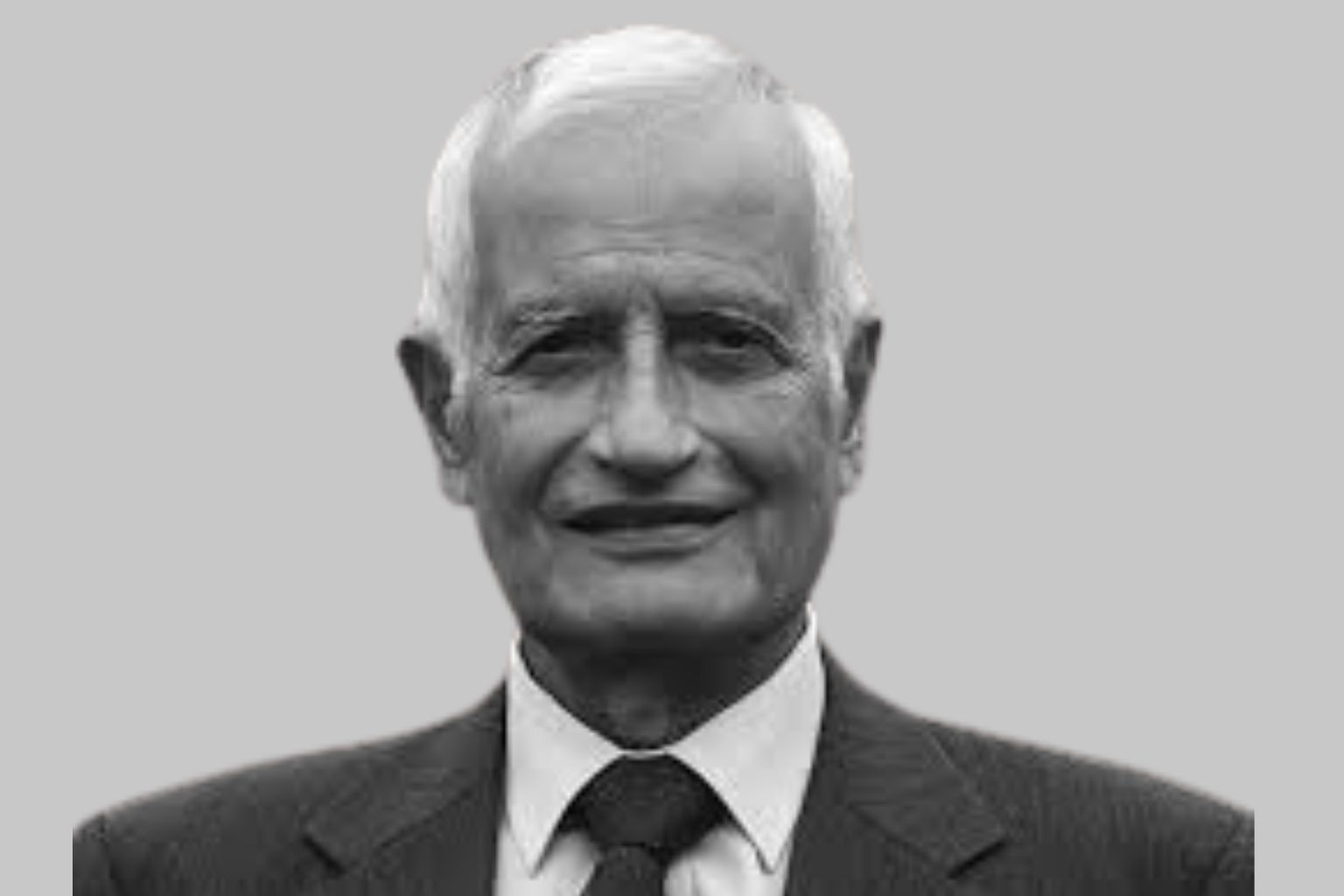
Prof. Dr. Suresh Raj Sharma, KU Founding Vice-Chancellor, Dies at 86
Educationist and founding Vice-Chancellor of Kathmandu University (KU), Prof. Dr. Suresh Raj Sharma, has died at the age of 86. He was widely associated with efforts to move Nepal’s education sector from traditional forms of teaching toward modern, technical and practice-oriented education.
Prof. Dr. Sharma died on Wednesday evening while undergoing treatment at HAMS Hospital in Kathmandu.
Birth and Academic Journey
Prof. Dr. Sharma was born on BS 1997 Shrawan 7 in Khurkot, Sindhuli. His early education began in his village, where he studied Sanskrit and English at home during childhood. He later continued his studies through Sarlahi and India.
In 1956, he passed matriculation, equivalent to the then SLC level, from Saraswati Secondary School in Janakpur. He later completed ISc from Public Science Campus in Kathmandu, now known as Amrit Science Campus, and earned a BSc from Tri-Chandra Campus.
Selected for a scholarship under the Colombo Plan, Sharma completed his MSc in Karnataka, India, in 1964. He later received a British Council scholarship and earned a PhD in Chemistry from South Bank University in the United Kingdom.
After completing his doctoral studies, he returned to Nepal in 1977.
Establishment of Kathmandu University and Contribution to Higher Education
Prof. Dr. Sharma began his professional career as a faculty member at Tribhuvan University. He later played a central role in establishing Kathmandu University in BS 2048 Mangsir.
Before the university was established, Sharma and several colleagues from Tribhuvan University had founded Kathmandu Valley College in Pulchowk. The institution was subsequently developed into Kathmandu University in Dhulikhel.
Sharma served continuously as Vice-Chancellor of Kathmandu University from BS 2048 to BS 2069, a period of 21 years. He resigned in Kartik 2069 with two years remaining in his sixth term.
During his leadership, Kathmandu University expanded its academic work across medicine, engineering, management, science and humanities. His work became part of the broader transformation of higher education in Nepal.
He is also credited with helping introduce higher education in Computer Engineering and Information Technology in Nepal for the first time. In recognition of his contribution to the development of information and communication technology education, he received the Pioneer ICT Award 2024.
Sharma advocated keeping academic institutions free from party-political interference. He also played an important role in developing Kathmandu University’s partnership with Dhulikhel Hospital, linking university-based medical education with healthcare services beyond major urban centres.
Role in Technical and School Education
Prof. Dr. Sharma was also the founding Executive Director of the Council for Technical Education and Vocational Training (CTEVT).
Following the direction of then King Birendra, CTEVT was established in BS 2045. During Sharma’s leadership, 10 technical training-provider institutions were established in different parts of the country.
His work focused particularly on taking skills-oriented education to people in remote and underserved areas. Technical education initiatives were introduced in locations including Jumla in Karnali, Jiri in Dolakha and Dhankuta during his tenure.
This work contributed to the development of technical and skill-based education under CTEVT and helped expand access to vocational learning outside Nepal’s major cities.
Beyond university and technical education, Sharma served for 12 years as a member of the then National Education Committee. He also served for eight years as Chair of the Management Committee of Budhanilkantha School.
He additionally worked as the founding member-secretary of the then research institute for applied science and technology.
Educationists Remember Sharma
Following Prof. Dr. Sharma’s death, educationists and academics recalled his contribution to Nepal’s education sector.
Prof. Dr. Bhola Thapa and former Kathmandu University Vice-Chancellor Dr. Ram Kantha Makaju Shrestha remembered Sharma as a visionary educationist who challenged traditional learning practices and helped establish a stronger foundation for modern and practical education.
Educationist Kedar Bhakta Mathema also described Sharma’s contribution to the development of Nepal’s education sector as historic and exceptional.
Sharma’s career was closely associated with efforts to move higher education beyond classroom theory toward more applied, technology-oriented and internationally connected forms of learning. His emphasis on practical education, technical skills and institution-building remains an important part of his legacy in Nepal’s education sector.


Comments 0
No comments yet. Be the first to start the conversation.