




School Enrollment Rate Rises, but Retention Remains a Challenge: More Than Half of Students Leave Studies Midway
The Constitution of Nepal has made education up to the basic level compulsory and free, and education up to the secondary level free. Although the government has achieved notable success in bringing children within access to schools through various enrollment campaigns and scholarship programs, retaining enrolled students up to the secondary level has become a major challenge in Nepal’s school education.
Alarming Situation Shown by Data
According to data from the Centre for Education and Human Resource Development, the number of students repeating grades and leaving school midway is concerning. The data shows that the grade repetition rate is slightly higher among girls than boys, while the school dropout rate is higher among boys than girls.
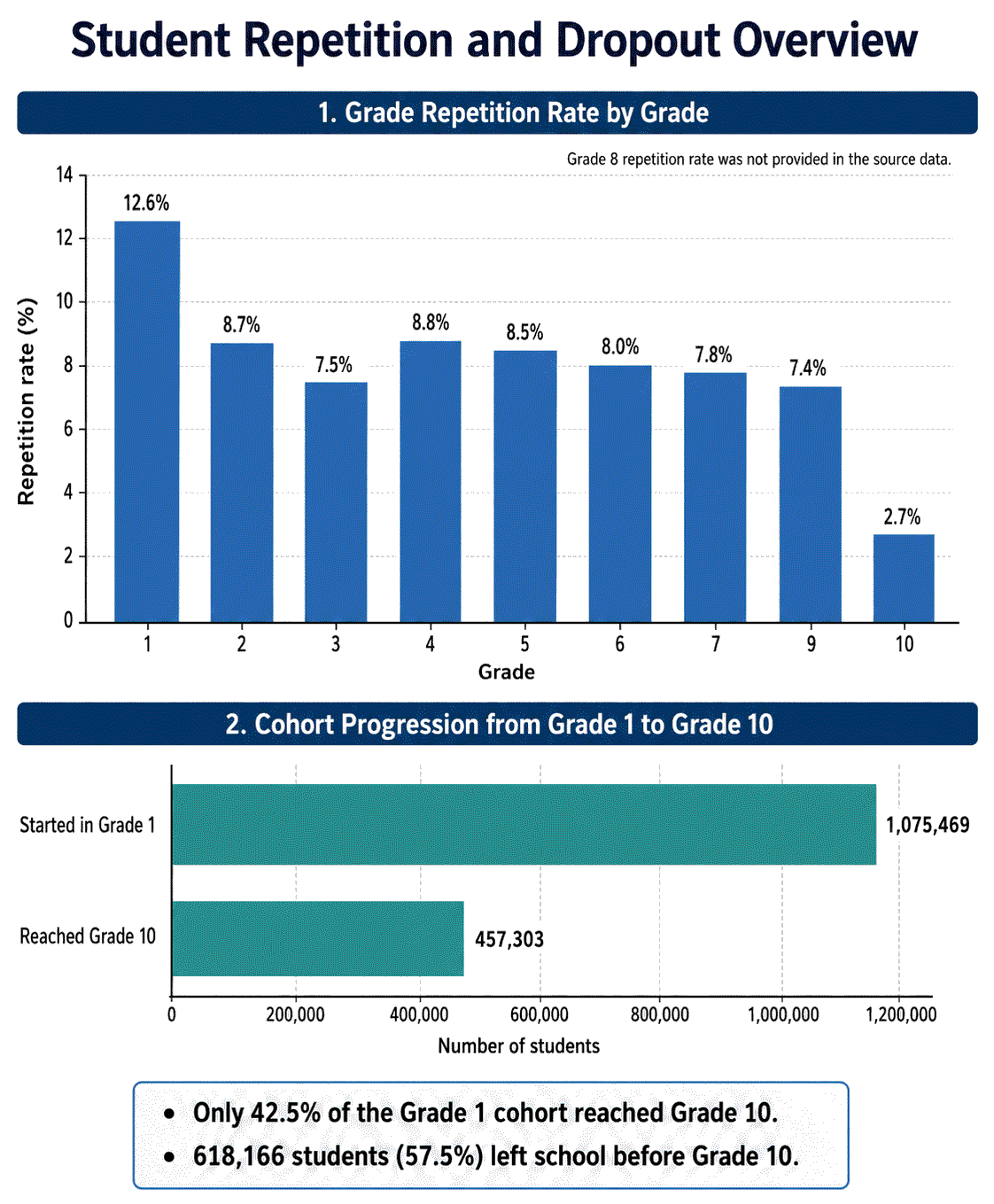
The grade repetition rate is highest in Grade 1, where 12.6 percent of students repeat the same grade. Similarly, 8.7 percent of students repeat Grade 2, 7.5 percent repeat Grade 3, 8.8 percent repeat Grade 4, 8.5 percent repeat Grade 5, 8 percent repeat Grade 6, 7.8 percent repeat Grade 7, and 7.4 percent repeat Grade 9. In Grade 10, however, this rate drops to 2.7 percent.
The most concerning issue is the school dropout rate. Data shows that out of 1,075,469 students enrolled in Grade 1 ten years ago, only 457,303 students were able to reach Grade 10. This means more than half of the children enrolled in school leave at some stage before completing the secondary level.
Why Do Children Leave School?
No single factor alone is responsible for children leaving school midway. Economic, social, geographical, and educational factors are found to have a combined effect behind this problem.
Poverty and Household Responsibilities: Children from economically weak families are often compelled to support livelihoods by helping in agriculture, livestock farming, wage labor, and household work instead of studying regularly.
Geographical Remoteness: Especially in hilly and mountain areas, schools being far away and the lack of transportation facilities have also made it difficult for children to attend school.
Lack of Educational Environment and Infrastructure: Some schools lack physical infrastructure, qualified teachers, and a quality learning environment. Traditional teaching methods, a shortage of educational materials, and rote-based learning have created frustration among students.
Health and Nutrition: Weak health and nutrition conditions among children have also led to irregular school attendance and learning setbacks.
Parental Awareness: When parents are not aware of the long-term importance of education, they are also found not to give priority to their children’s regular study.
Possible Solutions
The need for effective steps to solve the problem of students leaving school has been highlighted. A system should be developed to regularly monitor the learning status and attendance of every child enrolled in school.
There is a need to identify at-risk and economically weak students on time and expand scholarships, the midday meal program, free educational materials, and transportation facilities. In addition, emphasis has been placed on making schools child-friendly, safe, and technology-friendly while enhancing teachers’ professional capacity.
The Continuous Student Assessment System introduced by the Ministry of Education up to Grade 5 is also expected to have a positive impact. Such a system will help reduce exam-related fear and lower students’ frustration and lack of interest in school.
Ultimately, since school education is a fundamental right of every child, the state’s responsibility is not limited to enrolling children in school. It is equally important to create an environment where they can complete their studies up to the secondary level. For this, the active role of the government, schools, teachers, parents, and the community is indispensable for improving student retention.
School News Education News