



Private Sector Entry in Medical Education: Paradox of Workforce Growth, Quality, and Migration
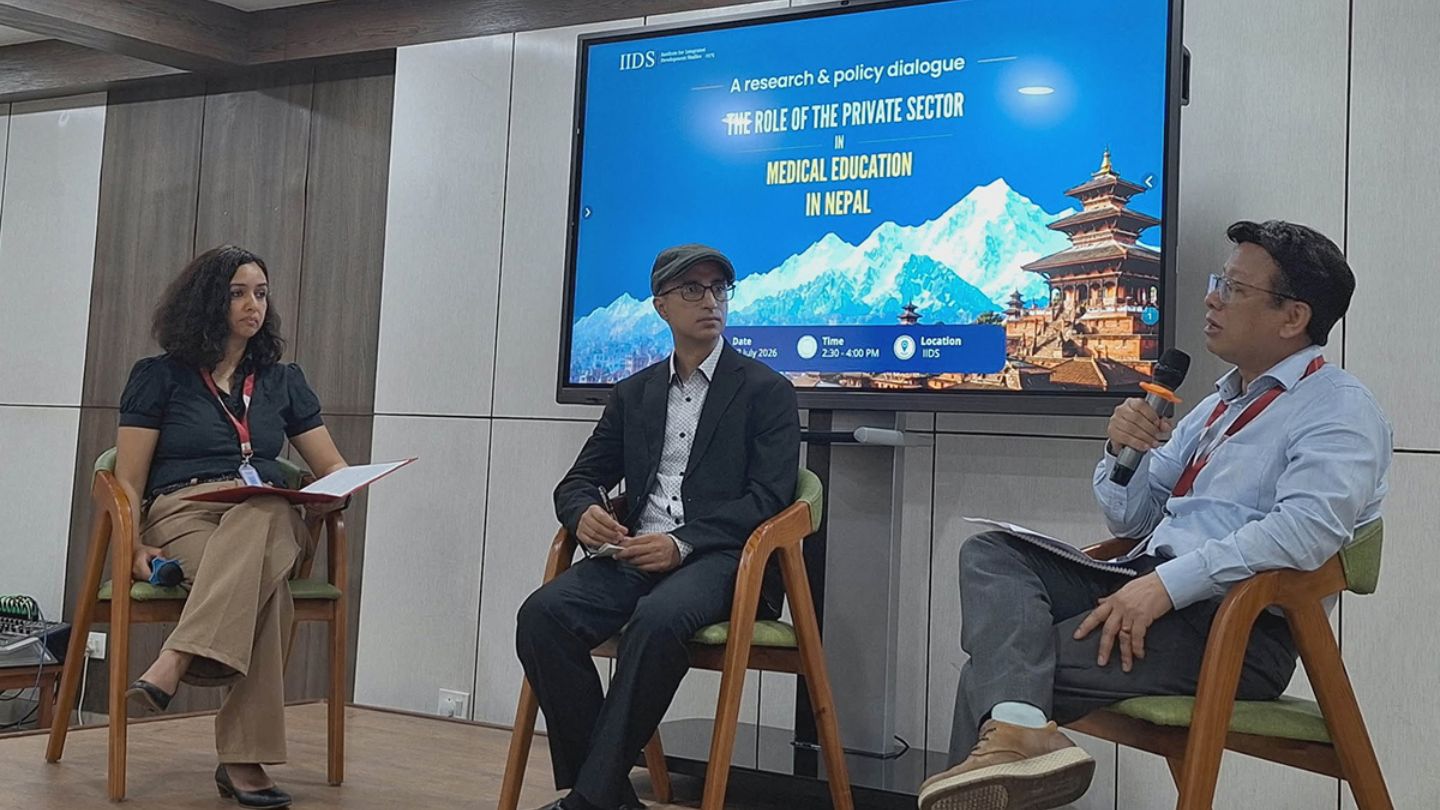
A study report titled “The Privatization Paradox,” presented at the Institute for Integrated Development Studies (IIDS) in Dhumbarahi, Kathmandu, has concluded that while the entry of the private sector into Nepal’s medical education has increased the number of hospitals and health workers, it has also created a paradox in terms of quality service and workforce retention.
The study, which included health service expert Dr. Kiran Raj Pandey, IIDS Research Director Uttam Sharma, Dr. David McCoy, and other experts, covers the current state of medical education in Nepal and its complexities. The report states that although the private sector was opened up in 1990 with the objective of addressing the shortage of doctors and saving the money spent on studying abroad, it has now created several contradictions.
Workforce Growth and Production Status
According to the study, the number of doctors in Nepal has increased fivefold over the past 20 years, mainly due to private-sector investment.
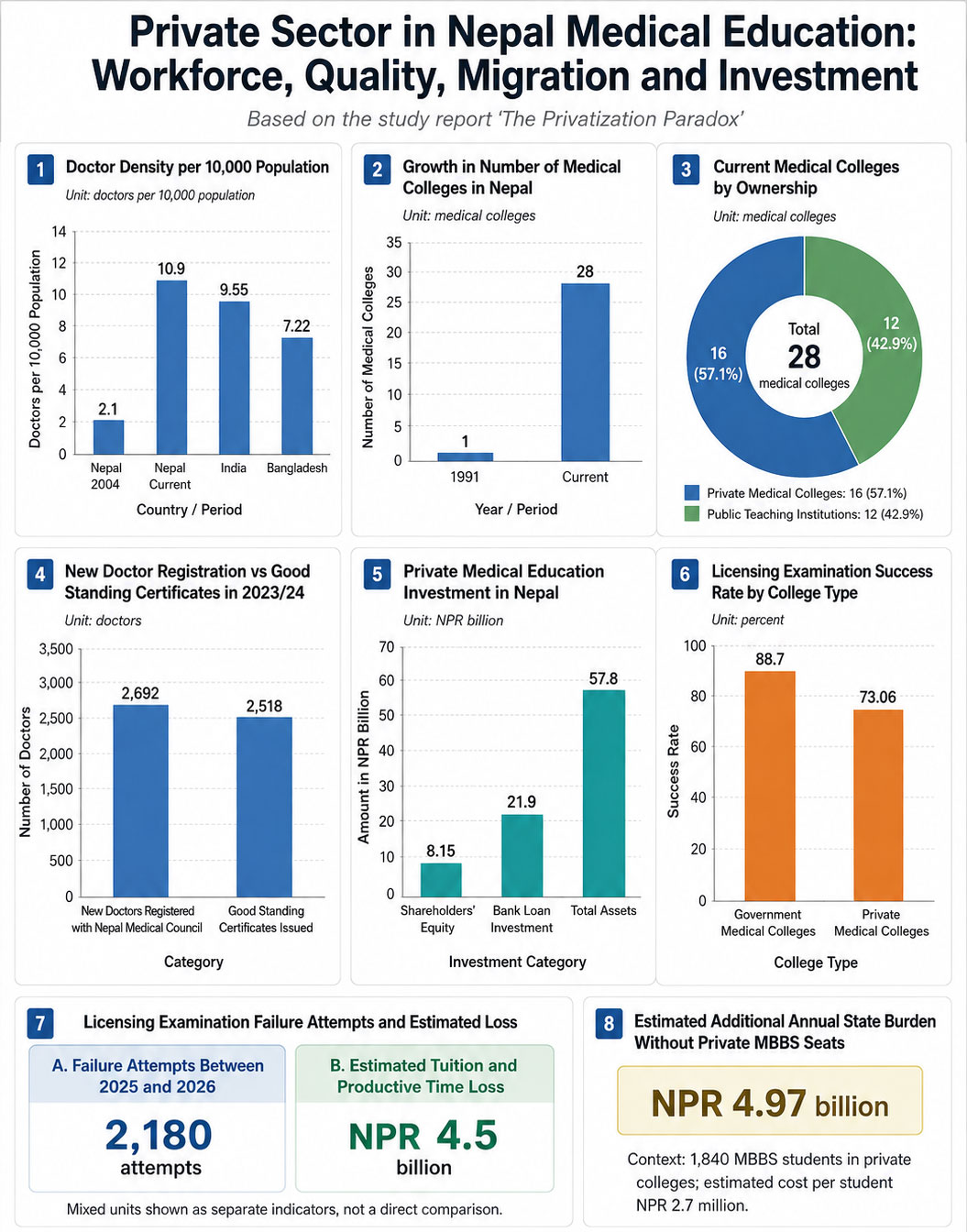
Doctor density: Nepal currently has 10.9 doctors per 10,000 population, which is higher than neighboring India (9.55) and Bangladesh (7.22). In 2004, the figure in Nepal was only 2.1 per 10,000 population.
Number of medical colleges: Since 1991, the number of medical colleges in the country has increased from 1 to 28, including 16 private and 12 public teaching institutions.
Domestic production: At present, more than 82 percent of doctors are being produced within the country. In 1997, this figure was 17.2 percent, as mentioned in the source as “2 out of 9,116,” while the remaining doctors had studied in countries including India, Russia, Bangladesh, China, and Pakistan.
Foreign Migration and Unequal Distribution
Presenting the working paper at the program, Dr. Pandey said that despite numerical growth, a serious paradox has emerged.
Migration situation: According to 2023/24 data, 2,692 new doctors were registered with the Nepal Medical Council, while 2,518 received the “Good Standing Certificate” required to go abroad. When more health workers than those produced in Nepal obtain permission for foreign migration, it is as if billions of rupees of state investment are being wasted.
Financial burden and lack of opportunities: Students who have paid high fees of Rs. 4 million to Rs. 4.5 million to study in Nepal are migrating to the United States, the United Kingdom, or Gulf countries due to the lack of suitable opportunities and security within the country.
Urbanization trend: To recover their study expenses, 88 percent of students tend to prefer staying only in cities, which has kept the situation unchanged: doctors are concentrated in Kathmandu while hospitals in remote areas remain empty.
Economic Investment and Savings for the State
According to the report, the private sector has mobilized a large amount of capital in Nepal’s medical education.
Private investment: The 16 private medical colleges have Rs. 8.15 billion in shareholders’ equity, while banks have invested Rs. 21.9 billion in loans. The total assets of these institutions exceed Rs. 57.8 billion.
Relief for the state: Dr. Pandey said that if the government had to educate the 1,840 MBBS students currently studying in private medical colleges at the same rate as government colleges, at around Rs. 2.7 million per student, it would have to bear an additional annual financial burden of about Rs. 4.97 billion, nearly Rs. 5 billion.
Questions on Quality and Licensing Examination Results
The most concerning aspect pointed out by the study is the result of the licensing examination.
Success rate: According to Nepal Medical Council data, the success rate of those who studied at government medical colleges is 88.7 percent, while that of private colleges is only 73.06 percent.
Economic and social loss: As mentioned in the source, between 2025 and 2026 alone, students failed the licensing examination 2,180 times, including students who failed more than once. The tuition fees and productive time lost by these students alone amount to around Rs. 4.5 billion.
Experts’ Panel Discussion
After the presentation of the working paper, a panel discussion was held with Dr. Anup Subedi and economist Dr. Bishwas Gauchan.
Dr. Anup Subedi’s view: Migration is increasing because the state has not provided workplaces, proper opportunities, and remuneration. Due to the state’s inability to ensure proper management, even doctors who provide specialized services have become unemployed. Citizens in rural areas lack access, and even in places where access exists, there are problems of unnecessary tests and surgeries, as well as the lack of quality services. He emphasized that if the workforce is not managed within the country, opening new colleges would be similar to wasteful spending, and that doctors should be provided proper remuneration, workplace security, and career development opportunities to retain them in remote areas.
Dr. Bishwas Gauchan’s view: He argued that the provision in the Medical Education Act requiring private colleges to be converted into non-profit trusts within 10 years is unfair and impractical. He said asking business owners who have already invested billions of rupees to suddenly hand over their businesses would discourage the private sector and create a crisis in the long term. He proposed that Nepal should aim to become a “regional medical hub” by bringing in 10,000 foreign students and suggested a “public-public partnership” model for opening new colleges in partnership with government hospitals by using funds from institutions such as the Citizen Investment Trust.
Recommendations of the Study
The study recommends moving away from the old “input”-based monitoring system that only looks at physical infrastructure and adopting competency-based assessment that tests students’ skills.
It also suggests expanding clinical seats at the postgraduate level for specialization.
According to other experts present at the program, the old curriculum of medical education should be improved to produce competent teachers, and an immediate serious study should be conducted on the economic impact of the legal provision requiring private colleges to become non-profit institutions.

.jpg)

Comments 0
No comments yet. Be the first to start the conversation.