



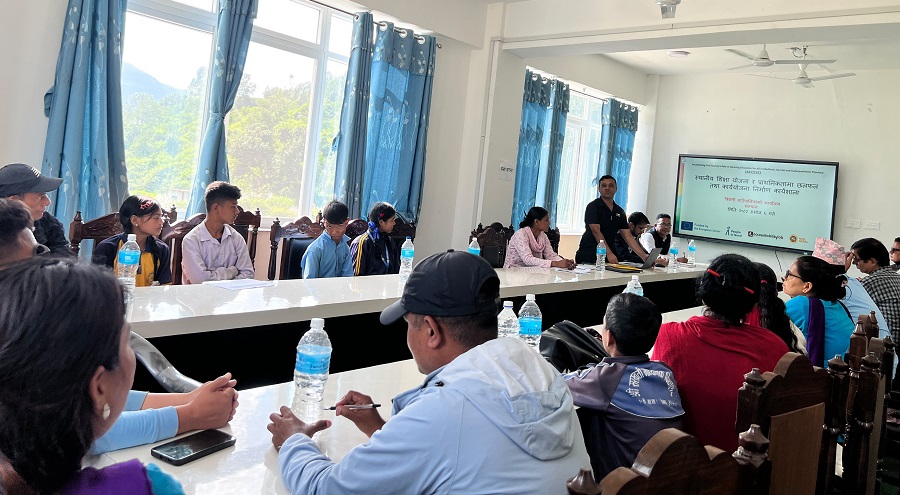
10-Year Education Plans Reviewed in Three Salyan Local Levels: Action Plans Prepared with Focus on Inclusive Education
Three local levels in Salyan have reviewed their 10-year education plans and prepared separate action plans to effectively implement the priorities set for inclusive education. Siddha Kumakh Rural Municipality, Triveni Rural Municipality, and Sharada Municipality reviewed the implementation status of their education plans and concluded that coordination and responsibilities among local governments, schools and communities need to be further clarified.
The review identified the need for additional work in identifying and re-enrolling out-of-school children, early identification and screening of children with disabilities, management of educational data, prioritization of budgets, and effective implementation of inclusive education programs. Action plans have been prepared incorporating activities that can be implemented within the current academic year to address the identified problems and priorities.
The review was conducted for the first time two years after the 10-year education plans were prepared. It examined the goals and priorities included in the education plans in relation to their implementation status.
Pratibha Oli, Senior Education Officer of Siddha Kumakh Rural Municipality, said that the education plan should not remain limited to a document and needs to be implemented effectively at the school level. She said an action plan had therefore been prepared to organize upcoming activities according to identified priorities.
Sangita Budha, Senior Education Officer of Sharada Municipality, said the action plan had been prepared on a priority basis by identifying challenges in implementing the education plan and outlining measures to address them.
Similarly, Ganesh Prasad Acharya, Senior Education Officer of Triveni Rural Municipality, said the action plan includes activities that can be carried out during the current academic year through coordination among the local government, schools, and communities. He added that the roles and responsibilities of the concerned stakeholders have also been clearly defined.
During the discussions, participants reviewed the situation in each local level, progress on commitments made through the Girls and Inclusive Education Network, and the implementation status of initiatives undertaken by the local governments.
The School Education Sector Plan was reviewed from the perspectives of equity, inclusion, gender equality, and civic participation. For this purpose, the ACCESS Project had developed an integrated framework covering 29 indicators under six thematic areas. The framework was used to identify progress, challenges, and areas requiring improvement.
The action plans also define the roles of local governments, schools, civil society organizations, communities, and community learning centres in implementing the priorities identified through the review.
Khim Bahadur Rawat, Chairperson of Triveni Rural Municipality, said the activities included in the action plan would be implemented through the concerned branches and agencies. He also noted that cooperation among all concerned stakeholders is necessary for the effective implementation of education-sector plans.
The reviews and preparation of the action plans in the three local levels of Salyan were carried out through the ACCESS Project with support from the European Union.
The project is being implemented in five local levels of Salyan and Jajarkot with the objective of strengthening the role of civil society in ensuring education for all and improving accessibility and inclusion in education, along with quality in the education sector.


Comments 0
No comments yet. Be the first to start the conversation.