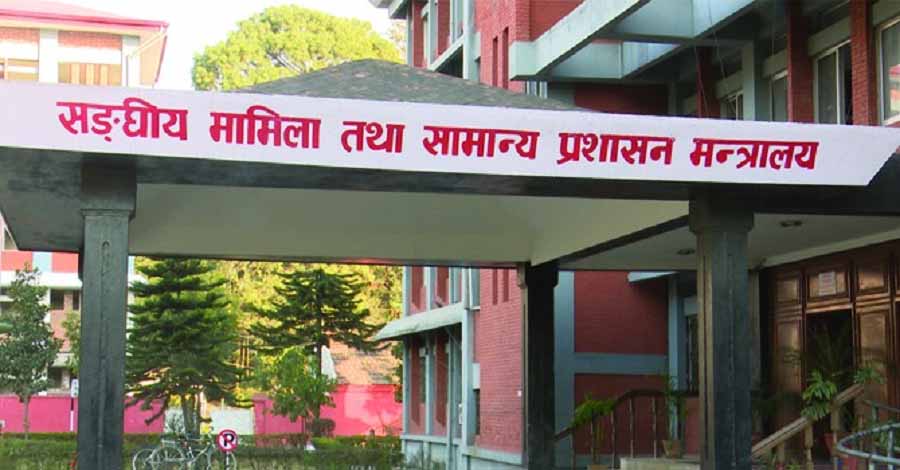
The service processes and administrative services delivered by the Ministry of Federal Affairs and General Administration (MoFAGA) strengthen and energize the relationship between citizens and government within Nepal’s evolving state structure.
A closer review of the ministry’s service scope shows that it operates as a broad “administrative ecosystem,” with direct and indirect effects on the daily lives of residents across all 753 local levels.
The ministry’s services can be broadly grouped into three strategic categories. First is civil service employee management, which includes complex areas of career development from recruitment coordination to retirement. Second is the strengthening of local governments, including legal framework support, technical assistance, and institutional capacity development. Third is administrative coordination for federalism, which ensures operational unity and policy alignment among the federal, provincial, and local levels.
Many citizens assume that the ministry’s services are limited only to staff working inside Singha Durbar. In reality, when a remote ward office registers births through a digital system or when a municipality implements a budget effectively, the background support often includes ministry-provided software, training, and policy guidance.
From “model laws” to the posting of Chief Administrative Officers, these services keep local democracy functioning. For students and researchers, these services are practical study areas in public administration. For the general public, they form a concrete foundation for good governance.
The core aim of the ministry is to make service delivery simple and technology-friendly while protecting policy clarity, employee accountability, and local autonomy. This section provides a detailed, factual analysis of MoFAGA’s services, clearly showing the seriousness of the institution and the full scope of its work.
The ministry’s services primarily stand on three constitutional pillars:
Administrative pillar: Civil service employee management
Federalism pillar: Coordination among federal, provincial, and local levels
Development pillar: Local infrastructure and capacity development
This section presents the ministry’s services based on alphabetical presentation and thematic importance.
Record Management (PIS Update)
A service to update each civil servant’s personal details from initial appointment to retirement in the Personnel Information System (PIS). This improves transparency in seniority, training records, and performance evaluation.
Employee Transfer and Posting
A service that transfers federal civil servants to different ministries, departments, and local levels in accordance with law.
Performance Evaluation Coordination
Determining the standards to measure employee performance and maintaining relevant records.
Leave and Foreign Study Approval
Providing nominations and administrative approvals required for higher education or overseas training.
Model Laws
Preparing drafts or model formats of acts, rules, and procedures required by all 753 local levels to operate effectively.
Examples include local market management procedures and education-related regulations.
Deployment of Chief Administrative Officers
Posting federal employees as Chief Administrative Officers to provide administrative leadership for local government operations.
Fiscal Equalization and Grant Coordination
Administrative coordination of budgets allocated to local levels based on the recommendations of the National Natural Resources and Fiscal Commission.
Local-Level Capacity Development
Providing training to elected representatives and staff on good governance, budget preparation, and legal procedures.
Services Through the Department of Local Infrastructure (DoLI)
Providing technical support and setting standards for rural roads, suspension bridges, and local irrigation projects.
Technical Consultation
Providing engineering and technical guidance needed by local levels during large infrastructure construction.
LISA (Local Government Institutional Capacity Self-Assessment)
Providing a digital platform that helps local levels assess their own performance.
E-Governance Support
Supporting local levels with software and information technology to make services more technology-friendly.
Public Grievance Hearing
Addressing complaints related to local levels or civil service administration through “Hello Sarkar” or the ministry’s portal.
You may think, “These are all government tasks—what do they mean in my personal life?”
Example 1: Recommendation for Citizenship or Birth Registration
When you visit a ward office, the secretary or staff working there are managed through MoFAGA’s personnel systems. If employees are not posted on time, even small services can be delayed for months.
Example 2: Local Road Construction
What standards should a suspension bridge or rural road follow? Which budget headings should be used and how should spending be planned? This policy clarity is part of the services guided by this ministry.
Because most ministry services are institutional in nature, citizens rarely need direct access. However, citizens can seek ministry services or information in the following situations:
Using the Right to Information (RTI)
If you need information on decisions, expenditure details, or matters of public importance, you can submit an application to the information officer.
Complaints and Grievances
If a local level acts against the law or an employee refuses to deliver services, a complaint can be filed at the ministry’s grievance section.
Using the Website
By reviewing the “public service charter” on the ministry website, citizens can learn how long specific services typically take.
According to the study, there are serious issues in service delivery that citizens should understand:
Challenge 1: Staff Vacancies and Frequent Transfers
Why it happens: Nepal’s difficult geography and the tendency of employees to prefer accessible areas affect service delivery in remote local levels.
Solution: The ministry is preparing to implement an “Automated Transfer System,” which is expected to reduce human interference.
Challenge 2: Jurisdiction Disputes Between Central and Local Levels
Why it happens: In some cases, federal laws and local laws overlap or conflict when constitutional powers are exercised.
Solution: The ministry provides dispute-resolution facilitation through an “inter-level coordination council.”
Federalism has not been in place for a long time in Nepal. In this process, MoFAGA’s biggest service is “transitional management,” including:
Transforming former District Development Committees into District Coordination Committees
Sending recommendations to the Council of Ministers regarding changes in local-level boundaries and names
Setting standards for the order of precedence and service facilities of local elected representatives
If you are a student of Public Administration or Political Science, the ministry may provide the following support:
Data and reports: Status of Nepal’s bureaucracy, women’s participation, and progress in local development
Library and records: Access to older reports and documents related to administrative reform
Internship: In some cases, practical learning opportunities may be provided to students based on specific criteria
The ministry uses the following mechanisms to improve transparency in service delivery:
Weekly bulletin: Information on major decisions made during the week
Spokesperson: A senior official designated to respond to media and public queries
Online portal: Transfer lists, promotion recommendations, and foreign study results can be viewed online
The ministry cannot resolve every issue instantly. Some limitations include:
Judicial authority: The ministry cannot impose punishment; it can only recommend administrative action
Budget constraints: The ministry cannot provide all requested budgets to local levels, as allocation depends on ceilings set by the Ministry of Finance and the National Planning Commission
Respect for self-governance: Since local governments are autonomous, the ministry cannot interfere in every minor decision
The Ministry of Federal Affairs and General Administration functions as the brain of Nepal’s public administration. The services it delivers play a key role in shaping the country’s future and supporting the success of federalism.
Practical advice for citizens:
If you face problems in local-level service delivery, first communicate with your municipality or rural municipality’s Chief Administrative Officer. If the issue remains unresolved, only then contact the ministry’s coordination section or the grievance portal. Clear communication based on proper process often leads to faster outcomes.
Website: www.mofaga.gov.np
Address: Singha Durbar, Kathmandu
Grievance Handling Officer: You can fill out the form by visiting the “Grievance” tab on the ministry website.
This article is based on research and current legal provisions. Since government policies and procedures may change over time, readers are requested to verify the latest official updates or Nepal Gazette notices before making any important decision. This content is for educational and informational purposes only.

.jpg)