




The comparison between the American education system and the Finnish model is often presented as a simple contrast: one system is competitive, test-heavy, and unequal; the other is calm, teacher-led, and successful. That framing is easy to remember, but it leaves out the most important point.
The United States and Finland have different population sizes, governance traditions, funding structures, social policies, labor markets, and reform histories. A fair comparison has to ask how each system is organized, what pressures it faces, and which lessons can transfer across countries.
The useful answer is not that Finland should be copied or that the American system should be dismissed. Finland offers lessons in coherence, teacher preparation, trust, early support, and equity. The United States offers lessons in institutional diversity, local experimentation, public accountability, and multiple education pathways. Both systems also face real problems. Finland’s international performance remains important but has declined in recent PISA cycles, while the United States shows mixed international results and continuing concerns about uneven opportunity.
Answer Summary:
The Finnish model is not a perfect system to copy, and the American education system is not one uniform system to judge as a whole. Finland’s strength lies in coherence, teacher preparation, trust, and early support. The U.S. system is larger, more decentralized, more varied, and more unequal. The real comparison is about how governance, funding, teachers, assessment, and student support work together.
Table of Content
- What Do We Mean by the American Education System?
- What Is the Finnish Model?
- The Core Difference: Governance and Trust
- Side-by-Side Comparison
- Outcomes: What Test Data Can and Cannot Prove
- Teachers: Training, Autonomy, and Professional Status
- Assessment and Accountability
- Equity, Funding, and Student Support
- Strengths of the American System
- Strengths of the Finnish Model
- Limitations and Criticisms
- What Can Other Countries Learn?
- Practical Implications
- Final Takeaway
Key Takeaways:
-
The U.S. education system is highly decentralized and varies widely by state, district, and community.
-
Finland has a clearer national framework with strong local and teacher-level responsibility.
-
Finland uses assessment, but it relies less on high-stakes standardized testing than the United States.
-
Finnish teacher autonomy is linked to strong teacher preparation, not simply policy trust.
-
PISA and NAEP are useful indicators, but they do not measure every part of education quality.
-
Directly copying Finland is risky unless teacher preparation, funding, student support, and social context are considered together.
What Do We Mean by the American Education System?
The American education system is not a single national school system in the way many readers imagine. It is a decentralized structure shaped by federal law, state policy, local school districts, courts, school boards, teachers, families, and communities.
States and local districts carry major responsibility for curriculum standards, school finance, teacher licensing, graduation rules, and daily school operations. Federal policy can influence civil rights protections, funding programs, reporting requirements, and assessment expectations, but it does not operate U.S. schools directly.
This decentralization creates flexibility and unevenness. A school district in Massachusetts, Texas, California, rural Alaska, or a low-income urban area may operate under very different conditions. Students’ experiences can vary by state law, district resources, teacher supply, school leadership, neighborhood conditions, and family income.
For readers who want a wider foundation, Collegenp’s guide to Education Systems Explained: Models and Qualification Levels can help place the American structure within broader international education models.
The phrase “American education system” should therefore be used carefully. It is more accurate to describe it as a large federal education structure with strong state and local variation.
What Is the Finnish Model?
The Finnish model refers to Finland’s publicly guided education system, where national direction, local responsibility, teacher professionalism, and student support are closely connected.
The Finnish National Agency for Education describes the system as including early childhood education and care, pre-primary education, basic education, general upper secondary education, vocational education and training, higher education, and adult education. Compulsory education applies to all 6–18-year-olds and includes pre-primary, primary, lower secondary, and upper secondary education.
Basic education in Finland lasts nine years. After that, students usually move into general upper secondary education or vocational upper secondary education and training. The system is often discussed for teacher professionalism, broad public provision, local curriculum adaptation, and a lower-stakes approach to assessment compared with many countries.
The term “Finnish model,” however, can be misleading when it is used as a brand. Finland is not a country without standards, assessment, or accountability. What differs is the balance. Finland relies less on high-stakes standardized testing and more on professional preparation, local responsibility, school self-evaluation, and national evaluation for improvement.
The Core Difference: Governance and Trust
The most important difference between the U.S. education system vs Finland is governance. The American system is fragmented and accountability-oriented; the Finnish system is more coherent and trust-oriented.
In the United States, education authority is divided across federal, state, district, and local actors. This makes the system flexible, but it also makes quality and opportunity uneven. Public reporting, standardized assessment, legal protections, and policy debate play major roles because the system is large and unequal.
Finland also has local autonomy, but it operates within a more coherent national framework. The Finnish Ministry of Education and Culture states that teachers are required to have a master’s degree, that teacher education includes teaching practice, and that the Finnish system is based on trust in teachers and teacher education. Teachers have considerable freedom in choosing teaching methods and materials within the curriculum framework.
This does not mean one country has autonomy and the other does not. Both do. The difference is where autonomy sits. In the United States, autonomy is often political, legal, and district-based. In Finland, autonomy is more closely connected to professional preparation and local educational responsibility.
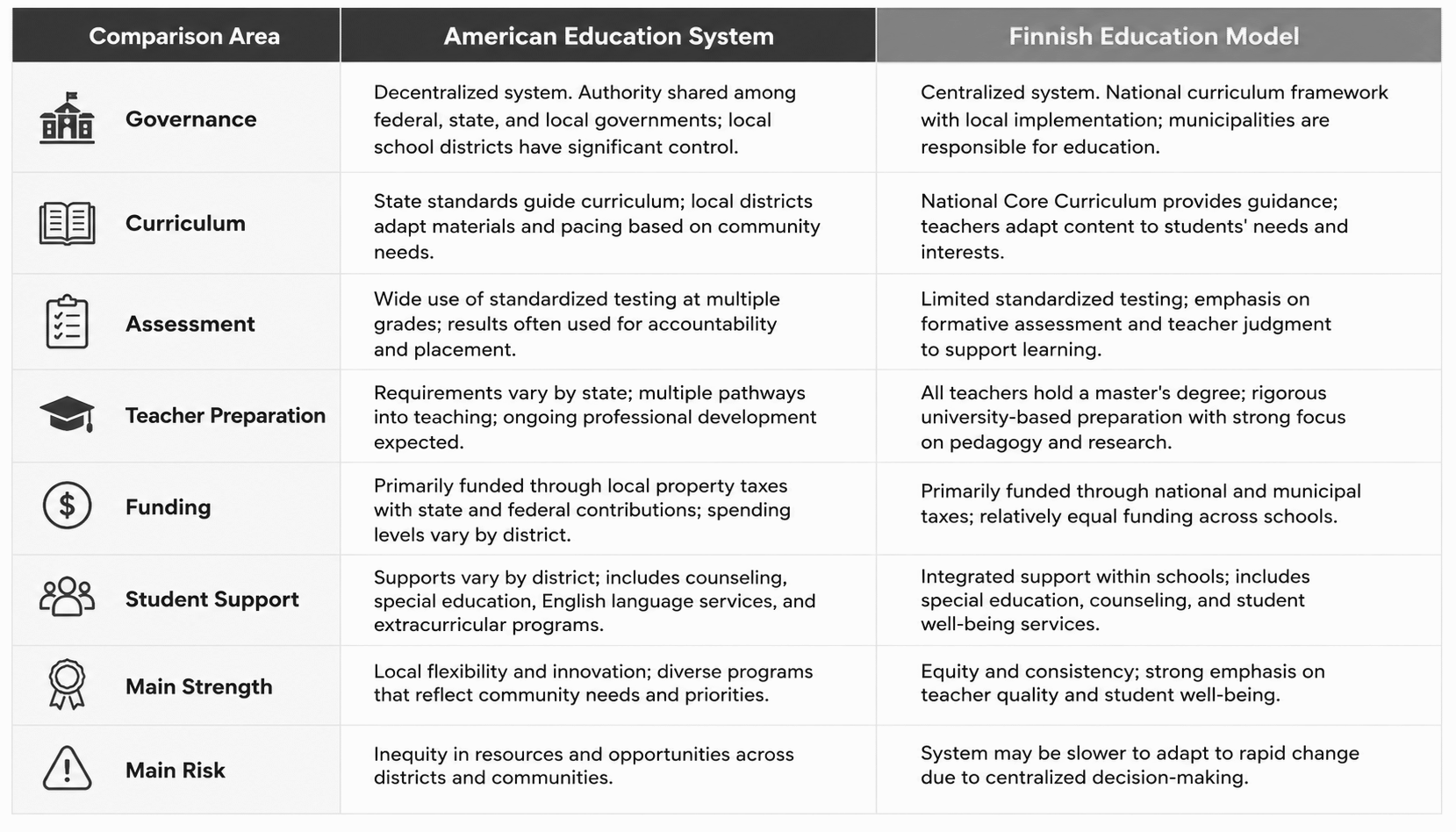
Side-by-Side Comparison
| Area | United States | Finland |
|---|---|---|
| Governance | Highly decentralized across federal, state, district, and local actors | National framework with local and municipal implementation |
| Compulsory education | Varies by state, generally through the teenage years | Applies to ages 6–18 |
| Curriculum | State standards and local curricula vary widely | National core curriculum with local adaptation |
| Assessment | Standardized testing, public reporting, and state or local assessment systems | Teacher assessment, school self-evaluation, national evaluation, and fewer high-stakes tests |
| Teacher preparation | Requirements vary by state and route into teaching | Teachers are required to hold a master’s degree |
| Funding | Mix of federal, state, and local sources; local revenue matters in many states | Publicly funded system with broad entitlement to education services |
| Main strength | Diversity, local experimentation, and multiple pathways | Coherence, teacher professionalism, early support, and equity orientation |
| Main risk | Uneven quality and opportunity across communities | Difficulty maintaining outcomes and adapting as society changes |
 Outcomes: What Test Data Can and Cannot Prove
International test results are useful, but they are not a complete measure of school quality. PISA measures selected competencies of 15-year-old students in reading, mathematics, and science. It does not fully capture civic learning, creativity, school climate, vocational pathways, student wellbeing, or long-term life outcomes.
The OECD PISA 2022 country note for Finland reports that Finnish students scored above the OECD average in mathematics, reading, and science. At the same time, it also reports that Finland’s average results were down compared with 2018 in all three subjects and that 2022 performance was lower than in any previous Finnish PISA assessment.
The U.S. picture is mixed. The National Center for Education Statistics reports that in PISA 2022, five participating education systems had higher average reading scores than the United States, 25 had higher mathematics scores, and nine had higher science scores. This suggests relative strength in reading and science compared with many participating systems, while mathematics remains a more difficult area for comparison.
Domestic U.S. data add another layer. The 2024 National Assessment of Educational Progress showed reading declines for both grade 4 and grade 8 students compared with 2022, while mathematics results were more mixed. The National Assessment Governing Board reported that reading scores were down nationally in both grades, grade 4 mathematics scores rose nationally by two points, and grade 8 mathematics scores were flat.
These patterns do not support a simple “Finland succeeds, America fails” conclusion. Finland remains a major reference point in education policy, but it is not immune to decline. The United States has areas of relative international strength, but it also faces serious equity and learning concerns.
Teachers: Training, Autonomy, and Professional Status
Teacher policy is one of the clearest differences between the two systems. Finland gives teachers broad professional freedom, but that freedom is tied to strong preparation.
In Finland, teachers are required to have a master’s degree, and initial teacher education includes teaching practice. This matters because a trust-based system depends on professional capacity. If teachers are expected to design instruction, assess learning, adapt materials, and respond to diverse student needs, the system must invest in their preparation before they enter classrooms and during their careers.
The United States has a more varied teacher labor market. Each state sets its own licensing requirements, and teachers may enter through traditional university-based programs or alternative pathways. This flexibility can help districts recruit teachers, especially in shortage areas. It can also create uneven preparation, mentoring, and professional support.
The lesson is not that every country must copy Finland’s exact teacher education structure. The more practical lesson is that teacher autonomy and teacher preparation must be aligned. A system cannot ask teachers to use professional judgment while giving them weak preparation, limited collaboration time, poor working conditions, or little instructional support.
Assessment and Accountability
Finland does not have “no tests.” It has a different assessment culture. The United States uses standardized testing more visibly because it is large, decentralized, and unequal. Public data can help families, policymakers, researchers, and civil rights advocates see whether different groups of students are being served fairly.
The weakness is that testing can become too dominant. When schools are judged mainly by test results, teaching can narrow, and teachers may feel pressure to prioritize tested subjects and formats. Assessment is useful when it helps diagnose learning, guide support, and reveal inequity. It becomes less useful when it reduces education to score management.
Finland uses a different balance. Assessment exists, but the system is less centered on school-by-school public ranking and high-stakes consequences. Teachers assess student learning, schools engage in self-evaluation, and national evaluation is used more for development than public competition.
The better question is not whether a system should assess students. Every education system needs assessment. The real question is what assessment is for: improvement, accountability, diagnosis, selection, public transparency, or political signaling. Different answers create different school cultures.
Equity, Funding, and Student Support
Equity is where the comparison becomes most serious. The American system’s local variation can support innovation, but it can also deepen inequality.
Public school funding in the United States comes from federal, state, and local sources. In many states and districts, local revenue and property wealth remain important parts of the school finance debate. This means students may attend schools with very different resources depending on where they live. Funding formulas, state aid, local tax bases, and political choices all shape opportunity.
Finland’s model is more explicitly built around universal access, student welfare, and early support. The Finnish system connects compulsory education, teacher preparation, local services, and support for learning within a relatively coherent public framework.
This is why the Finnish model cannot be reduced to classroom techniques such as fewer high-stakes tests or more teacher freedom. Those features are connected to wider structures: teacher education, public provision, curriculum coherence, support services, and social policy. Without those conditions, copying surface-level practices may not produce similar results.
Strengths of the American System
The American system’s strengths are easiest to miss when the comparison focuses only on national averages.
Its size and decentralization allow experimentation. Magnet schools, charter schools, district reforms, dual enrollment, community colleges, advanced coursework, career and technical education, adult learning, and varied higher education pathways all exist within a broad education ecosystem. Some of these pathways serve students well; others raise quality and equity questions. The point is that the system contains many routes rather than one standard track.
Readers comparing academic and technical pathways may also find Collegenp’s guide on Academic Education vs Technical Education useful for understanding how different routes serve different learner needs.
The United States also has a strong culture of public debate. Education problems are examined by researchers, journalists, courts, parents, advocacy groups, unions, school boards, and policymakers. That debate can be polarized, but it also keeps school quality, civil rights, curriculum, funding, and opportunity gaps visible.
Another strength is postsecondary diversity. Students may move into universities, community colleges, technical programs, apprenticeships, military pathways, work-based training, or adult education. The challenge is that access to these options is uneven, and cost can shape opportunity.
Strengths of the Finnish Model
Finland’s main strength is coherence. Its policies on curriculum, teacher education, local responsibility, public provision, and student support are more closely aligned than in many decentralized systems.
Teacher professionalism is central. Finland’s trust-based model depends on strong preparation and professional discretion. Teachers are not simply following scripts from a distant authority; they are expected to make informed decisions about methods, materials, and student needs within a shared curriculum framework.
Finland also shows the value of early support. A system that identifies learning needs early may reduce later remediation and prevent some students from being left behind. The Finnish model reminds policymakers that equity is not only a value statement. It has to be built into funding, curriculum, teacher workload, student welfare, and support services.
Limitations and Criticisms
Both systems face criticism, but for different reasons.
In the United States, major concerns include uneven school funding, achievement gaps, teacher shortages in some areas, politicized curriculum debates, high postsecondary costs, and the tension between local control and national equity. A decentralized system can adapt to local needs, but it can also leave students with very different opportunities.
In Finland, the challenge is not the same. The country remains influential in education policy discussions, but its PISA decline shows that past success does not guarantee future performance. Finland must continue responding to demographic change, immigration, regional differences, student wellbeing concerns, teacher workload, and changing postsecondary needs.
A serious comparison should avoid romantic claims. Finland is not an education utopia, and the United States is not a single failing system. Both contain lessons and warnings.
What Can Other Countries Learn?
The most transferable lesson from Finland is not “less homework” or “start school later.” It is system alignment. Finland connects teacher preparation, curriculum expectations, local responsibility, assessment philosophy, and student support. Countries interested in reform should ask whether their policies work together or pull in different directions.
The most transferable lesson from the United States is that diversity of pathways can matter. A system can serve different learners through academic, technical, local, and postsecondary options. But choice needs safeguards. Without attention to funding, information, quality control, and access, variety can become inequality.
Vocational and technical routes are part of this wider discussion. Collegenp’s article on The Role of Vocational Education in Economic Development provides related context on why practical education pathways matter beyond traditional academic routes.
For policymakers, the comparison suggests that education reform should not be treated as a single lever. Testing, curriculum, teacher preparation, school finance, student support, early childhood education, and postsecondary pathways interact. Reform is more likely to help when those parts are designed together.
Practical Implications
For Parents and Students
Do not judge a school only by the country it belongs to. Look at teacher quality, school climate, curriculum, safety, student support, assessment pressure, wellbeing, and post-school pathways.
A strong U.S. school may offer wide opportunities, advanced programs, and flexible pathways. A Finnish school may offer consistency, support, and less visible test pressure. Individual experience still matters.
For Teachers and School Leaders
The comparison shows that professional trust must be supported. Teachers need preparation, mentoring, collaboration time, reasonable workloads, and room to adapt instruction.
Autonomy without support can become isolation. Accountability without trust can become compliance. The stronger model is not simply “more freedom” or “more accountability,” but a better match between responsibility, preparation, and support.
For Policymakers
The key lesson is coherence. Countries that want Finnish-style trust must invest in teacher preparation and student support. Countries that want American-style diversity must protect equity and transparency.
No reform should be judged only by whether it looks successful in another country. It should be judged by whether it fits the country’s governance, funding, teacher workforce, student needs, and public goals.
Final Takeaway
The American education system and the Finnish model represent two different ways of organizing public education. The U.S. system is broad, decentralized, diverse, and uneven. The Finnish model is smaller, more coherent, trust-based, and equity-oriented, but it also faces performance and adaptation challenges.
The better question is not “Which system is better?” A more useful question is: which design choices improve learning, fairness, teacher quality, and student wellbeing in a specific context?
Finland shows that trust, strong teacher education, and early support can matter. The United States shows that scale, diversity, transparency, and multiple pathways can matter. Neither lesson works alone. Education systems improve when policies fit together and when reform is designed for real students rather than slogans.






Comments 0
No comments yet. Be the first to start the conversation.