




Many readers want books that do more than repeat quick advice. They want difficult books that teach deeper thinking: books that slow the mind, test assumptions, and reward careful attention.
That does not mean hard books automatically make a person smarter. A dense book is useful only when its difficulty serves understanding. Some books are hard because they handle complex ideas. Others are hard because of style, translation, unfamiliar vocabulary, or the reader’s lack of background. The point is not to suffer through famous titles. The point is to choose challenging books that help readers think with more patience and precision.
This guide is for global readers, students, professionals, and independent learners interested in philosophy, literature, science, political economy, and critical thinking. It does not dismiss all self-help books. Some practical books are useful when they are specific, evidence-aware, and realistic. The difference is that the books below usually ask deeper questions than “What should I do next?”
Answer Summary:
Difficult books can teach deeper thinking by making readers work with uncertainty, long arguments, layered language, and complex systems. The seven books below are not quick improvement manuals. They can help readers practice different forms of thinking: epistemic humility, process thinking, systems thinking, close attention, interpretive flexibility, pattern awareness, and model awareness.
Table of Content
- How to Read Hard Books Without Turning Them Into Homework
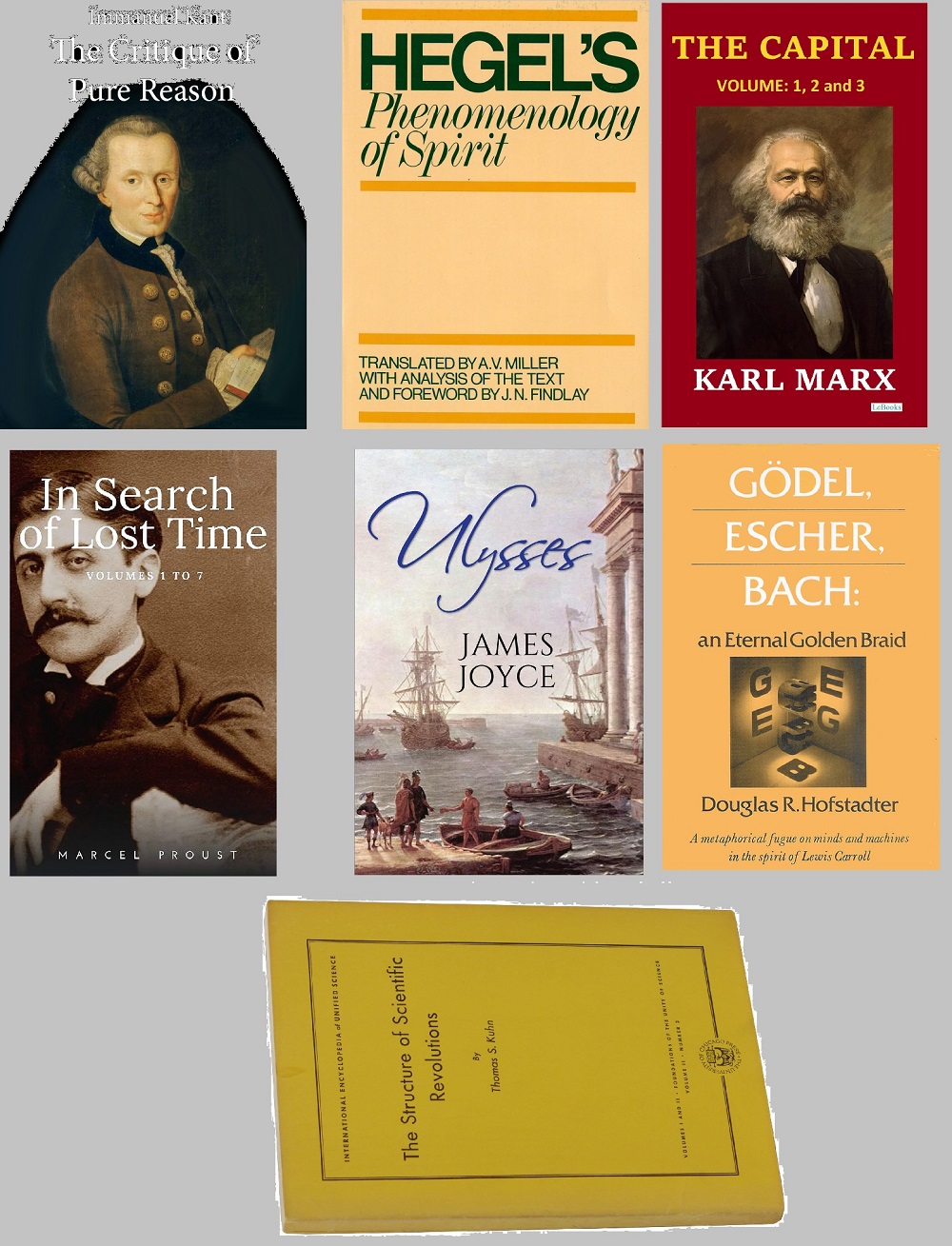
- 1. Critique of Pure Reason by Immanuel Kant
- 2. Phenomenology of Spirit by G. W. F. Hegel
- 3. Capital, Volume I by Karl Marx
- 4. In Search of Lost Time by Marcel Proust
- 5. Ulysses by James Joyce
- 6. Gödel, Escher, Bach by Douglas Hofstadter
- 7. The Structure of Scientific Revolutions by Thomas S. Kuhn
- What These Books Offer That Self-Help Often Cannot
- The Limits of Difficult Reading
- A Practical Reading Order
- Final Thought
Key Takeaways:
-
Hard books are useful when difficulty leads to insight.
-
The goal is deeper thinking, not intellectual status.
-
Self-help is not useless, but quick advice has limits.
-
Difficult books need context, patience, and repeat reading.
-
Readers should use introductions, notes, and guides when helpful.
-
This list is selective, not a universal canon.
-
Slow reading matters more than finishing quickly.
How to Read Hard Books Without Turning Them Into Homework
Hard books become more useful when readers approach them with a method. The aim is not to understand every sentence at once, but to understand what kind of thinking the book is asking for.
Start with one question: “What is this book training me to notice?” Kant trains limits. Hegel trains development. Marx trains systems. Proust trains attention. Joyce trains interpretation. Hofstadter trains pattern recognition. Kuhn trains awareness of models.
Readers who are building consistency may find it useful to pair difficult reading with a simple plan for how to build a reading habit as a student. Dense books are easier to continue when reading time is short, regular, and realistic.
Use confusion as a signal, not a verdict
Confusion does not always mean the book is beyond reach. It may mean the author is using unfamiliar terms, building a slow argument, or expecting background knowledge.
A practical method is to read in three passes:
-
First pass: identify the main problem.
-
Second pass: mark repeated terms and examples.
-
Third pass: explain one paragraph in your own words.
For retention, readers can combine difficult reading with active recall vs re-reading. After a section, close the book and write three sentences: what the author claims, how the author supports it, and what remains unclear.
1. Critique of Pure Reason by Immanuel Kant
Immanuel Kant’s Critique of Pure Reason is one of the major works of modern philosophy. Stanford Encyclopedia of Philosophy identifies it as Kant’s “first Critique,” first published in 1781 with a second edition in 1787.
Why it is difficult
Kant uses terms that do not behave like everyday language: intuition, understanding, category, synthetic a priori judgment, and transcendental idealism. Readers often struggle because Kant is not only making claims about knowledge. He is asking what must already be in place for experience and knowledge to be possible.
The book also moves with unusual care. Kant separates types of judgment, tests the reach of reason, and warns against claims that appear rational but cannot be justified.
What it can teach
Kant can teach epistemic humility. He trains readers to ask, “What can I know?” before asking, “What do I believe?”
That skill matters in study, public debate, and personal judgment. People often argue from confidence without asking whether the claim is grounded. Kant makes confidence more disciplined.
How to approach it
Do not start by trying to read the whole book quickly. Begin with an introduction to Kant’s project, then read selected sections slowly. Keep a glossary of repeated terms. When a sentence feels too dense, ask what distinction Kant is trying to protect.
2. Phenomenology of Spirit by G. W. F. Hegel
G. W. F. Hegel’s Phenomenology of Spirit is difficult because it presents thought as movement through stages. Stanford Encyclopedia of Philosophy notes that Hegel completed the work in late 1806 and that it was published in 1807.
Why it is difficult
Hegel rarely gives readers a simple claim and leaves it there. A position appears, develops, reveals a tension, and changes into another position. Readers who expect a direct argument may feel lost because the structure is developmental rather than linear.
The difficulty is also conceptual. Hegel is concerned with consciousness, recognition, contradiction, freedom, and history. These ideas are not treated as isolated topics. They unfold through relation and conflict.
What it can teach
Hegel can teach process thinking. Instead of treating ideas, identities, or institutions as fixed, he pushes readers to ask how they develop.
This is useful outside philosophy. In history, politics, education, and social life, people often freeze a situation at one moment and miss the forces that produced it. Hegel trains readers to ask: What tension is working here? What has changed? What may this become?
How to approach it
Beginners may want to read a guide before the original. Focus first on the movement of the argument, not every technical term. After each section, write down the starting position, the tension inside it, and the next position that emerges.
3. Capital, Volume I by Karl Marx
Karl Marx’s Capital, Volume I is a demanding work of political economy and social analysis. Stanford Encyclopedia of Philosophy summarizes Marx’s economic analysis around commodity production, labor power, capital, and surplus value.
Why it is difficult
Marx begins with the commodity, an ordinary object produced for exchange. From there, he builds a wider analysis of value, money, labor power, capital, and exploitation.
The challenge is scale. A product is not treated as only a product. It carries labor relations, market assumptions, social organization, and power. The reader must learn to see everyday economic life as part of a wider system.
What it can teach
Capital can teach systems thinking. Whether readers agree with Marx or not, the book trains them to look beneath surface appearances.
That makes it different from advice that focuses only on individual habits. Marx asks how larger structures shape the choices that later appear personal. This does not remove personal responsibility, but it makes analysis less shallow.
How to approach it
Read the first chapters slowly. They are difficult because Marx is setting up the framework. Make a list of core terms: commodity, use value, exchange value, labor power, surplus value, capital. Keep the reading neutral and critical. The goal is to understand the argument before agreeing or disagreeing with it.
4. In Search of Lost Time by Marcel Proust
Marcel Proust’s In Search of Lost Time is difficult in a different way from Kant, Hegel, or Marx. It does not challenge readers mainly through formal argument. It challenges them through attention, memory, social observation, and long reflective sentences.
Why it is difficult
Proust asks readers to slow down. A gesture, a room, a sound, a taste, or a social exchange may open into pages of memory and reflection. Readers who expect fast plot movement may become impatient.
The book’s difficulty lies in how closely it observes inner life. It shows how memory changes experience, how desire distorts judgment, and how social life depends on details people often miss.
What it can teach
Proust can teach deep attention. He shows that human life is not made only of events. It is also made of perception, memory, embarrassment, longing, habit, and interpretation.
This kind of reading can help readers become less quick to judge. Proust makes ordinary experience more complex, which is part of the book’s value.
How to approach it
Read Proust in small sections. Do not measure progress only by pages finished. Ask what the narrator notices that most people would ignore. Keep notes on memory, time, social class, love, and jealousy.
5. Ulysses by James Joyce
James Joyce’s Ulysses is a major work of modernist fiction. The British Library describes it as a novel that has daunted, dazzled, and puzzled readers since its 1922 publication, while also noting its modernist experimentation and attention to everyday life.
Why it is difficult
Ulysses changes style again and again. Its chapters shift in voice, structure, rhythm, reference, and literary method. The book is set in Dublin over one day, but Joyce turns ordinary movement through the city into a dense experiment in language and consciousness.
Readers may feel lost because Joyce often refuses to explain. Meaning comes through inference, sound, parody, allusion, and repeated patterns.
What it can teach
Ulysses can teach interpretive flexibility. It rewards readers who can change methods: read for character, then sound, then structure, then comedy, then social detail.
That matters because serious thinking does not use only one tool. Some problems need logic. Some need context. Some need close reading. Some need tolerance for ambiguity.
How to approach it
Use an annotated edition or reading guide. Read one episode at a time. Do not worry if every allusion is unclear. Ask what the chapter is doing formally and how the style changes the experience of everyday life.
6. Gödel, Escher, Bach by Douglas Hofstadter
Douglas Hofstadter’s Gödel, Escher, Bach is difficult because it connects logic, mathematics, music, art, language, self-reference, and artificial intelligence. It is playful in style but demanding in structure.
Why it is difficult
The book asks readers to hold many patterns at once. A mathematical proof, an Escher drawing, a Bach fugue, and a dialogue may all become part of the same inquiry into minds and meaning.
Readers may struggle because the book moves across fields. It does not stay in one discipline long enough to feel familiar.
What it can teach
Gödel, Escher, Bach can teach pattern awareness. It helps readers notice loops, levels, symbols, analogy, and self-reference.
This is useful for readers interested in logic, creativity, cognitive science, or artificial intelligence. The book does not reduce thinking to a list of rules. It shows how meaning can emerge from layered systems.
How to approach it
Read in sections. When the technical material becomes heavy, pause and return later. Track recurring ideas such as recursion, strange loops, formal systems, and self-reference. The book becomes clearer when repeated patterns begin to connect.
7. The Structure of Scientific Revolutions by Thomas S. Kuhn
Thomas S. Kuhn’s The Structure of Scientific Revolutions is more accessible than several books on this list, but it changes how many readers think about knowledge. The University of Chicago Press describes the book as first published in 1962 and as a major work in the history and philosophy of science.
Why it is difficult
Kuhn’s difficulty is not mainly sentence-level density. The challenge is conceptual. He asks readers to think about science not only as an accumulation of facts, but also as work done within paradigms: shared models, standards, examples, and assumptions.
This can unsettle readers who imagine scientific progress as a simple line from ignorance to truth.
What it can teach
Kuhn can teach model awareness. He helps readers ask: What framework shapes what experts see? What counts as a valid problem inside this field? What gets treated as an anomaly?
This does not mean readers should distrust science. A careful reading can make respect for science more mature by showing how scientific communities revise their tools, questions, and standards.
How to approach it
This is a strong starting point for many readers. Read it before the denser philosophy books if you want a shorter introduction to how assumptions shape inquiry. Keep notes on paradigm, normal science, anomaly, crisis, and scientific revolution.
What These Books Offer That Self-Help Often Cannot
These books offer depth rather than quick instruction. Self-help often asks, “What should I do?” These works ask wider questions about knowledge, systems, memory, language, consciousness, and scientific change.
This does not make self-help useless. Practical guidance can help when the problem is specific: building a routine, managing time, or learning a skill. The limitation appears when advice becomes too simple for the problem it claims to solve.
Difficult books teach readers to ask better questions:
-
What can I know?
-
What assumptions shape this view?
-
What system produced this situation?
-
What does language hide or reveal?
-
What model am I using without noticing?
-
What changes when I slow down?
Readers who want to strengthen critical thinking skills should not only collect opinions. They should practice evaluating claims, methods, evidence, and missing context.
The Limits of Difficult Reading
Hard does not always mean better. A book may be difficult because the idea is complex, but it may also be difficult because the prose is old, the translation is demanding, or the reader needs more background.
There is no need to treat difficulty as a status symbol. A shorter introduction, lecture, discussion group, or secondary source may make the original book more useful. Readers can also compare books with lectures, essays, and other learning formats. For that broader question, Collegenp’s guide on reading books vs watching educational videos may help students choose the right format for a specific learning goal.
This list also has a clear limitation. It is centered on Western philosophy, literature, political economy, cognitive science, and philosophy of science. It should not be treated as a universal list of deep books. Readers should add works from other languages, regions, traditions, and disciplines.
A Practical Reading Order
A good reading order depends on the reader’s interest and background. The sequence below is a safer path for many beginners because it starts with books that give clearer entry points before moving toward denser works.
A safer starting sequence
-
The Structure of Scientific Revolutions
-
Gödel, Escher, Bach
-
In Search of Lost Time
-
Capital, Volume I
-
Critique of Pure Reason
-
Phenomenology of Spirit
-
Ulysses
This order is not fixed. A literature-focused reader may begin with Proust or Joyce. A philosophy student may begin with Kant. A reader interested in economics may begin with Marx.
A simple note-taking method
Use three columns:
-
Claim: What is the author saying?
-
Method: How is the author building the point?
-
Question: What remains unclear, weak, or debatable?
This method keeps reading active without turning every page into an exam. It also helps readers compare books across disciplines.
Final Thought
Difficult books are worth reading when they make attention sharper, judgment slower, and questions more careful. They are not shortcuts to intelligence. They are demanding conversations with ideas that resist easy summary.
For readers who feel tired of quick advice, these seven books offer another route: less instruction, more understanding. That route is slower, but it can leave readers with stronger habits of thought.





Comments 0
No comments yet. Be the first to start the conversation.