



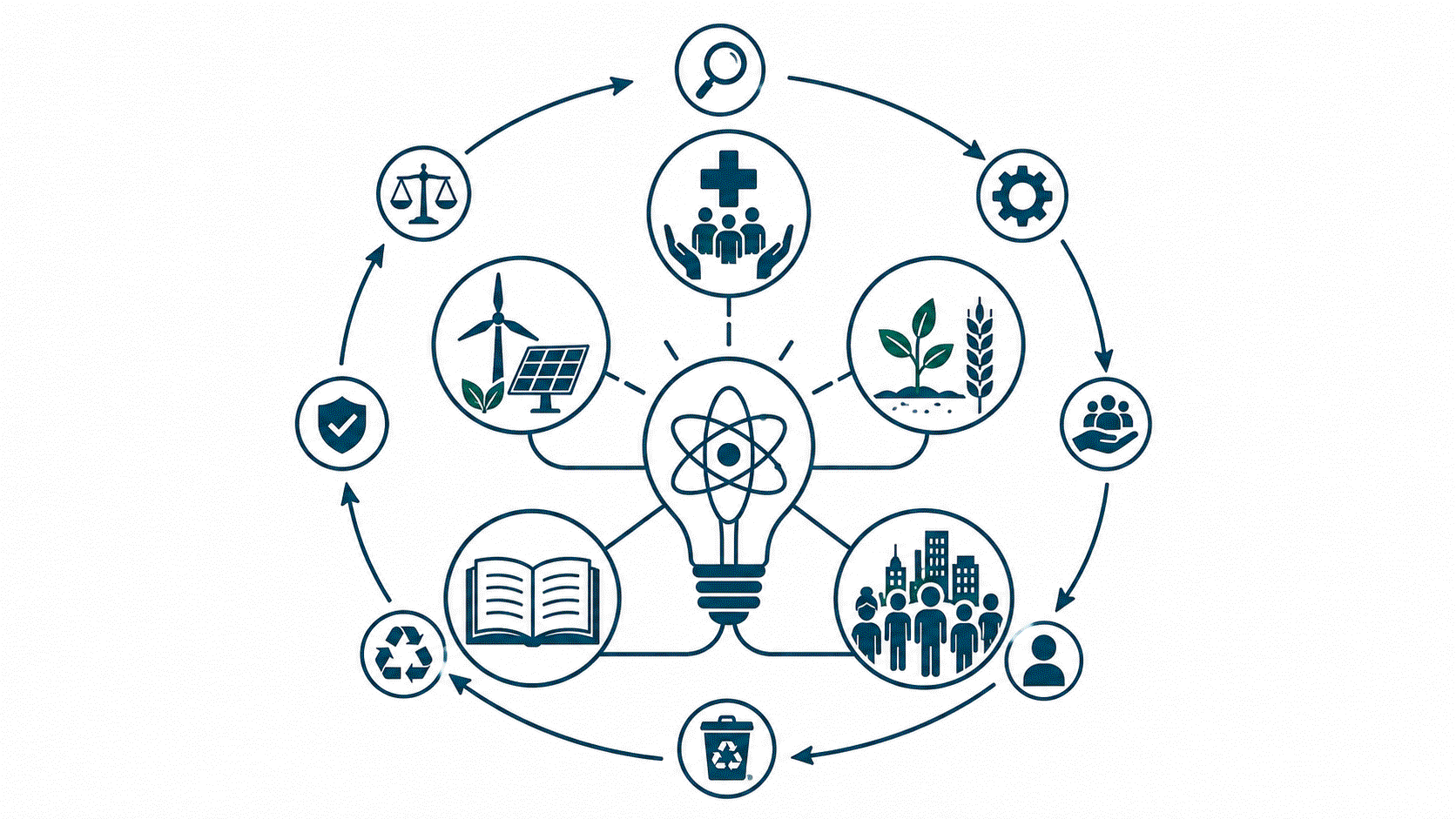
Scientific innovation affects society when research-based knowledge becomes a product, process, method, or system that enters practical use. It can support better health, food systems, energy services, education, communication, public services, and economic activity. It can also reshape work, concentrate benefits, increase resource use, produce waste, and raise concerns about privacy, fairness, control, and accountability.
The outcome depends on more than the quality of the underlying science. Design choices, testing, finance, infrastructure, skills, market incentives, public policy, adoption, maintenance, and disposal all influence what happens after an innovation leaves the research setting.
Answer Summary: Scientific innovation can create substantial social benefits, but positive outcomes do not follow from novelty alone. A sound assessment asks whether an innovation works, who can access it, who receives the gains or bears the risks, what environmental and social costs arise across its life cycle, what remains uncertain, and who is accountable when evidence or circumstances change.
Table of Content
- What Scientific Innovation Means
- How Innovation Produces Social Effects
- Where Scientific Innovation Creates Value
- Where Scientific Innovation Creates Costs and Risks
- Why Benefits and Costs Are Unevenly Distributed
- What Evidence Can and Cannot Establish
- Benefits and Risks Across Sectors
- Six Questions for Evaluating an Innovation
- What Responsible Innovation Looks Like
- What the Evidence Suggests
Key Takeaways:
-
Scientific discovery and scientific innovation are related but distinct.
-
Novelty does not establish effectiveness, safety, fairness, or sustainability.
-
Health, food, energy, education, and services can benefit from science-based change.
-
Exposure to automation is not the same as complete job replacement.
-
Environmental assessment should cover production, use, rebound effects, and disposal.
-
Price, infrastructure, skills, institutions, and market power shape who benefits.
-
Responsible innovation requires evidence, participation, accountability, and continued review.
What Scientific Innovation Means
Scientific innovation refers here to a new or substantially improved product, process, method, or system that depends materially on scientific knowledge, research, or evidence and has entered practical use.
The Organisation for Economic Co-operation and Development defines innovation more broadly as a new or improved product or process that differs significantly from previous products or processes and has been made available to users or brought into use. This article adds a science-based boundary to the definition used in the OECD Oslo Manual 2018.
Several related terms need to remain distinct:
| Term | Meaning in this article |
|---|---|
| Scientific discovery | New knowledge, evidence, or explanation. It may not lead to a practical application. |
| Technology | A tool, technique, capability, or system. Some technologies depend heavily on scientific research, while others develop mainly through design, craft, or practice. |
| Innovation | A new or substantially improved product or process that has been made available or brought into use. |
| Diffusion | The spread and adoption of an innovation among people, organizations, sectors, or countries. |
| Impact | Intended and unintended changes associated with development, adoption, use, scale, and end-of-life handling. |
These distinctions correct two common misconceptions. A discovery does not automatically become an innovation, and a technology does not produce broad social benefit merely because it exists. An application may work technically while remaining unaffordable, inaccessible, difficult to maintain, or unsuitable for a particular setting.
Newness also provides no evidence by itself that an innovation is safer, more effective, fairer, or more environmentally sustainable than an existing option. Those conclusions require relevant evidence and comparison.
How Innovation Produces Social Effects
Scientific innovation produces social effects through a chain of activities and decisions rather than through invention alone.
Life-cycle pathway: Research → development → testing → deployment → diffusion → use and maintenance → adaptation or replacement → disposal
Different questions arise at each stage:
-
Research choices influence which problems receive attention.
-
Testing determines what is known about performance and risk.
-
Deployment depends on finance, standards, infrastructure, and institutional capacity.
-
Diffusion affects whether use remains concentrated or becomes widespread.
-
Maintenance influences reliability and long-term cost.
-
Disposal determines whether waste and pollution are transferred elsewhere.
A product can succeed in controlled testing but perform differently where electricity, training, maintenance, or supply systems are limited. A service can expand in connected urban areas while remaining unavailable or unaffordable elsewhere. A device may reduce emissions during operation while creating material, energy, or waste burdens at other stages.
This systems view explains why invention, adoption, and social impact are not interchangeable. Technical performance is important, but the surrounding institutions and conditions determine whether that performance produces durable public value.
Where Scientific Innovation Creates Value
Scientific innovation can create public value when it addresses a genuine need, performs reliably, reaches intended users, and operates within systems that support safe and sustained use. Evidence about a defined intervention, population, outcome, and period is more useful than broad claims about science as a whole.
Health and Public Health
Scientific innovation can support disease prevention, diagnosis, treatment, surveillance, and health-service delivery. Vaccination provides one of the clearest population-level examples.
A World Health Organization-led analysis published in April 2024 estimated that global immunization efforts had saved at least 154 million lives during the preceding 50 years. The estimate applies to vaccination over that defined period and does not imply that every medical innovation produces a benefit of comparable scale. The methodology and findings are summarized in the WHO immunization impact report.
The health impact depended on more than vaccine discovery. Manufacturing, financing, supply chains, trained health workers, monitoring, public-health systems, community participation, and trust were needed to translate scientific knowledge into population benefit.
Technical effectiveness is necessary, but it may not be sufficient. A health product can be scientifically sound while remaining unavailable, unaffordable, improperly delivered, or difficult to use safely in some settings.
Productivity, Economic Activity, and Services
New products and improved processes can support economic activity, new services, better coordination, and more effective use of knowledge. Benefits often require complementary investment in equipment, skilled workers, data systems, standards, financing, maintenance, or changes in workflow.
A tool that produces gains for a large organization with technical staff may be harder for a small business or public agency to adopt. Aggregate productivity gains can also conceal different outcomes across workers, firms, regions, and countries.
The total effect may be difficult to measure because knowledge is often intangible, outcomes remain uncertain, and effects may appear across markets, institutions, and long periods. Productivity should therefore be assessed alongside job quality, access, environmental costs, and the distribution of gains.
Food and Agriculture
Scientific innovation can support crop and animal health, soil and water management, food safety, storage, logistics, weather information, nutrition, and resilience.
Outcomes depend on local ecology, farm size, land access, finance, infrastructure, extension services, input availability, markets, and local knowledge. A method designed for one production system may be ineffective or costly in another.
Farmers and affected communities can contribute knowledge about local conditions, practical constraints, and unintended effects. Their participation may reveal problems that do not appear during laboratory research or centralized planning.
The useful question is not simply whether an agricultural innovation is advanced. It is whether it solves a defined problem under local conditions without creating costs that outweigh its benefits.
Energy and Climate Mitigation
Scientific innovation can support lower-emission technologies and wider changes in energy and production systems.
The Intergovernmental Panel on Climate Change examines research, technological development, deployment, diffusion, finance, institutional capacity, and international cooperation as connected parts of climate mitigation. Innovation can support climate goals, but it is not sufficient without the conditions needed for adoption and scale. These relationships are assessed in IPCC AR6 Working Group III, Chapter 16.
Policy, finance, infrastructure, technology transfer, supply chains, land use, and public acceptance influence what can be deployed and at what pace. The fairness of a transition also depends on who pays, who receives the benefits, and whether affected workers and communities can participate in decisions.
Readers seeking a focused explanation of the underlying systems can review the science of renewable energy technologies.
Education, Knowledge, and Scientific Collaboration
Science-based tools and open research practices can support communication, collaboration, access to information, and reuse of research outputs.
Access to information does not guarantee equal educational benefit. Devices, connectivity, language, disability access, teacher preparation, privacy protection, and content quality remain important. A digital learning platform has limited value when students lack reliable access or teachers lack the time and support needed to integrate it effectively.
Technology is most useful in education when it strengthens sound teaching and learning practices rather than replacing them without evidence. Collegenp’s article on how technology has changed education examines these conditions in more detail.
Where Scientific Innovation Creates Costs and Risks
Scientific innovation can create costs when evidence is weak, systems are deployed too quickly, access is unequal, incentives reward harmful use, or environmental burdens are ignored. Harm can also occur when a system performs as designed but distributes gains and risks unfairly.
Job and Skill Transformation
Automation can change job tasks, required skills, workplace monitoring, staffing, and the organization of work.
A joint International Labour Organization and NASK study published in May 2025 estimated that one in four workers worldwide were in occupations with some exposure to generative artificial intelligence. The study concluded that job transformation was more likely than complete replacement because many exposed occupations still required human input. The findings and methodology are presented in the ILO and NASK global occupational-exposure report.
Exposure is not a prediction that one in four workers will lose their jobs. It measures the relationship between occupational tasks and the technical capabilities assessed by the study. Actual outcomes depend on adoption, cost, organizational decisions, regulation, worker participation, customer needs, and changes in technology.
Task exposure, task automation, job transformation, and job disappearance are different outcomes. Treating them as interchangeable can produce exaggerated claims about employment.
Workplace decisions also matter. The same system might be used to reduce repetitive work, support employees, intensify monitoring, remove responsibilities, or lower staffing. Training, worker consultation, labor protections, and the distribution of productivity gains shape the outcome.
Unequal Access and Concentrated Benefits
An innovation cannot deliver its intended benefit to people who cannot afford, reach, understand, or safely use it.
The International Telecommunication Union estimated that approximately 6 billion people, or 74 percent of the global population, were using the internet in 2025. It estimated that 2.2 billion people remained offline and reported continuing disparities in affordability, infrastructure, service quality, and skills. The figures are available through the ITU Facts and Figures statistics portal.
Connection statistics do not measure the full quality of access. Two people counted as online may have different devices, connection reliability, digital skills, language support, safety protections, and ability to pay for continued service.
Research capacity and economic gains can also become concentrated among organizations and regions that already control finance, infrastructure, data, intellectual property, or distribution systems.
Collegenp’s article on the digital divide and universal internet access provides a focused explanation of these barriers.
Environmental and Material Costs
Environmental assessment should cover more than the period when a product is operating.
Depending on the technology, production may require energy, water, land, minerals, chemicals, transport, and manufacturing facilities. Use may add electricity or material demand. Repair and maintenance can extend useful life, while rapid replacement can increase waste.
Efficiency improvements can also produce rebound effects. A service that becomes cheaper or easier to use may be used more often, reducing part of the expected resource or emission saving.
These burdens do not cancel every environmental benefit. They mean that the environmental result should be assessed across production, operation, repair, replacement, and end-of-life handling rather than through one stage alone.
The environmental footprint may also differ by location. Electricity sources, water availability, manufacturing standards, waste systems, and supply chains affect the result. Collegenp’s article on the environmental impacts of artificial intelligence provides a sector-specific example.
Ethical, Privacy, and Governance Concerns
Scientific innovation can affect privacy, autonomy, dignity, fairness, safety, and the ability to challenge decisions.
These risks become harder to manage when a system is difficult to inspect, data collection is unclear, an affected person cannot appeal, or responsibility is divided among researchers, developers, vendors, governments, and users.
A technically accurate system may still be used in a setting where its purpose, oversight, or consequences are unacceptable. Evidence about performance does not settle every ethical or political question.
Governance should therefore consider:
-
what information is collected;
-
who controls the system;
-
whether affected people understand its use;
-
whether decisions can be questioned;
-
how errors or harms are addressed;
-
whether responsibility is clearly assigned.
The level of oversight should reflect the seriousness of the possible consequences. A research-support tool does not require the same controls as a system affecting health care, employment, public benefits, or legal rights.
Why Benefits and Costs Are Unevenly Distributed
The same innovation can produce different outcomes because users and institutions do not begin with equal resources, infrastructure, skills, influence, or exposure to risk.
Important conditions include:
-
Price and financing: Purchase costs, subscriptions, maintenance, replacement, and access to credit affect adoption.
-
Infrastructure: Electricity, transport, laboratories, clinics, connectivity, and supply chains shape practical use.
-
Skills and language: People need relevant knowledge, support, understandable information, and accessible design.
-
Institutions: Standards, public services, research systems, procurement, and regulatory capacity influence quality and reach.
-
Market power: Control of data, intellectual property, platforms, equipment, or distribution can concentrate gains.
-
Geography and environment: Distance, climate, local resources, and rural or urban conditions affect suitability.
-
Time: Early users may gain before prices fall, evidence improves, or governance develops.
-
Social position: Income, gender, disability, occupation, and legal status can affect access and exposure to harm.
Global averages can conceal major differences. Higher productivity does not show how gains are shared. An increase in connectivity does not show affordability or service quality. Lower operating emissions do not reveal where materials were obtained or who manages the waste.
A distributional assessment asks four linked questions:
-
Who gains?
-
Who pays?
-
Who decides?
-
Who carries risks that may not appear in the headline measure?
These questions move the discussion beyond a simple list of advantages and disadvantages. They show how social institutions and power influence the practical effects of innovation.
What Evidence Can and Cannot Establish
Evidence can establish defined effects under specified conditions, but it cannot support one universal verdict about scientific innovation across every sector and society.
Several limitations need to remain visible:
-
A strong result for one intervention does not prove that all science-based products have the same effect.
-
Occupational exposure does not equal adoption, unemployment, or complete replacement.
-
A modelled estimate or projection is not an observed outcome.
-
A global or national average does not show how effects are distributed within populations.
-
Evidence of technical effectiveness does not settle questions of fairness, affordability, rights, or public priorities.
-
Agreement about a scientific mechanism can coexist with uncertainty about scale, timing, distribution, and future behaviour.
-
Novelty does not establish superiority over existing alternatives.
Readers evaluating a claim should check:
-
Who produced the evidence?
-
What population, place, and period were studied?
-
Was the result observed, estimated, or projected?
-
What comparison was used?
-
Does the wording claim association, causation, or possibility?
-
What limitations did the original source report?
-
Has newer evidence replaced the finding?
Collegenp’s guide to evaluating research evidence and overclaims provides a more detailed evidence-literacy framework.
Benefits and Risks Across Sectors
The effects of scientific innovation differ by sector, location, population, and stage of adoption. The table is an analytical summary rather than a scoring system or a prediction that every listed outcome will occur.
| Sector | Potential benefits | Main risks or limits | Distribution question |
|---|---|---|---|
| Health | Prevention, diagnosis, treatment, surveillance, service delivery | Weak evidence, unsafe use, cost, supply gaps, mistrust | Who receives safe and affordable care? |
| Work and services | Productivity support, new services, reduced routine work | Task loss, monitoring, deskilling, unequal gains | Who controls the system and shares the gains? |
| Food and agriculture | Resilience, food safety, resource management, improved information | Local mismatch, dependency, cost, ecological trade-offs | Can smaller producers access and adapt it? |
| Energy and climate | Lower-emission options, improved performance, system change | Material demand, land use, pollution, rebound effects | Who pays for the transition and who benefits? |
| Education and knowledge | Wider access, collaboration, reusable research | Connectivity gaps, weak content, privacy concerns | Who has meaningful access and support? |
| Digital systems | Faster communication and wider service reach | Exclusion, concentration, security and privacy risks | Are access, skills, and accountability broadly available? |
Each row requires evidence about the specific technology, setting, affected population, and period. An innovation should not be judged only through the category to which it belongs.
Six Questions for Evaluating an Innovation
No single formula measures the total social value of every innovation. The following framework helps readers compare evidence, access, distribution, environmental effects, uncertainty, and accountability.
| Question | Core test | Evidence to seek |
|---|---|---|
| 1. Does it work? | Does it address the stated problem under realistic conditions? | Study design, comparison with alternatives, real-world outcomes, failure rates |
| 2. Who can access it? | Can intended users afford, reach, understand, and use it safely? | Price, infrastructure, language, disability access, training, geography |
| 3. Who gains and who bears risk? | How are benefits, losses, and risks distributed? | Effects on users, workers, communities, non-users, and future generations |
| 4. What is the full life-cycle cost? | What happens during production, use, maintenance, and disposal? | Energy, water, materials, pollution, repair, rebound effects, waste |
| 5. What remains uncertain? | Which conclusions are established, limited, disputed, or untested? | Sample, period, assumptions, transferability, data gaps, unintended effects |
| 6. Who decides and responds? | Is responsibility clear if evidence changes or harm occurs? | Oversight, participation, transparency, monitoring, appeal, redress |
The first question prevents novelty from replacing evidence. The second and third examine meaningful access and distribution. The fourth checks whether a benefit at one stage creates costs elsewhere. The fifth keeps uncertainty attached to the claim. The sixth connects technical performance with governance and responsibility.
The framework can be applied to vaccines, agricultural methods, energy systems, digital platforms, research tools, and emerging technologies. The evidence required will differ, but the questions remain useful.
What Responsible Innovation Looks Like
Responsible innovation connects scientific and technological development with social needs, public values, trust, and accountability.
In practice, a responsible approach may include:
-
defining the public problem before selecting a technical response;
-
testing performance and safety under realistic conditions;
-
involving affected communities, workers, users, and relevant specialists;
-
examining access, affordability, disability inclusion, and language;
-
assessing material, energy, pollution, and disposal effects;
-
protecting privacy, dignity, rights, and routes for appeal;
-
making evidence and uncertainty available where openness is safe and lawful;
-
monitoring outcomes after deployment;
-
revising, limiting, or withdrawing a system when evidence changes.
Responsible innovation does not mean eliminating every uncertainty before action. That may be impossible. It means identifying important uncertainties, monitoring outcomes, assigning responsibility, and retaining the ability to respond when new evidence appears.
Governance needs differ by technology, risk, jurisdiction, and institutional capacity. A low-risk research tool does not require the same oversight as a system affecting medical care, employment, public benefits, or legal rights.
What the Evidence Suggests
Scientific innovation is neither automatic social improvement nor inevitable harm. It is a pathway through which scientific knowledge enters practical life, and its effects are shaped by evidence, institutions, markets, infrastructure, skills, public choices, and the distribution of power.
Science-based change can generate substantial benefits. The estimated global effect of vaccination is one strong example. Evidence also documents occupational transformation, unequal digital access, concentrated benefits, environmental pressures, and ethical concerns.
The most defensible judgment is therefore case-specific. Readers need to ask whether an innovation works, who can use it, who gains or bears risk, what happens across its life cycle, what remains uncertain, and who is responsible when circumstances change.
Scientific progress can expand what society is capable of doing. Whether that capability produces broad public value depends on the choices made during research, development, adoption, governance, and distribution.







Comments 0
No comments yet. Be the first to start the conversation.