



Foundations of State Functioning in Nepal
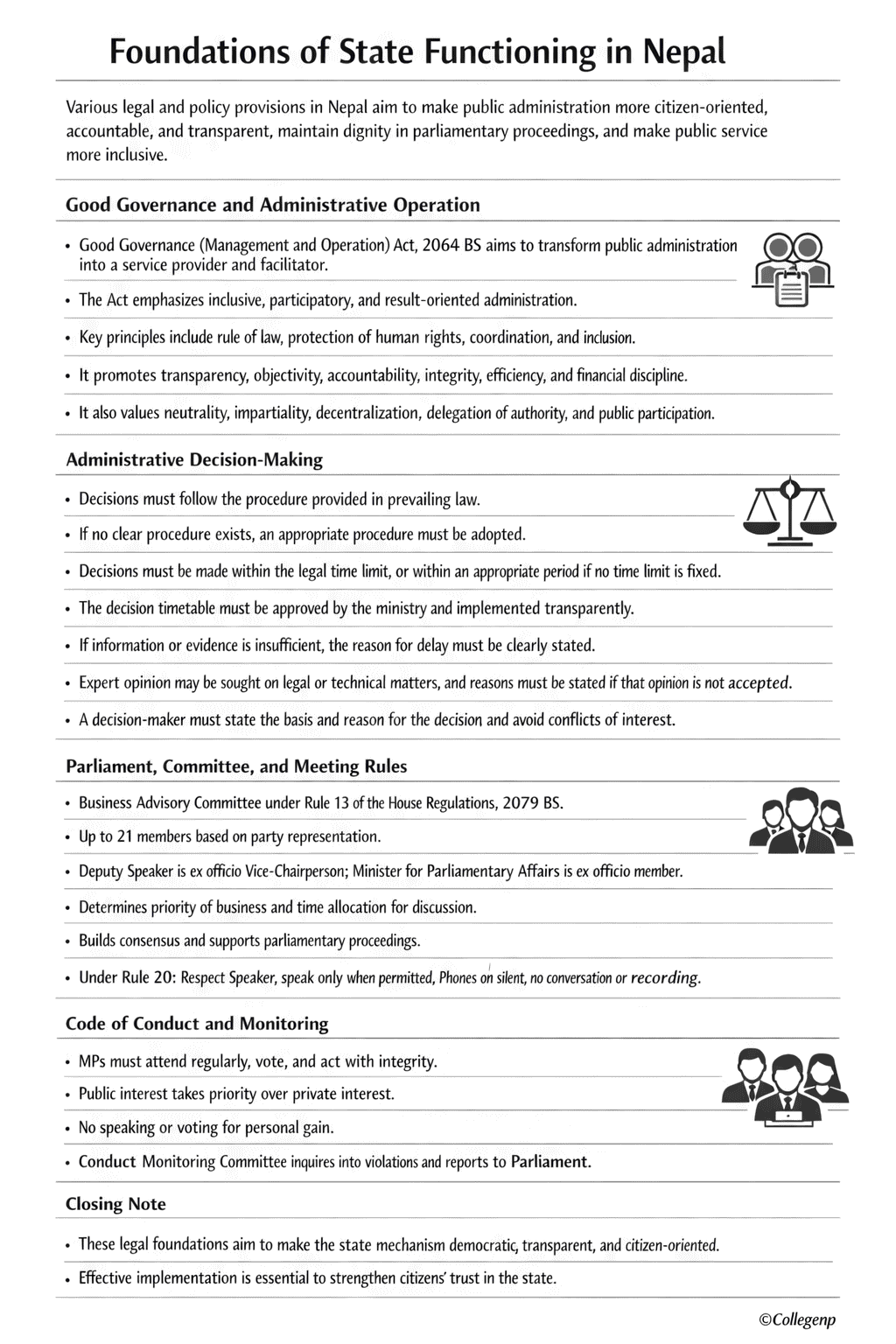
Various legal and policy provisions are in force in Nepal to make public administration more citizen-oriented, accountable, and transparent, to maintain dignity in parliamentary proceedings, and to make public service more inclusive.
From the Good Governance (Management and Operation) Act, 2064 BS, to the House of Representatives Regulations, 2079 BS, and the provisions of the Teachers Service Commission, these frameworks provide clear guidance for the responsible and lawful functioning of state institutions.
These provisions are aimed at making administrative decisions objective, ensuring that the legislature proceeds in a lawful manner, and making the supply of human resources in the education sector fair and inclusive.
For broader context on Nepal’s administrative system, these legal frameworks show how governance, legislative conduct, and public service delivery are expected to function within a democratic state.
Foundations of Good Governance and Administrative Operation
To guarantee good governance in the country, public administration needs to be transformed into a service provider and facilitator. To address this goal, the Good Governance (Management and Operation) Act, 2064 BS emphasizes making the administrative system inclusive, participatory, and result-oriented.
The Act sets clear foundations for administrative operation. It places the broader interest of the nation and the people above all else.
In addition, it identifies the rule of law, the protection of human rights, coordination, and inclusion as key operational principles. Its central spirit is to keep administration free from corruption, efficient, and financially disciplined, while maintaining transparency, objectivity, accountability, and integrity.
The Act also gives importance to maintaining the neutrality and impartiality of the administrative mechanism, ensuring public access to decision-making processes, promoting decentralization and delegation of authority, and increasing public participation through the maximum use of local resources.
Legal Guidance in Administrative Decision-Making
Administrative decisions affect citizens, the private sector, and government bodies themselves, from routine operations to complex policy matters. Therefore, the Act prescribes definite procedures and standards to make the decision-making process of public officials transparent and systematic.
When making any decision, the procedure provided in prevailing law must be followed. If the law does not clearly provide a procedure, an appropriate procedure must be adopted based on the nature of the matter.
Timely decision-making is treated as another important indicator of good governance. A decision must be made within the time limit prescribed by prevailing law. If no time limit has been fixed, the concerned authority must decide within a period considered appropriate.
The decision timetable must be approved by the ministry and implemented transparently. If a decision cannot be made on time due to lack of sufficient information or evidence, the officer concerned is required to clearly state the reason.
To promote transparency, there is a provision to seek the opinion and advice of subordinate staff while making decisions. In matters that require decision-making at different levels, the official at each level must present a clear opinion and conclusion. If any issue arises on that basis, the final decision-maker must address it.
Where a legal or technical issue needs to be resolved, the opinion of the relevant expert may be sought. If such expert opinion is not accepted as the basis of the decision, the reason for not accepting it must also be stated.
The Act further requires an administrative officer to clearly state the basis and reason for any decision, not evade responsibility, comply with official and professional conduct, and consult stakeholders and civil society when necessary.
It also contains a strict provision against deciding matters involving a conflict of interest. If there is a situation where the decision would directly benefit the officer, a close relative, or a member of the joint family in terms of interest or business, the concerned officer must not decide the matter and must hand over that responsibility to an equivalent or one-level higher authority.
Parliamentary Dignity and the Business Advisory Committee
Parliament is the supreme forum where the representatives of the sovereign people make laws and discuss national issues. To make its proceedings orderly and effective, provision has been made for a Business Advisory Committee as a coordinating mechanism between the Speaker and Parliament.
According to Rule 13 of the House of Representatives Regulations, 2079 BS, this committee is formed under the chairpersonship of the Speaker and may have up to 21 members based on party representation in Parliament.
The Deputy Speaker serves as the ex officio Vice-Chairperson, and the Minister for Parliamentary Affairs serves as an ex officio member. As needed, the Speaker may invite other members. Meetings of this committee are held regularly while Parliament is in session and, at other times, as required.
Role of the Committee
The main responsibility of the committee is to determine the priority of matters to be presented in meetings and the time to be allocated for discussion.
Through dialogue among political parties, the committee helps build maximum consensus and create an environment for the smooth conduct of meetings. It also advises the Speaker on conducting the overall parliamentary business in a democratic and lawful manner.
Rules to Be Followed in House Meetings
To uphold the dignity of Parliament, Rule 20 of the House of Representatives Regulations, 2079 BS sets strict rules for members to follow during meetings.
When the Speaker enters the chamber, all members must stand in respect. After the meeting ends, members may leave the chamber only after the Speaker has exited.
Members may speak only after being given time by the Speaker, and they must speak from the designated place while addressing the Speaker.
Members may not leave their place while the Speaker is speaking. They must listen attentively and are not allowed to walk between the Speaker’s chair and the member who is speaking.
Likewise, no one may engage in conduct that disrupts the meeting or breaches decorum. Members may not read books or newspapers unrelated to the proceedings. Phones must be kept on silent mode, and conversation or recording through phones is prohibited.
Code of Conduct for Members of Parliament and the Monitoring Mechanism
To ensure that members of Parliament remain aware of their official responsibilities, stay free from conflicts of interest, and maintain ethical conduct, the House of Representatives Regulations apply a clear code of conduct.
Members are required to behave in a manner consistent with prevailing social morality, attend meetings and committees regularly, exercise their voting rights, and perform their duties faithfully and honestly.
Members must always give priority to the public interest. If a conflict arises between private and public interest, they must stand in favor of the public interest.
They may not speak or vote in meetings for personal or financial gain. Confidential information obtained by virtue of office may not be turned into a matter of financial transaction.
If a member has a personal interest in a matter under consideration, that member must inform the House or committee and is ethically bound not to participate in the discussion.
Conduct Monitoring Committee
To ensure implementation of this code of conduct, there is a Conduct Monitoring Committee in the House of Representatives.
This committee is chaired by the Speaker. The Deputy Speaker serves as Vice-Chairperson, the Leader of the Opposition serves as a member, and 12 members nominated by the Speaker on the basis of party representation also serve on the committee.
The Secretary-General of the Federal Parliament serves as the secretary of the committee.
Powers of the Committee
Based on information or complaints regarding violation of the code of conduct, the committee has the authority to conduct an inquiry, obtain information from the concerned member, person, or media outlet, make decisions based on facts, and submit a report to Parliament.
Qualifications and Inclusion in Teacher Service
Like administration and the legislature, the education system is also regarded as an important area of public service delivery. Policy provisions have therefore been made to make it fair and inclusive.
For the fulfillment of permanent teacher posts in community schools, the Government of Nepal has established the Teachers Service Commission.
The teaching license process and related eligibility provisions are an important part of this structure in the school education system.
Eligibility Standards
The Teachers Service Commission Regulations, 2057 BS set clear standards for selecting qualified candidates.
Accordingly, non-Nepali citizens, persons below 18 years of age, and persons who have completed 40 years of age are considered ineligible for teacher posts. However, the age limit does not apply to teachers who already hold permanent appointment and are currently in service.
In addition, persons convicted by a court in a criminal case involving moral turpitude, persons dismissed in a way that disqualifies them from future government service or teacher service, persons without a teaching permit or license, and persons who have not completed the training required by law are not eligible to become candidates for teacher posts.
Reservation and Inclusion Practice
To bring all sections of society into the mainstream of the education sector, the commission has implemented a special reservation arrangement.
Of the total posts to be filled through open competition in approved positions, 33 percent of the posts are set aside for reservation. This 33 percent is treated as 100 percent and posts are filled through separate competition among different marginalized groups.
This provision supports wider inclusion in education governance and teacher recruitment.
Reserved Categories
Under this reservation structure, 33 percent of the reserved seats are allocated to women, and 27 percent are allocated to Indigenous Nationalities.
Likewise, 22 percent of the seats are allocated for Madhesi, Indigenous Nationalities, Dalit, backward class, or minority communities residing in the Tarai-Madhesh.
A separate 9 percent of the seats is allocated to the Dalit community, and 4 percent is allocated to the backward community.
This policy has helped develop teacher service as a true reflection of society and support a fair distribution of opportunity.
Conclusion
Overall, administrative accountability through the Good Governance Act, parliamentary dignity and oversight through the House of Representatives Regulations, and the guarantee of inclusive public service through the provisions of the Teachers Service Commission have created a strong foundation for making Nepal’s state mechanism democratic, transparent, and citizen-oriented.
Only the effective implementation of these legal foundations can strengthen citizens’ trust in the state.







Comments 0
No comments yet. Be the first to start the conversation.