



Nepal’s Administrative System: Historical Evolution, Federal Structure, and Dimensions of Reform
The administrative mechanism is the backbone of any nation. In Nepal’s context, public administration is not only a means of implementing government policies, but also a bridge that connects the state and its citizens.
After the promulgation of the Constitution of B.S. 2072, Nepal transitioned from a unitary state system to a federal governance system. This has brought the most significant transformation in Nepal’s administrative history.
An administrative system is not merely a group of employees or an arrangement of offices. It is a complete framework of laws, procedures, values, norms, and accountability toward public service. From the Licchavi period to the present federal democratic republican era, Nepal’s administration has experienced many ups and downs and transformations.
Table of Content
- Nepal’s Administrative System: Historical Evolution, Federal Structure, and Dimensions of Reform
- Nepal’s Administrative History: A Brief Review
- Administrative Structure of Federal Nepal (Current Form)
- Civil Service: The Permanent Administrative Mechanism
- Serious Problems in Nepal’s Administration
- Practical Solutions (The Way Forward)
- The Role of Youth and the Attraction of Public Service
- Conclusion
- Research and References
Nepal’s Administrative History: A Brief Review
Nepal’s current administrative form was not built overnight. It is the outcome of centuries of political change, social needs, and foreign influence.
To understand any country’s administration, it is essential to examine its historical foundation carefully, because past practices shape the present work culture and administrative tendencies.
Ancient and Medieval Era: Administration Based on Religion and Community (Licchavi and Malla Periods)
Nepal’s administrative history appears systematic from the Licchavi period itself. One major reason this era is considered a “golden age” is its strong administrative mechanism.
In the Licchavi period, although the king was at the center of governance, the administration was largely decentralized. High-level bodies such as “Antarasan” (the king’s private court) and “Parmasan” carried out judicial functions.
For public-level service delivery, there were specialized offices or authorities, such as:
-
Kuther (land administration and revenue)
-
Shulli (five major offenses or criminal matters)
-
Lingwal (canals, roads, and public construction)
-
Mapchok (marriage and family matters)
The strongest feature of this era was the “Panchali” practice, which represented an early and genuinely democratic form of local government. Local communities were directly involved in village development and dispute resolution.
By the Malla period, this system became more developed. The Malla kings created various “Guthi” institutions and administrative offices to promote trade, art, and religion, linking administration closely with citizens’ daily lives.
Shah and Rana Administration: Centralized and Command-Oriented Style (From Unification to 2007)
With Prithvi Narayan Shah’s territorial unification, Nepal’s administration shifted toward a military and security-based structure.
The “Divya Upadesh” served as a guiding principle for administration at that time, with clear instructions on controlling corruption and maintaining a just system. The “Tharghar” (a group of elite families) and the “Bhardari Sabha” advised the king in policy-making. However, the system was more focused on state expansion and stability than on citizen-centered governance.
After Jung Bahadur Rana rose to power in B.S. 1903, Nepal’s administration turned into “family-based authoritarian rule.” The Ranas used administration as a tool to eliminate opponents and collect revenue.
Institutions such as the following were established:
-
Commandery Kitabkhana (maintaining employee records)
-
Munshikhana (foreign affairs)
-
Jangi Adda (military administration)
However, employee selection was conducted through the “Pajani” practice, which required annual job renewal. As a result, professional competence was overshadowed by a culture of pleasing the rulers.
An important achievement of this era was the effort to bring administration under a legal framework through the “Muluki Ain” of B.S. 1910.
Foundation and Transformation of Modern Administration (2007 to 2072)
After the establishment of democracy in 2007, Nepal’s administration began shifting from the mindset of a “ruler” to that of a “servant.”
For the first time, the “Buch Commission” (2009), formed under Indian administrative expert N.M. Buch, presented a merit-based civil service model for Nepal.
Building on this foundation, in B.S. 2013, under the leadership of then Prime Minister Tankaprasad Acharya, the Civil Service Act and the active role of the Public Service Commission began. This laid the basis for a stable and professional administration.
During the Panchayat era, commissions were formed for administrative reform in B.S. 2025 under Bhedananda Jha and in B.S. 2032 under Dr. Bhesh Bahadur Thapa. These commissions aimed to decentralize administration and introduce the concept of Development Administration, but the centralized nature of power kept reforms largely limited to paperwork.
After the political change of 2046, the “High-Level Administrative Reform Commission” formed in 2048 (under the leadership of Girija Prasad Koirala) made many recommendations to align administration with a liberal economy and democratic values. As a result, modern concepts such as inclusion, transparency, and citizen charter entered administrative practice.
However, political instability and conflict slowed these reforms, further strengthening the need for federalism in 2072.
Administrative Structure of Federal Nepal (Current Form)
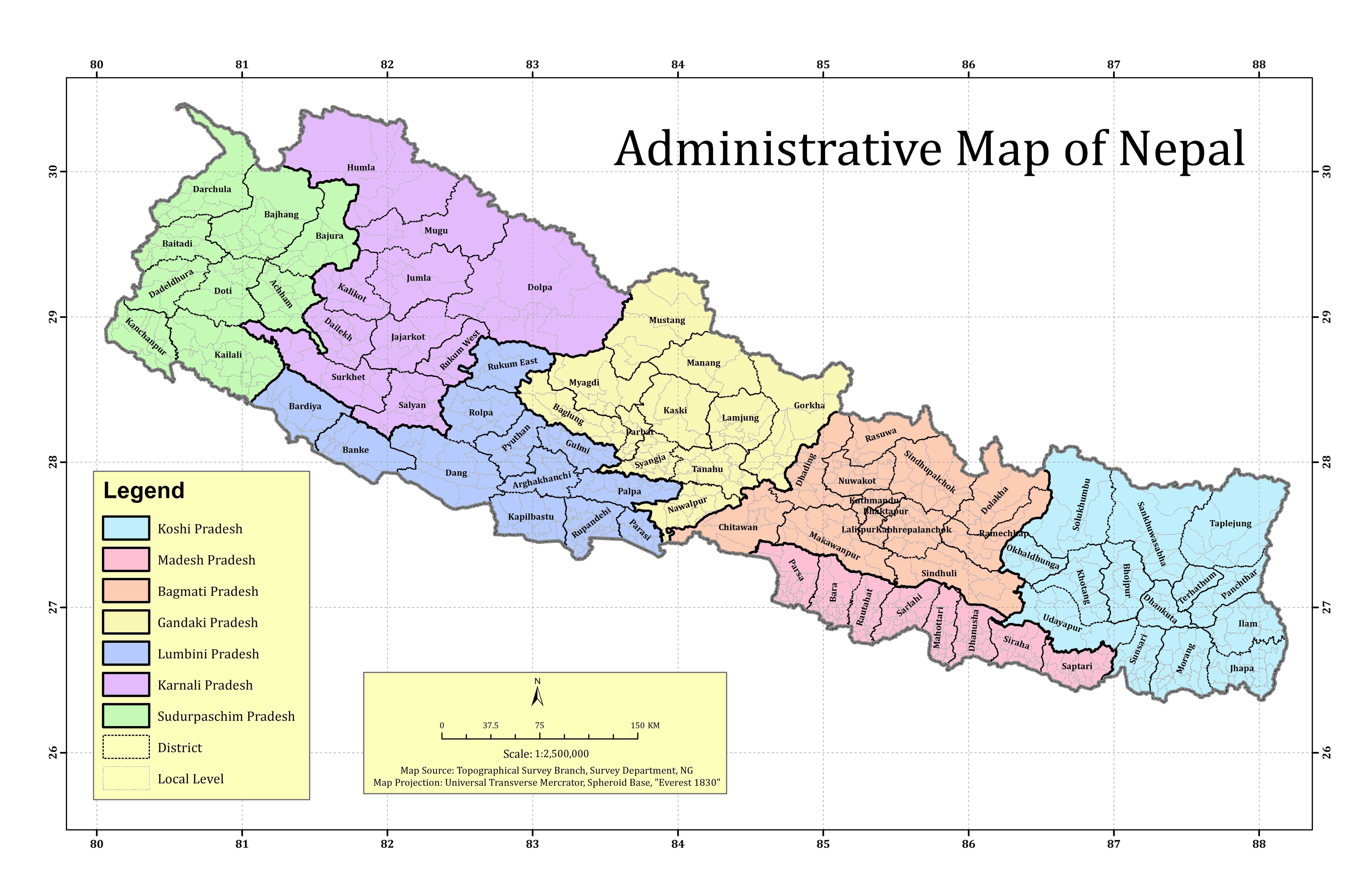
With the Constitution of Nepal (2072) transforming Nepal from a unitary system to a federal framework, the administrative structure has also undergone a fundamental change.
This change is not only geographical division, but also the “devolution of power and authority.” Based on the principle of “cooperation, coexistence, and coordination,” the new administrative model aims to bring the state’s presence from the center to citizens’ doorsteps.
The current administrative structure can be analyzed across three levels.
Federal Administration (Central or Federal Level)
Federal administration is the top level of Nepal’s administrative pyramid. Its primary role is focused on policy-making, setting national standards, national security, foreign relations, and managing large-scale infrastructure.
Office of the Prime Minister and Council of Ministers (OPMCM)
This is the “nerve center” of Nepal’s overall administrative mechanism. It coordinates among ministries, monitors national priority plans, and facilitates cabinet decisions administratively.
The Chief Secretary leads this institution administratively and is the highest-ranking civil servant in Nepal’s bureaucracy.
Federal Ministries
At present, there are 22 ministries at the federal level. Each ministry is politically led by a minister and administratively led by a Secretary of the special class.
Ministries formulate national policies and laws for their subject areas (such as education, health, and finance).
Constitutional Bodies
Constitutional bodies play an important role in ensuring cleanliness and accountability in administration.
-
The Public Service Commission safeguards the merit-based system (Meritocracy).
-
The Commission for the Investigation of Abuse of Authority works to control corruption.
-
The Office of the Auditor General ensures transparency and auditing of government expenditure.
Provincial Administration (Middle Level)
As a new federal practice, seven provinces have established their own administrative structures. This level works as a bridge between the federal and local levels.
Office of the Chief Minister and Council of Ministers
This is the central hub for provincial administrative leadership and coordination. A “Chief Secretary” (special class) assigned by the federal government manages the administrative command and acts as an administrative link between the province and the federation.
Provincial Ministries
To implement subjects under the provincial authority list (such as provincial police, agriculture, irrigation, and local roads), each province has ministries and directorates under them.
Provincial Public Service Commission
This commission functions autonomously to select technical and administrative human resources required for the province and to support local levels in staff recruitment.
Local Administration (Basic or Grassroots Level)
Local administration is the level that turns the concept of “Singhadurbar in every village” into reality. It remains in direct contact with citizens and serves as the frontline of service delivery.
753 Local Units
Under this structure, there are:
-
6 Metropolitan Cities
-
11 Sub-Metropolitan Cities
-
276 Municipalities
-
460 Rural Municipalities
These units are not only administrative entities, but “local governments” that exercise constitutional authority.
Chief Administrative Officer (CAO)
The Chief Administrative Officer functions as the executive and administrative head of the local level. The CAO is responsible for implementing decisions of the local executive, allocating budgets, and managing employee administration.
Ward Offices
This is the lowest and most effective unit of administration. The ward level handles:
-
Registration of personal events such as birth, death, and marriage
-
Issuing various recommendations
-
Implementing small local plans at the community level
Citizens often experience the state’s presence for the first time through the ward office.
Nepal’s current administrative structure has prevented excessive centralization of power. However, challenges remain regarding staff adjustment, resource distribution, and legal ambiguity among federal, provincial, and local levels. Only when all three levels work as complementary systems can citizens fully receive the real benefits of federalism.
Civil Service: The Permanent Administrative Mechanism
In Nepal’s administrative system, the civil service is often called the “Permanent Government.”
Political leadership elected through elections (the periodic government) changes over time after setting policies and directions. However, institutionalizing, implementing, and ensuring the state’s presence to citizens is mainly carried out by civil servants.
Since civil servants are selected through intense competition by a constitutional and impartial body like the Public Service Commission, the dignity and credibility of the civil service remain high in Nepal.
Civil service is not merely a means of employment. It is a primary tool to demonstrate the state’s capacity, legitimacy, and effectiveness. Its fundamental features can be analyzed as follows.
Merit System and Impartiality
The strongest pillar of the civil service is the “merit system.” Nepal’s Public Service Commission examination system is widely viewed as highly credible and impartial.
Regardless of nepotism, favoritism, or political influence, employees are selected based on intellectual ability, writing skills, and interview performance. This ensures the entry of the country’s best minds into state administration.
This system prioritizes “capability” over “connections.”
Political Neutrality and Commitment to Implementation
The first duty of a professional bureaucracy is “political neutrality.” This means that regardless of personal political beliefs, employees should not act for or against any political party in the workplace.
No matter which party or ideology leads the government, civil servants must implement prevailing laws and lawful government decisions without hesitation. Providing objective, evidence-based advice during policy-making and implementing decisions honestly after they are finalized is the core spirit of neutrality.
Hierarchical Structure and Professional Chain of Command
Nepal’s civil service has a clear hierarchical structure. It is broadly divided into:
-
Gazetted
-
Non-gazetted
This structure, led by the Chief Secretary, includes positions such as Secretary, Joint Secretary, Under Secretary, Section Officer, and assistant-level staff.
This hierarchy ensures “unity of command” and “clarity of accountability.” Each level has defined powers and responsibilities, enabling organized execution of large administrative tasks.
Secure Career Development and Legal Protection (Tenure Security)
After entering the civil service, employees receive strong legal protection under the Civil Service Act. Employees cannot be removed based on political retaliation or personal interests.
The assurance of serving until a specified age (currently 58 years), opportunities for timely promotion, training, pension, and gratuity creates a stable environment to work. This security allows civil servants to focus on long-term planning.
Inclusion and Social Representation
After the People’s Movement of 2062/63, a new dimension of “inclusion” was introduced into Nepal’s civil service.
Currently, 45% of seats are reserved for:
-
Women
-
Indigenous nationalities (Adivasi/Janajati)
-
Madhesi
-
Dalit
-
Persons with disabilities
-
People from backward regions
This has ensured representation from all geographies, castes, and communities in Nepal’s administration. It supports a more people-oriented and multi-dimensional administrative system, helping services reach all citizens more easily.
The civil service is the nation’s intellectual asset. Only if this mechanism becomes capable, impartial, and technology-friendly can the country achieve its goal of prosperity. Keeping it free from political interference and making it more professional is today’s key necessity.
Serious Problems in Nepal’s Administration
Long experience and research show that Nepal’s administration faces both structural and practical challenges.
Implementation Gap
In Nepal, policies and plans are often well-designed, but delays appear at the implementation stage. The failure to complete national pride projects on time is a major result of this gap.
Excessively Centralized Mindset
Although the Constitution has delegated authority to local levels, resources, tools, and administrative mindset remain center-focused (Singhadurbar-centered). Provinces and local levels lack adequate autonomy in staff management.
Corruption and Lack of Integrity
The compulsion to rely on “middlemen” or offer “gifts” even for small services has not been fully eliminated. Policy corruption is another major challenge.
Trade Unions and Politicization
Party-based trade unions within the civil service have encouraged political interference in transfers, promotions, and postings. This has weakened administrative professionalism.
Low Use of Technology
Despite slogans like “Digital Nepal,” many government offices still rely heavily on paper files and a “basket system,” causing delays in service delivery.
Practical Solutions (The Way Forward)
It is not enough to identify problems alone. Practical pathways for solutions must also be found.
Immediate Need for a Federal Civil Service Act
It is unfortunate that even after so many years since the Constitution was promulgated, the Federal Civil Service Act has not been introduced. This Act must clearly define relationships and career development pathways for employees across federal, provincial, and local levels.
Result-Oriented Performance System
Employee evaluation should not be based only on attendance, but on delivered results. The principle of “reward those who work and penalize those who do not” must be strictly implemented.
Full Digitalization (E-Governance)
Every government service must be brought into an online system. If citizens can receive services from home, corruption naturally decreases. A “faceless” and “paperless” administration is a current necessity.
Citizen Charter and Service With Compensation
The citizen charter displayed in government offices should not be only for display. If services are not delivered within the stated time, a strict system must be enforced to make responsible employees compensate citizens.
Employee Morale and Career Development
Employee remuneration should be adjusted according to inflation and current living standards so that staff do not fall into temptation. Regular training must also be arranged to strengthen capacity development.
The Role of Youth and the Attraction of Public Service
Nepal is currently in a “demographic dividend” phase, with a significant number of active and educated youths.
Integrating this energetic workforce into the nation’s core administrative stream is not only a necessity, but also an essential condition for state transformation. Today’s aware youth view Nepal’s administration beyond the traditional job-seeking mindset.
Unbroken Trust in the Public Service Commission
While many public institutions in Nepal are criticized due to political interference and instability, the Public Service Commission stands as an institution that has preserved its impartiality and credibility for decades.
The deep belief that “only those who study and have capability succeed” is why millions of youths—from remote villages to city corners—remain dedicated to preparing for public service. This trust is the greatest asset of Nepal’s administrative system.
Why Join the Civil Service? Not Just a Job, But an Opportunity
For many, civil service may appear as a secure job with a pension. But in depth, it is a rare opportunity to participate directly in “state governance.”
Key opportunities include:
-
Contribution to policy-making: A draft or opinion prepared by a Section Officer or Under Secretary can influence national policy. Youth can use academic knowledge and new perspectives at the policy level.
-
Direct public service: Working as a Chief Administrative Officer at the local level or as an Assistant Chief District Officer enables immediate response to citizens’ problems. From distributing senior citizen allowances to rescue operations during disasters, the satisfaction gained is rarely found in corporate jobs.
-
Social prestige and stability: In Nepali society, holding a high administrative position is regarded with great respect. Career security and pride in being part of the state’s backbone are major attractions.
Agents of Change and Innovation
Nepal’s administration still carries the influence of rigidity and “red tapism” to some extent. Older generations of staff have valuable experience, but in many cases, adapting to technology and a rapidly changing global environment presents challenges.
Here, the youth’s role becomes decisive.
Technology-Friendly Administration
Today’s youth are “digital natives.” They can simplify complex paper-based procedures through e-governance and digital signatures.
Innovative Thinking
Instead of being trapped in old files and past precedents, youth often ask, “How can this be done faster and more transparently?” They can transform administration from “command and control” into “facilitation and service.”
Integrity and Ethics
The new generation has strong awareness of accountability and zero tolerance toward corruption. This helps reduce policy-level and practice-level corruption present in public administration.
Only the youth have the power to transform Nepal’s administrative system from “Singhadurbar-centered governance” into “service at citizens’ doorsteps.” If the country’s best talents enter administration through public service, the goals of good governance and economic prosperity will not remain distant.
Therefore, the new generation must move forward, understanding the civil service not merely as a livelihood but as a great national mission of nation-building. Only the arrival of youth can modernize Nepal’s administration into a truly people-oriented and technology-friendly system.
Conclusion
Nepal’s administrative system is passing through a transitional period. Shifting from a unitary framework to a federal framework is itself a complex process.
Structures have been formed, but the “work culture” within those structures remains largely old.
Administration is not a machine; it is a living system. To make it successful, laws and regulations alone are not enough. The intention, ethics, and commitment of the people involved are equally important.
Unless the mentality develops to become a “servant” rather than a “ruler,” no administrative reform will become meaningful.
Making Nepal’s public administration clean, capable, impartial, transparent, corruption-free, and accountable to citizens is the major responsibility of today. For this, strong political will in leadership and professional ethics in administrative leadership are essential.
Research and References
-
Constitution of Nepal (2072): Administrative provisions in Article 285 and Parts 13, 14, and 15.
-
Civil Service Act, 2049 and Regulations, 2050: Foundation of employee administration.
-
Reports of Administrative Reform Commissions (2048, 2070): Suggestions for administrative reform in Nepal.
-
Annual Report of the Public Service Commission: Statistics on the merit system and human resource management.
-
Good Governance (Management and Operation) Act, 2064: Provisions on transparency and accountability in public administration.





Comments 0
No comments yet. Be the first to start the conversation.