



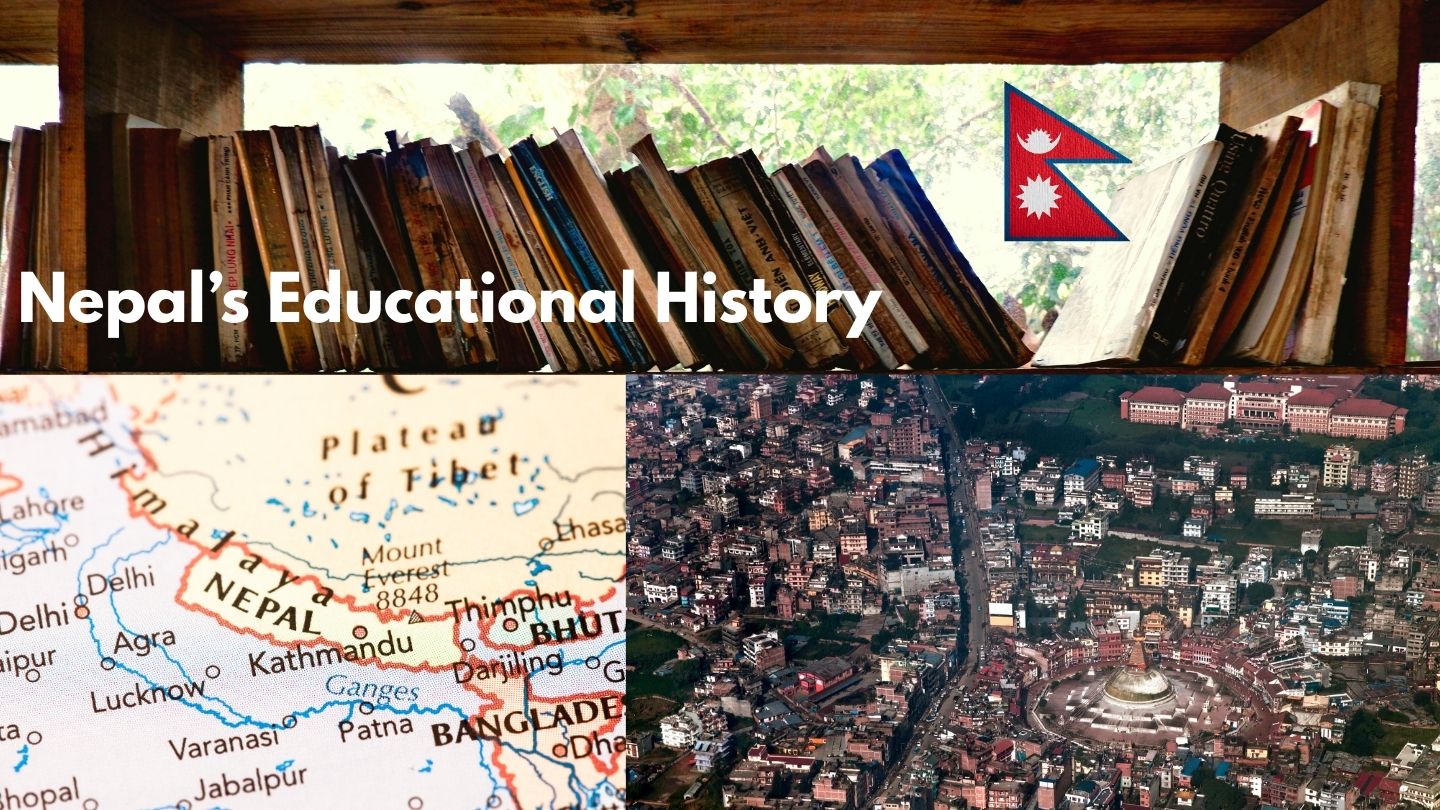
Nepal’s Educational History: A Deep Analysis of the Ancient, Medieval, and Modern Periods
A nation’s progress depends on the quality and historical evolution of its education system. In Nepal’s context, the education system has continuously changed with the movement of time. Many solutions to today’s educational problems are hidden somewhere within the pages of our own history.
The journey from Eastern philosophy in the ancient period to Western methods in the modern era was not easy. In this article, we will search for answers to two key questions: “Where did our original education go wrong?” and “What should the path forward look like?”
Nepal’s ancient educational history should not be analyzed only through dates and events, but also through its philosophical and social impacts. Below is a detailed and research-based analysis of the educational condition in the ancient era (including the Kirat and Lichchhavi periods).
Table of Content
- Nepal’s Educational History: A Deep Analysis of the Ancient, Medieval, and Modern Periods
- Ancient Period (From Ancient Times to B.S. 936): The Foundation of Knowledge, Values, and Discipline
- Medieval Education (B.S. 936 to 1825)
- Beginning of the Modern Period (B.S. 1825 to Present)
- Current Problems: Continuation of Historical Mistakes
- Real Solutions and a Practical Roadmap
- Conclusion
- Sources for Further Research (Citations)
Ancient Period (From Ancient Times to B.S. 936): The Foundation of Knowledge, Values, and Discipline
Nepal’s ancient education system was not limited to literacy. It was a spiritual and practical process aimed at awakening the inner potential of a human being. Education was seen as a “third eye,” helping people break free from worldly illusions and realize truth.
Gurukul Education System
The Gurukul system was a high intellectual center of the time. Students (Batu) did not go there only to read books, but to learn the art of living life.
Residential discipline and celibate student life
After reaching a certain age (after the Upanayan rite), students would go to the teacher’s hermitage. Studying under the direct guidance of the Guru developed self-control and self-reliance. Waking up early, daily rituals, collecting firewood, and seeking alms (Bhikshyatan) were considered part of education. This helped remove pride in the sons of both royal families and ordinary people.
Oral tradition and memory science
In an era without printing machines or paper, extraordinary practice of “Shruti” (learning by listening) and “Smriti” (memorization) was common. Complex grammar rules and Vedic mantras were memorized in specific tones (Udatta, Anudatta, and Swarita). This strengthened mental memory power.
Multidimensional curriculum
This was not limited to religious learning. Through the “Shadang” (Shiksha, Kalpa, Vyakarana, Nirukta, Chhanda, and Jyotish), students learned astronomy, mathematics, and phonetics. Ayurveda provided medical knowledge, while Dhanurveda offered military education.
Buddhist Vihar and Bihar Education: Global Reach and Logic
Nepal—especially the birthplace of Buddha and the Kathmandu Valley—has been fertile ground for Buddhist philosophy since ancient times.
Sangha and Bihar system
Buddhist education was more institutional and democratic. Vihars (Monasteries) functioned like universities. Both monks and householders could receive education there.
Logic and philosophy (Epistemology)
A key feature of Buddhist learning was “Hetuvidya” (logic). Students were taught not to accept anything based on blind belief, but to test it through reasoning before adopting it. With the development of Mahayana and Vajrayana, there was also specialized study of mantra practice and metallurgy.
Center of cultural exchange
Scholars from Bhota (Tibet) and India frequently traveled to and from Nepal’s monasteries. The arrival of great philosophers like Acharya Vasubandhu helped raise Nepal’s educational standard to an international level.
Lichchhavi-Era Educational Structure: Full State Responsibility
The Lichchhavi period is called Nepal’s “Golden Age,” largely because the state invested heavily in education.
Agrahar and Guthi system
Lichchhavi kings provided scholars with free land for settlement and an income source (Agrahar). These areas became autonomous educational zones. Since they were tax-free, teachers could share knowledge without economic pressure.
Scholarly excellence and inscriptions
The high level of Sanskrit used in Lichchhavi inscriptions shows strong competence in grammar (especially Paninian grammar). Anshuverma himself was a great scholar. The claim that he composed a grammar text called “Shabdavidya” suggests that rulers also served as guides for education.
Subject diversity
There was deep study of “Nitishastra” for administration, “Arthashastra” for diplomacy, and “Purana” and “Smriti” for religious practices. Skills of fine arts and architecture were also transferred through generations and Sanghas.
Deep Problem Analysis: Limits of the Historical System
Despite its richness, ancient education had some fundamental problems that influenced Nepal in later periods:
Inequality in access (The Merit-Status Divide)
Gurukul education was mostly based on the caste system. This kept a large section of society (those considered lower caste and, in many cases, women) away from formal knowledge. This created a deep gap between an “intellectual elite” and a “working class.”
Practical vs. theoretical conflict
Since education was heavily focused on spiritual liberation (moksha after death), progress in physical and scientific innovation did not occur as much as it could have.
Lack of documentation
Over-reliance on oral tradition caused many valuable knowledge systems to disappear when the Guru-disciple chain broke.
Ancient education teaches us that:“Education is not only a tool to earn a living; it is a link for character-building.” Today we have technology, but we lack the “meditation” and “concentration” that ancient learners practiced.
Only if we can connect the Lichchhavi-era “research culture” and the Gurukul “discipline” with modern technology can we restore the intellectual dignity built by our ancestors. The present generation must internalize the fact that ancient Nepal was not an “importer” of education, but an “exporter” (a Guru Nation).
Medieval Education (B.S. 936 to 1825)
In Nepal’s history, the medieval period (B.S. 936 to 1825) was not only a time of political upheaval. It was a golden age of Nepali originality, art, and “practical skills.”
Building upon the foundation of “spiritual philosophy” from the ancient era, the medieval period created a palace of “craftsmanship” and “professional competence.” This period developed under the influence of Malla kings in the Kathmandu Valley and various Sen, Khas, and Kirati states outside the Valley.
Education was not limited to “knowing something,” but was focused on “becoming something and showing it.” Below is a deep analysis of medieval educational practices.
Nature of Malla-Era Education: The Confluence of Art and Scholarship
Malla kings made education highly prestigious within the royal court and among the upper social classes.
Co-existence of Sanskrit and mother tongues
Sanskrit was used for intellectual discourse and official documents. However, a major shift was the beginning of literature, drama, and genealogies in local “Nepal Bhasa” (Newari) and other mother tongues. This brought education closer to everyday life.
Tantric knowledge
The “higher education” of the medieval era: Based on my research and study, Tantra was considered as difficult and prestigious as today’s “Post-Doctoral” research. It was not limited to mantras, but involved deep study of physiology, psychology, and the use of plants. This education, delivered in “Agam” houses, was highly secretive and specialized.
Foreign contact and knowledge exchange
Kathmandu’s monasteries and temples served as “transit hubs” for Tibetan and Indian scholars. Local scholars translated ancient texts into the Ranjana script and sent them abroad. This made Nepal an “academic gateway” of South Asia at that time.
Mundhum and Oral Education: Nature as a Classroom (Kirat Tradition)
Outside the Valley, especially in eastern Nepal, the Kirat community’s Mundhum education system remained alive. It can be called an “unwritten university.”
Education of nature and life
Mundhum teaches humans to be protectors of nature. It believes education means understanding trees, soil, and rivers. As “Fedangma” and “Sambas” orally narrated history and ethics, the new generation learned identity and dignity.
Collective leadership
Kirat education encouraged “Haihang” (collective discussion), where youth participated in decision-making. This was an early form of today’s “Group Discussion” or “Civic Education.”
Vocational or Technical Education: Today’s Need, Yesterday’s Practice
Today we talk about Technical and Vocational Education (TVET), but the Malla era was one of its most successful models.
Hereditary expertise (Guild System)
There were no formal schools for woodcraft, sculpture, or metalwork, but every home functioned as a school. A craftsperson’s child learned from an early age to use tools like chisels and carving implements. However, learning was not just copying; it included knowledge of measurement, geometry, and scientific methods to identify material quality.
Architectural knowledge
The grand temples and palaces of the era—built in ways that amaze modern engineers—were products of this practical education. Stone carving patterns or balancing the load of a temple pinnacle required advanced physics and mathematics.
Fine arts and performance
Drama and dance were part of education. Performances on Dabali stages delivered religious and social teachings to the public. This was not merely entertainment, but an effective tool of mass communication.
Problems of Medieval Education: An Expert Perspective
A deeper look shows certain issues that caused long-term setbacks:
Knowledge enclosure (Exclusionary Practices)
Knowledge and skills were restricted to specific castes or specific Guthis. A goldsmith’s expertise was not allowed to leave the family line. This prevented universalization of knowledge and caused many important technologies to disappear.
Strong in experience, weak in documentation
Craftspeople built great temples, but traditions of making detailed drawings and manuals did not develop. This made knowledge transfer difficult and gradually reduced originality.
Lack of institutional structure
Responsibility for education was left entirely to families or community organizations (Guthis). Since the state did not invest in a systematic and unified curriculum, educational standards varied significantly across regions.
Medieval education clearly teaches
“When education is connected to hands-on skill, civilization is built.” Today’s modern system, which often produces unemployment, needs to learn from the medieval era’s professional seriousness.
Only by combining ancient philosophy with medieval craftsmanship can the rebuilding of a “civilized and self-reliant Nepal” become possible.
Beginning of the Modern Period (B.S. 1825 to Present)
Nepal’s modern educational journey has been highly dynamic and fascinating. It reflects changes in social awareness and political transformation. In ancient and medieval times, education depended on personal and community efforts, but in the modern period it became a matter of “state policy.”
Below is a factual analysis of the major phases of modern education.
Early Shah Period (B.S. 1825–1910): Unification and Military Priority
During the unification of Nepal, the meaning of education changed. With state expansion and national unity as the main challenge, “practical warfare skills” were valued more than “formal schooling.”
Military and administrative knowledge
Through his “Divya Upadesh,” Prithvi Narayan Shah emphasized self-defense and patriotism. His focus on domestic production and knowledge over foreign clothes and culture can also be seen as a form of “original education.”
Need for skilled clerks
A small number of individuals learned skills informally from palace officials and scholars—writing petitions, land measurement, and office-court tasks. This can be considered a type of “tahabil education,” which later helped lay the foundation for Nepal’s civil service.
Rana Period: Restriction and Elite Conflict (B.S. 1910–2007)
The 104-year Rana rule is often called the “dark age” of education, yet Nepal tasted Western education for the first time during this period. It was paradoxical: rulers used education as a symbol of power while keeping it away from the public.
Jung Bahadur and Durbar High School (1910)
After visiting Britain in 1850, Jung Bahadur Rana understood how education could strengthen society. However, he viewed education less as a tool to spread awareness and more as a means to secure equal standing for the Ranas in global politics. Durbar High School, started on Ashoj 27, 1910 (B.S.), was only for Rana children, deepening educational class divisions.
Chandra Shumsher and Tri-Chandra College (1975)
Chandra Shumsher established Tri-Chandra College in 1918 (B.S. 1975) for higher education. During its establishment, he felt he was “sowing seeds for his own era.” He was aware that education could raise voices against the Ranas, yet he could not ignore foreign pressure and the demands of time. This began the production of graduate-level manpower in Nepal.
Restriction on language and culture
The Ranas strictly restricted education and literature in local languages (such as Newari). Education became focused on producing clerical staff who would serve the administration.
Role of Padma Shumsher
He is called the “father of schools” because he advocated access to schooling for ordinary children and eased certain restrictions.
Post-Democracy Educational Expansion (B.S. 2007–2027)
The 2007 revolution opened not only politics but also education. With literacy below 2 percent, the situation was serious.
Research and policy-making
The “National Education Board” of 2009 and especially the “Nepal National Education Planning Commission” of 2011 (with support under the leadership of Rudolph and Hood) provided the first objective national picture of Nepal’s education. It laid the foundation for “education for all” and envisioned a curriculum that would build Nepali identity.
Establishment of Tribhuvan University (TU) (2016)
The establishment of Tribhuvan University ended the need to depend entirely on foreign countries for higher education. It was a major step toward educational sovereignty.
National Education System Plan (B.S. 2028–2032): A Strict Experiment
The most ambitious and controversial plan of this period was the 2028 education plan. It nationalized education.
Uniform education
It governmentized all schools to remove differences between private and community schools. While the goal was to promote “national unity,” it discouraged community investment and participation.
Skill-based education (Vocationalism)
Based on my research, the 2028 plan made vocational education compulsory to make every student self-reliant. It was an early form of today’s “learn while studying” model. However, because the state could not manage enough manpower and infrastructure, it remained limited to paper.
Reasons for failure
The plan became more a tool to promote Panchayat political ideology than to improve education. Teachers became employees, and local community responsibility toward schools weakened to zero.
Multiparty Era and Private Sector Entry (After 2046)
After 2046, liberalization opened education to the private sector.
Outcome
It brought quality education in urban areas, but gradually education began transforming into a type of commodity. Nepal’s system became divided into two poles: government schools for poor children and expensive boarding schools for wealthy children. The result has been youth unemployment and extreme foreign migration (brain drain).
Modern Nepal’s educational history clearly shows
“When education only gives certificates but not skills and employment, that system fails.” Whether the failed experiment of 2028 or today’s costly private education, the root problem has always been the distance between the “curriculum and the market.”
Young people must understand that in Nepal’s history, education was used at times for religious liberation and at times to sustain power. But today, instead of making education only a “passport,” Nepal needs a fusion of “technology and indigenous knowledge,” learning lessons from its own history.
Current Problems: Continuation of Historical Mistakes
When we examine Nepal’s educational history, we reach a point where challenges stand like mountains above achievements. As an education scholar and a researcher who has closely observed this sector for the past two decades, I do not view Nepal’s current educational crisis as only a “management weakness.”
It is the continuation of historical mistakes and the result of failing to transform with time. In this section, we will discuss today’s urgent problems and a scientific roadmap for solutions.
The Huge Gap Between “Theory” and “Practice”
In ancient times, knowledge and practice were two sides of the same coin—learning meant doing. But today, education has become only a “burden of textbooks.” Students memorize the laws of physics but cannot repair a broken electric plug.
Our curriculum provides information but does not provide the “wisdom” to use it. This is the failed legacy of vocational education that the 2028 plan tried to implement but could not achieve.
Unequal Education: One Country, Two Types of Citizens
Nepal’s education system has created “segregation” in society. Expensive private schools produce “privileged manpower,” while community schools funded by the state appear weak in producing “skilled manpower.”
As a result, opportunities are divided among students of the same class based on economic status. From the perspective of social justice, this is a serious historical mistake.
Educated Unemployment and Migration (The Crisis of Brain Drain)
The most painful aspect is that the education system does not prepare an educated youth to see opportunities in their own soil. After completing Grade 12, most students immediately focus on making a passport, which is a major failure of university-level education.
We produced manpower that is “capable of going abroad,” but failed to produce entrepreneurs “capable of creating within the country.”
Real Solutions and a Practical Roadmap
Pointing out problems alone is not research. Suggesting a scientific path for solutions is the duty of a responsible writer. Based on my experience, the following changes are essential to improve Nepal’s education system.
A Blend of Ancient Gurukul Philosophy and Modern STEM
Nepal needs a model that connects Eastern discipline and ethics with Western science and technology (Science, Technology, Engineering, and Math).
Discipline: Students should practice self-discipline and mindfulness similar to the Gurukul tradition.
STEM: From Grade 7, students should learn practical applications of coding, robotics, and artificial intelligence (AI) to compete in the global market.
Real Decentralization of Education and Local Ownership
So far, education has been controlled from Kathmandu’s “center.” Based on my analysis, education improves only when local communities own their schools.
Each local government should allocate at least 20 percent weight to a local curriculum based on regional potential (such as agriculture, tourism, herbs). Learning from the Lichchhavi “Agrahar” system, education should move toward community leadership rather than strict government control.
“Learn, Earn, and Grow” (Integrative Learning Model)
By the time students reach higher secondary level (Grades 9–12), they must become skilled in at least one practical area.
Model after Grade 10: Students should not have only a certificate, but at least one skill such as plumbing, agricultural technology, graphic design, or handicrafts that can make them immediately self-reliant.
There should be agreements between schools and local industries so students can study four days a week and work two days (Apprenticeship). This can address unemployment at its roots.
Teacher Quality and Retraining (Teachers Re-engineering)
The most valuable infrastructure is the teacher. In my 20 years of experience, I have seen that unless teachers update themselves, educational quality does not improve.
The state must develop a system where teachers are not treated only as job-holding employees, but are supported to become continuous learners and researchers.
From all three periods of Nepal’s educational history (ancient, medieval, and modern), one conclusion emerges: “Skill without knowledge is disabled, and knowledge without skill is meaningless.”
The path forward is to move ahead by combining the values of the ancient era, the craftsmanship of the medieval era, and the technology of the modern era. Youth must understand that education is not just something given by others; it is a journey of building oneself in a way that matches the soil of one’s own nation.
It is still not too late. If we reform policy-level systems and change the personal attitude toward learning, Nepal can once again become South Asia’s intellectual hub (Wisdom Center).
Conclusion
Nepal’s educational history is not only a list of events. It is the development process of Nepali national consciousness. Only by coordinating the philosophical knowledge of the ancient period, the technical skills of the medieval period, and the technology of the modern period can we build Nepal for the 21st century.
Young readers must understand that education is not only about earning a certificate, but about becoming a wise human being.
Sources for Further Research (Citations)
-
Nepal’s History – Baburam Acharya
-
Education in Nepal: Origins and Developments – Research Papers
-
National Education Commission Reports 2049/2055 – Government of Nepal
-
Lichchhavi-era inscriptions and historical research materials







Comments 0
No comments yet. Be the first to start the conversation.