




Nepal’s Administrative Reform: AI and Predictive Rights
From Bureaucracy to AI-Friendly Good Governance
Nepal’s public administration has long suffered from “opacity” and “delays.” When an ordinary citizen submits a file at the District Administration Office or the Transport Office, they often have no clear idea when their work will be completed. This uncertainty becomes a key root of corruption and administrative inefficiency.
Even in the third decade of the 21st century, it is unfortunate that the progress of government work still depends on piles of files and a person’s mood. The solution is not “AI” alone, but “AI-enabled governance.”
This article presents practical and scientific approaches on how the Government of Nepal can bring its entire data ecosystem into AI systems, and how a citizen can sit at home and “predict” whether their work will be completed or not.
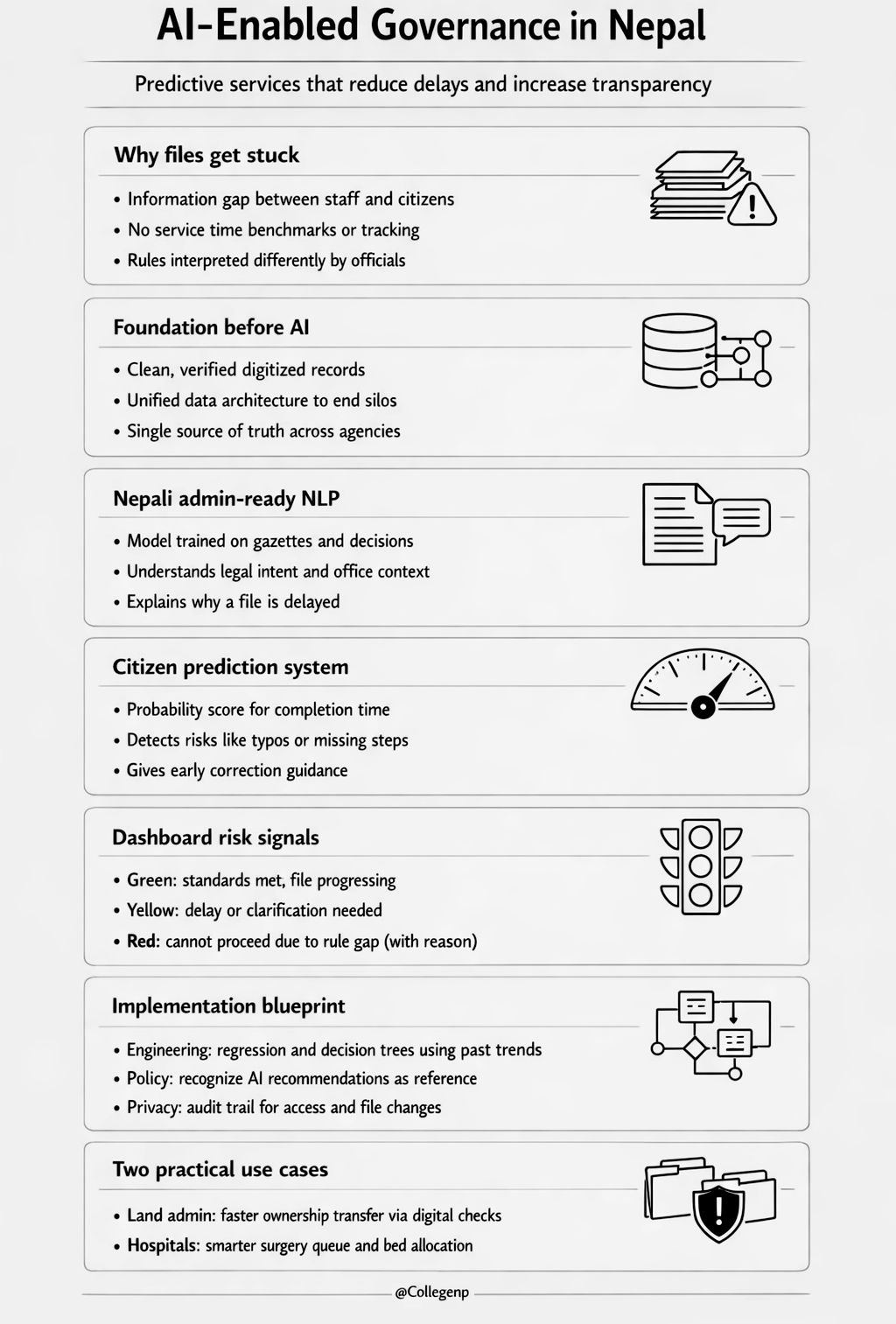
The Depth of the Problem—Why Files Get Stuck
Research indicates that in Nepal, more than 80% of delays happen not because of “incomplete documents” or “lack of clear policy,” but due to a “tendency to avoid administrative responsibility.” A common saying in Nepal’s public administration has become:
“A file won’t move without wheels.”
But these “wheels” are not only financial. They also represent an embedded “procrastination culture” within the administrative structure. Missing paperwork often becomes an excuse; the real problem lies in invisible processes and systemic weaknesses.
By observing how different government offices function, three chronic problems behind stalled files can be identified.
Information Asymmetry and Power Imbalance
In administration, “information is power.” In most government services in Nepal, the information gap between officials and service seekers is wide.
Only the responsible desk staff often know:
-
which legal clause applies for a certain service,
-
how many documents are required, and
-
which desks the file must pass through.
This “secrecy” establishes officials in a powerful position, while citizens are pushed into the role of a constant “petitioner.” When citizens do not know the legal status of their submitted file or the next procedural step, they are forced to depend on middlemen.
One set of data suggests that more than 50% of files are returned a second time with remarks like “this is missing” or “that didn’t reach,” even though a complete checklist of required documents could be provided at the first submission. This is a deliberately created wall of information.
Total Lack of Benchmarks and Service Level Standards
In international practice, there is a concept called a Service Level Agreement (SLA), where a clear time limit is defined: “x” service within “y” days.
Although Nepal’s Civil Service Act and Good Governance Act mention “time limits,” there is no scientific monitoring system or data dashboard to track enforcement. No one holds historical records such as the average time required by an office for a typical transfer of ownership or recommendation letter.
When something is not measured, improvement becomes nearly impossible. Due to the lack of data, claims like “I completed work on time” or “someone delayed it” have no scientific foundation. As a result, file backlogs and missing files become normal, because no official’s performance evaluation is questioned based on holding a file.
Subjective Interpretation and Discretionary Power
Many laws and procedures in Nepal are “unclear” or “multi-meaning.” This ambiguity provides officials with discretionary power.
It is common to see that:
-
one office chief approves a file smoothly,
-
but as soon as a new chief arrives, the same file is stopped saying “the rule doesn’t match.”
When legal interpretation becomes subjective rather than objective, officials become unwilling to take “risk.” Fear of audit objections or complaints to anti-corruption bodies leads to the mindset that “not deciding is the safest path.”
This defensive bureaucracy traps files in cycles of comments and reviews, but they do not reach closure.
The Foundation for Moving Government Work into AI Systems
Transforming government services into AI systems in Nepal is not just about installing software. It is about restructuring the state’s “memory” and “decision-making process.”
AI works on the principle of “garbage in, garbage out” (GIGO). If initial data is incorrect or insecure, AI outputs can become even more dangerous. Therefore, before implementing AI, the Government of Nepal must complete “data cleaning” and “digitization.”
The following steps are essential.
Unified Data Architecture and the End of Data Silos
Currently, different state bodies in Nepal face the problem of data isolation. For example, the National ID system under the Ministry of Home Affairs, the driving license data under the Ministry of Physical Infrastructure and Transport, and PAN details under the Ministry of Finance are not fully integrated.
To implement AI, the first requirement is to break these separate “data silos” and build a unified data architecture.
Nepal’s Government Integrated Data Center (GIDC) must be developed as a “central nervous system,” and the Government Interoperability Framework (GEIF) must be strictly implemented.
In technical terms, this is known as a “Single Source of Truth,” where data entered once (such as birth registration or educational qualification) can be shared and used by all government bodies. This frees citizens from the hardship of carrying the same document to multiple offices and provides AI with large-scale, clean, and verified datasets for analysis.
Developing Natural Language Processing (NLP) Suitable for Nepali Administration
Government work is largely based on laws, regulations, and reports written in complex Nepali legal language. Even if a basic AI model understands Nepali grammar, it cannot automatically understand Nepal’s administrative context and legal intent.
For this, Nepal needs to develop its own Large Language Model (LLM), trained on:
-
all government gazettes,
-
Cabinet decisions, and
-
Supreme Court precedents.
AI must learn how official “comments” are written, the authority boundaries of officials at different levels, and the logic embedded in regulations. Only then can AI answer questions raised on a file or identify context-based reasons for delays.
This removes language barriers and builds a foundation for citizens to interact with the system in their mother tongue and obtain predictive insights about government processes.
Citizen Prediction (Predictive Analytics)—How It Works
The core issue of this article is how citizens can know the future outcome of their applications. This can be called an “Administrative Forecasting System.”
The Concept of a “Probability Score”
For example, if you apply for a passport, the AI system checks your details using factors such as:
-
Whether your citizenship details are verified in the central database
-
How fast the office has been processing files over the past three months
-
Whether there are technical errors in your photo or biometrics
Based on this, the system can inform you:
“Your passport has a 95% probability of being ready within 7 days.”
If a 5% risk is detected, the system can immediately notify:
“A small typo is detected in your address details. Please correct it now.”
A Citizen Dashboard: The Basis for Whether Work Will Be Completed
When a citizen opens a mobile app, they should see not only a progress bar, but also a risk factor.
-
Green: The file is moving forward; all standards are met.
-
Yellow: Staff delay is occurring, or clarification is required.
-
Red: The file cannot move forward due to legal or regulatory limitations (with reasons).
This way, AI warns citizens in advance whether their work is likely to be completed. It ends the need to visit government offices repeatedly for weeks.
The Implementation Blueprint
To implement this system in Nepal, work is required at three levels.
Level 1: Engineering (Algorithm Development)
The Government of Nepal should use models such as:
-
regression analysis, and
-
decision tree models.
Ten years of historical government decisions and file settlement trends can be used to train AI systems.
Level 2: Legal Arrangements
Nepal’s current decision-making process is not AI-friendly. The Good Governance Act should be amended to recognize AI recommendations as an official reference.
Citizens should receive legal rights to question:
-
why an official approved a file that AI rejected, or
-
why a file predicted as eligible by AI was still delayed.
Level 3: Security and Data Privacy
Protecting personal data is the biggest challenge in AI systems. To address this, blockchain technology can be used to maintain an unbreakable audit trail showing:
-
who accessed data, and
-
who changed the file.
Real-World Problems and AI-Based Solutions
Talking about good governance in theory and applying it in practice are different. Below are two concrete examples of how AI can solve everyday citizen problems in Nepal’s government offices.
Land Administration (Malpot): Digital Closure for Plot Division and Ownership Transfer
Land revenue and survey offices in Nepal are widely seen as centers of corruption and delay. The main reasons are dependence on physical records and human manipulation of maps.
Existing problem:
For a normal land ownership transfer, it can take weeks to match records, verify restrictions, and check tenancy-right disputes. During this time, middlemen become active.
AI solution:
An AI-based system integrating computer vision and blockchain compares historical maps with current GIS satellite data within seconds.
By scanning digital archives, if AI detects no legal obstacles such as court stay orders or duplicate records, it instantly issues a “green signal” (automatic clearance).
The system can notify the citizen:
“After checking 10 parameters, no error was found. The registration process will begin within 25 minutes.”
This fully controls personal discretion and intentional delay.
Public Health: Surgery Time and Bed Management
In large hospitals like Bir Hospital or Tribhuvan University Teaching Hospital (TUTH), the reality is that patients often wait 6 months to 2 years for a basic operation.
Existing problem:
There is no integrated system showing patient complexity and doctor availability. In some cases, even if beds are available, patients are turned away due to system gaps.
AI solution:
If AI is integrated into a Centralized Hospital Management System (CHMS), it can perform pressure analysis. AI compares patient case priority with the hospital load factor.
If the queue at Maharajgunj appears too slow, the system can automatically predict and suggest:
“For your treatment, Province Hospital in Butwal has available skilled staff and machines, where surgery is possible within 3 days.”
Result:
This reduces unnecessary crowding in Kathmandu hospitals and directly contributes to life-saving outcomes by predicting treatment availability. It also ends informal influence in bed distribution and ensures fair allocation.
Ethical and Practical Challenges
No technology is flawless. While implementing AI, Nepal must remain alert to the following issues.
-
Algorithmic bias
If AI is trained on discriminatory historical data, it can produce wrong decisions. It must be audited periodically by human experts. -
Digital divide
For rural citizens without smartphones, local-level “AI support desks” should be established. -
Employment concerns
Employees may resist AI due to fear of losing jobs. However, the reality is that AI does not take away work; it reduces only repetitive and burdensome tasks.
International Practices and Nepal’s Path
The concept of AI-based governance and predictive performance is now becoming a global trend. Nepal does not need to start from zero. It can adapt successful models from other countries to local realities.
Estonia’s “Bürokratt” Model
Estonia is widely considered a global poster child of digital governance. Its “X-Road” data exchange layer connects all government agencies.
Its most recent step is “Bürokratt,” a network of AI-based virtual agents. It does not only answer citizen questions but also provides real-time predictions on:
-
which stage a service process is in, and
-
how long it may take.
Nepal can build similar AI bots that understand Nepali and local languages and hand over file tracking to citizens.
India’s “Faceless Assessment” and AI Use
Neighboring India has implemented a “faceless” system in income tax and customs. In this system, AI keeps the identity of the reviewing officer hidden and distributes files randomly.
This eliminates direct interaction between officials and taxpayers, reducing corruption risk. Under India’s “AI for All” strategy, systems are also being developed to help farmers predict crop diseases and market prices—useful for Nepal’s agriculture and government relief distribution.
Singapore’s “Smart Nation” and Predictive Maintenance
Singapore uses AI not only for citizen services but also in infrastructure planning. Through “digital twin” technology, the government can predict when roads or bridges may fail.
This is called predictive maintenance. Nepal can similarly analyze budget spending rates and construction speed to forecast whether contractors can complete projects on time.
A Pilot Roadmap for Nepal
If Nepal attempts to implement everything at once, complexity may lead to failure. Therefore, under the Digital Nepal Framework, the first phase should focus on three pilot sectors.
-
Passport and driving license
AI can instantly verify photos and details, reducing rejection rates. -
Land revenue and land reform
The logic of plot division and ownership transfer should be converted into digital algorithms. -
Public Service Commission and recruitment processes
Using AI for answer-sheet evaluation and result publication reduces human errors and delays.
After successful implementation in these sectors, the system can be expanded to local government and ward levels using learned patterns from data and experience.
Rather than blindly importing technology, Nepal must first build legal frameworks for data sovereignty and ethical AI.
Conclusion
Taking government work into AI is not only a software issue—it is a matter of political will. When citizens can run the system and know the future of their work, trust in administration increases. This technology breaks the wall between citizens and the state.
Nepal’s young generation should demand a system where outcomes are determined not by “an employee’s smile” or “a middleman’s setup,” but by the fairness of technology.
One clear point remains: the future of good governance should not be only in human hands, but also in transparent code.
When a citizen can confidently say:
“I registered my file. AI says there is a 99% chance it will be completed. Now I won’t worry.”
That will be the day Nepal becomes a truly digital Nepal in the real sense.
Note
This article is fully based on research, existing digital frameworks, and global best practices. It does not represent any political party or ideology; it only analyzes the potential of good governance and technology.





Comments 0
No comments yet. Be the first to start the conversation.