



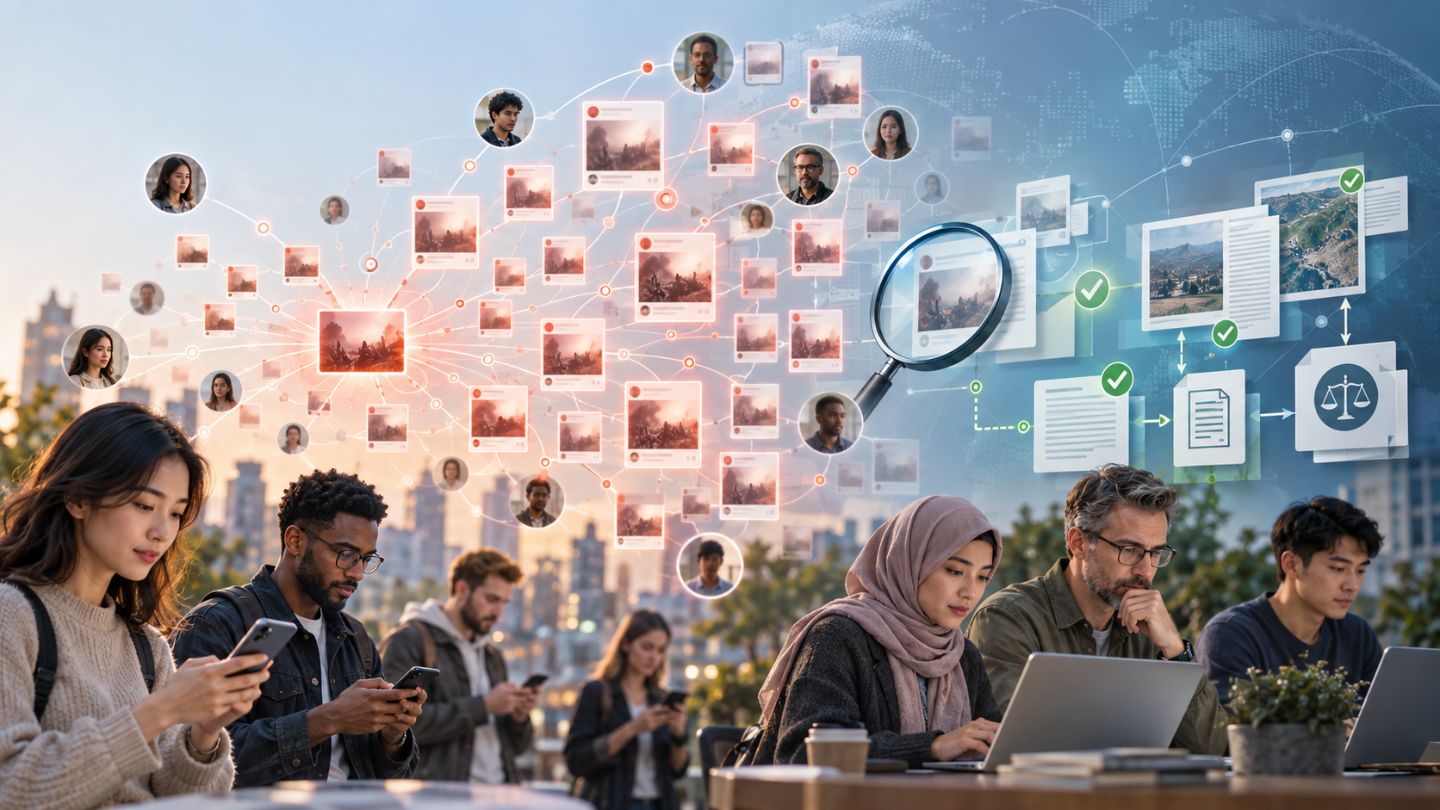
A questionable claim rarely arrives with a warning that it is false. It may come from a friend, appear in a familiar-looking post, surface in several search results, or reach you through different social networks. By the third or fourth encounter, the claim can begin to feel familiar even when you still do not know where it came from.
That pattern helps explain why misinformation cannot be reduced to gullibility. Its spread involves attention, sharing, repetition, social relationships, network structure, and platform design. Whether someone believes a claim involves another set of factors, including prior knowledge, familiarity, reasoning, emotion, identity, trust, and judgments about evidence.
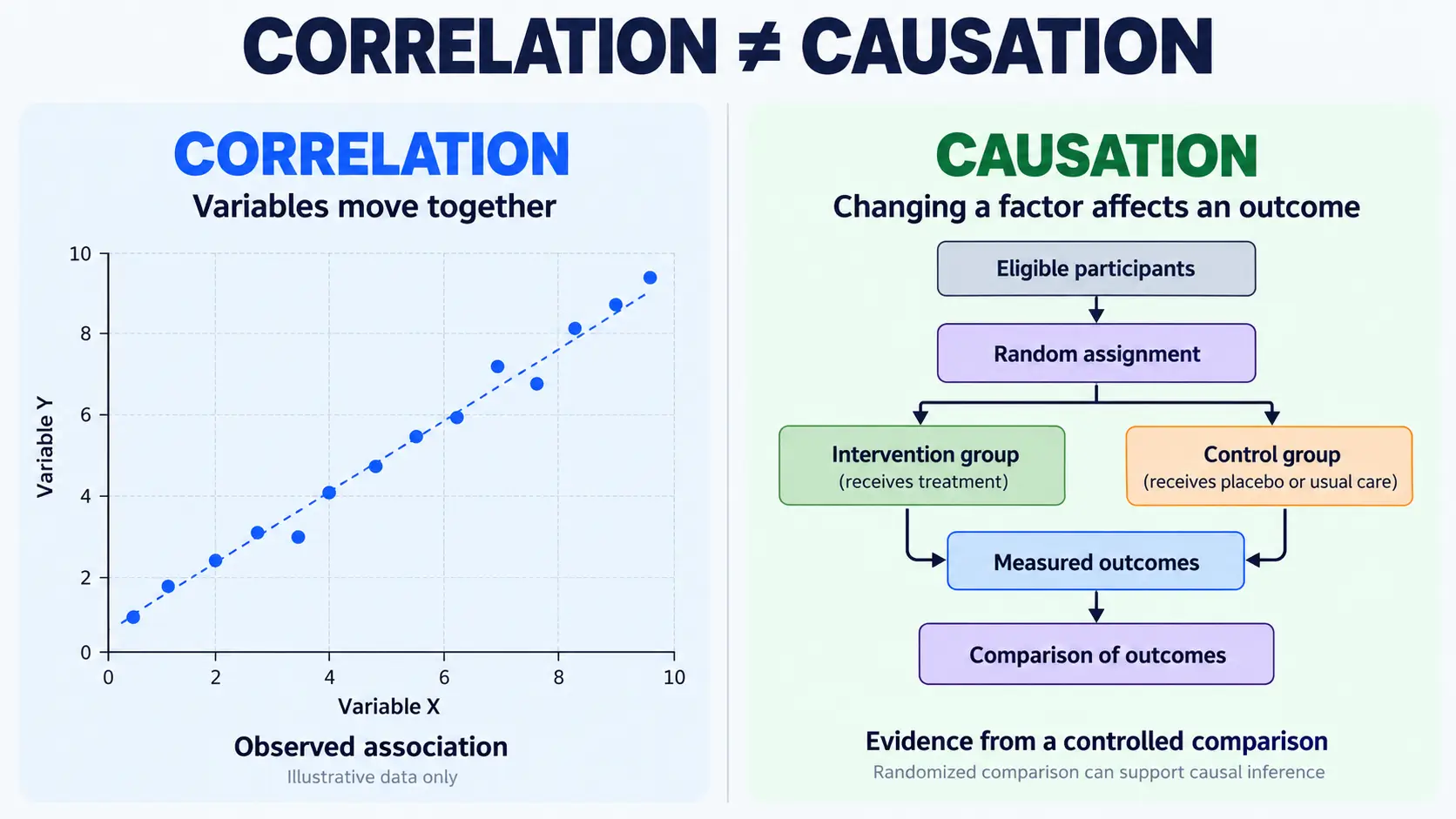
These outcomes need to be separated. A person can encounter false information without believing it, believe it without sharing it, or share it without deciding that it is true. Research on misinformation repeatedly finds that belief and sharing are related but not identical.
A 2023 experiment involving 34,286 participants in 16 countries found that participants with a more analytic cognitive style and stronger accuracy-related motivations were better at distinguishing true from false headlines in every sampled country. The study concerned COVID-19 misinformation and headline judgments, so it should not be treated as a universal measure of intelligence or susceptibility.
Answer Summary: Misinformation spreads when attention-grabbing content is shared, repeated, and redistributed through social networks and digital platforms. People may believe it because familiarity, limited attention, prior beliefs, emotion, social cues, and source judgments can all affect evaluation. Repetition can modestly increase perceived truth, while corrections usually help without fully erasing earlier influence. The practical response is not blanket distrust but stronger truth discernment: identify the exact claim, trace the evidence, compare independent sources, and preserve uncertainty when the evidence is incomplete.
Table of Content
- What misinformation means
- How misinformation spreads
- Why people believe misinformation
- Why misinformation can survive a correction
- How to check a questionable claim before sharing
- What research says about reducing misinformation
- Common misconceptions about misinformation
- What to remember
- Reference
Key Takeaways:
-
Exposure, belief, sharing, and behavior are different outcomes.
-
Repetition can increase perceived truth on average.
-
Emotional reactions can encourage sharing without proving a claim is false.
-
False information does not spread faster than truth in every setting.
-
Source reputation helps, but evidence and independent confirmation matter more.
-
Corrections usually improve accuracy, though earlier misinformation may still influence reasoning.
-
Better discernment is a stronger goal than treating all information with suspicion.
What misinformation means
Misinformation is commonly defined as false information shared without an intention to deceive. UNESCO distinguishes it from disinformation, which involves deliberate dissemination of false or misleading information with an intention to deceive or manipulate. Terminology varies across institutions and research traditions, so intent should not be assigned to a person or source without evidence.
When intent is unknown, “false or misleading information” is often a more accurate description.
The phrase “fake news” creates another problem because it can refer to fabricated stories, manipulated media, misleading headlines, satire presented without context, or genuine reporting falsely dismissed as fabricated. UNESCO has also cautioned that the term lacks a straightforward, commonly understood meaning.
For a reader trying to evaluate a claim, better questions are:
-
What exactly is being claimed?
-
What evidence supports it?
-
Where did the information originate?
-
Has important context been removed?
-
Are apparently separate sources independent of one another?
-
Is uncertainty being presented accurately?
These questions shift attention from labels to evidence.
How misinformation spreads
Misinformation often moves through a cycle rather than a single event. A claim gains attention, someone shares it, other people encounter it, repeated exposure increases familiarity, and further sharing creates new opportunities for the process to continue.
Attention creates the first opportunity
Information cannot influence a reader who never notices it. Novel, surprising, or emotionally provocative content can attract attention and make sharing more likely.
A 2024 Science paper examined eight studies using US Facebook and Twitter data alongside behavioral experiments. The researchers found that misinformation sources evoked more outrage than trustworthy sources in the studied datasets and that outrage was associated with sharing. Participants were also more willing to share outrage-evoking misinformation without reading it first.
This does not mean emotionally powerful information is unreliable. Accurate information can provoke anger, fear, relief, or surprise. Emotion is a reason to slow down and inspect the evidence, not a reason to dismiss a claim.
Imagine receiving a post describing an alarming event. Your first impulse may be to warn other people. The useful question at that moment is not whether your concern is sincere. It is whether the evidence has been checked before the warning is amplified.
Sharing is not the same as believing
Someone may share information to warn others, participate in a group discussion, express identity, entertain friends, signal concern, or react to outrage. The act of forwarding a post does not reveal exactly what the sender believes.
A 2021 Nature study found that headline accuracy affected participants' accuracy judgments more strongly than their sharing intentions. When attention was shifted toward accuracy, the quality of news participants were willing to share improved.
The 16-country study published in 2023 also found generally positive effects from subtle accuracy prompts across the countries examined.
A useful habit follows from this evidence: ask “Is this accurate?” before asking “Should I share this?”
Repetition can make a claim feel more credible
One of the clearest findings in misinformation research is the illusory truth effect: repeated information tends to receive higher truth ratings than information encountered for the first time.
A 2026 Nature Communications meta-analysis synthesized 182 studies, 366 effect sizes, and 31,184 participants. After adjustment for small-study effects, the researchers found a small but reliable average increase in perceived truth from repetition, alongside substantial variation between studies and conditions.
Repetition does not force belief. It changes one signal available to the mind: familiarity.
This distinction becomes important when the same claim appears in several places. Five accounts may quote the same original post. Several websites may reproduce one wire story. A screenshot may be reposted thousands of times without anyone adding new evidence.
Volume is not the same as independent confirmation.
Social networks multiply exposure
Every share creates another opportunity for a claim to be encountered, repeated, modified, or removed from its original context.
A landmark 2018 Science study examined about 126,000 verified true and false stories tweeted by roughly three million people more than 4.5 million times between 2006 and 2017. In that dataset, false news travelled farther, faster, deeper, and more broadly than true news. Bots accelerated true and false news at similar rates.
The scope matters. This was a large historical Twitter dataset, not proof that false information always spreads faster than accurate information across every platform, subject, country, and period.
Platform design affects distribution, but does not explain everything
Recommendation systems, sharing tools, engagement signals, and network structure can influence which information receives attention. Treating “the algorithm” as a complete explanation, however, hides important differences in user behavior and exposure.
A 2024 Nature review found that exposure to false and inflammatory content was often low on average and concentrated among a smaller group of high-exposure users in the research it assessed. The authors also argued that claims assigning most exposure to algorithms often exceeded the available evidence and noted major evidence gaps outside the United States and Western Europe.
The more defensible explanation is interaction: platforms shape opportunities for exposure, while people, networks, motivations, and sharing decisions shape what travels through them.
Why people believe misinformation
Belief usually develops from several signals working together. A reader rarely evaluates every online claim by locating the original study, checking its methodology, comparing independent evidence, and investigating the source before forming an impression.
Familiarity can be mistaken for evidence
A statement you recognize is easier to process than a completely unfamiliar one. That ease can contribute to a sense that the statement is credible.
The danger is subtle because you may remember the claim without remembering its origin. Something first encountered in an unverified post may later feel like background knowledge.
That is why “I have heard this before” answers a question about exposure, not truth.
Attention is limited
Online information is commonly encountered while people are scanning feeds, answering messages, watching videos, studying, or moving between tasks. Under those conditions, a person may react to relevance, emotional impact, or social meaning before deliberately considering accuracy.
Accuracy-prompt research suggests that some low-quality sharing occurs because accuracy is not the main focus at the moment of decision, even among people who prefer to share accurate information.
This is a useful distinction because it changes the practical response. Better decisions do not always require teaching someone an entirely new worldview. Sometimes they require creating enough friction for an accuracy check to occur.
Knowledge and careful reasoning help without creating immunity
Relevant knowledge helps because it provides information against which a new claim can be checked. Analytic reflection can also help readers notice contradictions, weak evidence, or conclusions that do not follow from the facts.
The cross-national 2023 experiment found associations between analytic cognitive style, accuracy motivation, and better truth discernment across all 16 countries studied.
None of this means that misinformation belief is a measure of intelligence. Expertise is also domain-specific. A person who evaluates claims carefully in one field may lack the knowledge needed to assess another.
When a subject falls outside your knowledge, confidence should decrease and verification should increase.
Identity and social relationships affect evaluation
Information does not arrive in a social vacuum. People may give more attention or credibility to claims shared by trusted friends, admired figures, or members of groups with which they identify.
Major psychological reviews identify social identity, trust, prior beliefs, source cues, emotion, and social norms among the factors that can influence misinformation belief and sharing.
This does not mean people automatically accept information that matches their identity. Nor does disagreement with a group prove that a claim is true. Identity is one influence among several.
A credible source is useful, but not decisive
A professional-looking page, familiar institution, large audience, or confident speaker can affect how information is received. None is a substitute for checking the underlying evidence.
A 2024 systematic review covering 91 studies and 64,162 participants found inconsistent source-credibility effects across misinformation research. The review identified major differences in how studies defined credibility, selected sources, and measured outcomes.
A stronger source check asks whether the source has relevant expertise, whether the original evidence can be inspected, whether the claim accurately represents that evidence, and whether independent sources support the same conclusion.
For readers who want a dedicated checking method, Collegenp's guide to information verification skills provides a related practical framework.
Why misinformation can survive a correction
Corrections usually improve accuracy, but memory does not work like a document in which an incorrect sentence can be deleted cleanly.
Researchers use the term continued influence effect for situations in which corrected misinformation still affects later reasoning. A major 2022 review describes this lingering influence as an established challenge in knowledge revision.
This should not be confused with the backfire effect, where a correction would make belief in the false claim stronger. A 2020 review concluded that backfire effects are not a robust general empirical phenomenon.
A useful correction should make the accurate information easy to understand, identify the relevant error, and provide a replacement explanation when the evidence supports one. If uncertainty remains, the correction should preserve it.
For example, “That statistic is false” may leave a gap if the incorrect number had been used to explain an event. A stronger correction identifies the supported figure or explains that reliable data are unavailable.
How to check a questionable claim before sharing
Verification does not require investigating every sentence you encounter. The amount of checking should match the importance of the claim and the consequences of being wrong.
For a claim that could affect another person's health, money, education, reputation, or important decisions, use a more deliberate check.
1. Identify the exact claim
Separate the factual statement from the commentary surrounding it.
A long post may contain one checkable claim hidden among opinion, interpretation, and emotional language. Write that claim in a single sentence.
2. Trace it toward the original evidence
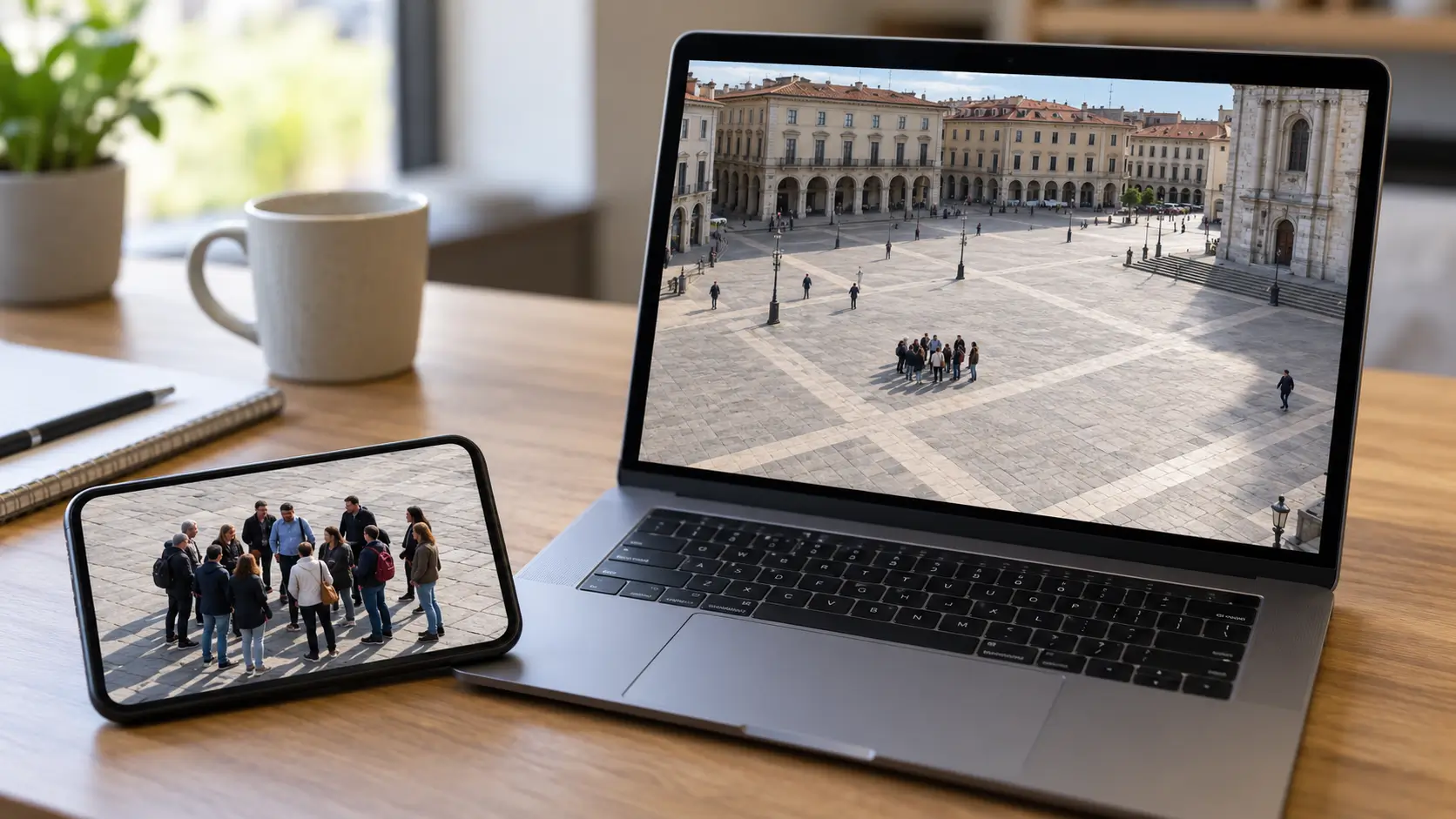
A screenshot of a headline is not the article. A social post summarizing research is not the research. A quotation without context is not enough to establish what the speaker meant.
Move toward the earliest reliable source you can find: the original report, study, dataset, official statement, transcript, or document.
3. Read outside the page
Researchers and educators call this lateral reading: leaving the page you are evaluating and checking what other sources say about the source, claim, and evidence. The approach has been tested in educational settings and is especially useful when a website's appearance gives few reliable clues about credibility.
4. Compare independent evidence
Look for genuine corroboration rather than additional copies of the same material.
Three articles repeating one press release provide less independent evidence than three sources that reached the same conclusion from separately gathered information.
Collegenp's guide on how to check claims before sharing develops this decision point in more detail.
5. Check scope and context
Ask whether a number refers to the right population, whether a study examined humans or simulations, whether a quotation has been shortened, and whether an old event is being presented as current.
A claim can contain accurate pieces and still create a misleading conclusion.
6. Preserve uncertainty when verification fails
Not every claim can be settled quickly.
“I cannot verify this yet” is a legitimate conclusion. It is more accurate than choosing between confidence and blanket disbelief when the available evidence is weak.
What research says about reducing misinformation
Research supports several interventions, but none makes people permanently resistant to misinformation.
A 2024 Nature Human Behaviour review examined 81 papers and grouped individual-level interventions into nine broad types, including accuracy prompts, corrections, media-literacy tips, lateral reading, warnings, friction, social norms, and prebunking approaches. Their usefulness varies by context and outcome.
Media literacy has shown beneficial average effects. A 2024 meta-analysis of 33 studies involving 36,256 participants found improved fake-news credibility assessment following media-literacy interventions.
Yet improving skepticism is not automatically the same as improving judgment. Experiments involving 6,127 participants in the United States, Poland, and Hong Kong found that several misinformation interventions reduced belief in false information while also reducing perceived credibility of accurate information in the tested settings.
That trade-off points toward a better goal: truth discernment.
Readers need methods that help them become more accurate about both false and true information rather than methods that teach them to distrust everything. Collegenp's article on media literacy for spotting misinformation provides further practice for that purpose.
Common misconceptions about misinformation
| Oversimplification | What the evidence supports |
|---|---|
| “Only gullible people believe misinformation.” | Susceptibility reflects interacting cognitive, social, emotional, and contextual factors. |
| “Sharing proves belief.” | Sharing and belief are distinct outcomes that can diverge. |
| “False information always spreads faster than truth.” | This occurred in a major Twitter dataset, but the finding is not a universal rule. |
| “Algorithms are the main cause.” | Platform systems matter, but exposure also depends on networks, users, motivations, and concentration among high-exposure groups. |
| “Corrections usually make false beliefs stronger.” | Backfire is not a robust general finding; incomplete correction and continued influence are better-supported concerns. |
| “The safest approach is to trust nothing.” | Better discrimination between strong and weak evidence is more useful than generalized skepticism. |
What to remember
Misinformation is better understood as a process than as evidence of a fixed flaw in a particular type of person.
Attention affects what gets noticed. Sharing creates new exposure. Repetition creates familiarity. Social relationships and identity affect how claims are received. Knowledge and reasoning influence evaluation. Platforms shape distribution. Corrections can improve accuracy without removing every trace of earlier misinformation.
For the reader facing a questionable claim, the practical distinctions matter most:
-
Familiarity is not evidence.
-
Repetition is not independent confirmation.
-
Sharing is not proof of belief.
-
Source reputation is not the same as source quality.
-
Emotional impact does not determine truth or falsehood.
-
Correction can help even when its effect is incomplete.
-
Uncertainty should remain visible when evidence is inconclusive.
The aim is not to become suspicious of every statement. It is to know when a claim deserves more checking and how to perform that check without confusing confidence, repetition, or popularity with evidence.
Reference
-
UNESCO. “Misinformation” and “Disinformation.”
-
Ye, S., et al. “Systematic Review and Meta-Analysis of the Evidence for an Illusory Truth Effect and Its Determinants.” Nature Communications (2026).
-
Ecker, U. K. H., et al. “The Psychological Drivers of Misinformation Belief and Its Resistance to Correction.” Nature Reviews Psychology (2022).
-
Arechar, A. A., et al. “Understanding and Combatting Misinformation Across 16 Countries on Six Continents.” Nature Human Behaviour (2023).
-
Vosoughi, S., Roy, D., and Aral, S. “The Spread of True and False News Online.” Science (2018).
-
McLoughlin, K. L., et al. “Misinformation Exploits Outrage to Spread Online.” Science (2024).
-
Budak, C., et al. “Misunderstanding the Harms of Online Misinformation.” Nature (2024).
-
Mang, V., Fennis, B. M., and Epstude, K. “Source Credibility Effects in Misinformation Research: A Review and Primer” (2024).
-
Pennycook, G., et al. “Shifting Attention to Accuracy Can Reduce Misinformation Online.” Nature (2021).
-
Kozyreva, A., et al. “Toolbox of Individual-Level Interventions Against Online Misinformation.” Nature Human Behaviour (2024).
-
Lu, C., et al. “Can Media Literacy Intervention Improve Fake News Credibility Assessment? A Meta-Analysis.” Cyberpsychology, Behavior, and Social Networking (2024).
-
Hoes, E., et al. “Prominent Misinformation Interventions Reduce Misperceptions but Increase Scepticism.” Nature Human Behaviour (2024).
-
Swire-Thompson, B., DeGutis, J., and Lazer, D. “Searching for the Backfire Effect: Measurement and Design Considerations.” Journal of Applied Research in Memory and Cognition (2020).



Comments 0
No comments yet. Be the first to start the conversation.