



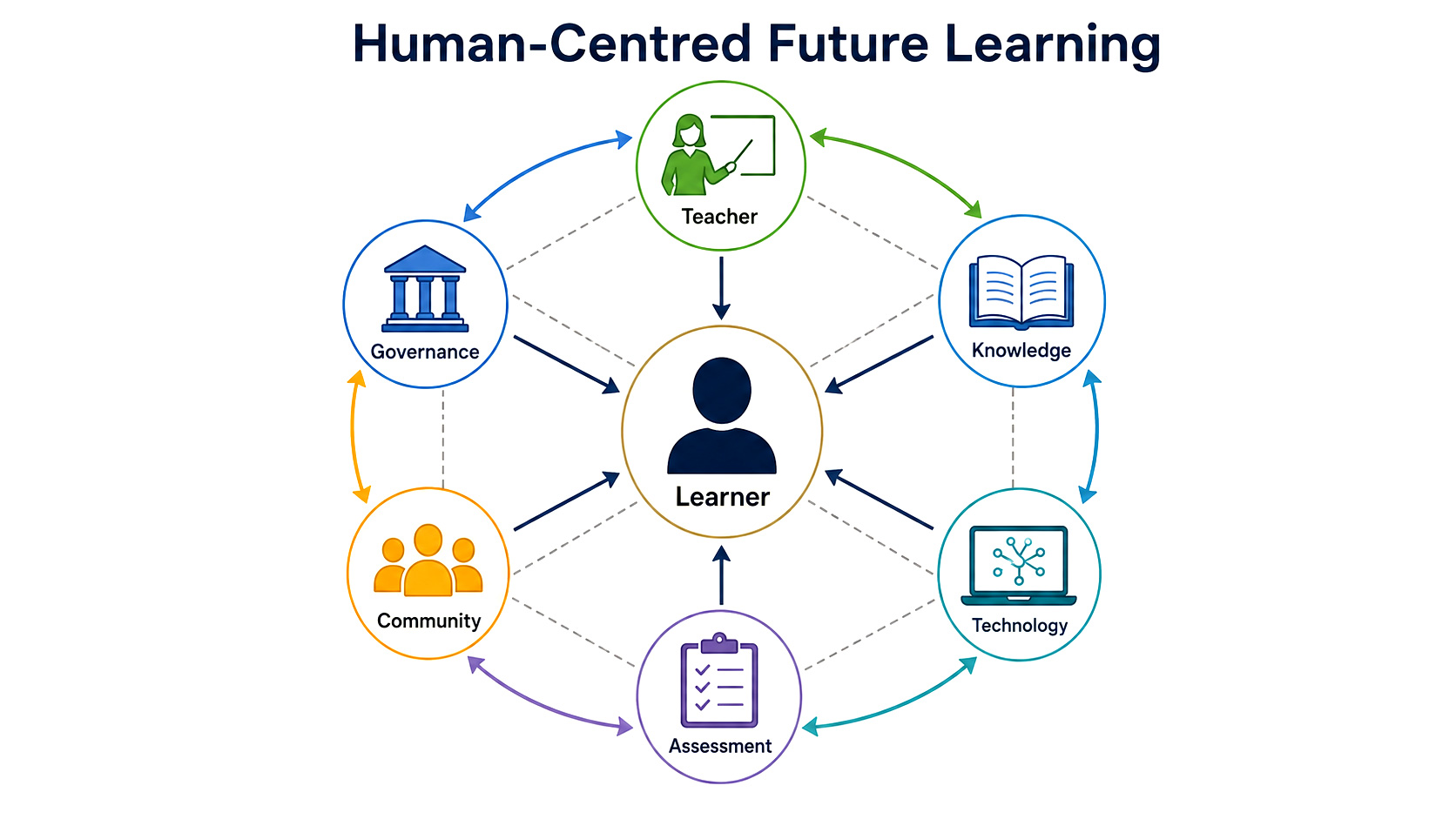
Learning is becoming more connected across classrooms, homes, workplaces, communities, and digital systems. Artificial intelligence can already produce explanations, questions, summaries, and feedback within seconds, while schools and colleges are using a wider range of face-to-face, digital, remote, and offline methods.
These developments do not mean every education system will change at the same pace. Nor does adopting technology prove that students are learning more. The World Economic Forum’s education-readiness framework places governance, infrastructure, pedagogy, assessment, learner experience, equity, and trust alongside AI adoption.
For students, teachers, parents, and education leaders in Nepal, the practical question is not what one future classroom will look like. It is how to prepare for plausible changes while protecting the conditions that make learning meaningful.
Answer Summary: The future of learning is likely to combine teachers, digital resources, AI support, flexible participation, and continued learning throughout life. Teachers will remain responsible for judgment, context, assessment, relationships, and learner welfare. Nepal’s priorities include teacher capacity, reliable and low-bandwidth access, appropriate local-language materials, accessible design, sound assessment, data protection, and clear institutional responsibility.
Table of Content
- What Does the Future of Learning Mean?
- What May Change and What Will Remain?
- What Is Influencing Learning Now?
- How Certain Are Future-Learning Claims?
- Seven Likely Shifts in Learning
- What Will Still Matter?
- Opportunities, Conditions, and Risks
- What Does the Future of Learning Mean for Nepal?
- How Can Students Prepare?
- How Can Teachers and Schools Prepare?
- What Should Parents and Guardians Ask?
- Role-Based Preparation Matrix
- How to Evaluate Claims About the Future of Education
- What Should Readers Watch Next?
- A Practical Direction for Future Learning
Key Takeaways:
-
AI should support defined learning goals rather than determine them.
-
Teachers remain central to judgment, assessment, relationships, and learner protection.
-
Personalization should adjust support without assigning students fixed learning-style labels.
-
Assessment increasingly needs evidence of reasoning, process, and application.
-
Digital access must account for language, disability, privacy, connectivity, and cost.
-
Nepal’s education plan establishes policy goals, not proof of completed implementation.
-
Students need subject knowledge, AI literacy, critical thinking, communication, and self-regulation.
What Does the Future of Learning Mean?
The future of learning refers to plausible changes in how people gain knowledge and skills, who supports them, what counts as evidence of learning, and how education systems provide access. It is broader than AI in education.
-
AI-assisted learning: The use of artificial intelligence to support activities such as explanation, practice, feedback, planning, or administration under human oversight.
-
AI literacy: The knowledge, skills, and attitudes needed to understand, critically evaluate, use, and question AI responsibly.
-
Personalized learning: Adjustments to pace, content, support, or learning pathways according to learner needs.
-
Blended learning: A planned combination of face-to-face teaching and digital or remote activity.
-
Lifelong learning: Learning across different stages of life through formal, non-formal, community, or work-related routes.
-
Futures thinking: The use of trends, uncertainty, and alternative possibilities to improve decisions made today.
The OECD and European Commission’s AI literacy framework describes AI literacy as a combination of knowledge, skills, and attitudes. It includes understanding how AI works, evaluating its outputs, and using it ethically and creatively. It is not limited to knowing how to operate a tool.
Personalized learning also needs a clear definition. Adjusting practice, pace, examples, or feedback is not the same as assigning students permanent visual, auditory, or kinesthetic learning-style labels. Future-learning plans should respond to demonstrated learner needs without reducing students to fixed categories.
What May Change and What Will Remain?
Learning methods may change faster than the human foundations of education.
| What may change | What is likely to remain essential |
|---|---|
| More AI support for practice, explanation, feedback, and planning | Teachers who provide judgment, context, guidance, and care |
| More blended, remote, offline, and flexible participation | Clear goals, structured teaching, and sustained practice |
| More varied assessment methods and process evidence | Foundational knowledge and the ability to explain reasoning |
| More adjustment of pace, support, and learning pathways | Fair standards and meaningful academic challenge |
| More learning across school, college, work, and communities | Motivation, feedback, belonging, and relationships |
| More attention to data and digital governance | Trust, accountability, safety, and inclusion |
This distinction matters because technology use is not evidence that learning has improved. UNESCO’s Global Education Monitoring Report on technology in education explains that evidence differs by technology, outcome, learner group, and setting. Education systems should begin with educational needs and intended learning outcomes rather than treating access to technology as the final goal.
What Is Influencing Learning Now?
Several forces are influencing education at the same time. Technology is important, but changes in work, public policy, inequality, learner expectations, and institutional capacity also shape how education develops.
Generative AI Is Changing Access to Information and Feedback
Generative AI can quickly produce explanations, examples, questions, summaries, and draft feedback. These functions may help students practise and assist teachers with preparation.
The same systems can generate inaccurate, incomplete, biased, or unsuitable material. Fluent language does not prove that an answer is correct.
Responsible use therefore requires clear educational goals, teacher oversight, suitable assessment, data safeguards, and processes for correcting mistakes.
Digital Systems Are Expanding Where Learning Can Happen
Learning can take place through classroom discussion, printed materials, online platforms, offline resources, mobile devices, libraries, workplaces, and community programmes.
Digital access can support continuity and widen access to resources, but it does not guarantee participation, understanding, or improved outcomes.
Schools should begin with the learning problem. They should then consider whether a digital method is suitable, whether teachers can use it effectively, and how its educational value will be evaluated.
Changes in Work and Society Increase the Need for Continued Learning
Changes in technology and work practices are increasing interest in learning beyond one school or university qualification.
People may need to update existing knowledge, learn new methods, or move between formal education, professional training, workplace learning, and independent study. However, broad global forecasts should not be treated as precise predictions about future jobs or salaries in Nepal.
For a focused explanation of this wider learning process, readers can refer to Collegenp’s article on why lifelong learning matters.
Learners Are Using More Sources Outside Formal Institutions
Students can now access lessons, communities, tools, and explanations outside a single institution. This can expand choice, but it also increases the need for source evaluation, self-regulation, and guidance.
Learner agency does not mean leaving students without structure. Students still need clear goals, subject knowledge, feedback, practice, and help in judging the quality of information.
How Certain Are Future-Learning Claims?
Future-learning claims do not all have the same evidential strength.
| Confidence level | Meaning | Examples |
|---|---|---|
| Strong direction | Several authoritative frameworks identify the same need | Human oversight, teacher capacity, AI literacy, equity, and assessment review |
| Emerging practice | Use is increasing, but outcomes depend on design and context | AI-supported feedback, adaptive practice, blended participation, and process-based assessment |
| Uncertain prediction | Available evidence does not support a universal conclusion | AI replacing teachers, schools disappearing, one technology dominating education, or all examinations ending |
These are editorial confidence categories rather than statistical measures. They distinguish well-supported directions from emerging practices and unsupported predictions.
Seven Likely Shifts in Learning
Current evidence supports changes in teaching roles, learning methods, and assessment more strongly than it supports the disappearance of teachers or schools.
1. AI Is Used as a Support Tool Under Human Oversight
AI may support explanations, practice questions, translation, feedback, and planning. A teacher or institution still needs to define the purpose, check suitability, address errors, and take responsibility for the learning environment.
Teacher roles may change across subjects, age groups, and education systems. The important distinction is between using AI for defined support and transferring educational responsibility to an automated system.
2. Personalization Focuses on Support Rather Than Fixed Labels
Personalization may involve additional practice, alternative examples, different pacing, targeted feedback, or varied routes toward a shared learning goal.
Its value depends on task design, evidence quality, teacher oversight, privacy, and learner agency. A system that provides a useful hint may support practice. A system that completes the task may prevent the learner from developing the intended skill.
Personalization should therefore be judged by what learners understand and can do, not by how much content a system can automatically generate.
3. Face-to-Face and Digital Learning Are Combined in More Settings
Education systems are likely to continue combining classroom teaching, digital resources, remote participation, printed materials, and offline tools.
The right combination depends on age, subject, learning goal, connectivity, language, disability access, teacher support, and local conditions. No single delivery model is suitable for every learner or institution.
4. Assessment Gives More Attention to Reasoning and Process
When generative AI can produce a finished response, that response alone may provide less evidence of what a student understands.
Schools and colleges may therefore use combinations of:
-
supervised work;
-
oral explanation;
-
annotated drafts;
-
source records;
-
practical demonstrations;
-
problem-solving steps;
-
short reflections on decisions.
The appropriate mix depends on the subject, educational level, available resources, and fairness requirements.
5. Teacher Work Gives More Attention to Design, Feedback, and Verification
Teachers may use technology for selected routine tasks, but they remain responsible for interpreting learner needs, choosing appropriate activities, checking understanding, maintaining standards, and supporting student welfare.
UNICEF’s Digital Education Strategy 2025–2030 takes an equity-focused and human-centred approach. It connects digital education with learning outcomes and inequalities involving disability, gender, language, geography, and access.
New systems may increase workload when schools do not provide training, planning time, technical support, or clear policies. Claims of efficiency should therefore be tested rather than assumed.
6. Subject Knowledge and Durable Skills Are Developed Together
Critical thinking depends partly on knowledge of the subject being considered. Students need concepts, facts, vocabulary, and methods as well as communication, collaboration, source evaluation, creativity, and self-regulation.
Collegenp’s article on critical-thinking strategies for students provides practical methods for questioning evidence, comparing explanations, and explaining conclusions.
General skills should complement academic knowledge rather than replace it.
7. Learning Continues Across Different Stages of Life
People may return to learning through further study, workplace training, professional development, community education, or independent projects.
Access to continued learning is affected by time, cost, disability, language, caregiving responsibilities, connectivity, employer support, and the availability of suitable programmes. Lifelong learning should not be presented as an individual responsibility detached from these conditions.
What Will Still Matter?
Several foundations remain important regardless of which tools are used.
Foundational Knowledge and Practice
Learners need enough knowledge to identify errors, connect ideas, and ask informed questions. They also need opportunities to retrieve, apply, explain, and revise what they have learned.
AI may assist practice, but regular independent work remains useful for checking whether a learner can perform the intended task without automated completion.
Human Relationships and Belonging
Teaching involves more than delivering information. Teachers and peers contribute feedback, expectations, motivation, discussion, care, and social connection.
A future-learning system that weakens these relationships may increase access to information without improving the quality of learning.
Critical Source Evaluation
Students need to ask:
-
Who produced this claim?
-
What evidence supports it?
-
What context is missing?
-
Does another credible source agree?
-
Is the information current?
These questions are central to both AI literacy and digital literacy. An AI response may be useful while still containing invented references, inaccurate statements, or hidden assumptions.
Collegenp’s guide to digital literacy for teachers and learners provides further guidance on evaluating information and using technology responsibly.
Safety, Inclusion, and Local Relevance
Digital learning does not become equitable simply because a resource is online. Students may face barriers involving devices, connectivity, disability, language, household conditions, or cost.
Teachers, students, parents, and authorities must assess whether materials fit the curriculum, language, age group, and social context in which they will be used.
Opportunities, Conditions, and Risks
Technology can support learning when its purpose, evidence, and safeguards are clear.
| Opportunity | Condition for possible benefit | Risk when poorly designed |
|---|---|---|
| Faster feedback | Feedback is checked, relevant, and followed by learner action | Students accept errors or skip reflection |
| Additional practice | Tasks match the learning goal and preserve useful challenge | Tools complete the task instead of supporting practice |
| Teacher-planning support | Teachers review and adapt generated material | Incorrect or unsuitable content reaches students |
| Flexible access | Resources work across devices, bandwidth levels, and languages | Learners with fewer resources are excluded |
| Personalized support | Data use is transparent and learners retain agency | Bias, labelling, surveillance, or dependence |
| Accessibility support | Disabled learners are included in design and testing | Accessibility is added late or omitted |
| Administrative assistance | Any time saved supports teaching and student services | New systems create additional workload |
| New assessment formats | Tasks reveal reasoning and remain proportionate | Monitoring becomes intrusive or unreliable |
Schools should ask whether a tool addresses a genuine educational need, whether it supports learners fairly, and whether its outcomes can be evaluated.
What Does the Future of Learning Mean for Nepal?
Nepal’s immediate priority is not to adopt every new technology. It is to strengthen the conditions under which appropriate technology can support teaching, inclusion, access, and continuity.
Nepal’s School Education Sector Plan Sets a Policy Direction
The Government of Nepal’s School Education Sector Plan 2022–2032 includes goals and strategies related to information and communication technology facilities, connectivity, digital learning materials, teacher and student skills, technology-enabled teaching, and coordination across government levels.
The plan is a policy and implementation framework. Its goals and targets do not prove that every school has achieved them. The document identifies continuing gaps in facilities, access, capacity, suitable materials, and coordination.
Current claims about nationwide connectivity, device availability, teacher training, or classroom adoption therefore require newer official implementation evidence.
Infrastructure Includes More Than Devices
Technology use depends on electricity, connectivity, maintenance, technical support, secure storage, replacement planning, and teacher access.
Low-bandwidth and offline approaches may remain necessary. Printed materials, downloadable resources, local storage, radio, television, and community access can contribute to a resilient system where continuous internet service is unavailable.
Teacher Capacity Requires Continued Support
The School Education Sector Plan includes teacher digital skills, digital materials, ICT-supported teaching, and technology use in teacher development.
Effective implementation requires more than one-time training. Teachers need opportunities to test resources, review student work, discuss errors, adapt materials, and decide whether a method supports the curriculum and learner needs.
Language and Accessibility Affect Participation
Digital systems may perform unevenly across languages and formats. Schools should test whether content is understandable, accurate, accessible, and usable on the devices available to learners.
Accessibility should include readable layouts, alternative formats, captions where needed, keyboard access, screen-reader compatibility, and options that work on shared or lower-cost devices.
Coordination Is Required Across Government Levels
Federal policy, provincial support, local planning, school leadership, teacher practice, and community needs must connect.
Without clear responsibility, schools may receive equipment without maintenance, training without follow-up, or platforms without appropriate content and technical support.
Resilience Requires More Than One Delivery Channel
A resilient education system should not depend on one platform or one form of connectivity. It should preserve several workable routes to learning during disasters, public-health emergencies, or other disruptions.
Nepal Readiness Checklist
Before expanding digital or AI-supported learning, schools and authorities should ask:
-
What educational problem is being addressed?
-
Is there a workable low-bandwidth or offline option?
-
Do teachers have training, planning time, and technical support?
-
Is the content suitable for the curriculum and learner age?
-
Is it available in appropriate languages and accessible formats?
-
What personal data is collected, stored, shared, or reused?
-
How will student understanding be assessed?
-
Is maintenance funded beyond the initial purchase?
-
Are institutional and government responsibilities clear?
-
Can learning continue during disruption?
-
How can students, teachers, and parents report problems?
How Can Students Prepare?
Students can prepare by developing judgment and independent learning habits rather than trying every new tool.
-
Understand AI’s limits. Generated answers may contain errors, bias, or invented sources.
-
Check consequential information. Verify dates, policies, quotations, calculations, and references through authoritative sources.
-
Continue independent practice. Write, solve, retrieve, explain, and revise without automated support when the goal is to test personal understanding.
-
Keep evidence of the process. Save notes, drafts, calculations, sources, and revision decisions when appropriate.
-
Follow institutional rules. Clarify whether AI use is allowed, restricted, or must be disclosed.
-
Protect personal information. Do not enter sensitive or identifying data into a service without a clear educational reason and suitable safeguards.
-
Develop knowledge and durable skills. Combine subject knowledge with communication, critical thinking, collaboration, digital literacy, and self-regulation.
-
Choose tools by purpose. Use a resource because it supports a defined learning need, not simply because it is new.
Collegenp’s guide to important learning skills for students provides related practical guidance on communication, problem-solving, self-management, and learning habits.
How Can Teachers and Schools Prepare?
Schools should begin with the learning need rather than the product.
Define the Educational Purpose
State the problem clearly. A school may need better feedback, suitable learning materials, accessible formats, additional practice, or ways to maintain learning during disruption.
A clear purpose makes it easier to decide whether technology is necessary and what evidence would count as improvement.
Establish Acceptable-Use Rules
Schools should explain:
-
what forms of support students may use;
-
what work must be completed independently;
-
when AI assistance must be disclosed;
-
what information must not be entered into a service;
-
how teachers will respond to unclear or disputed use.
Rules should reflect the student’s age, subject, task, and institutional context.
Use Assessment That Reveals Understanding
Suitable methods may include supervised work, oral explanation, drafts, practical tasks, source records, calculations, and reflection.
The goal is to collect fair evidence of learning, not to place students under unnecessary or intrusive surveillance.
Test on a Limited Scale
A limited trial can help a school examine student work, participation, access barriers, teacher workload, technical problems, and unintended effects.
Usage figures or satisfaction scores alone do not establish that learning improved. Schools need measures connected to the original educational purpose.
Support Teachers
Teachers need training, time for adaptation, technical assistance, clear responsibilities, and opportunities to share findings.
Technology should reduce a defined burden or improve a defined part of teaching. It should not create new administrative work without educational value.
Review Privacy, Equity, Accessibility, and Procurement
Before adopting a system, schools should examine:
-
what data is collected and why;
-
who can access the data;
-
how long the data is retained;
-
whether it may be reused to train systems;
-
whether the resource works on shared or lower-cost devices;
-
whether it supports relevant languages;
-
whether disabled learners can use it;
-
whether teachers can inspect and correct the content;
-
what happens if the service changes or ends;
-
how educational impact will be evaluated.
What Should Parents and Guardians Ask?
Parents do not need specialist technical knowledge to ask useful questions.
-
What learning goal does the resource support?
-
When must the student work independently?
-
How does the teacher check understanding?
-
What information about the student is collected?
-
Who can access or reuse that information?
-
Is the service suitable for the student’s age?
-
Is an offline or non-digital alternative available?
-
How can families report harmful content, errors, bias, or privacy concerns?
-
How are students with disabilities or weak connectivity included?
-
What evidence will be used to decide whether the approach is helping?
A school should be able to explain its educational purpose and safeguards in clear language.
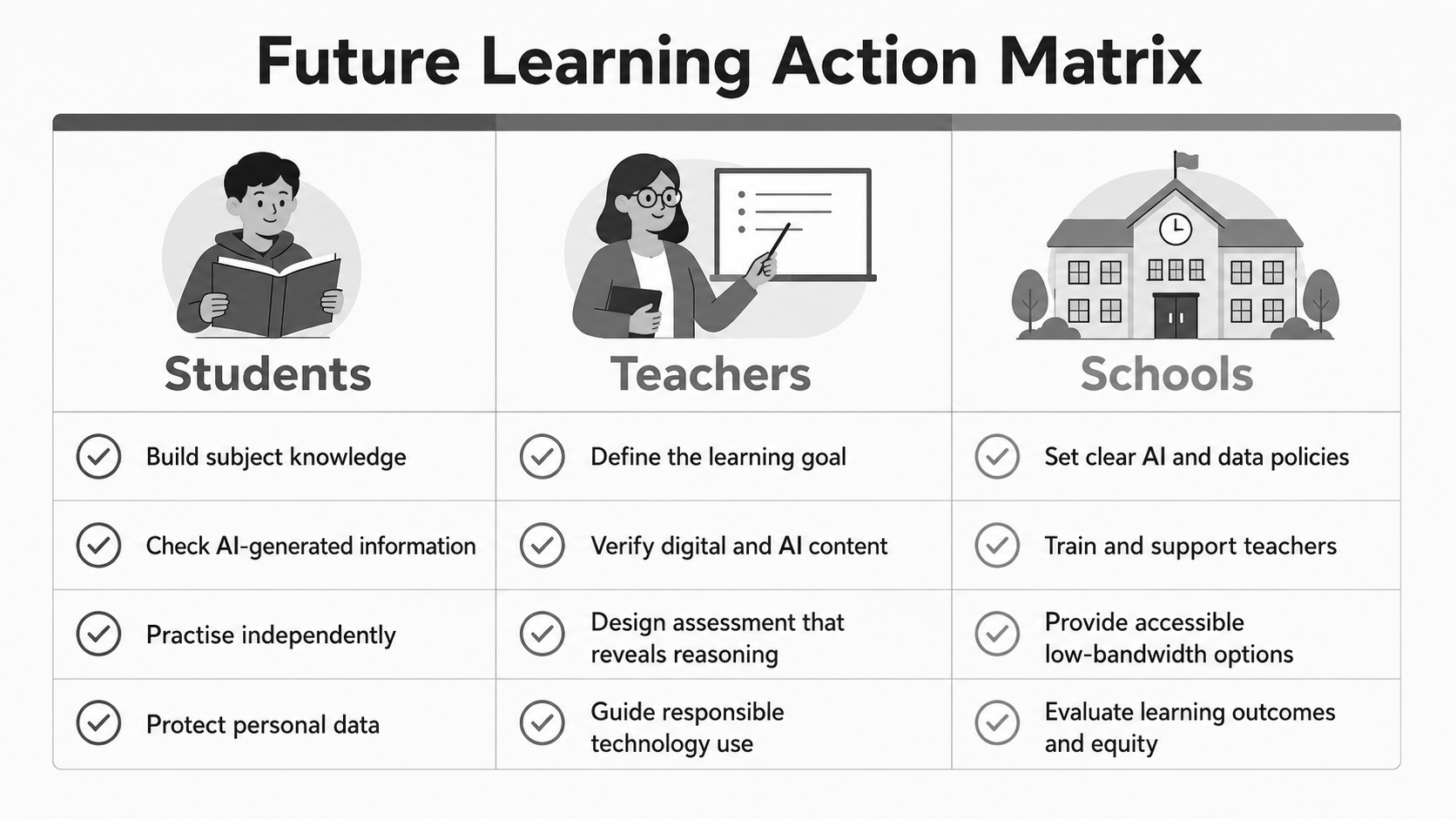
Role-Based Preparation Matrix
| Group | Priority | Evidence to look for | Assumption to avoid |
|---|---|---|---|
| Students | Independent practice, AI literacy, source checking, and process records | Ability to explain, apply, and revise work | A polished answer proves understanding |
| Teachers | Task design, feedback, verification, and assessment review | Evidence of learning and manageable workload | Automation removes professional judgment |
| Parents | Purpose, privacy, access, safety, and accountability | Clear rules, teacher oversight, and alternatives | More technology means better learning |
| School leaders | Governance, teacher capacity, accessibility, procurement, and evaluation | Defined outcomes, equitable access, and review findings | Purchasing a system solves an education problem |
| Public authorities | Infrastructure, standards, language, inclusion, and coordination | Current implementation data and independent evaluation | Policy targets prove completed delivery |
 How to Evaluate Claims About the Future of Education
A credible claim should answer basic questions about evidence and context.
-
Who is making the claim: a public authority, researcher, school, company, or commentator?
-
What evidence supports it?
-
Is the evidence independent of the product being promoted?
-
Which country, learner group, subject, and outcome were studied?
-
What infrastructure, teacher support, and time were required?
-
Does the evidence measure access, usage, satisfaction, or learning?
-
What costs, risks, and excluded learners are not discussed?
-
Is the statement a measured result, policy goal, scenario, forecast, or opinion?
-
Is newer evidence available?
-
Would the conclusion apply in a multilingual, low-bandwidth, or shared-device setting?
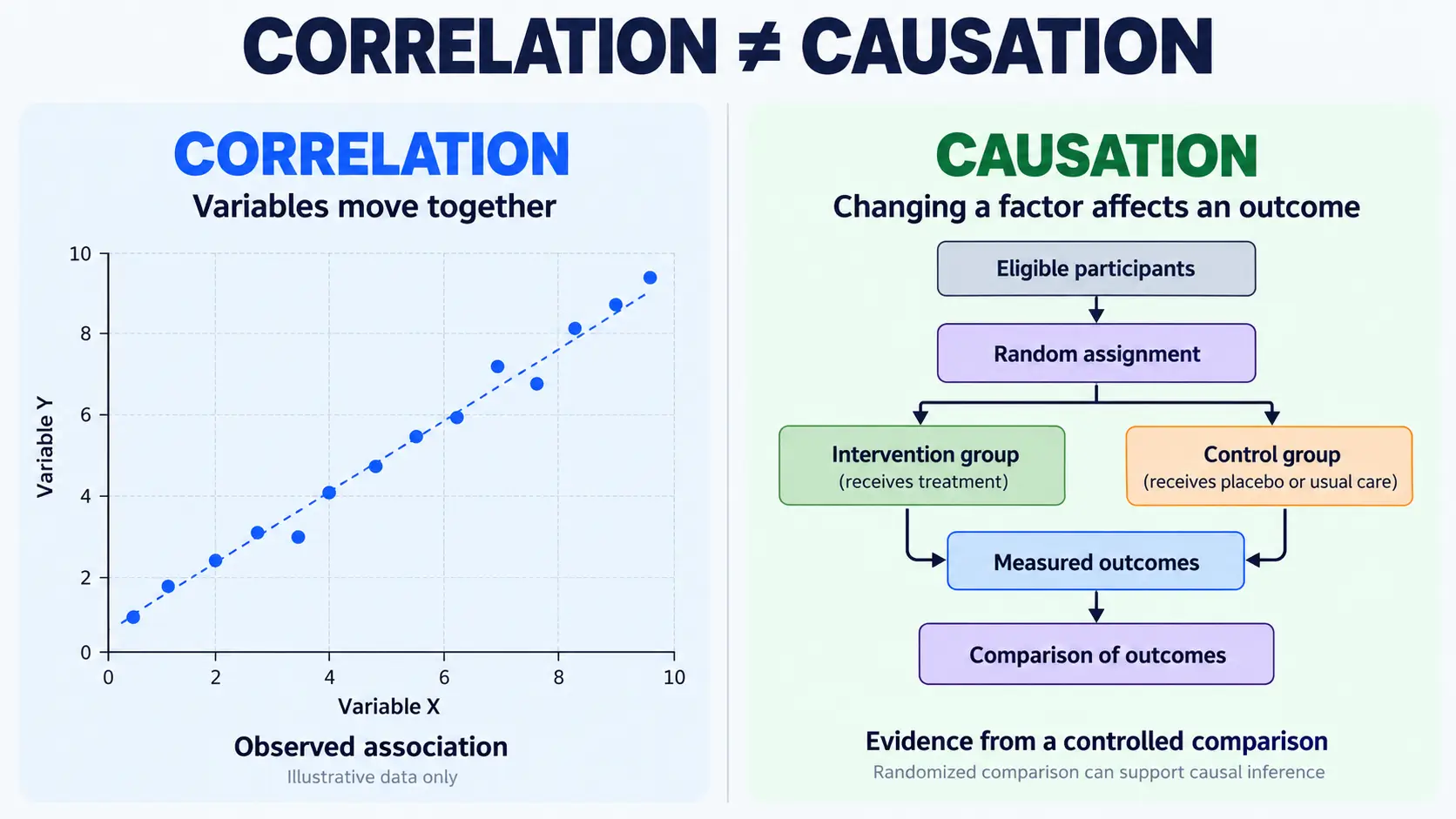
Possibility, policy intention, and measured outcome should not be treated as the same thing.
What Should Readers Watch Next?
The following areas require periodic review because evidence, policy, and technology may change:
-
official Nepal curriculum, assessment, and digital-education updates;
-
current official data on connectivity, devices, accessibility, and teacher capacity;
-
school and university rules for generative AI and academic integrity;
-
independent evaluations of learning outcomes;
-
AI literacy and child-safety frameworks;
-
local-language accuracy and accessibility;
-
assessment methods that provide evidence of reasoning;
-
teacher workload and professional-support findings;
-
privacy and data-governance requirements.
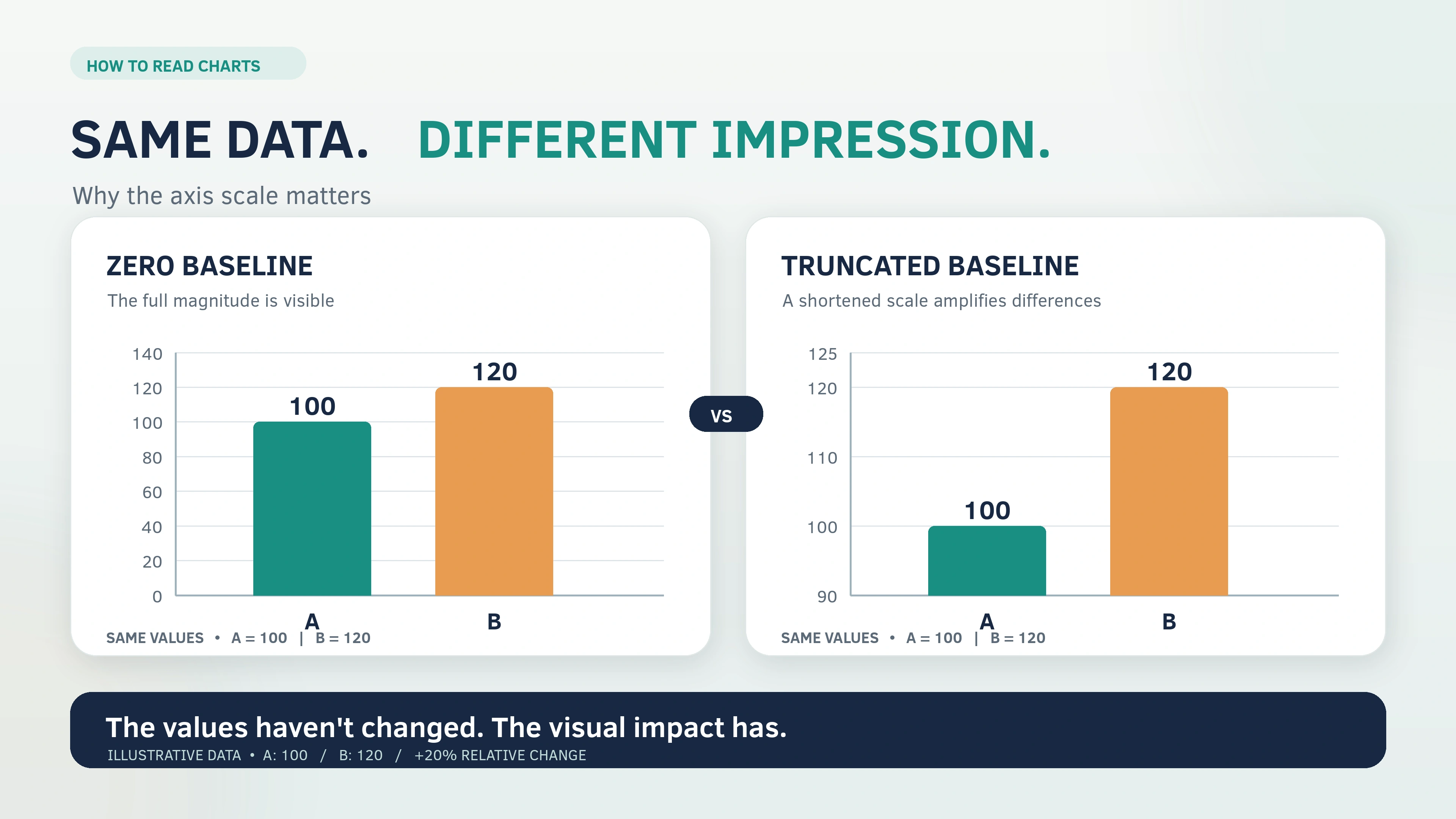
Older adoption figures should not be presented as current without confirming their date, population, and definition.
A Practical Direction for Future Learning
The future of learning should be judged by what students understand, can apply, can explain, and can continue learning—not by the number of technologies used.
Students can combine AI literacy with independent practice and source checking. Teachers can connect tools to defined learning goals while protecting time for feedback, judgment, and relationships. Parents can ask for clear explanations of purpose, privacy, inclusion, and assessment. Schools and public authorities can strengthen infrastructure, teacher capacity, local-language resources, accessibility, governance, and evaluation.
Technology can widen access to support, but it cannot take institutional responsibility for educational goals, standards, learner protection, or public trust.
A responsible direction for future learning is human-centred, evidence-aware, equitable, and open to revision.





Comments 0
No comments yet. Be the first to start the conversation.