




Technology can make sustained focus harder by introducing notifications, competing tasks, rapid content changes, and frequent opportunities to switch. That is different from proving that digital technology has permanently reduced everyone’s ability to pay attention.
“Attention span” is an imprecise popular phrase. It may refer to remaining engaged with a task, filtering distractions, monitoring for important information, resisting an impulse to switch, or returning to a goal after an interruption. These abilities vary with the task, environment, motivation, fatigue, age, and method of measurement.
This distinction matters to students who fear that scrolling has damaged their concentration, parents concerned about screen exposure, educators deciding how devices should fit into lessons, and workers managing messages and competing digital tasks.
Answer Summary: Technology can interrupt attention through alerts, competing content, and task switching. Some patterns of digital-media use are associated with poorer attention outcomes, but the strength and meaning of those associations vary by task, age group, content, exposure, and study design. Research does not support a universal eight-second human attention span or the claim that ordinary technology use permanently damages everyone’s ability to focus.
Table of Content
- What Does Attention Span Mean?
- What Does the Research Show?
- How Do Notifications and Task Switching Affect Focus?
- What Does Research Say About Media Multitasking?
- Does Having a Phone Nearby Reduce Performance?
- How Do Social Media and Short-Form Videos Relate to Attention?
- Can Technology Change Attention Over Time?
- How Does the Evidence Differ by Age?
- Why Is Screen Time an Incomplete Measure?
- How Can People Protect Attention While Using Technology?
- When Do Attention Problems Need Further Support?
- Focus on Conditions, Not a Stopwatch
Key Takeaways:
-
There is no universal human attention-span number.
-
The eight-second claim lacks a clear peer-reviewed foundation.
-
Notifications can interfere with performance during an ongoing task.
-
Media multitasking is associated with poorer attention in some reviews, but the evidence does not prove lasting causal harm.
-
Research does not support a broad claim that merely having a phone nearby impairs everyone’s thinking.
-
Heavier short-form-video use is associated with poorer attention outcomes, but much of the evidence is observational.
-
Findings involving children, adolescents, and adults should be interpreted separately.
-
Useful strategies target avoidable interruptions rather than all technology use.
What Does Attention Span Mean?
Attention is a group of related mental processes, not one internal stopwatch.
Sustained attention means maintaining task-relevant performance over time. Selective attention involves prioritizing relevant information while filtering competing input. Cognitive control helps a person follow a goal, suppress an unrelated response, and change tasks when the goal requires it. Vigilance generally refers to monitoring for signals that may appear infrequently.
These processes overlap, but they are not interchangeable. Someone may remain engaged during a conversation but struggle with a repetitive monitoring task. A student may read effectively in a quiet room yet switch repeatedly when messages and entertainment remain visible.
Researchers can measure particular forms of attention under defined conditions. They cannot responsibly assign one duration to every person, activity, and setting.
How Long Can Humans Pay Attention?
There is no scientifically defensible number that applies across all people and tasks.
Attention during a lecture, examination, conversation, video, laboratory test, or driving task involves different demands. Prior knowledge, motivation, fatigue, stress, task difficulty, teaching method, and environmental distractions can all affect performance.
A 2016 critical review of lecture-attention research found that commonly repeated fixed limits, including the idea that student attention inevitably fades after approximately 10 to 15 minutes, were not well supported by primary evidence. The review focused on lectures, so it should not be treated as a theory of every form of attention.
The better question is not simply, “How long can a person pay attention?” It is, “Attention to what, under which conditions, and measured in what way?”
Why Is the Eight-Second Claim Unsupported?
The popular claim that humans have an eight-second attention span is not supported as a universal scientific limit.
The number is usually repeated without identifying a peer-reviewed study that defines the type of attention, task, population, or measurement involved. Comparing human attention with that of a goldfish adds another unsupported comparison because the behaviors and testing conditions are not equivalent.
The defensible conclusion is that digital environments may increase competition for attention. That does not establish that human attention has fallen to one fixed duration.
| Common claim | Evidence-based interpretation |
|---|---|
| Humans can pay attention for only eight seconds | No universal eight-second limit has been established |
| Students stop paying attention after a fixed number of minutes | Lecture attention varies with task design, teaching, interaction, and measurement |
| Technology has permanently shortened everyone’s attention | A population-wide permanent decline has not been demonstrated |
| Attention changes with context | This is consistent with how attention is defined and measured |
What Does the Research Show?
Evidence is strongest for immediate interruption and task-specific performance effects. It is less conclusive for broad claims about permanent changes in human attention.
| Research supports | Research does not establish |
|---|---|
| Notifications can interfere with an ongoing task | Every alert produces lasting attention loss |
| Frequent switching can fragment a work or study session | Task switching permanently damages attention |
| Some meta-analyses associate heavier media multitasking with poorer attention | The association proves that multitasking caused the difference |
| Heavier short-form-video use is associated with poorer cognitive outcomes | Short videos permanently reduce everyone’s attention |
| Some childhood studies associate screen exposure with attention difficulties | Screens are a proven single cause of attention problems or ADHD |
| One randomized trial found improved sustained-attention performance after blocking mobile internet | Everyone should block mobile internet |
| Phone presence affects performance in some individual experiments | A nearby phone reduces performance for every person and task |
| Content, purpose, context, and timing matter | Total screen time alone explains attention outcomes |
Why Study Design Matters
Different research methods answer different questions.
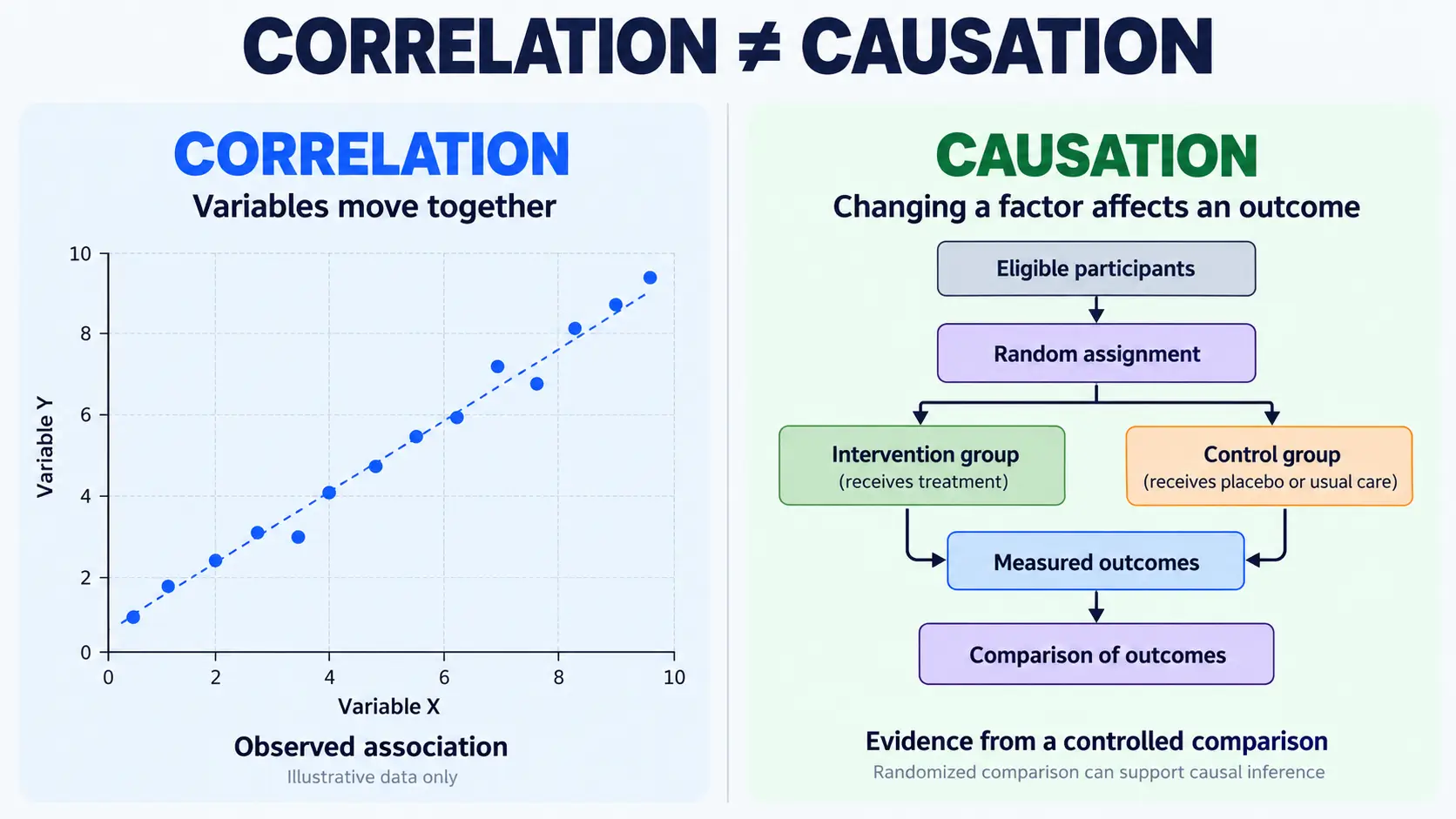
A randomized experiment tests whether changing a condition produces a difference under the study’s circumstances. Its findings may still be limited by the sample, task, setting, and duration.
A meta-analysis combines findings across studies. It can provide a wider view, but its conclusion depends on the quality, measurements, and similarity of the included research.
Longitudinal studies follow people over time and can examine which pattern appears first. They cannot automatically remove every alternative explanation or rule out influence in both directions. Cross-sectional studies identify relationships at one point in time but cannot establish causation.
This distinction matters because claims about technology and attention often begin with an association and later get described as proven damage.
How Do Notifications and Task Switching Affect Focus?
Technology most clearly affects attention by adding competing cues and tasks to the immediate environment.
A person may open an alert, ignore it, or continue working while mentally monitoring it. Opening it interrupts the current goal. Ignoring it may still require a response. Returning to the original task can involve remembering what was being done and rebuilding the relevant context.
Notifications Can Interrupt an Ongoing Task
Experimental evidence indicates that notification sounds can slow responses during an ongoing activity.
In a 2022 smartphone-notification experiment, participants responded more slowly on trials paired with notification sounds than on control trials. The study also reported differences in measures related to cognitive control and attentional engagement. It did not establish permanent attention loss or show that every notification has the same effect.
For students and workers, the practical concern is repeated competition. Each banner or sound introduces another possible action: inspect it, respond, dismiss it, or continue while keeping it in mind.
Reducing nonessential alerts is therefore a reasonable, mechanism-based strategy. It is not a treatment or a guarantee of improved performance.
Task Switching Breaks Continuity
Task switching occurs when attention moves from one goal to another, such as leaving an assignment to answer a message and then returning.
The disruption is not limited to the time spent on the second task. The person must also re-establish the original goal, locate the stopping point, and retrieve information that was active before the interruption.
Not every switch is avoidable or harmful. Some work requires communication, monitoring, and changing priorities. The useful distinction is whether a switch serves the current goal or interrupts it without a clear benefit.
What Does Research Say About Media Multitasking?
Media multitasking is associated with poorer attention or cognitive-control outcomes in some reviews, but the findings do not prove permanent causal harm.
Media multitasking means using several media streams at once or switching rapidly among tasks when at least one involves media. Examples include watching a lesson while messaging, reading while monitoring social media, or repeatedly moving between an assignment and unrelated videos.
A 2017 analysis focused largely on distractor filtering. Across 39 effect sizes, it found a weak association between heavier media multitasking and distractibility. The association became non-significant after adjustment for small-study effects, leading the authors to question whether the laboratory finding was reliable.
A 2023 three-level meta-analysis involving adolescents and young adults found a moderate negative association between media multitasking and cognitive control. Heavier media multitaskers performed worse on inhibition and working-memory measures, while the difference in cognitive flexibility was not statistically significant.
A 2025 meta-analysis of media multitasking and attention included 33 studies, 36,861 participants, and 110 effect sizes. It reported a correlation of 0.19, with greater media multitasking associated with poorer attention. The authors described the conclusion as provisional, and the type of attention measurement influenced the relationship.
The reviews examined different outcomes, populations, and measurements, so their results are not directly interchangeable. Together, they support concern about an association between heavier media multitasking and some attention or cognitive-control outcomes. They do not establish that media multitasking caused the differences, that the effects are permanent, or that everyone is affected in the same way.
Does Having a Phone Nearby Reduce Performance?
Research does not support a universal claim that the mere presence of a smartphone reduces cognitive performance.
A 2023 randomized experiment recruited 49 university students aged 20 to 34. Seven were excluded, leaving a final sample of 42. Participants completed an attention task by video conference with their switched-off phone either face down on the desk or outside the room. The study reported slower performance in the phone-present condition.
Its small sample, remote setting, and specific task limit how widely the result can be applied.
Broader meta-analyses have found limited or no consistent overall cognitive effect from smartphone presence. Findings differ according to the cognitive task, phone placement, study design, and statistical power.
The evidence suggests that phone presence may matter for particular people, tasks, or settings. It has not been shown to impair every type of cognitive performance.
Moving a phone out of reach can still be tested during demanding work. Any benefit should be observed rather than assumed.
How Do Social Media and Short-Form Videos Relate to Attention?
Social media and short-form feeds can create repeated opportunities to redirect attention, but they should not be treated as one uniform exposure.
Social media may involve direct communication, group coordination, educational material, creative work, entertainment, or recommendation-driven feeds. These activities place different demands on attention.
The clearest concern arises when social media becomes a competing goal during another task. Alerts, visible feeds, or habitual checking can repeatedly pull attention away from the intended activity. This mechanism does not prove that every platform or pattern of use produces lasting changes.
Problematic use also differs from total time. Longitudinal research involving children and adolescents has found relationships in both directions between digital-media use and ADHD-related symptoms. Associations are generally stronger for problematic use than for total screen time.
What Does Current Short-Form-Video Research Show?
Heavier short-form-video use is associated with poorer attention and inhibitory-control outcomes, but the evidence remains largely observational.
A 2025 systematic review and meta-analysis of short-form-video use combined data from 98,299 participants across 71 studies. Increased use was associated with poorer cognitive outcomes, with attention and inhibitory control among the strongest relationships. These findings describe associations and do not establish that short-form videos caused the differences.
A later systematic review focused on people aged 25 or younger and found that most included studies were cross-sectional. It linked heavier, unstructured use with inattention, impulsivity, weaker working-memory performance, and poorer self-regulation, while describing the evidence as preliminary.
These reviews justify concern, but they do not support claims that short videos permanently rewire the brain, cause irreversible decline, or damage every viewer’s attention.
The most accurate conclusion is that heavier use is associated with poorer attention-related outcomes, while the direction, permanence, and individual impact remain uncertain.
Can Technology Change Attention Over Time?
Long-term change is harder to establish than immediate interruption.
Three levels should remain separate:
-
Immediate interruption: an alert or switch affects the current task.
-
Repeated use pattern: checking and switching become a regular way of studying or working.
-
Long-term capacity: a measurable change remains when the technology or cue is absent.
Experiments provide evidence for immediate effects. Observational research can identify repeated patterns and associations. Claims about lasting changes require well-designed longitudinal or intervention studies and should not be inferred from one task or brief exposure.
What Did the Mobile-Internet Trial Find?
A 2025 randomized mobile-internet blocking trial tested the effect of blocking internet access on participants’ smartphones for two weeks. Calls and text messages remained available, and participants could still use the internet on other devices.
The study enrolled 467 participants. Sustained attention was measured with the gradual-onset continuous performance task. After the first intervention period, the intervention group showed a small improvement in task accuracy, with a within-person effect size of 0.24. The delayed-intervention group later showed an improvement of similar size.
Compliance and attrition limit the finding. Of the 467 participants who agreed to the intervention, 266 set up the blocking application and 119 met the preregistered compliance definition. A total of 313 completed all three surveys. Participants who completed every measurement point also had better sustained-attention scores at baseline than those who dropped out.
The study provides causal evidence that changing mobile-internet access can improve measured sustained attention under its conditions. It does not establish that everyone should block mobile internet or that a set period away from a phone produces a universal reset.
Can Attention Improve?
Attention performance can change when conditions change.
The mobile-internet trial found a small improvement in one objective measure of sustained attention. This suggests that measured performance is not fixed. One intervention cannot establish what will work for every person or how long an effect will last.
Readers can test changes to their digital environment. Those tests should be treated as personal observation rather than evidence of treatment, recovery, or permanent cognitive change.
How Does the Evidence Differ by Age?
Findings involving young children should not be transferred directly to adolescents, university students, or working adults.
Developmental stage, family environment, school demands, content, sleep, device purpose, and research methods differ substantially among these populations.
| Population | What the evidence suggests | Main caution |
|---|---|---|
| Young children | Several observational studies associate higher screen exposure with attention difficulties | Direction may be bidirectional, and causation is not established |
| Adolescents | Problematic use and ADHD-related symptoms may influence each other over time | Technology is not a proven single cause of ADHD |
| University students | Alerts, media multitasking, and some phone conditions can affect measured outcomes | Laboratory and small-sample findings do not apply uniformly |
| Working adults | Messages and task switching can interrupt ongoing work | Effects depend on the task, role, urgency, and environment |
| People with accessibility needs | Technology may support communication, organization, and access | Removing useful functions may create other difficulties |
Young Children
Systematic reviews report associations between screen exposure and attention difficulties in young children, but the evidence is observational and varied.
A 2023 systematic review of children younger than seven found consistent cross-sectional associations but mixed longitudinal findings. It also identified possible bidirectionality: screen exposure may relate to later attention outcomes, while children who already have attention or self-regulation difficulties may receive or seek more screen use.
A separate 2022 systematic review also found an association between screen time and attention problems in children while emphasizing variation in exposure definitions and attention measures.
Parents should not treat all screen use as equivalent. Content, timing, adult involvement, family circumstances, background media, and the activities displaced by screen use may all matter. Findings involving preschool children should not be generalized to adults.
Adolescents and ADHD-Related Symptoms
Digital-media use has not been established as a single cause of attention-deficit/hyperactivity disorder.
A systematic review of longitudinal studies found evidence of relationships in both directions between digital-media use and ADHD-related symptoms in children and adolescents. Associations were generally small, varied by the type of digital media, and sometimes became weaker after researchers accounted for other variables.
There is no single test for ADHD. Sleep disorders, anxiety, depression, and certain learning disabilities can produce similar symptoms. Clinical assessment considers persistent symptoms, developmental history, impairment, and whether difficulties occur in more than one setting.
Difficulty concentrating after scrolling is not enough to diagnose ADHD or establish that a device caused it.
Adults, Students, and Knowledge Workers
Adult evidence often comes from laboratory experiments, self-reported media habits, meta-analyses, and relatively short interventions.
For students, the main issue may be switching between coursework and social communication. For educators, it may be whether a device serves the learning activity or introduces unrelated options. For knowledge workers, interruptions may come from workplace messaging, email, calendar alerts, and competing browser tabs.
The useful question is not whether technology is inherently good or bad. It is whether the available functions support the current goal or compete with it.
Why Is Screen Time an Incomplete Measure?
Screen time is easy to count but too broad to explain attention by itself.
The same duration can include writing, research, communication, accessibility support, creative production, passive entertainment, or repeated switching among unrelated activities. These uses are not cognitively equivalent.
A more informative assessment considers:
-
Purpose: learning, creating, communicating, organizing, or entertainment
-
Content: coherent, rapidly changing, interactive, or emotionally demanding
-
Timing: during focused work, leisure, or the period normally used for sleep
-
Device role: necessary work tool or competing secondary device
-
Concurrent activity: single-tasking or moving among several streams
-
Social context: independent use, classroom use, or use with a caregiver
-
Displacement: sleep, physical activity, reading, conversation, or another task
-
Control: intentional use or use that repeatedly disrupts responsibilities
-
Accessibility: whether the device provides communication, organizational, sensory, or learning support
Purposeful technology can support learning, coordination, access to information, communication, and organization. That value does not remove distraction risks. It explains why the practical target should be disruptive patterns rather than screen exposure treated as one uniform category.
How Can People Protect Attention While Using Technology?
The most defensible strategies reduce specific interruptions and unnecessary opportunities to switch.
| Pattern | Likely attention demand | Adjustment to test | Evidence position |
|---|---|---|---|
| Nonessential notifications | Adds a competing cue and decision | Silence or batch selected alerts | Experimental evidence supports immediate interference |
| Repeated message checking | Breaks continuity of the current task | Use planned checking periods | Mechanism-based guidance |
| Many unrelated tabs | Keeps alternate goals available | Retain only the task and required references | Practical guidance |
| Phone within easy reach | May affect some people or tasks | Move it out of reach and compare sessions | Mixed evidence |
| Rapid-feed use during study | Creates repeated opportunities to switch | Separate it from the study period | Associations exist; lasting causal effects remain uncertain |
| Technology required for the task | Supports learning, work, or accessibility | Keep necessary functions and remove unrelated cues | Context-dependent |
Start With an Alert Audit
Review which applications can interrupt a focused period.
Keep emergency, caregiving, school, or work-critical channels active where necessary. Silence promotional and non-urgent notifications. Remove badges that prompt repeated checking, and use scheduled communication periods when an immediate response is not required.
This advice follows the observed immediate effect of notifications. It should not be presented as a clinical intervention.
Match the Digital Setup to the Task
Different activities require different digital conditions.
Research may require several sources and search tools. Close reading, complex writing, revision, or calculation may benefit from fewer unrelated options.
Before beginning, identify:
-
The outcome required from the session
-
The documents and applications needed
-
The visible items likely to invite an unrelated switch
-
The communication channels that must remain available
-
The next planned time for checking messages
-
The point at which the session will end
The goal is not to eliminate technology. It is to align the digital environment with the selected task.
Use Age- and Context-Appropriate Decisions
Students can keep the assignment, notes, and required references in one workspace while moving social communication to a planned break.
Parents can examine content, context, timing, and displaced activities rather than relying on one universal screen-time rule. Age, school requirements, family circumstances, and accessibility needs should remain part of the decision.
Educators can decide whether a device has a defined purpose in a particular lesson. A device may support research, participation, or accessibility in one setting and create unrelated competition in another. Fixed claims that every student stops paying attention after a particular number of minutes should not determine lesson design.
Readers interested in balancing screen time with reading can use a separate task-specific routine rather than treating all screen exposure as equally distracting.
Try a Seven-Day Attention-Protection Test
A short observation period can identify which conditions relate to a recurring task.
-
Select one task, such as reading, studying, lesson planning, or writing.
-
Record the intended duration or required outcome.
-
Count unplanned checks or switches.
-
Change one factor, such as notification settings, phone distance, or message-checking times.
-
Record whether the task was completed.
-
Compare similar sessions with and without the change.
-
Retain changes that help and remain practical.
This is a personal tracking exercise. It is not a diagnostic test and cannot establish a clinical or permanent cognitive effect.
Consider Sleep and Other Causes of Poor Focus
Attention problems should not automatically be attributed to technology.
Sleep disorders, anxiety, depression, certain learning difficulties, workload, stress, illness, and environmental disruption can also affect concentration.
A technology habit may be one part of the pattern rather than its only cause.
When Do Attention Problems Need Further Support?
Device adjustments are not a substitute for qualified assessment when attention difficulties are persistent, severe, or present across several settings.
Further support may be appropriate when concentration problems regularly interfere with education, work, relationships, responsibilities, or safety. A healthcare or qualified mental-health professional can consider symptoms, developmental history, daily impairment, and other possible explanations.
Readers should not diagnose ADHD from screen habits, stop prescribed care, or replace professional support with a period away from devices.
This article provides general educational information, not diagnosis or treatment.
Focus on Conditions, Not a Stopwatch
Technology does not give every person one shorter attention timer.
It can change the conditions around attention by adding alerts, competing goals, rapid content changes, and opportunities to switch. Evidence is strongest for immediate interruption and some task-specific associations. Evidence for long-term, universal change remains less certain.
A practical response is specific: reduce avoidable alerts, match technology to the task, observe personal patterns, retain useful and accessible functions, and seek qualified support when attention difficulties persist across daily life.





Comments 0
No comments yet. Be the first to start the conversation.