



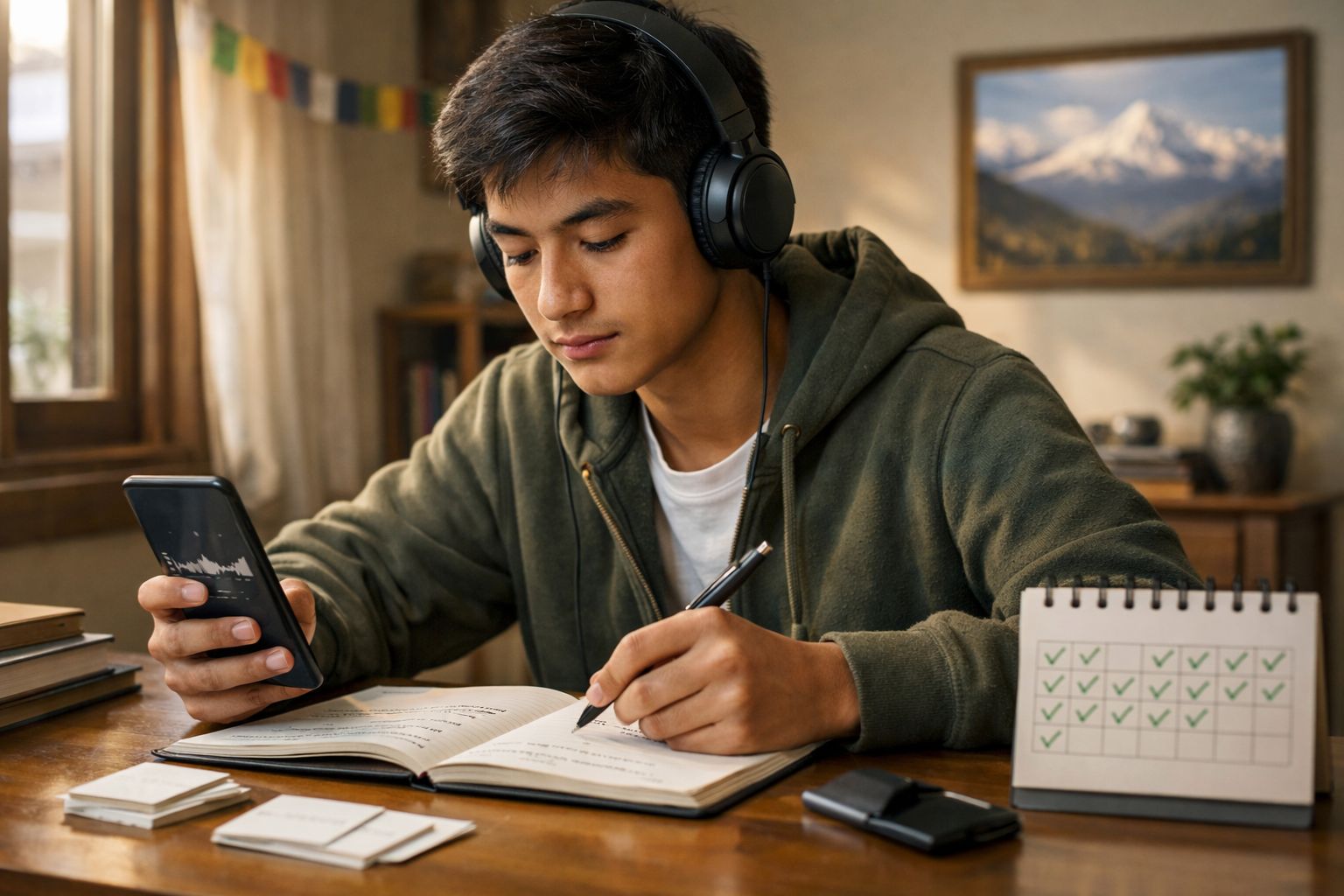
Learning With Podcasts and Audiobooks: A Guide to Retention
Podcasts and audiobooks can turn spare minutes into learning time. Many people listen while traveling, exercising, or handling household tasks. This pattern is not limited to adults. In UK survey data from the National Literacy Trust, 42.3% of children and young people aged 8–18 reported enjoying listening to audio in their free time in 2024, compared with 34.6% who reported enjoying reading.
The practical question is not whether audio can teach. It can. The question is whether your listening turns into retention—knowledge you can explain, use, and recall later without replaying the audio.
A common frustration sounds like this: “I finished the episode (or the chapter), but a week later I cannot explain what it said.” Online discussion threads reflect the same problem, especially for people who listen during commutes or workouts and cannot stop to write notes.
This guide focuses on retention. You will learn how audio fits (and where it struggles), how to choose podcasts and audiobooks that support learning, and how to run a simple workflow—pause points, prompts, retrieval practice, and spaced review—based on learning methods that are consistently supported in research reviews.
Explain: What Retention From Audio Means
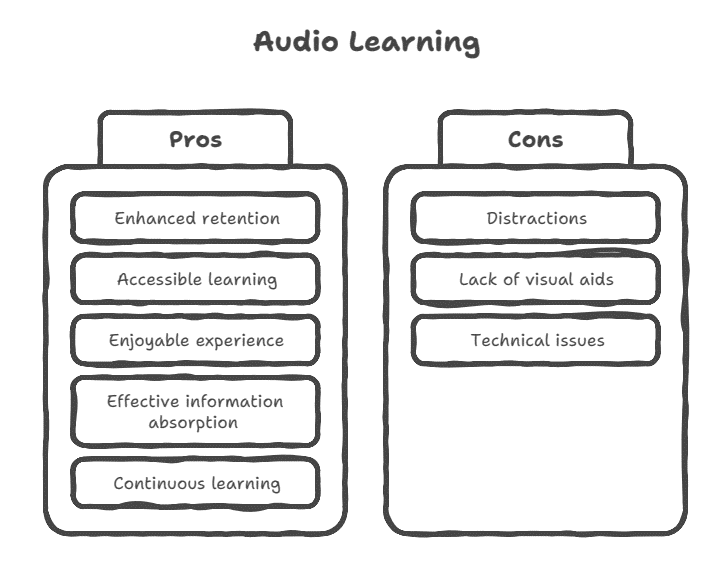
Exposure vs recall
Listening is exposure. Retention is recall—what you can bring to mind later when the audio is off.
Evidence syntheses in cognitive and educational psychology highlight retrieval practice (practice testing) as a reliable way to improve long-term retention across many learning materials and settings.
For audio learning, this distinction matters because listening often happens in one continuous pass. If you do not add moments of retrieval (summaries, self-questions, quick quizzes), the session can remain close to passive exposure.
A practical definition:
-
Exposure: “I heard it.”
-
Retention: “I can explain it, apply it, or answer questions about it later.”
Why listening can feel productive but fade quickly
Listening can feel easy because it flows. That smoothness can hide shallow encoding, especially when:
-
The audio keeps moving forward even if you missed a step in the argument.
-
It is harder to scan backwards compared with a printed page.
-
Listening happens alongside other tasks.
Divided attention is a major risk. Research on classroom multitasking suggests that splitting attention during learning can reduce comprehension and performance, with effects extending beyond the multitasker in some contexts.
This does not mean you need silence for every episode. It means your environment should match the difficulty of the audio.
Listening vs reading comprehension: what research suggests
Comparisons between listening and reading do not produce a universal rule. A meta-analysis of reading and listening comprehension comparisons reports that results vary across studies and conditions, rather than showing a consistent advantage for a single modality across all cases.
In real study routines, the difference often shows up as control:
-
Reading offers quick scanning, re-reading, and visual structure (headings, paragraphs, diagrams).
-
Listening offers convenience and can support comprehension when the content is clear and attention remains on-task.
In a classroom-context study comparing podcasted material to text, the podcast group performed worse on quiz retention than the text group in that setting.
This does not mean “audio cannot work.” It suggests that audio needs structure and active processing supports when the goal is durable recall.
Reading while listening: when it helps and when it distracts
Some learners combine audio with text (reading while listening). Evidence is mixed. In a study comparing audiobook, e-text, and dual modality, comprehension did not differ significantly across conditions in that design.
A useful way to think about this comes from multimedia learning research: adding modes can help when it supports selection and organization of information, but it can also overload working memory when it adds competing demands.
Practical decision rule:
-
Use reading + listening when you need support with names, terminology, structure, or language learning.
-
Use audio-only when you want screen-free focus and the content does not require frequent cross-checking.
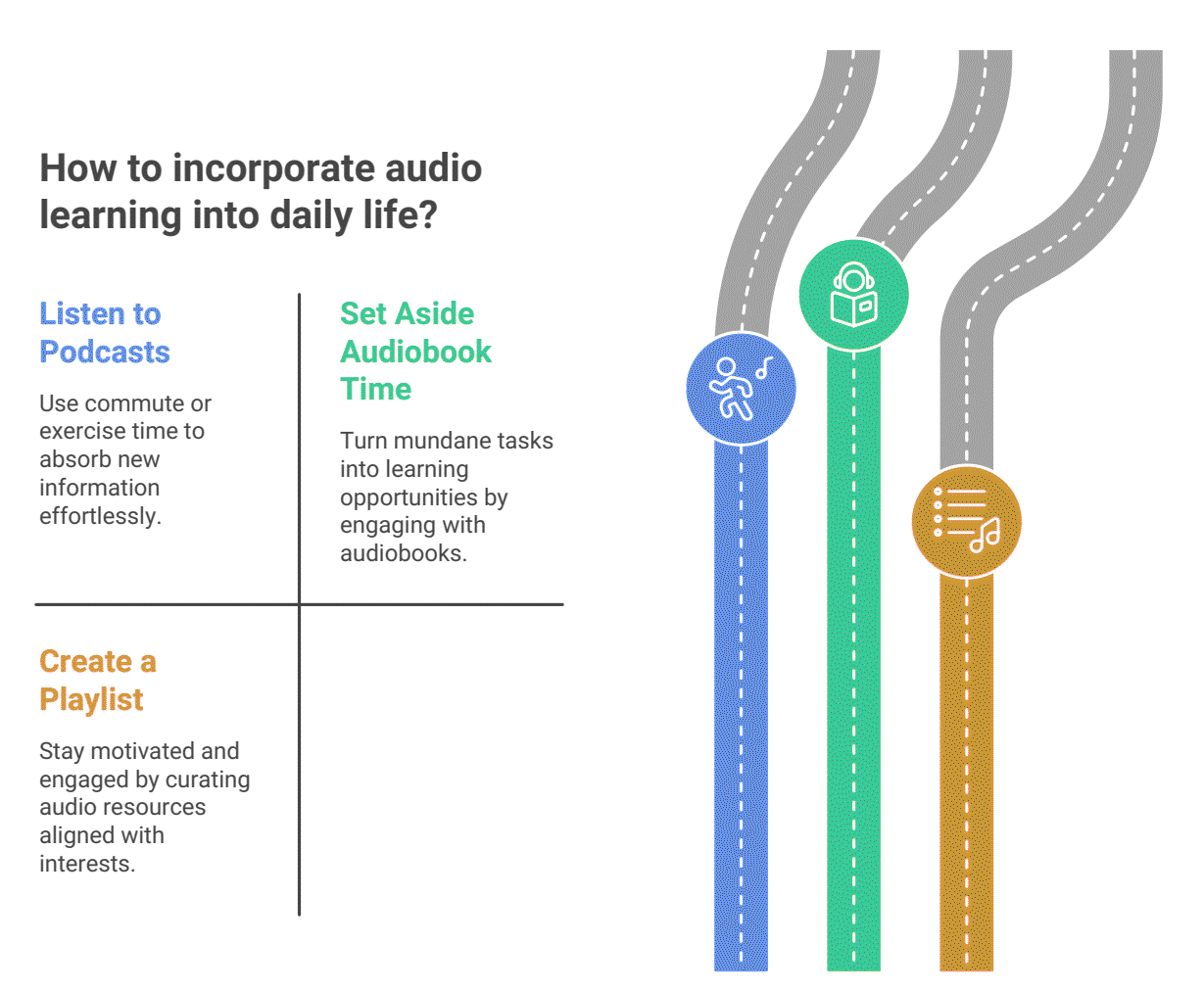
Inform: Choosing Audio That Supports Learning
Match format to goal
Different audio formats behave differently for learning.
Narrative, explanation, interview, lecture-style audio
-
Narrative (stories, biographies): often works well in audio because sequence and emotion are carried by voice.
-
Explanation (structured nonfiction): works well when the speaker uses clear signposting and summaries.
-
Interview: helpful for perspectives and examples; can drift without strong structure from the host.
-
Lecture-style: strongest when paired with show notes, references, and a clear outline.
In professional education, podcasts are often treated as supplements rather than replacements. A review of podcasting in medical education notes growing use and also highlights gaps in evidence-based design guidance—reinforcing the value of structured, learning-oriented production.
Skills practice vs commentary
If your goal is skill-building (exam preparation, language learning, technical knowledge), look for:
-
clear learning objectives
-
examples and practice prompts
-
recap segments
-
references to primary sources or further reading
If your goal is awareness and context, commentary content can still help, but treat it as mapping ideas and questions rather than mastering details.
Quality signals for podcasts and audiobooks
Audio quality is not only sound clarity. It is credibility, structure, and verification cues.
Use this checklist:
-
Who is speaking or writing?
-
relevant expertise that can be checked (training, professional track record, research contributions)
-
-
What sources are cited?
-
show notes, references to peer-reviewed research, or named documents
-
-
How is the content structured?
-
definitions, segments, summaries, and recap points
-
-
What is the content type?
-
teaching, reporting, storytelling, or opinion
-
-
Can you verify key claims?
-
links to studies, transcripts, or citations that allow checking
-
Online guides and tools frequently recommend transcripts and timestamped highlights, largely because audio is harder to search than text.
That tactic becomes more valuable when paired with verification habits: confirm names, statistics, and study claims using the linked sources.
Audio alongside formal learning
Audio resources can support formal study, but they are not credentials.
Audio is not a credential
Podcasts and audiobooks can improve understanding and vocabulary, but they do not provide formal assessment by default. In education and hiring contexts, assessment and documented outcomes often matter.
Audio fits well as support for:
-
previewing a topic before class
-
reviewing after lectures
-
building context for essays or projects
-
reinforcing terminology through repeated exposure
Certificates and degrees: quick definitions and fit
-
A certificate usually indicates completion of a shorter, skills-focused program with defined outcomes.
-
A degree is typically a longer, broader program with cumulative assessment and wider recognition.
Audio can support both pathways by strengthening comprehension and recall, but the credential value comes from the assessed program, not from listening time.
Practical Insight: A Retention Workflow for Audio Learning
Many people already know how to press play. The retention gains come from what you do around the listening.
Two techniques appear repeatedly in evidence reviews for long-term retention:
-
retrieval practice (practice testing)
-
distributed practice (spaced learning)
The workflow below adapts those methods to podcasts and audiobooks.
Step 1: Set a purpose and pre-write questions
Before listening, write one sentence:
-
“After this session, I want to explain: ______.”
Then write two to four questions you expect the audio to answer:
-
What problem is being addressed?
-
What are the key terms and how do they relate?
-
What evidence or example supports the claim?
-
What would change in my study routine or project plan if this holds?
This step shapes attention and also sets up retrieval later.
Step 2: Use pause points and micro-summaries
Pick two to five pause points in each session. For long audiobook chapters, use a pause point every 10–15 minutes.
At each pause, say or write a micro-summary:
-
Main claim:
-
Reason:
-
Example:
-
Open question:
The goal is not volume. The goal is retrieval—bringing the idea to mind and shaping it in your own words, which aligns with the mechanisms behind the testing effect.
Step 3: Capture notes with minimal friction
Your capture method should match your listening context.
Hands-busy capture options
-
Walking or commuting: record a short voice memo (episode title + one idea + one example).
-
Public transport: write brief bullets rather than full sentences.
-
At a desk: pause and write the micro-summary.
Community discussions often highlight the same constraint: many listeners consume audio in contexts where typing is not realistic.
Transcripts, bookmarks, and highlights
Many podcast and transcript tools focus on transcripts, time-stamped highlights, and quote-style bookmarks because audio is difficult to search later.
Use transcripts for:
-
names, terminology, and spelling
-
definitions you want to revisit
-
claims that need verification
-
quick review before a test or discussion
Multimedia learning research supports combining modes when it reduces confusion and supports active processing rather than adding competing demands.
Step 4: Convert notes into retrieval practice
This step is where retention changes.
From each session, convert three to eight captured ideas into prompts:
-
Flashcard prompts
-
Prompt: “Define X.”
-
Answer: definition + one example
-
-
Short-answer prompts
-
“List the main reasons for…”
-
“Explain the difference between…”
-
-
Teach-back
-
Record a 60-second explanation for a classmate.
-
Evidence reviews rate practice testing as a high-utility technique for long-term retention.
A note-taking principle that transfers well to audio: aim for generative notes rather than verbatim transcripts. In the longhand vs laptop note-taking research, the proposed advantage for longhand relates to deeper processing when notes are summarized and rephrased rather than copied.
Step 5: Use spaced review
Spacing works because time gaps create partial forgetting, which forces retrieval when you return—strengthening memory across sessions. A meta-analysis of distributed practice documents robust spacing effects across many experiments and outcomes.
A practical review cadence:
-
Day 0: 3–5 minutes of self-quizzing using your prompts
-
Day 2: quiz again, rewrite weak answers
-
Day 7: quiz again, add one transfer task
-
Day 21: quiz once more, then archive
If you maintain two review points, keep Day 2 and Day 7. These gaps often surface what faded and what remained.
Step 6: Build transfer
Retention becomes useful when you can use ideas outside the original context.
Choose one transfer task per week:
-
apply a concept to an assignment problem
-
write a 150–250 word explanation
-
teach the concept to a peer
-
connect the idea to a decision (study plan, project approach, revision method)
Transfer tasks also function as retrieval practice because they require you to reconstruct the idea and apply it.
Playback speed choices
Many listeners adjust playback speed. Research on playback speed and distractions suggests that comprehension outcomes depend on conditions and materials, and that multimedia presentations can mitigate some costs at faster speeds in some contexts.
Practical decision rule:
-
Increase speed only if you can still produce accurate micro-summaries at pause points.
-
If you need repeated rewinds for core concepts, slow down or switch to text for that section.
-
If you use transcripts, check terminology and definitions there rather than replaying long segments.
Outcomes and Limitations
Signs learning is sticking
After one to two weeks, look for these signals:
-
You can explain the core idea without replaying the audio.
-
You can provide an example and a counterexample.
-
You can answer your pre-written questions in an organized way.
-
You can identify weak points and name what you need to review.
Common failure points and fixes
Multitasking, noise, and fatigue
Divided attention is a major reason audio learning feels productive but fades fast. Evidence on laptop multitasking in learning contexts supports the broader risk: split attention can reduce comprehension and performance.
Fixes:
-
Match audio difficulty to environment difficulty.
-
Maintain two playlists: “light listening” (narrative, recap) and “study listening” (dense, structured).
-
Use micro-summaries as an attention check. If you cannot summarize, treat it as a signal to pause, rewind, or stop.
When to switch to text or mixed media
Switch formats when:
-
the topic includes dense definitions, formulas, diagrams, or heavy cross-referencing
-
you need precise citation or verification
-
you need to compare multiple arguments side-by-side
-
you repeatedly rewind for the same section
Cognitive load theory helps explain why: working memory limits make learning harder when extraneous demands (noise, task switching, high complexity) rise. Instructional design can reduce those demands by simplifying presentation and matching the format to the task.
Two-week self-check plan
Use a brief test to check whether your workflow is improving retention:
-
Choose one audiobook chapter or two podcast episodes on a single topic.
-
Create 10 retrieval prompts from your notes.
-
Test yourself on Day 2 and Day 7 without replaying the audio.
-
Track which prompts were strong, which failed, and what changed performance (slower speed, transcript review, shorter sessions).
This approach measures recall rather than time spent listening.
Conclusion
Learning with podcasts and audiobooks can support strong retention when listening is paired with retrieval and review. Evidence syntheses consistently support two levers for long-term memory: retrieval practice (practice testing) and spaced learning (distributed practice).
Audio also has limits. When attention is divided, comprehension can drop, and research on multitasking during learning supports treating split attention as a real risk. For dense material, text or mixed media can offer better control through scanning, re-reading, and visual structure, and modality research suggests outcomes depend on conditions rather than on a single “best” format.
A practical next step is to select one short audio resource, write a purpose statement and questions, generate 10 prompts, and run Day 2 and Day 7 self-checks without replaying. Use the results to decide when audio fits your goals and when text is the stronger option.
FAQs
Are audiobooks as effective as reading for learning?
It depends on the material and conditions. Research comparing reading and listening shows varied patterns across studies rather than a single winner across all contexts.
How many notes should I take from a podcast episode?
Aim for a small set of micro-summaries and several retrieval prompts. Generative notes (rephrased in your own words) can support deeper processing compared with near-verbatim capture.
What is the fastest way to remember what I hear?
Convert key points into retrieval prompts and revisit them across multiple days. Retrieval practice and spacing are consistently supported in evidence reviews for long-term retention.
Is listening while exercising or commuting a problem?
It can be, especially for dense material. If you cannot summarize at pause points, treat the session as exposure and switch to lighter content or a more focused setting for study audio. Evidence on multitasking during learning supports treating divided attention as a risk factor.
Should I speed up audiobooks and podcasts?
Speed can work for some materials and conditions, but comprehension depends on context. Increase speed only if you can still produce accurate micro-summaries and answer your prompts without repeated rewinds.
Reference
-
National Literacy Trust. Children and young people’s listening in 2024 (report page), 2025.
-
Dunlosky, J., Rawson, K., Marsh, E., Nathan, M., & Willingham, D. Improving Students’ Learning With Effective Learning Techniques. Psychological Science in the Public Interest, 2013.
-
Roediger, H. L., & Karpicke, J. D. Test-Enhanced Learning: Taking Memory Tests Improves Long-Term Retention. Psychological Science, 2006.
-
Cepeda, N. J., Pashler, H., Vul, E., Wixted, J., & Rohrer, D. Distributed Practice in Verbal Recall Tasks: A Review and Quantitative Synthesis. Psychological Bulletin, 2006.
-
Clinton-Lisell, V. A Meta-Analysis of Reading and Listening Comprehension Comparisons Across Age Groups. Review of Educational Research, 2022.
-
Rogowsky, B. A., Calhoun, B. M., & Tallal, P. Does Modality Matter? SAGE Open, 2016.
-
Daniel, D. B., & Woody, W. D. Retention for Podcasted Material in a Classroom Context. Teaching of Psychology, 2010.
-
Sana, F., Weston, T., & Cepeda, N. J. Laptop Multitasking Hinders Classroom Learning for Both Users and Nearby Peers. Computers & Education, 2013.
-
Mueller, P. A., & Oppenheimer, D. M. The Pen Is Mightier Than the Keyboard. Psychological Science, 2014.
-
Mayer, R. E. Multimedia Learning (book chapter excerpt/PDF), 2002.
-
Sweller, J. Cognitive Load Theory, Learning Difficulty, and Instructional Design. Learning and Instruction, 1994.
-
Cho, D., Cosimini, M., & Espinoza, J. Podcasting in Medical Education: A Review of the Literature. Korean Journal of Medical Education, 2017.
-
Chen, A., Kumar, S. E., Varkhedi, R., & Murphy, D. H. The Effect of Playback Speed and Distractions on the Comprehension of Audio and Audio-Visual Materials. Educational Psychology Review, 2024.
-
The Reading Agency. The State of the Nation’s Adult Reading: 2024 Report, 2024.
