



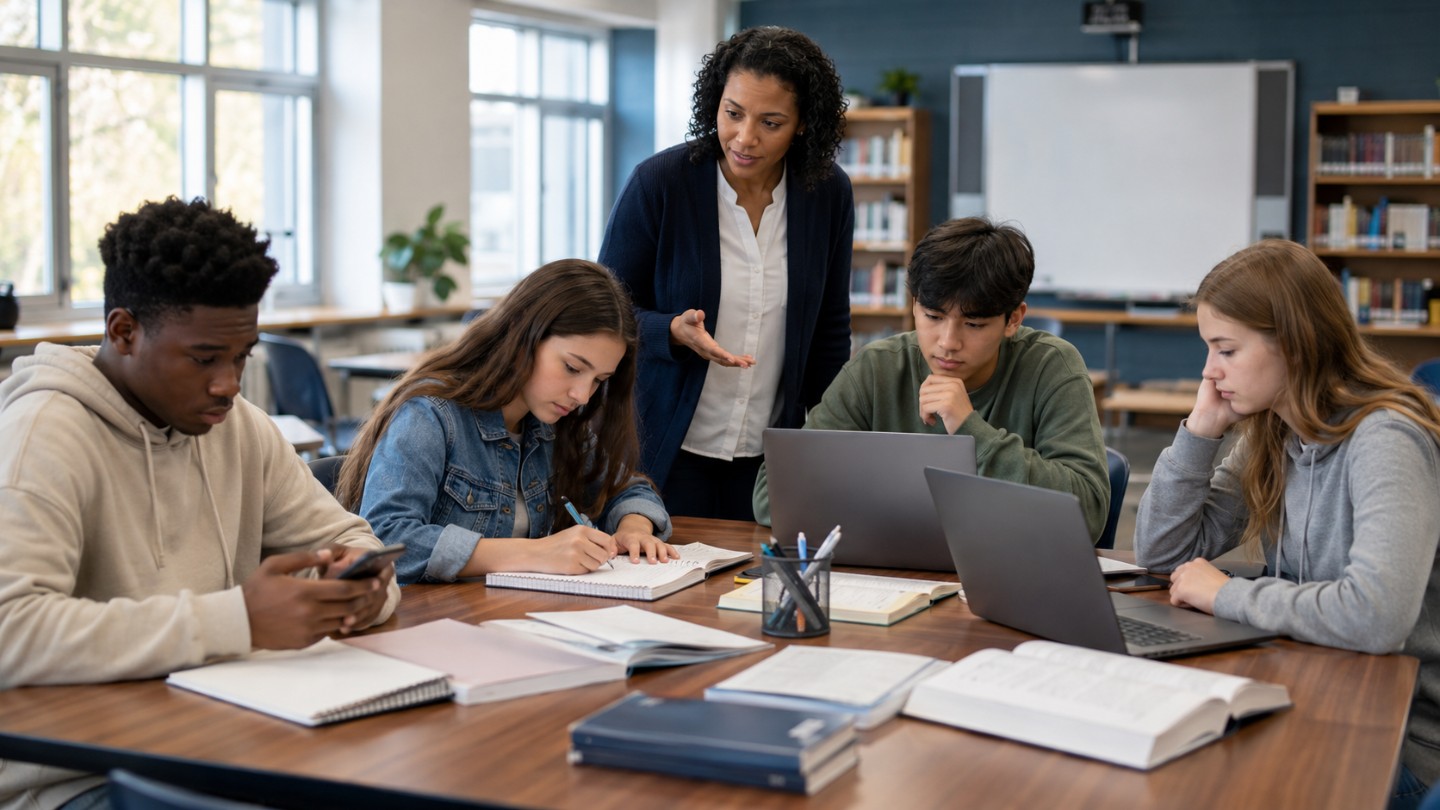
Technology can support learning, but it can also harm students when it interrupts attention, reduces sleep, replaces physical activity, weakens research habits, or becomes a shortcut for schoolwork. The negative effects of technology on students usually come from unmanaged use, not from every device or digital tool.
In this article, “technology” means the digital tools students commonly use for school and personal life: smartphones, laptops, tablets, social media, online classes, learning apps, search engines, games, and artificial intelligence tools. A laptop used for guided research is different from a phone full of notifications during a lesson. An AI tool used for practice is different from submitting AI-written work as original homework.
Answer Summary:
The main negative effects of technology on students are classroom distraction, weaker attention, lower academic focus, poor sleep, less physical activity, social media pressure, reduced face-to-face communication, plagiarism and AI overreliance, misinformation, cyberbullying, privacy risks, and unequal access to devices or internet. These risks increase when technology use is excessive, poorly guided, unsafe, or not connected to a clear learning purpose.
Table of Content
- Quick Answer: 10 Negative Effects of Technology on Students
- How Technology Affects Learning
- How Technology Affects Health and Well-Being
- How Technology Affects Social Life and Safety
- AI Tools, Cheating, and Academic Honesty
- Digital Divide and Unequal Access
- When Technology Helps Instead of Hurts
- How Students Can Reduce the Negative Effects
- How Parents and Teachers Can Support Healthy Use
- Conclusion
Key Takeaways:
-
Technology is most harmful when it distracts from learning.
-
High non-school screen time is linked with sleep and activity concerns.
-
Social media can increase comparison, pressure, and online safety risks.
-
AI tools can support learning but should not replace original work.
-
Unequal access to devices and internet can widen education gaps.
-
Smartphone rules work better when paired with digital literacy.
-
Students need clear routines, not fear-based messages.
Quick Answer: 10 Negative Effects of Technology on Students
The negative effects of technology on students include distraction, weaker academic focus, poor sleep, less physical activity, social media pressure, reduced communication practice, academic dishonesty, misinformation, cyberbullying, privacy risks, and unequal access. These effects depend on purpose, timing, content, supervision, and balance.
| Negative effect | How it happens | Student example | Practical response |
|---|---|---|---|
| Classroom distraction | Notifications and apps interrupt attention | Checking messages during a lesson | Keep phones away during focused instruction |
| Weaker academic focus | Multitasking reduces deep work | Writing homework while watching videos | Use one task and one screen at a time |
| Poor sleep | Late screen use pushes bedtime later | Scrolling in bed before school | Set a device-off time before sleep |
| Less physical activity | Long screen time replaces movement | Gaming for hours after school | Add daily movement before leisure screens |
| Social media pressure | Feeds encourage comparison | Feeling left out after viewing posts | Limit passive scrolling |
| Weaker communication practice | Online contact replaces conversation | Messaging instead of group discussion | Create device-free discussion time |
| AI misuse and plagiarism | Tools replace original work | Submitting AI-written answers | Use AI for explanation, not final work |
| Misinformation | Fast answers replace source checking | Citing a viral post in an essay | Check author, date, evidence, and source |
| Cyberbullying and privacy risks | Harmful content spreads online | Private information shared without consent | Block, report, save evidence, and seek help |
| Digital divide | Access differs by home and location | No stable internet for online assignments | Offer offline and low-bandwidth options |
How Technology Affects Learning
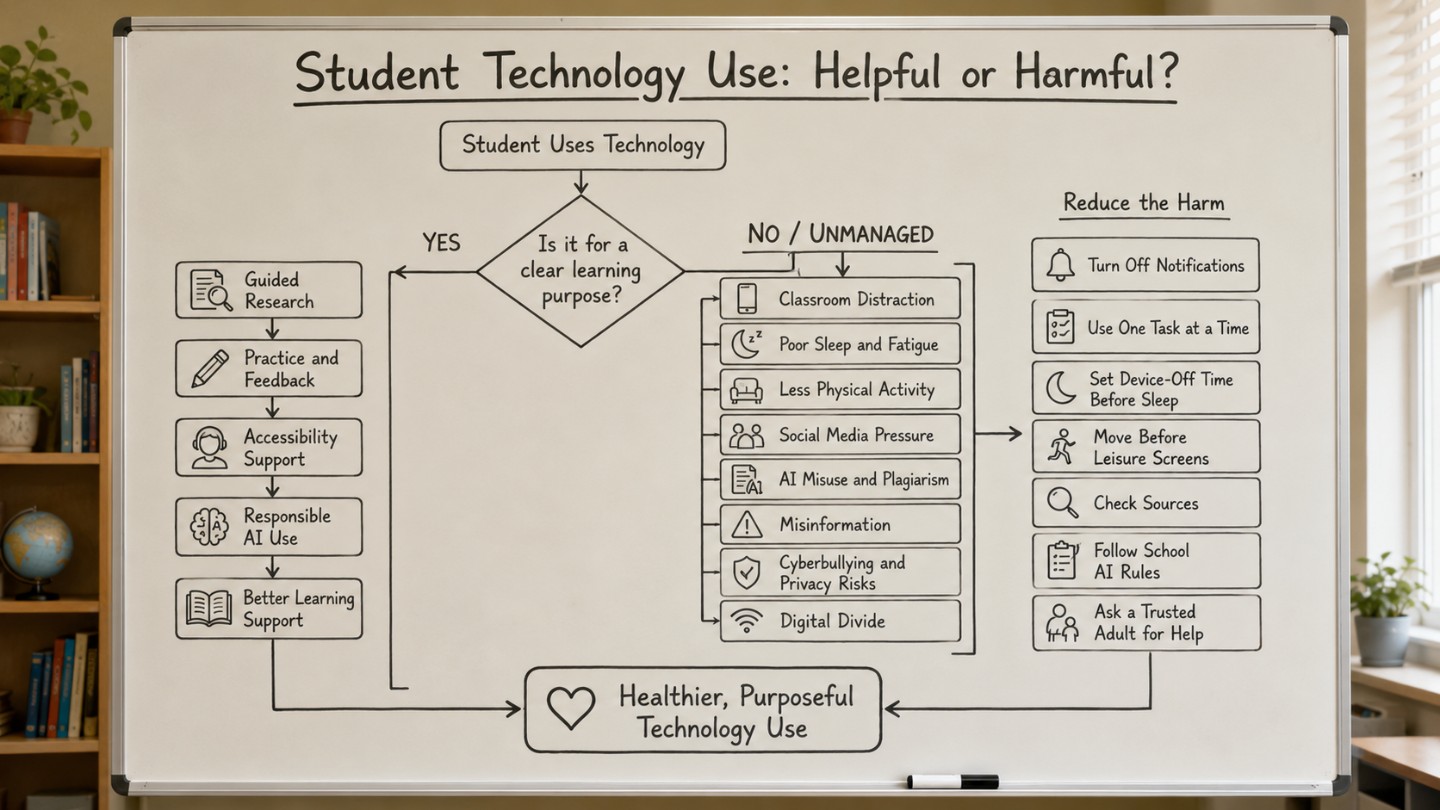
Technology can weaken learning when it interrupts attention, encourages multitasking, or replaces active study. Students learn more deeply when they listen, read, write, solve problems, ask questions, receive feedback, and explain ideas in their own words.
Classroom distraction and reduced attention
Classroom distraction is one of the clearest harmful effects of technology on students. A phone, tablet, laptop, or smartwatch can shift attention away from the teacher, the task, and classmates.
OECD’s PISA reporting found that 30% of students reported being distracted by digital devices during every or most mathematics lessons. OECD also reports that students distracted by other students’ device use scored lower in mathematics after accounting for students’ and schools’ socio-economic profile.
The key point is not that every device lowers achievement. The risk is more specific: unmanaged device use during learning time can break attention, reduce participation, and make it harder to process new material.
Weaker academic focus
Technology can make studying feel busy while reducing deep learning. A student may watch summaries, copy search results, switch between tabs, or ask an AI tool for answers without building understanding.
Deep learning requires effort. Students need to read carefully, solve problems, compare ideas, write in their own words, and correct mistakes. When technology skips those steps, the assignment may look complete while the learning remains weak.
A safer study routine is simple: define the task, open only the tools needed for that task, keep the phone away, and check understanding without relying on copied answers. Students who need a separate focus routine can read digital distraction and focus habits for students.
Lower-quality homework and research
Search engines, short videos, and AI tools can help students start learning, but they can also encourage surface-level work. Students may accept the first answer they see, use outdated information, or copy wording without checking the original source.
This is a learning problem, not only a rule problem. Students who do not practice reading, evaluating sources, and explaining ideas may struggle later in exams, projects, interviews, or higher study.
How Technology Affects Health and Well-Being
Technology can affect student health when screen time replaces sleep, movement, rest, and offline routines. Many health findings in this area show association rather than direct proof that screen time alone causes each outcome, so claims should be stated carefully.
Poor sleep and fatigue
Excessive screen time can contribute to poor sleep when students use devices late at night, keep notifications on, or stay engaged with games, videos, and social media close to bedtime.
CDC/NCHS reported that during July 2021 through December 2023, 50.4% of U.S. teenagers ages 12–17 had four hours or more of daily screen time, excluding schoolwork. This figure applies to U.S. teenagers in that survey period, not all students worldwide.
CDC’s 2025 analysis also found that high non-school screen time among U.S. teenagers was associated with poorer outcomes across sleep, physical activity, weight, mental health, and perceived support. The study supports careful association-based wording, not a claim that screen time alone causes each outcome.
Students can protect sleep by setting a device-off time, charging phones away from the bed, turning off autoplay, and keeping school-night routines predictable. For related reading, see screen time vs study time for teens.
Less physical activity
Technology can reduce physical activity when leisure screen time replaces walking, sports, outdoor play, household tasks, hobbies, or in-person activities. This risk is stronger when students already spend long hours sitting in class and then spend most of their free time seated with screens.
A practical habit is to place movement before entertainment screens. Students can walk, stretch, play, exercise, or complete household tasks before starting games, videos, or social media. The goal is not to remove all screens; it is to stop screens from crowding out movement.
Mental health pressure from social media
Social media can affect students through comparison, pressure to respond, fear of missing out, online conflict, and exposure to harmful content. It can also support connection, so the effect depends on the student, platform, content, time spent, privacy settings, and support around the student.
The U.S. Department of Health and Human Services states that up to 95% of young people aged 13–17 report using a social media platform. The U.S. Surgeon General’s advisory also says there is not enough evidence to conclude that social media is sufficiently safe for children and adolescents.
Students can reduce pressure by limiting passive scrolling, muting accounts that trigger comparison, protecting sleep time, and speaking with a trusted adult when online activity begins to affect mood, schoolwork, sleep, or relationships. A study-focused follow-up is social media effects on focus and study habits.
How Technology Affects Social Life and Safety
Technology affects student social life when online interaction replaces in-person practice or creates risks that follow students beyond school hours. Students need both digital communication skills and face-to-face communication skills.
Reduced face-to-face communication
Technology can reduce practice with face-to-face communication when students rely mainly on messages, short replies, or online reactions. Classroom discussion, group work, listening, disagreement, and public speaking all build skills students need beyond school.
This point should not be overstated. Communication skills depend on family habits, school culture, personality, language, age, and peer relationships. The safer conclusion is that students benefit from protected time for real conversation, group discussion, presentations, and collaborative problem-solving.
Cyberbullying and privacy risks
Cyberbullying and privacy loss are serious online safety risks. Students may face harmful messages, fake accounts, public embarrassment, unwanted sharing of private information, or pressure to post personal details.
Students should not be expected to handle online harm alone. Safer steps include blocking harmful accounts, reporting abuse through the platform or school process, saving evidence when appropriate, avoiding retaliation, and telling a trusted adult.
Privacy also matters. Students should avoid sharing passwords, location details, school schedules, private documents, or personal images with people they do not know well.
Misinformation and weak research habits
Technology gives students fast access to information, but fast access is not the same as reliable evidence. Search results, social posts, AI-generated answers, and short videos can be incomplete, outdated, biased, or wrong.
A useful source check has four questions:
-
Who created this information?
-
What evidence does it give?
-
When was it published or updated?
-
Why was it created?
For school assignments, students should prefer teacher-approved materials, textbooks, official sources, peer-reviewed research, and recognized educational organizations. A related school-level resource is digital literacy in schools curriculum.
AI Tools, Cheating, and Academic Honesty
AI tools can help students understand difficult topics, but they can weaken learning when used to avoid thinking, reading, writing, or problem-solving. The academic risk is not only cheating; it is losing the chance to build the skill.
Students should follow their school’s AI rules. A safe academic boundary is to use AI for explanation, practice questions, brainstorming, or feedback, but not to submit AI-generated work as original work unless the teacher clearly allows it.
Students should also verify AI answers. AI tools can produce incomplete or inaccurate information, and students remain responsible for the work they submit.
A useful self-check is: “Can I explain this answer without the tool?” If the answer is no, more learning is needed. For a fuller discussion, see AI tools for students ethical and practical use.
Digital Divide and Unequal Access
Technology can widen educational inequality when students do not have the same access to devices, internet, quiet study space, paid tools, or technical support. A digital assignment may be simple for one student and difficult for another.
The digital divide is not only about owning a phone. A student may have a phone but no laptop for writing. Another may share one device with siblings. Some students may have weak connectivity, data limits, electricity issues, or no quiet study space.
Schools can reduce this harm by offering printed alternatives, offline tasks, flexible submission options during connectivity problems, device support where available, and low-bandwidth learning materials.
When Technology Helps Instead of Hurts
Technology helps students when it supports a clear learning goal. It becomes harmful when it distracts from the goal or replaces the learning process.
Helpful uses include:
-
Reading assigned digital materials
-
Practicing skills with feedback
-
Watching teacher-selected explanations
-
Using accessibility tools
-
Collaborating on supervised class projects
-
Researching from credible sources
-
Using AI for practice or clarification within school rules
Harmful uses include:
-
Checking messages during lessons
-
Studying with unrelated tabs open
-
Using AI to submit work without understanding it
-
Scrolling late at night
-
Copying information without checking the source
-
Sharing private information online
-
Spending long periods sitting without breaks
UNESCO reports that by the end of 2024, 79 education systems, or 40%, had laws or policies banning smartphone use in schools. UNESCO also states that technology should be used in class only when it clearly supports learning outcomes. (UNESCO)
How Students Can Reduce the Negative Effects
Students can reduce technology’s negative effects by changing routines before problems start. The most useful changes are simple, repeatable, and realistic.
Study with fewer distractions
Before studying, students can:
-
Write the exact task first.
-
Keep the phone away from the desk.
-
Turn off notifications.
-
Close unrelated tabs.
-
Use one screen when possible.
-
Take breaks away from the screen.
Protect sleep
Before bedtime, students can:
-
Stop games, social media, and videos at a fixed time.
-
Charge the phone away from the bed.
-
Turn off autoplay.
-
Avoid checking messages after lights-out.
-
Prepare school materials before starting leisure screen time.
Use AI tools responsibly
Students can use AI tools to ask for explanations, generate practice questions, review grammar, or compare outlines. They should not use AI tools to replace their own reading, reasoning, or final answers unless the teacher clearly allows that use.
Check sources before trusting information
Students should avoid using the first search result as final evidence. They should check the organization, author, date, evidence, and purpose of the source. For academic writing, students should save source details as they work.
How Parents and Teachers Can Support Healthy Use
Parents and teachers can support healthier technology use by setting clear rules, teaching digital judgment, and modeling the behavior they expect.
Classroom rules should be specific
A weak rule says, “Use technology responsibly.” A clearer rule says, “Phones stay in bags during explanation, discussion, and independent writing unless the teacher gives permission.”
Classroom rules should explain when devices are allowed, where phones should be during instruction, which tools are approved, and what happens when device use distracts others.
Families can create media routines
Family media routines work better when they are practical. Useful routines include device-free meals, phone-free homework periods, device-off time before bed, and shared rules about privacy and respectful online behavior.
Parents and caregivers can also ask students which apps help them learn, which apps distract them, and what support they need for homework.
Schools should teach digital literacy
Rules alone are not enough. Students need to learn how to evaluate sources, protect privacy, respond to cyberbullying, cite sources, use AI honestly, and separate learning tools from entertainment.
Digital literacy is part of student safety and academic integrity. It should be taught directly rather than assumed.
Conclusion
The negative effects of technology on students are real, but they are not caused by technology alone. The main risks come from distraction, excessive leisure screen time, weak boundaries, unsafe online spaces, poor research habits, AI misuse, and unequal access.
A balanced approach works better than fear-based advice. Students need digital tools for learning, but they also need focused study time, sleep, movement, honest work, privacy awareness, source-checking skills, and support from adults. Technology helps when it serves learning. It harms when it controls attention, replaces effort, or widens inequality.







Comments 0
No comments yet. Be the first to start the conversation.