



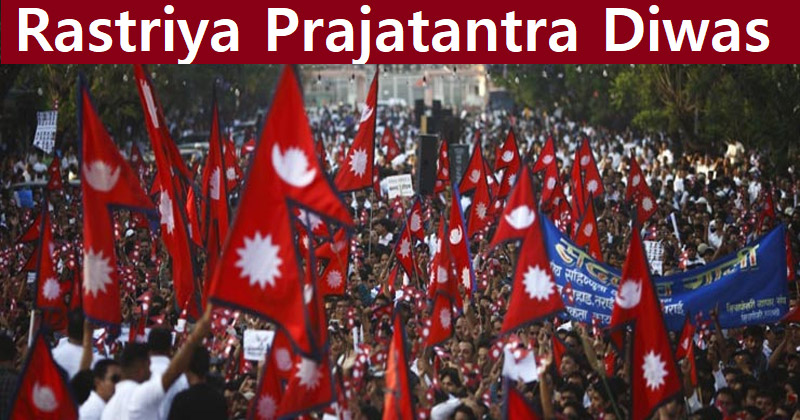
National Democracy Day in Nepal (Rastriya Prajatantra Diwas): Meaning, Date, and History
Rastriya Prajatantra Diwas (राष्ट्रिय प्रजातन्त्र दिवस) is observed to remember a major turning point in the country’s political history: the shift in 1951 that followed the end of the Rana-era dominance (1846–1951) and opened a new phase of governance and rights.
People often want one clean sentence—“what happened on that day?”—but Nepal’s democratic story has more than one milestone.
That creates a real trade-off for writers and students: keep it simple and risk mixing dates, or explain it properly and spend a bit more space on context. This article keeps the core story clear while showing how Falgun 7 relates to later milestones like Loktantra Diwas and Republic Day.
What Prajatantra Diwas is and when it is observed
Date in the Nepali calendar (Falgun 7)
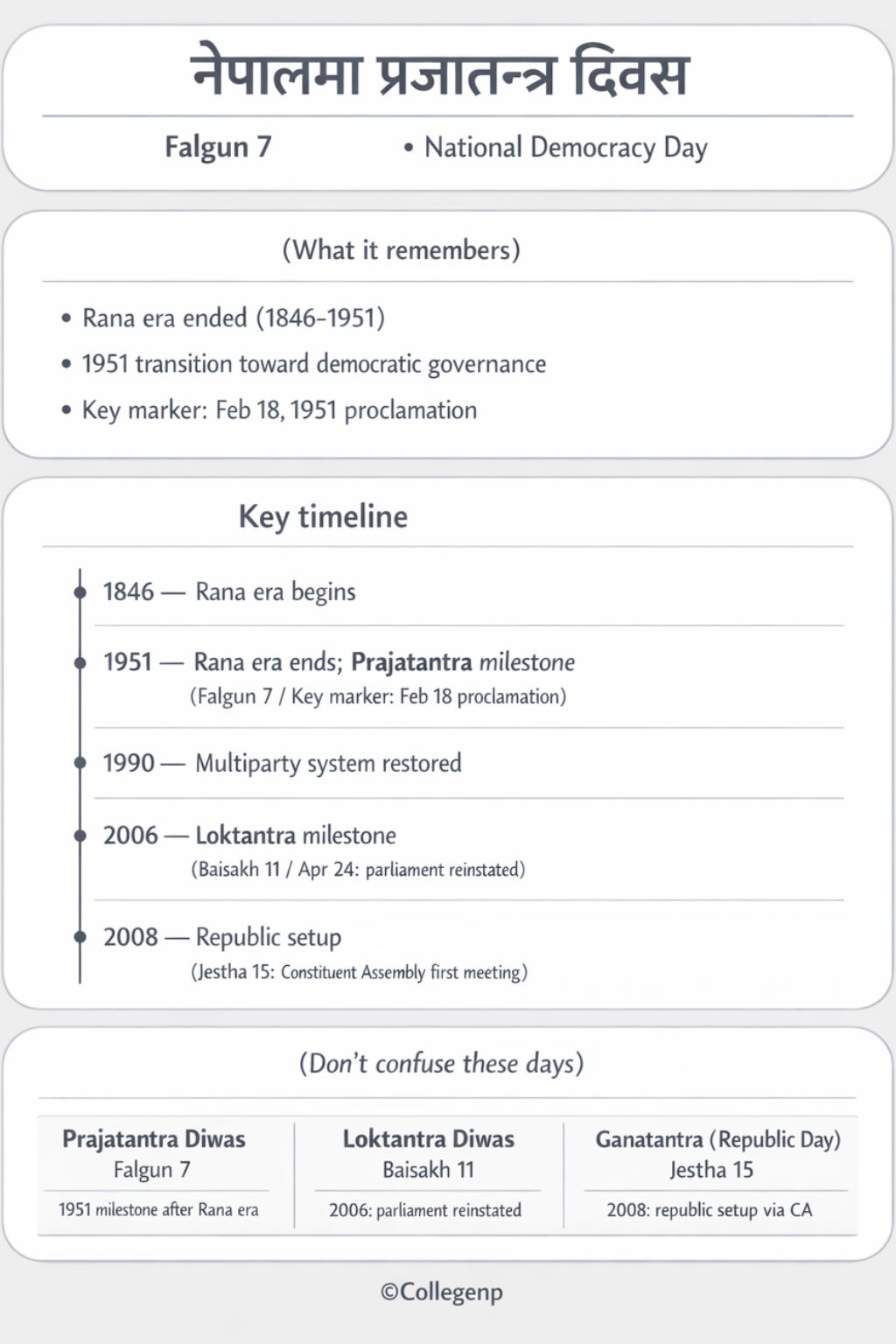
Prajatantra Diwas is observed on Falgun 7 (फागुन ७) in the Bikram Sambat calendar. It is listed as “Rastriya Prajatantra Diwas” in official holiday/leave references and is treated as a nationally significant day.
What “Prajatantra” means in Nepal’s context
In Nepali political language, “prajatantra” points to governance that recognizes citizens’ rights and public participation rather than rule concentrated in a narrow hereditary structure. The day is tied to Nepal’s 1951 turning point, remembered through official programs and messages.
The historical background: Rana era to the 1951 transition
Rana era timeline (1846–1951)
Britannica describes the “Rana era” as 1846–1951, when control of government lay with the Rana family after Jung Bahadur seized power and made the prime ministership hereditary.
This matters for Prajatantra Diwas because the day’s meaning is built around the end of that era and the start of a different political order.
The 1950–51 change and the Feb 18, 1951 proclamation
A key reference point in many summaries is February 18, 1951, when King Tribhuvan made a historic proclamation about forming a coalition government and moving toward rule by elected governments under a people-written constitution.
Britannica also places Nepal’s 1950 palace revolt and restoration of the crown’s authority in 1951 at the heart of this transition.
Early governance framework (Interim Government arrangements)
The political shift also involved early institutional arrangements for governing. The “1951 Constitution English” text hosted by ConstitutionNet includes provisions about a Cabinet headed by a Prime Minister or Minister nominated by the King, showing how governance was structured in that interim phase.
The timeline after 1951: why Nepal has multiple democracy milestones
Nepal’s path after 1951 includes progress, setbacks, and reinventions. Understanding these helps explain why Falgun 7 remains meaningful even though later democracy-related days exist.
1960/61 party restrictions and the Panchayat period (high-level)
Multiple timelines note that political parties were later banned and an autocratic partyless system followed in the early 1960s. Reuters summarizes this shift and the broader pattern of political change.
1990 multiparty restoration
Britannica notes that political parties were not legalized again until 1990, when unrest led King Birendra to accept a multiparty parliamentary system.
This is one reason many people see 1990 as a “restoration” milestone, not the original 1951 opening.
2006 Loktantra Diwas (Baisakh 11)
Loktantra Diwas is tied to April 24, 2006 (Baisakh 11, 2063 BS), when the dissolved parliament was reinstated, signaling the defeat of direct royal rule at the time.
This is a separate milestone from Falgun 7, focused on re-establishing democratic institutions during a later crisis.
2008 Republic Day (Jestha 15)
ConstitutionNet documentation describes how the first meeting of Nepal’s Constituent Assembly on 15 Jestha 2065 approved a resolution related to implementing a republican setup and announced Nepal’s transformation into a federal democratic republic.
This is why “Ganatantra Diwas” (Republic Day) is treated as a distinct national milestone.
Prajatantra vs Loktantra vs Ganatantra
Quick comparisons (what each day remembers)
-
Prajatantra Diwas (Falgun 7): linked to the 1951 turning point after the Rana era (1846–1951) and the opening toward democratic governance.
-
Loktantra Diwas (Baisakh 11): linked to April 24, 2006 and the reinstatement of parliament.
-
Ganatantra Diwas (Jestha 15): linked to the Constituent Assembly’s first meeting and the formal move into a republican setup.
Common confusions and how to avoid them
A simple way to avoid mixing them is to match each day to its “core verb”:
-
Falgun 7: opened a new era after Rana control
-
Baisakh 11: reinstated parliament during a later movement
-
Jestha 15: declared the republican setup through the Constituent Assembly
If you keep the verb consistent, your writing stays clear even when you mention multiple milestones.
How Prajatantra Diwas is observed
Official messages and public programs
Government bodies publish messages and organize programs around the day. For example, an official notice from the Ministry of Federal Affairs and General Administration discusses national-level arrangements and programming for “Rastriya Prajatantra Diwas,” including multi-day scheduling around Falgun 6–8 for a given year’s celebrations.
What respectful commemoration looks like
In practice, respectful commemoration usually includes:
-
Remembering the civic purpose of the day (rights, participation, accountable governance)
-
Acknowledging that democracy is a process with multiple milestones
-
Keeping public discussion focused on learning, not personal attacks
Conclusion
Nepal’s Prajatantra Diwas (Falgun 7) remembers a foundational shift in 1951 after the Rana era (1846–1951).
It sits within a longer democratic journey that includes 1990’s multiparty restoration, 2006’s Loktantra Diwas milestone, and 2008’s republic declaration through the Constituent Assembly.
If you write about the day with a clean timeline and correct comparisons, your work will sound informed, balanced, and publish-ready.
FAQs
What is Prajatantra Diwas in Nepal?
It is National Democracy Day observed on Falgun 7, linked to Nepal’s 1951 democratic turning point after the Rana era.
Why is Falgun 7 important?
It is remembered as a marker of the 1951 shift toward democratic governance, often associated with the Feb 18, 1951 proclamation.
Is Loktantra Diwas the same as Prajatantra Diwas?
No. Loktantra Diwas is tied to April 24, 2006 (Baisakh 11) and the reinstatement of parliament.
When is Republic Day (Ganatantra Diwas) connected to Nepal becoming a republic?
It is tied to the Constituent Assembly’s first meeting on 15 Jestha 2065 and the resolution implementing a republican setup.
What is one reliable way to explain the difference between these days?
Use the “core event” method: Falgun 7 (1951 opening after Rana era), Baisakh 11 (2006 parliament reinstatement), Jestha 15 (republic setup through CA).





Comments 0
No comments yet. Be the first to start the conversation.