




Last updated: May 31, 2026
The use of IEMIS in Nepal matters because schools and education authorities need reliable data for planning, reporting, monitoring, and school management. IEMIS is not only a place to enter school records. It is part of Nepal’s education information system, where school-level data can support local planning, CEHRD reporting, and education management.
IEMIS is commonly used for the Integrated Education Management Information System or Integrated Educational Management Information System, depending on the official source. CEHRD lists IEMIS among its online services, and MoEST has published a Strategic Framework page for the Integrated Education Management Information System.
Education Management Information Systems are used to collect, process, analyze, and share education data for monitoring and decision-making. A UNESCO Institute for Statistics and Global Partnership for Education guide describes EMIS as responsible for collecting, processing, analyzing, and disseminating education data to support monitoring and evaluation of education-system performance.
Answer Summary: IEMIS in Nepal is a school education data system used to manage school profiles, student records, teacher details, infrastructure information, inclusion-related data, and reports. It supports school planning, local education planning, monitoring, Flash Reports, and education management. Schools should verify current update instructions through CEHRD or their local education authority before submitting data.
Table of Content
- What Is IEMIS in Nepal?
- Why Is IEMIS Important for Schools?
- What Data Is Managed in IEMIS?
- How IEMIS Supports School Planning
- How IEMIS Supports Local Education Planning
- How IEMIS Supports Reporting and Flash Reports
- IEMIS and Inclusive Education
- Roles of Schools, Local Levels, CEHRD, and MoEST
- Common Challenges in Using IEMIS
- How Schools Can Improve IEMIS Data Quality
- Where to Check Official IEMIS Updates
- What IEMIS Is Not
- Conclusion
Key Takeaways
-
IEMIS is Nepal’s school education data system.
-
It supports planning, reporting, monitoring, and school management.
-
Schools use it to update student, teacher, school, infrastructure, and inclusion data.
-
Local levels can use verified IEMIS data for planning and coordination.
-
CEHRD publishes IEMIS notices, service links, support links, and Flash Reports.
-
Current deadlines and procedures should be checked through official sources.
-
Accurate IEMIS data helps reduce planning and reporting errors.
What Is IEMIS in Nepal?
IEMIS is a digital education information system used to manage school-level data in Nepal. It connects school records with education planning, reporting, monitoring, and administration.
In simple terms, IEMIS helps answer practical questions such as:
-
How many students are enrolled in each grade?
-
What teacher information is recorded for a school?
-
What facilities does a school have?
-
Which students may need additional support?
-
What school-level data should local levels and CEHRD use for planning and reporting?
CEHRD’s website lists IEMIS under online services and also links to the IEMIS system through its important links section. The EMIS user manual page also describes login guidance for the Educational Management Information System.
IEMIS should not be understood only as a login portal. Its value depends on whether school data is accurate, verified, and used in planning.
Why Is IEMIS Important for Schools?
IEMIS is important because school planning becomes weaker when records are incomplete, outdated, or inconsistent. A school may have real needs in enrollment, staffing, infrastructure, or student support, but those needs may not appear clearly if the data is not maintained.
For schools, IEMIS helps organize:
-
student enrollment records;
-
student transfer information;
-
teacher details;
-
school profile details;
-
infrastructure records;
-
inclusion-related data;
-
school-level reports.
For local governments and education authorities, verified IEMIS data can support planning, monitoring, resource discussion, and reporting. UNICEF Nepal links EMIS with monitoring out-of-school children, including children with disabilities, and with local government planning and program implementation under Nepal’s federal structure.
For wider background on administrative constraints in Nepal’s education sector, readers may also refer to Collegenp’s article on education management challenges in Nepal.
What Data Is Managed in IEMIS?
IEMIS commonly manages school-level data related to schools, students, teachers, facilities, inclusion, and reports. Exact fields may change by module, academic year, and official notice, so schools should verify current instructions before data entry.
| Data Area | Examples | Why It Matters |
|---|---|---|
| School profile | School name, location, level, type, official identifiers | School identification and planning |
| Student data | Enrollment, grade, category, transfer details where required | Scholarships, exams, planning, and reporting |
| Teacher data | Teacher details, subject, position, appointment-related information where required | Staffing review and school management |
| Infrastructure | Buildings, classrooms, toilets, water, facilities | Budgeting and school improvement planning |
| Inclusion data | Disability-related screening, support needs, referrals where applicable | Inclusive education planning |
| Reports | School summaries and Flash Report-related data | Monitoring, reporting, and policy review |
This table is a reader-friendly summary. It should not replace the current IEMIS manual, CEHRD notice, or local-level instruction.
How IEMIS Supports School Planning
IEMIS supports school planning by giving school leaders a record base for identifying needs. A school improvement discussion is stronger when it uses verified records rather than memory or rough estimates.
For example, a school can review IEMIS data to check whether:
-
enrollment is increasing or decreasing by grade;
-
teacher records match the school’s current staffing situation;
-
infrastructure records reflect actual classroom and facility conditions;
-
student transfer records are updated;
-
students needing additional support are recorded responsibly;
-
submitted reports match the school’s internal records.
This helps schools prepare stronger school improvement plans and discuss needs with local education units. The data does not make decisions on its own. It gives school leaders and local authorities a clearer basis for asking what support is needed, what records need correction, and which issues require follow-up.
How IEMIS Supports Local Education Planning
IEMIS data can help local levels compare school needs across wards, clusters, and municipalities. Local education units can use verified data to review access, infrastructure, staffing, inclusion, and student-support needs.
CEHRD has published a local-level education planning resource book described as practical guidance for preparing and evaluating local education plans. In that context, IEMIS data can help local officials move from general planning to evidence-based review.
For example, if several schools show rising enrollment but limited classrooms, the local level may review infrastructure priorities. If records show transfer patterns or out-of-school concerns, officials may need to examine distance, migration, disability, poverty, language, or other local factors before planning support.
UN Nepal has noted that Nepal’s current IEMIS functions digitally and produces information on schools nationwide, while data gaps remain in non-formal education and lifelong learning. This shows both the value and the limit of IEMIS: it is useful for formal school information, but it may not fully cover learners outside the school system unless related data sources are strengthened.
How IEMIS Supports Reporting and Flash Reports
IEMIS supports reporting by providing school-level data that can feed into wider education statistics and publications. For schools, this means IEMIS entries are not isolated administrative records. They may contribute to official summaries, planning discussions, and monitoring. When a school enters inaccurate data, the problem may affect more than the school’s internal record. It can also weaken local planning and reporting.
This is why data verification matters. Schools should compare IEMIS entries with admission registers, transfer records, teacher records, infrastructure records, and local instructions before submission.
IEMIS and Inclusive Education
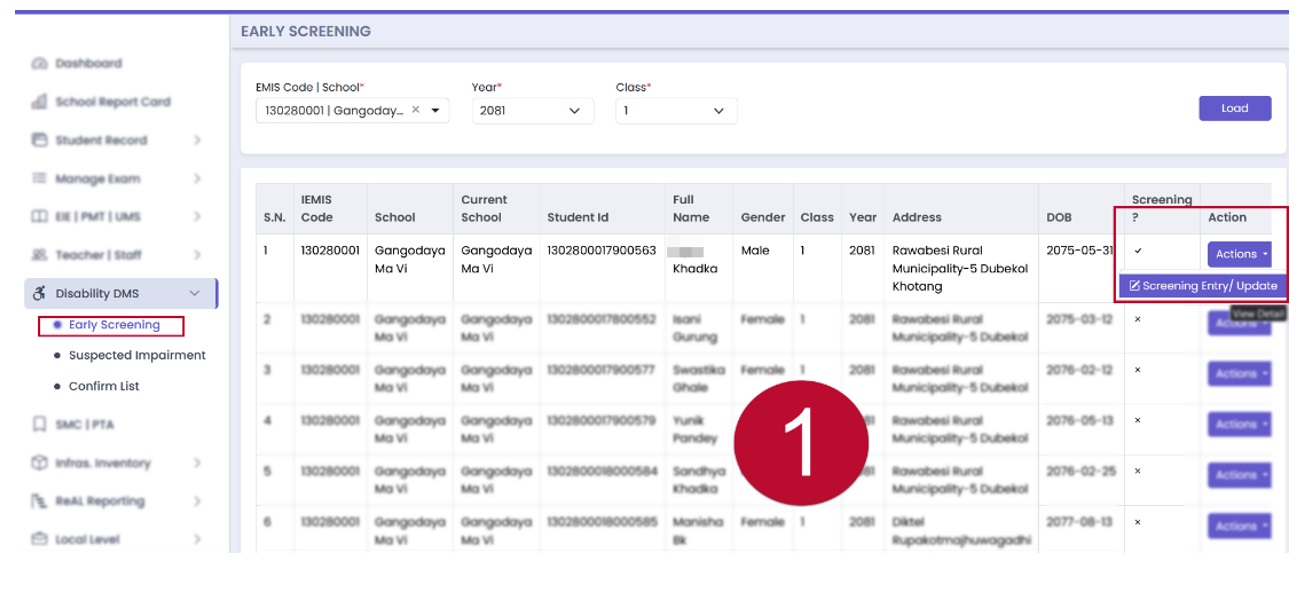
IEMIS can support inclusive education when disability-related data is entered carefully, verified responsibly, and used for support rather than labeling. Student disability data is sensitive and should be handled only by authorized users.
CEHRD’s Disability Data Management System manual states that the system supports management of disability-related data, including early detection, individualized intervention, impairment tracking, referrals, and educational planning. UNICEF Nepal also connects EMIS with monitoring out-of-school children, including children with disabilities.
This matters because schools and local levels need better information to plan support for students with disabilities. However, data entry alone is not inclusive education. Schools also need follow-up, family communication, referral support, trained staff, accessible learning environments, and appropriate classroom arrangements.
Roles of Schools, Local Levels, CEHRD, and MoEST
IEMIS works best when each stakeholder understands its role. Data quality cannot be handled by the portal alone.
| Stakeholder | Main Role in IEMIS |
|---|---|
| School principal | Ensure data is accurate, verified, and submitted according to official instructions |
| Teacher or admin staff | Update assigned student, class, teacher, school, and report data |
| Local education unit | Support schools, monitor submissions, verify records, and use data for local planning |
| CEHRD | Provide service links, notices, support resources, manuals, and reporting systems |
| MoEST | Provide policy direction and strategic framework for education data systems |
CEHRD lists IEMIS among online services, and MoEST hosts the Strategic Framework page for Integrated Education Management Information System.
Common Challenges in Using IEMIS
Common IEMIS challenges include data errors, late updates, duplicate records, transfer issues, training gaps, technical access issues, and limited use of data after submission. These are practical management problems, not only software problems.
Schools may face issues such as:
-
student names entered differently in different records;
-
grade or section errors;
-
duplicate student entries;
-
delayed transfer updates;
-
outdated teacher details;
-
incomplete infrastructure data;
-
disability-related data entered without proper verification;
-
confusion caused by unofficial instructions.
A school can submit data on time and still have weak data quality. Local levels should review accuracy, not only whether a school has completed a submission.
How Schools Can Improve IEMIS Data Quality
Schools can improve IEMIS data quality by treating data entry as part of regular administration. Waiting until the deadline increases the risk of errors.
Practical habits include:
-
assign one responsible data-entry person and one reviewer;
-
compare IEMIS entries with admission registers;
-
verify transfer records before submission;
-
review teacher records after staffing changes;
-
check infrastructure records before planning requests;
-
handle disability-related data with confidentiality;
-
keep copies of CEHRD and local-level notices;
-
correct errors as soon as they are found;
-
discuss IEMIS data during school planning meetings.
The aim is not only to complete portal entry. The aim is to keep school records accurate enough to support planning, reporting, and student services.
Where to Check Official IEMIS Updates
Schools should check CEHRD, official IEMIS or EMIS service pages, the IEMIS support portal, and local education authorities for current instructions. Update deadlines and procedures may change by academic year, program, or module.
Before updating IEMIS, schools should verify:
-
current portal access;
-
latest CEHRD notice;
-
academic-year-specific instructions;
-
local-level deadline;
-
required documents;
-
student transfer process;
-
disability-data entry guidance;
-
whether any new module or reporting requirement has been added.
Schools should avoid unofficial password, shortcut, or login advice. Operational issues should be handled through official CEHRD channels or the local education authority.
What IEMIS Is Not
IEMIS is not a replacement for school leadership, teacher judgment, classroom observation, or community consultation. It is also not a full picture of every learner outside the formal school system.
UN Nepal has noted that Nepal’s current IEMIS produces school information nationwide, but data gaps remain in non-formal education and lifelong learning.
This means IEMIS should be used with other local evidence, especially when planning for out-of-school children, non-formal learners, children with disabilities, and students at risk of exclusion.
IEMIS should also not be used only as a compliance task. If schools enter data but do not review it for planning, the system loses much of its practical value.
Conclusion
The use of IEMIS in Nepal is central to school data management, planning, monitoring, reporting, and inclusive education. Its value depends on accurate school records, careful verification, responsible handling of sensitive data, and regular use of data in school and local-level planning.
Schools should treat IEMIS as part of routine administration, not as a one-time update task. Local levels should use verified IEMIS data to support planning and follow-up. Readers should check CEHRD and local notices before acting on any deadline, portal instruction, or update process.






Comments 0
No comments yet. Be the first to start the conversation.