




Teacher support is important for students because learning becomes easier when students feel guided, respected, and able to ask for help. A supportive teacher explains lessons clearly, gives useful feedback, notices confusion, sets fair expectations, and helps students recover from mistakes.
This guide explains what teacher support means, why it matters, what it looks like in the classroom, and where its limits are. It is written for students, parents, teachers, and general readers who want a clear, evidence-supported answer.
Answer Summary: Teacher support helps students learn, participate, and stay engaged in school. It can support confidence, motivation, belonging, and emotional well-being when teachers combine clear instruction with respect, feedback, encouragement, and fair routines. Teacher support does not replace student effort, family support, peer relationships, or school resources, but it is an important part of a healthy learning environment.
Table of Content
- What Is Teacher Support?
- Why Is Teacher Support Important for Students?
- Types of Teacher Support
- Examples of Teacher Support in the Classroom
- Academic Support vs Emotional Support
- How Teacher Support Builds Confidence
- Why Teacher-Student Relationships Matter
- How Schools Can Strengthen Teacher Support
- Limits of Teacher Support
- Conclusion
Key Takeaways
-
Teacher support includes academic, emotional, social, and motivational help.
-
Students are more likely to ask questions when classrooms feel safe and fair.
-
Feedback helps students understand what to improve next.
-
Positive teacher-student relationships are linked with engagement and achievement.
-
Support should build independence, not dependence.
-
Serious emotional or safety concerns need qualified school or family support.
-
Teacher support works best with clear expectations and consistent routines.
What Is Teacher Support?
Teacher support means the guidance, feedback, encouragement, and structure that teachers provide so students can learn and participate. It includes how teachers explain lessons, respond to mistakes, listen to students, and create fair classroom routines.
In daily school life, teacher support can be simple. A teacher may explain a math problem again, help a student plan an essay, encourage a student after a low score, or create group roles so quiet students can participate. The goal is not to make school easier by lowering expectations. The goal is to help students understand what they need to do next.
Teacher support also connects with broader learning skills. For a Nepal-specific perspective, readers can refer to Collegenp’s guide on full learning skills and teacher support in Nepal.
Why Is Teacher Support Important for Students?
Teacher support matters because students learn through both instruction and relationships. When teachers provide clear help and respectful communication, students are more likely to stay engaged, ask questions, correct mistakes, and keep working through difficulty.
The Organisation for Economic Co-operation and Development’s 2025 paper on teacher support for student learning draws on PISA 2022 and earlier cycles. It reports that teacher support declined in most participating education systems between 2012 and 2022 and examines how school contexts, teacher practices, and student characteristics influence the support students receive.
Teacher support should be treated as one important learning factor, not the only factor. Student effort, family support, peer relationships, school resources, curriculum quality, assessment design, and access to learning support also shape student outcomes.
Types of Teacher Support
Teacher support has several forms. Students often need more than one type at the same time.
Academic Support
Academic support helps students understand lessons, complete tasks, correct mistakes, and improve their work. It includes clear explanation, guided practice, examples, revision help, and specific feedback.
A student who struggles with fractions may need the teacher to use a diagram or real-life example. A student writing an essay may need feedback on paragraph structure rather than a broad comment such as “improve writing.”
A 2024 study by Liu and colleagues examined teacher-student relationships, perceived social support, academic pressure, and academic engagement. The study connects positive teacher-student relationships with academic engagement through support and pressure-related pathways.
Students also need strong learning habits alongside teacher support. For practical study methods, readers can refer to Collegenp’s article on key learning strategies for student success.
Emotional Support
Emotional support helps students feel respected and able to continue learning after stress, failure, or confusion. It includes calm correction, encouragement, patient listening, and respectful classroom language.
Ruzek and colleagues studied how teacher emotional support relates to student motivation, including students’ experiences of peer relatedness, autonomy support, and competence.
Emotional support does not mean teachers should act as therapists. If a student faces serious emotional distress, safety concerns, or family problems, the teacher should involve the school’s counseling, safeguarding, or referral process.
Collegenp’s article on school counselors’ role in student success is relevant here because some student concerns require trained counseling or referral support beyond regular classroom help.
Social and Motivational Support
Social and motivational support helps students feel included and willing to participate. It includes respectful group work, fair routines, small goals, and encouragement linked to effort and strategy.
The Education Endowment Foundation (EEF) says effective teaching and learning requires positive relationships and interactions between teachers and pupils. It also recommends inclusive routines and a positive school environment for belonging.
This is why teacher support is not only about grades. It also affects whether students feel safe enough to ask a question, join group work, and keep trying after a difficult lesson.
Examples of Teacher Support in the Classroom
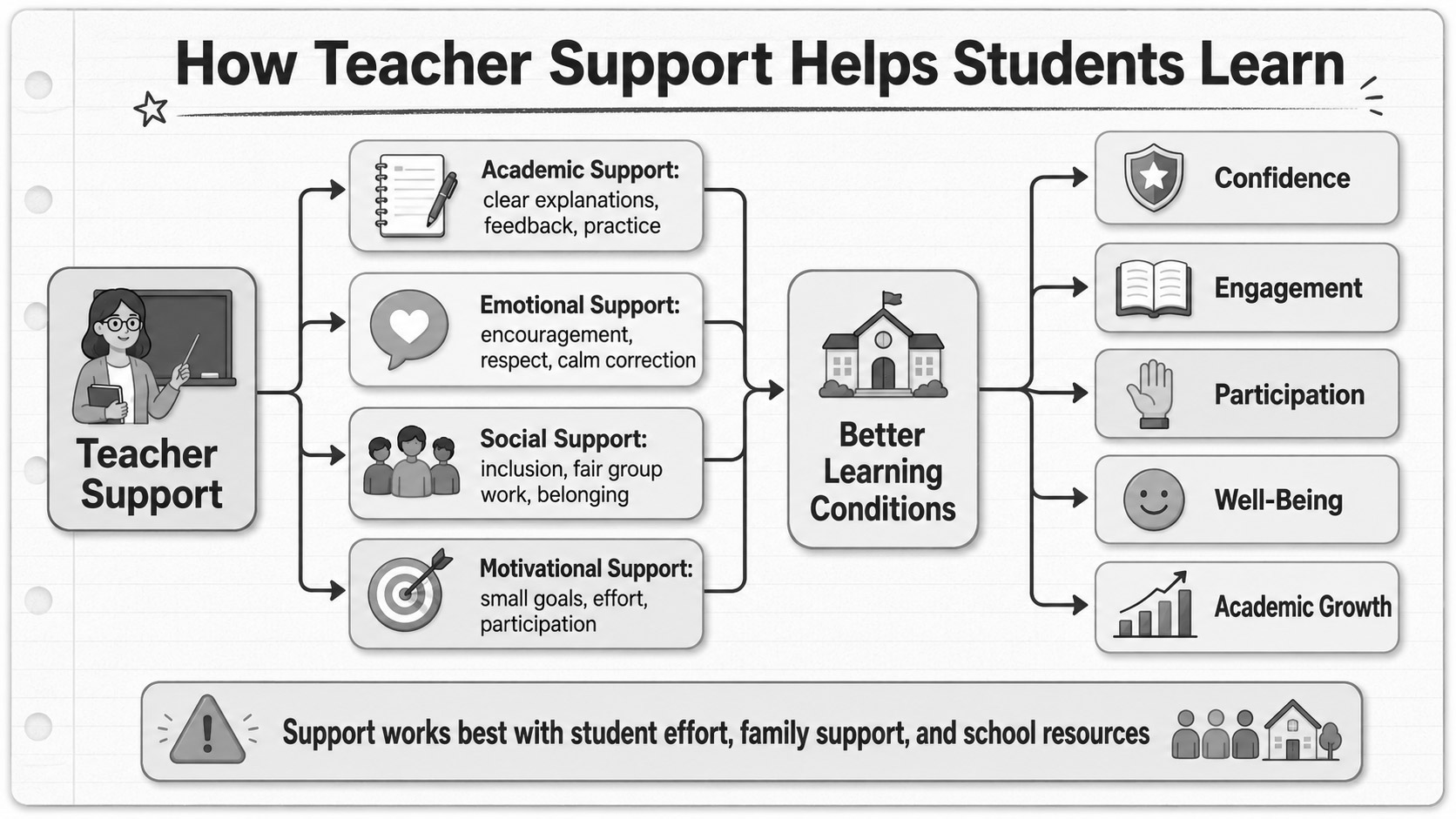
Teacher support is visible in daily teaching. It appears in feedback, routines, listening, examples, and the way a teacher responds when students make mistakes.
Clear Feedback
Clear feedback tells students what they did well, what needs improvement, and what to do next. A mark alone may tell a student the result, but it may not explain the next step.
Useful feedback may say: “Your answer identifies the main idea. Add one example from the text to support it.” This gives the student a concrete action. It also keeps the focus on learning rather than blame.
Repeated Explanation
Repeated explanation helps when the first explanation does not work for every learner. A teacher may use a diagram, a worked example, a shorter question, or a peer discussion to make the concept clearer.
Repeating the same sentence is rarely enough. Better support adapts the explanation without embarrassing the student.
Encouragement After Mistakes
Encouragement helps students treat mistakes as part of learning. A teacher can correct the error while protecting the student’s confidence.
For example, instead of saying a student is careless, the teacher can say: “The method is right until this step. Check how you changed the sign here.” This keeps the focus on the work, not the student’s worth.
Fair Classroom Routines
Fair routines help students know what to expect. Routines for asking questions, submitting work, receiving feedback, and joining group activities reduce confusion.
The Institute of Education Sciences What Works Clearinghouse practice guide for grades K–5 recommends low-intensity classroom behavior supports, including co-establishing, modeling, and teaching clear expectations so students can engage in learning.
Academic Support vs Emotional Support
Academic support and emotional support work together. Academic support helps the student understand the task. Emotional support helps the student feel able to attempt it.
| Type of Support | Meaning | Example |
|---|---|---|
| Academic support | Help with learning and schoolwork | Explaining a problem again |
| Emotional support | Help with stress, confidence, and feelings | Encouraging a student after a poor result |
| Motivational support | Help with effort and focus | Setting a short learning goal |
| Social support | Help with inclusion | Giving fair roles in group work |
A student who fears public speaking may need emotional support first, such as a private practice opportunity. The same student also needs academic support, such as a structure for organizing ideas and feedback on delivery.
How Teacher Support Builds Confidence

Teacher support builds confidence by helping students see that improvement is possible. Confidence grows when students understand what went wrong, receive guidance, and practice again.
A 2025 Scientific Reports article by Shao and colleagues studied teacher support, learning engagement, academic self-efficacy, psychological resilience, and positive academic emotion among 665 students from four public secondary schools in Eastern China. Because the study is context-specific, its findings should be used as supporting evidence rather than universal proof.
Confidence should be grounded in evidence. Praise alone may feel pleasant, but it is weaker than feedback tied to a specific skill. “Your conclusion is stronger because you returned to the main argument” is more useful than “good job.”
Support should also build independence. If a teacher solves every problem for a student, the student may become dependent. A stronger approach is to model, guide, check understanding, and then let the student try with less help.
Why Teacher-Student Relationships Matter

Teacher-student relationships matter because students are more likely to participate when they feel respected and understood. Good relationships also make it easier for teachers to notice when students need academic or emotional support.
The American Psychological Association says improving students’ relationships with teachers has positive implications for students’ academic and social development. Roorda and colleagues’ 2017 meta-analytic update examined 189 studies with 249,198 students from preschool to high school and investigated links between affective teacher-student relationships, engagement, and achievement.
Klem and Connell’s 2004 article links caring and supportive school relationships with positive academic attitudes, satisfaction with school, and academic engagement.
Strong relationships need professional boundaries. A supportive teacher treats students fairly, avoids favoritism, protects privacy, and follows school procedures when a concern requires specialist help.
How Schools Can Strengthen Teacher Support
Schools strengthen teacher support when they create systems that help teachers respond consistently. Support should not depend only on one teacher’s personality.
Build Clear Expectations
Students benefit when expectations are clear across classrooms. Rules, feedback practices, homework routines, and behavior expectations should be taught and reinforced.
The Australian Education Research Organisation describes positive teacher-student relationships as supportive and fair, developing in learning environments where students feel safe, understood, and appreciated.
Support Belonging
Schools can support belonging by making classrooms inclusive and respectful. Students should feel that they are seen as learners, not labeled by one mistake, grade, language background, or learning need.
Inclusive classroom practice is especially important for students with additional learning needs. For more context, you can refer to Collegenp’s article on inclusive classrooms for students with special needs.
Encourage Active Participation
Students need chances to participate in different ways. Some students answer aloud easily, while others participate better through written responses, pair discussions, group roles, or short reflection tasks.
Classroom engagement is not the same as being quiet or busy. A student can sit silently and still be confused. A student can also be active but unfocused. Supportive teachers check understanding, vary participation methods, and give students a clear role in learning. Readers looking for practical participation methods can refer to Collegenp’s guide on student engagement activities in the classroom.
Use Referral Pathways
Teachers should know when to refer students to school counselors, learning support staff, safeguarding leads, or school leaders. Classroom support is valuable, but some needs require trained professionals.
This is especially important when a student shows serious distress, repeated absence, major learning barriers, or a safety concern. The teacher’s role is to notice, respond respectfully, document concerns according to school policy, and connect the student to the right support.
Limits of Teacher Support
Teacher support helps students, but it cannot solve every learning problem alone. A student’s progress may also depend on attendance, sleep, health, language background, family responsibilities, peer relationships, school resources, curriculum, assessment pressure, and access to learning support.
This limitation protects readers from overblown claims. A supportive teacher can explain, encourage, guide, and refer. The student still needs practice, effort, honesty, and time. Schools still need fair policies, enough staff, safe classrooms, and support services.
A balanced view is more useful than a perfect-sounding one: teacher support improves learning conditions, but it is not the only condition.
Conclusion
Teacher support is important for students because it helps create the conditions for learning. Supportive teachers explain clearly, give feedback, listen respectfully, set fair routines, and help students respond to mistakes with effort rather than shame.
The strongest support combines care with standards. It helps students feel safe, but it also asks them to think, practice, participate, and take responsibility. For parents and schools, the key question is not only whether a teacher is kind, but whether students receive clear guidance, fair treatment, useful feedback, and access to extra help when needed.





Comments 0
No comments yet. Be the first to start the conversation.