



Table of Content
- Historical Background and the Entry of Modern Education in Nepal
- Major Current Challenges in Education Management in Nepal
- Strategic Measures to Improve Education in Nepal
- Conclusion
- List of Challenges in Education Management in Nepal
“Learning is a person’s finest adornment and hidden treasure.” Education, or vidya, is the true and deeply concealed wealth of human beings. The word shiksha, derived from the verbal root shiksh with the suffix a-tap, is also deeply connected to the meaning of governance or discipline. Without firm and positive discipline, it is nearly impossible to learn, understand, and master new things.
Thus, education is the principal means that guides human life from ignorance to knowledge, from darkness to light, and from barbarity to advanced civilization. The complete process through which a person becomes skilled, progresses, and attains mastery in any field is education, and it is this very process that unfolds the infinite possibilities within human beings.
If we reflect on the historical and evolutionary background of human development, we find that human beings have invented many astonishing things. Among them, the invention of language and script stands above all. In the world, there are many creatures far larger and physically stronger than humans.
Whether giant aquatic creatures like whales and land animals like elephants, or terrifying beasts such as tigers and bears, all of them today stand subdued before human intelligence. Human beings could not have physically withstood any of them, nor did humans possess the kind of innate collective and natural discipline found in hornets, ants, or bees.
If the weak wild creature called “man,” who once struggled inside caves to protect himself from jungle beasts, has today become a conqueror of the world, the full credit goes to language, consciousness, and the “education system” created to institutionalize that language-consciousness and pass it on to the next generation.
But when the education system, regarded as such a profound and life-changing instrument, cannot be managed properly, it leaves the whole society directionless. The greatest challenge before the state mechanism is the proper operation and management of such an intellectual weapon. Although the complex political, economic, and social crises Nepal faces today appear on the surface, their root cause lies in the large hole within education management itself.
Development cannot be achieved merely by spending budgets on physical infrastructure. People must be built, and education is that workshop of human formation. This article focuses on the many dimensions of education management in Nepal, its historical foundation, the pressing challenges of the present, and the serious steps needed to move beyond them. For broader background, readers may also explore the history of public education in Nepal and a wider overview of the Nepal education system, its challenges, and solutions.
Historical Background and the Entry of Modern Education in Nepal
To understand any education system, it is essential to examine its history. Once humans developed language and script, they began searching for ways to preserve the knowledge, technology, skills, and philosophy they had experienced across generations.
In Nepal and the Indian subcontinent, highly developed systems of Gurukul education, monastic or Gumba education, and Madrasa education already existed. These traditional institutions, based on life philosophy, natural science, Ayurveda, astronomy, literature, and advanced oral examination systems, served as means of strengthening human beings internally and externally.
But when external intrusion began in this region and British colonial rule was established, the direct blow fell on local education and civilization. In particular, British colonial planner Lord Macaulay dismantled the prevailing Gurukul and indigenous intellectual higher education structures of the Indian subcontinent and developed a system suited to colonial interests.
The British did this to produce manpower that would be “brown in color but entirely British in thought and outlook” — clerks and salaried functionaries. As a result, in place of indigenous schools, they established a ladder of primary schools, middle schools, high schools, and then colleges and universities with IA, BA, and MA levels in villages and towns.
Our great thinkers and scholars of the past — Vashistha, Vyasa, Brihaspati, or Panini — certainly did not produce great texts by attending Lord Macaulay’s school and studying English grammar through Fillmore or Nesfield.
Even today, Gurukul education remains quite strong in Nepal. Although neglected by the state, institutions such as Mahesh Sanskrit Gurukul in Devghat Dham and Harihar Gurukul continue to produce highly capable human resources in both classical philosophy, Sanskrit, English, and modern knowledge systems. Under the guidance of figures such as Swami Ramananda Giri and Swami Gyanananda Saraswati, students trained there appear able to prove themselves excellent in any circumstance.
The sad reality, however, is that Nepal’s formal education management, severed from its historical roots and caught in a race to imitate the West, has become deeply confused. This wider tension is also connected to debates around Nepal’s higher education policy, structure, and curriculum and the long-term trajectory of higher education in Nepal: past, present, and future.
Major Current Challenges in Education Management in Nepal
Universities can lead the world toward a positive and advanced direction, but when they are managed wrongly and without foresight, they can also produce the human resources that destroy an entire country and system. The present picture of Nepal’s schools and universities has become deeply discouraging.
Although Nepal has experimented with different educational models for a long time, the challenges of education management today are extremely multidimensional and deeply entrenched. These major challenges can be analyzed in the following points:
1. Policy Instability and Excessive Politicization
Although education should refine human life and open the door to its infinite possibilities, in Nepal it has become one of the greatest victims of party-based division and politicization. From the school level to Tribhuvan University, the country’s oldest university, educational institutions have openly become platforms for political organizations.
The tendency of political parties to capture educational institutions in the name of student, teacher, and professor organizations has disrupted teaching and learning. When vice-chancellors, administrators, and ordinary teachers are appointed not on academic merit and integrity but on party recommendation and membership, Nepal’s educational institutions cease to be places of scholarship and become arenas of political power games.
Because management is weak, many government schools have no students despite official posts and major state investment, while elsewhere schools seem to have become empty grounds stripped of educational quality. This concern closely aligns with ongoing discussions on the quality of education in Nepal and the need for a clearer education reform roadmap in Nepal.
2. The Divide Between Public and Private Schools
The duty of the state is to act as guardian and motivator for its citizens, but ordinary people in Nepal are unable to experience the state in that role today. The class divide between public and private education has taken on a very severe form.
Those who are wealthy and able to spend money receive education suited to the international market through private schools, while poor children and those from remote areas are compelled to enroll in government schools with low-quality physical and academic resources.
There is an immense gap in ability between children studying in Humla, Jumla, or remote hill districts and students in well-equipped private schools in Kathmandu. Yet the state has failed to carry out the guardianship needed to bridge this gap and provide equal opportunity to both groups.
In India and Western countries, admission to a public college is often regarded as prestigious, whereas in Nepal students are often forced into public institutions only because of poverty or lack of alternatives. This educational inequality is a serious failure of the Nepal government and the broader state structure. The issue is also reflected in conversations about community colleges in Nepal and their importance for reform.
3. Certificate-Oriented Education and Rising Brain Drain
In recent decades, the migration of Nepali youth has increased on an unprecedented scale. Every year, hundreds of thousands of students leave the country for study after obtaining a No Objection Certificate (NOC), and along with them, billions of rupees in capital flow out of the Nepali economy.
Young people are not going abroad only to gain higher education. They are leaving because they are exhausted by domestic political disorder, administrative dysfunction, and limited employment prospects.
When even the life cycle of ministers, members of parliament, and high-ranking officials appears more focused on personal interest and settling their children in developed countries, young people trying to study and build careers within Nepal suffer a deep psychological blow. Our curricula and examinations, too, are based not on creativity but on memorization.
As the state fails to provide technical knowledge or self-employment-oriented skills, a huge army of educated unemployed people is being created in society. In the end, many of them are left with no option except to leave the country on labor visas or under the identity of students. These concerns are closely tied to the current status of higher education institutions in Nepal and the broader need for higher education reform in Nepal.
4. Attitudes Toward Language and Contempt for One’s Own Culture
Today, knowing English is often treated as synonymous with being “civilized,” while speaking one’s mother tongue or local language is viewed as backward. Education ought to teach people how to understand reality, but instead a slave mentality has spread — the belief that modern science exists only in the suit-and-tie culture and twisted English speech of fair-skinned people.
Countries such as Japan, South Korea, and China, which have reached very high levels of development, continue to produce world-class research in their own languages and indigenous systems. Educational science clearly shows that the emotion and meaning of subject matter can be understood and expressed much more quickly in one’s mother tongue or the language embraced by the state than through an imported language, yet those responsible for management and curriculum have ignored this fact.
5. A Shortage of Moral Education, Values, and Life-Oriented Awareness
One important point on which we have repeatedly erred is thought itself. Human knowledge should not remain confined to the brain; it should be reflected in compassion, duty, discipline, and conduct.
As the maxim says, the values planted in a person during childhood cannot easily be altered throughout life. Yet Nepal’s current curriculum, from the primary level to the university level, does not in reality teach deep moral education anywhere.
Because young people are raised mainly through competition for examination marks, their sense of responsibility toward family, society, and the state is declining.
Our thinking has become trapped in the capitalist illusion that wealth alone is the ultimate essence and that money is everything. This has brought distortions into society in the form of corruption, moral decline, and the erosion of humanity.
Strategic Measures to Improve Education in Nepal
It would not be an exaggeration to say that many of the problems seen in Nepal are the results of minds operating without serious thought. The challenges and crises are certainly grave, but their solutions remain in our own hands and in clear policy strengthening.
To lead Nepal’s overall education system onto a transformative path, the state must adopt the following effective initiatives and policies:
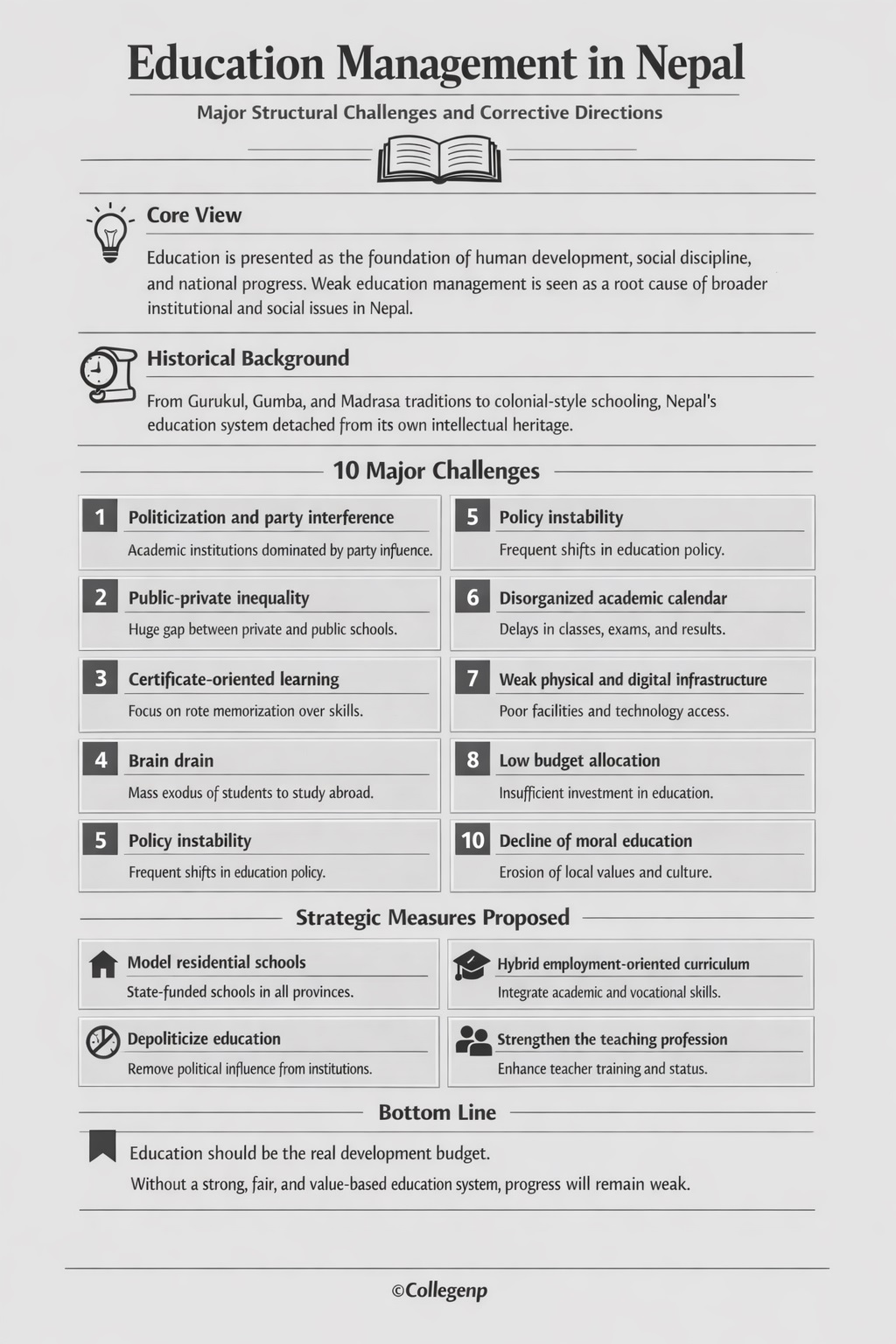
1. State-Funded “Model Residential Schools” in All Seven Provinces
Although the state has allowed educational institutions operating under different models — public, private, community, madrasa, and gumba — to grow in their own ways, there is an urgent need to introduce minimum uniformity among them. The state itself must lead this process.
Under a new concept, the state should establish full-time model residential secondary schools in all seven provinces, ensuring that from the basic level onward every child receives education in a system suited to their mother tongue and social environment. These schools should be run under direct state financial management, from food to accommodation.
The student selection process in such schools must be fair and merit-based, while ensuring access for economically lower- and middle-class children. Here the welfare principle of the state — taking from those who can afford and giving to those who cannot — should be vigorously applied through a cross-subsidy model.
Children selected into such schools could then undergo complete physical, intellectual, and moral transformation.
2. A Hybrid and Employment-Oriented Curriculum
The curriculum applied in model secondary schools and other educational institutions across the country must be highly practical and multidimensional. Mathematics, modern science, and technology should be taught with full importance, while Nepal’s philosophy, ancient science, and literature should be integrated alongside them.
Along with Nepali and English, classical thought and languages such as Sanskrit and local languages should be kept alive. At the same time, serious teaching in the social sciences — geography, anthropology, social psychology, and related subjects — is necessary.
For children from poor families who spend the entire day in class yet remain unable to meet even their evening meal needs, the rigid school timetable must be made more flexible. A “Learn and Earn” model has become essential, allowing them to study while also developing income-generating skills.
3. Making Education a Depoliticized Sector
No solid management policy can succeed unless it is implemented honestly and without controversy in practice. It is already overdue to legally prohibit party politics entirely from educational institutions.
Teachers and administrators who carry political flags should be removed immediately, and schools and universities should be entrusted to committed intellectuals who place academic research and children’s learning above all else.
4. Social Respect and Proper Management for Teachers
A common policy in countries with advanced education systems such as Finland and Singapore is to establish the teaching profession as more prestigious and more financially rewarding than even medicine and engineering.
Good education is unimaginable without good teachers. The fact that teaching is not considered an attractive profession in our society is a serious weakness of education management.
The state must prepare trained teachers with psychological awareness, scientifically redistribute posts, and ensure their full dedication to teaching and learning.
Conclusion
Philosophical and moral thought tells us that through education a person can attain a divine quality, while through its distortion a human being can become monstrous. Examples of this can still be seen scattered throughout society today.
Until the mathematical modern science that emerged from the Greek tradition and the Vedic, Sanatani, or inherited spiritual thought that arose from our own land are fused together, Nepal’s original education cannot become strong.
Should the state devote its budget only to roads and physical development, or should it invest in education that builds the refined human beings who will use those roads? Until the idea that “the real development budget is education itself” becomes the backbone of the state, there is a greater danger that problems will deepen rather than be solved.
The state must not remain absorbed only in sending youth abroad and counting remittance inflows. It must focus instead on education that transforms that vast human force and inner energy into national development. If a proper education system is established, no structure of the nation will fail.
List of Challenges in Education Management in Nepal
|
1. Extreme politicization and party interference: Party affiliation and politics dominate over academic ability at every level and appointment in the education sector. 2. Deep class gap: Educational inequality between expensive private and resource-poor government schools produces two types of citizens in society: 'haves' and 'have-nots'. 3. 'Certificate-oriented' unemployed education: Learning is not linked to practical skills, innovation, and market demands, and there is a practice of simply obtaining certificates by rote. 4. Brain drain: Due to the lack of assurance of education and employment in the country, millions of young people and billions of national capital go abroad every year. 5. Unstable policies and weak implementation: Education policies change as soon as the government changes, and rules and laws made with a long-term perspective are not effectively implemented. 6. Disorganized academic calendar: Students' valuable time is wasted due to the practice of not holding classes on time in universities, exams being postponed for months, and results taking years to come. 7. Lack of physical and digital infrastructure: Rural and most public schools lack basic facilities such as standard buildings, libraries, science laboratories, and technology (internet/computers). 8. Low budget allocation in education: State investment in education is much less than international standards (20%) (about 11%), and more than 90% of that is spent on salaries and allowances (no budget for research). 9. Lack of skilled teachers and modern training: The best talents of society are not attracted to the teaching profession and there is a lack of child-psychological and modern technology-friendly teaching styles even among working teachers. 10. Rejection of moral education and originality: While considering only a foreign language (English) as the standard of education, the philosophy, mother tongue, culture, and moral values of one's own country are disappearing from the curriculum. |







Comments 0
No comments yet. Be the first to start the conversation.