



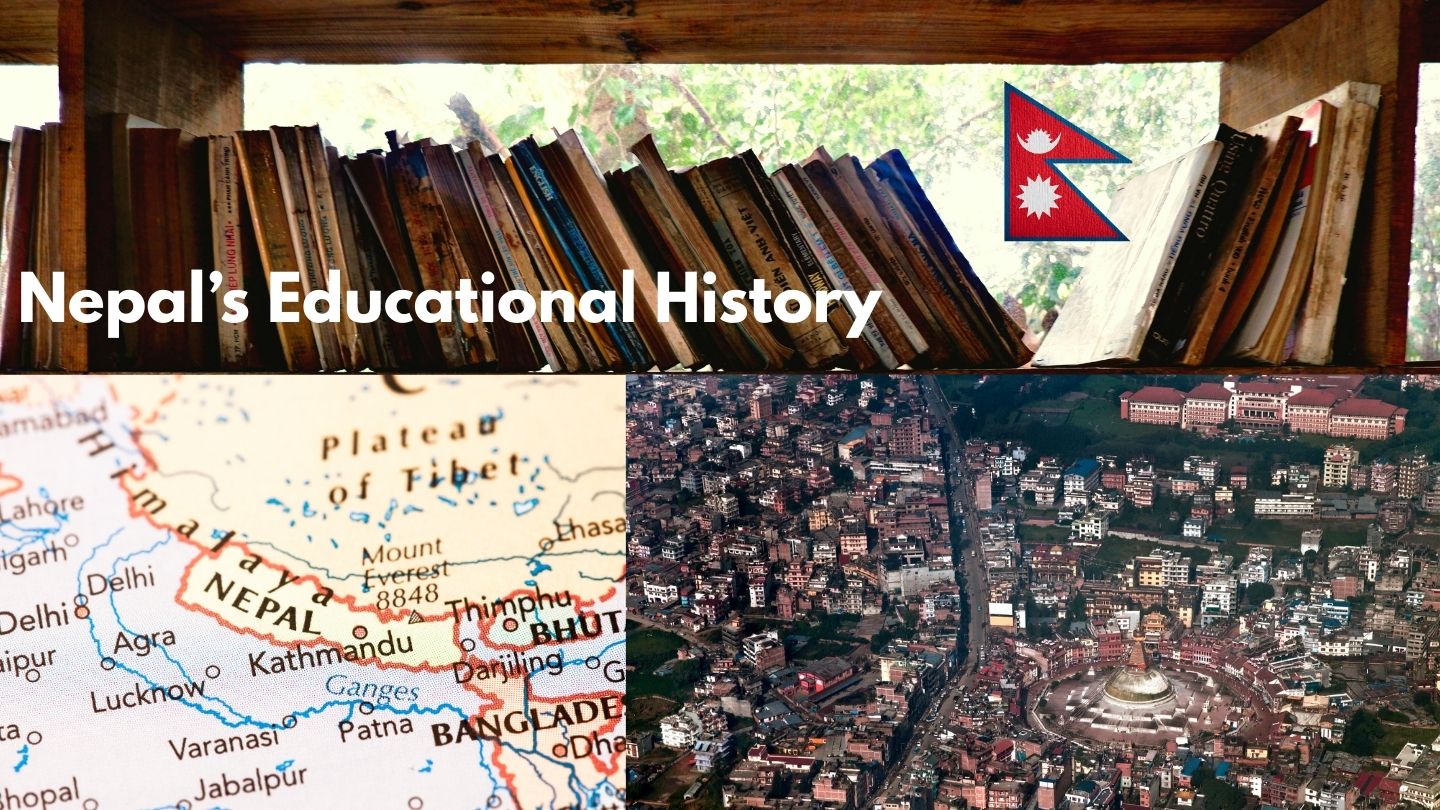
Table of Content
- The History of Public Education Expansion in Nepal
- Rana-Era Educational Context: From Elite Control to Managed Expansion (1846–1951)
- After the 1951 Revolution: Popular Rise and Debate in Public Education
- Panchayat Era: New Education Plan and a Control-Oriented System (1960–1990)
- Social and Marginalized Communities’ Struggles: History from Below
- From Multi-Party Democracy to Federalism: Modern Expansion and the Challenge of Privatization (Post-1990)
- Conclusion
- Historical Timeline
The History of Public Education Expansion in Nepal
Education is a primary vehicle of social transformation. Yet in Nepal’s history, access to education for ordinary people was, for a long time, as difficult as chewing iron grains. In different historical periods, the state kept citizens beyond the reach of education and used ignorance as a tool to preserve power.
Today, thousands of community (public) schools are spread across even the most remote parts of the country, and millions of children study in them. However, to reach its present form, public education in Nepal has passed through autocratic rule, policy intervention, grassroots rebellion, and a long social struggle.
A review of studies and academic research shows that the education history of Nepal has largely been written from a state-centered, top-down perspective, where only rulers or ruling classes are praised. In reality, the establishment, expansion, and preservation of public schools in Nepal became possible less through the state than through the labor of grassroots campaigners, ordinary citizens, and various marginalized communities.
In this detailed article, we examine how the public education system emerged in Nepal, how rulers used and controlled education for their own interests, how marginalized groups and communities awakened educational consciousness, and how this expansion gradually took a modern form.
Rana-Era Educational Context: From Elite Control to Managed Expansion (1846–1951)
Institutional and formal education in Nepal is generally believed to have taken root mainly after the beginning of Rana rule. After Jang Bahadur Kunwar (Rana) seized power through the Kot Massacre in 1846, the traditional education system based on Sanskrit, monasteries, and madrasas gradually faded into the background, and the seeds of Western-style “modern” education were sown.
Jang Bahadur’s Visit to Britain and the Beginning of English Education
In 1850, Jang Bahadur undertook a long journey to Europe. After seeing the development there and the power of English education, he returned to Nepal and around 1853/1858 established an English school in his own palace at Thapathali, known as Darbar High School. But this school was not for the general public.
It was opened exclusively for the sons and nephews of the Rana family and a few close courtiers. At that time, the rulers had no intention of educating the common people. The Ranas feared that if everyone received education, rebellion against the regime might follow.
Dev Shumsher’s Brief Effort and the Bhasha Pathshala
In Nepal’s educational history, Dev Shumsher is remembered as a relatively “liberal” ruler. After coming to power in 1901, he introduced a policy of opening Bhasha Pathshalas under the main vision and leadership of Jay Prithvi Bahadur Singh. During his total tenure of just 118 days, he established around 150 schools.
He introduced a policy of preparing and distributing books such as Aksharank Shiksha free of cost. He also implemented a progressive policy under which if a village community gathered 50 students, the state would provide one teacher, and if it gathered 100 students, it would provide two teachers.
This was the first historic step toward providing education in the Nepali (Gorkhali) language. But Dev Shumsher’s conservative brothers, especially Chandra Shumsher, could not accept a policy that would educate the subjects and make them aware. As a result, he was removed from power and sent into exile.
Chandra Shumsher and the Self-Interest Behind Sresta Pathshala
As soon as he came to power, Chandra Shumsher reversed Dev Shumsher’s policy. The newly opened Bhasha Pathshalas fell apart, and teachers’ salaries were suspended. After losing state support, those schools either closed or shrank back into traditional Sanskrit education. Even so, the Ranas needed lower-level clerks and employees to run the government, maintain court records, collect revenue, and operate the administration.
Out of that self-interest, the Sresta Pathshala was established in October 1905. The Sresta system taught basic mathematics, administrative knowledge, and literacy.
It had different levels of examinations, such as four-pass, seven-pass, and eleven-pass. Those who passed could obtain government jobs. Around the same time, former Gurkha soldiers returning from British service had also begun secretly expanding education in rural areas, which the Ranas tolerated only to a limited extent.
From Strict Regulation to Padma Shumsher’s Liberal Turn
The Rana education policy was essentially one of control and prohibition. The “Istihar” of 1939 and the “Sanad” issued in 1941 strongly discouraged the establishment of schools. Prior permission from a government officer or chief official became mandatory to open a school, and political or organizational involvement was prohibited. Even so, Padma Shumsher, who came to power after Juddha Shumsher, declared that the people would be given “appropriate education.”
He introduced Basic Education, influenced by Gandhian philosophy, and also opened school doors for women. But under Mohan Shumsher, education policy again became restrictive. As a result, by the time the 104-year Rana regime came to an end in 1951, Nepal’s total literacy rate had still not reached 2 percent.
After the 1951 Revolution: Popular Rise and Debate in Public Education
The restoration of democracy in 1951 (2007 BS) was a major leap in Nepal’s political and social history. With the fall of autocratic rule, openness spread everywhere. The largest and most positive surge of that era was seen in the field of education.
Competition to Open Schools and Community Ownership
After the collapse of Rana rule, efforts to open libraries, run clubs, and establish community organizations such as farmers’ associations and women’s associations accelerated. By collecting donations in neighborhoods and contributing handfuls of grain, local communities themselves spontaneously began establishing public schools and libraries. As a result, the literacy rate, which stood at only 2 percent in 2007 BS, rose to around 9 percent within a decade. Even without major state investment, school networks began to spread rapidly in rural areas through cooperation among teachers, intellectuals, and aware citizens.
National Education Commission and the Language Dispute
Although the number of schools increased, there was no uniformity among them. Some were basic schools, some Sanskrit pathshalas, some English schools, and some Sresta schools. To remove this variation and introduce a single system, the first National Education Planning Commission was formed in 1954 under the chairmanship of Rudraraj Pandey and with American expert Dr. Hugh Wood as adviser.
The Commission’s report of 1956 recommended the implementation of a unified education system across the country. But at the same time, a complex language dispute began. In 1957, the government led by K.I. Singh issued a directive making Nepali the compulsory medium of instruction in all schools, which sparked intense protest and political struggle in the Tarai/Madhesh.
There was resistance from the Tarai and some other regions on the grounds that a single language was being imposed in place of mother tongues, although over time this issue gradually took on a national character. Since centralized examinations such as the SLC were conducted entirely in Nepali, the education system increasingly moved toward “Nepalization.”
Panchayat Era: New Education Plan and a Control-Oriented System (1960–1990)
In December 1960 (2017 BS), King Mahendra dismissed the elected government and imposed the Panchayat system. He clearly understood that to make the regime more autocratic, it was necessary not only to suppress political parties but also to bring the education system under state control.
Nationalization of Schools
At first, the education committee formed under the leadership of Bishwabandhu Thapa introduced strict policies to keep schools under control. Sanskrit was again given priority, and English was removed from lower levels. Ultimately, in 1971 (2028 BS), during the reign of King Birendra, the National Education System Plan (NESP/New Education Plan) was implemented.
Its main strategy was to fully nationalize the schools that had been established and operated at the community level. Teachers were turned into employees, schools that had functioned without government grants were brought inside the state framework, and the entire education sector began to be controlled from the center.
The Construction of “Heroic History” and Ideological Monopoly in Education
The Panchayat-era education policy was directed less toward the spread of knowledge than toward producing citizens loyal to the Panchayat, or “manpower.” A new style of history writing was created, now often described as “heroic history.” In state-produced textbooks, fixed standards of “Nepaliness” were imposed.
Only the masculine, war-winning, patriotic stories of the ruling class were treated as “national history,” while the struggles of diverse regions, the realities of ordinary people, and cultural identities were removed from history or censored. From school to university level, teachers and students were prohibited from practicing democracy or holding political views. It is even believed that because highly educated students might question the rulers, secondary and higher education were made rigid and pass rates were controlled through what was called the Gateway concept.
Social and Marginalized Communities’ Struggles: History from Below
Although state documents record the contributions of kings and ministers, the real history of education was woven on the ground. Today’s education system stands not merely because of orders from above, but because of the thirst for education among oppressed groups.
Internal Efforts Within Brahmin Communities and Rural Pathshalas
According to historical evidence, in western Nepal and other rural areas, some far-sighted individuals, such as Harihar Gautam, who became a large landholder, and his teacher Dadhiram Marasini, began Dalane Pathshalas on their own initiative despite Rana neglect and expanded them into residential institutions. Harihar Sanskrit Pathshala in Gulmi is one major example.
They were inspired by the intellectual environment of Varanasi (Banaras).
Dalit Communities and Revolt Against Untouchability
The most struggle-filled educational journey belonged to Dalit communities. As early as the 19th century, missionary movements and progressive campaigns such as the Arya Samaj had already begun in India. The impact of those movements had also reached Nepal. Although the efforts of Dev Shumsher and Jay Prithvi Bahadur Singh created a limited environment in which some educational light could reach Dalit communities, society still did not accept them.
While Brahmin-Chhetri or Newar elite groups could access education comparatively easily, students from so-called lower castes were made to sit outside on the ground instead of inside classrooms and were subjected to discrimination. Historical records confirm that it took decades of struggle to break this extreme tradition.
Women’s Education: A Center of Resistance and Debate
For a long time in Nepal, there was no accepted idea of educating daughters. In newspapers and magazines such as Gorkhapatra and Sharada, intense debate took place among male elites over whether there should be women’s education at all. One side argued that women should receive education, but only to manage the household and become suitable mothers and good wives, which they described as “appropriate education.”
Female activists and some progressive intellectuals opposed this view. They argued that women should have the same right as men to independent education for equality, economic self-reliance, and service to the nation. The small door that Padma Shumsher opened after 1945 has today turned into a major achievement.
Madhesh and Cross-Border Grassroots Connections
The educational expansion of Madhesh and the eastern Tarai has a distinct social dimension. After the 1940s, aware Madheshi merchants and moneylenders made extensive use of cross-border intellectual networks in North India for educational expansion. Some leaders of the Indian independence movement who had come to Nepal as refugees found an environment here in which they could teach in schools.
Whether they were far-sighted figures such as Ramswaroop and Ramsagar or saints and mahants in society, they spent their own wealth on educational expansion and helped establish a strong system outside state control.
From Multi-Party Democracy to Federalism: Modern Expansion and the Challenge of Privatization (Post-1990)
With the restoration of multi-party democracy through the People’s Movement of 1990 (2046 BS), Nepal’s education system underwent another major change. Freed from the Panchayat’s ideological enclosure, Nepali education was pushed under neoliberal policy toward privatization and commercialization.
Since the 2050s BS, private and institutional schools, where profit is generated and English is often used as the medium of instruction, have grown dramatically in major cities and accessible areas. Based on recent data from the 2020 national indicator, there are around 35,520 schools across Nepal. Of these, around 6,687 are private (institutional) schools, while about 28,833 are community (public/government) schools.
Despite the strong attraction of private schools, public schools still remain the final foundation of basic education for 5 million children, about 72 percent of Nepal’s more than 7 million students.
Under Nepal’s federal democratic structure, full authority and responsibility for school education up to the basic and secondary levels have now been transferred to local governments, including rural municipalities and municipalities. Even so, governments are still struggling to implement effective education governance and accountable structures, as well as stronger community school management, to bridge the distance in ownership between communities and schools that began with Panchayat-era nationalization.
Conclusion
The development of public education in Nepal, like world history itself, did not move in a straight line. It arrived here through a highly complex, winding, and curved path. In the early stage, Rana rulers wanted to keep the subjects uneducated in order to secure their rule. With a few exceptions, they imposed severe restrictions even on opening schools. In the following period, with the arrival of democracy, a wave of self-driven public development arose, and educational institutions were built across the country through popular participation.
When citizens began to develop a sense of ownership, the Panchayat system again absorbed that energy through the New Education Plan and placed it under the grip of the state. In that process, the real struggles of women, Dalits, and marginalized communities were erased from education history, and a centralized ruling narrative was constructed. Even so, the consciousness, organization, and struggle for rights among ordinary people at the lower levels, history from below, built the broad public school system seen today.
Therefore, today’s challenge is not limited to constructing buildings. It is how to make this public education system, built through the sweat of marginalized people and earlier generations, more quality-focused, skill-based, and capable of producing the workforce required for the 21st century. If public schools fail to rise, more than 70 percent of the country’s generations will remain marginalized, and that will directly affect the state’s overall prosperity.
Historical Timeline
Pre-Rana and Early Rana Period
Early to Mid-20th Century
Around the 1951 Revolution and the Expansion of Openness
Panchayat Era
From Privatization to Recent Developments
|
Under Nepal’s present federal structure, these figures also connect closely with debates around education governance and public school quality, especially in relation to access, accountability, and long-term reform.







Comments 0
No comments yet. Be the first to start the conversation.