



Table of Content
- Traditional Rote Learning and Its Limits
- The Digital Age: The Gap Between Students and the Education System
- The Changing Role of the Teacher: Not a Ruler, but a Facilitator
- Practical and Age-Appropriate Education
- Ending the Era of Heavy School Bags
- Parents’ Obsession with Marks and a New Direction for Evaluation
- What Should Evaluation Look Like?
- How to Become a Successful Parent
- The Gap Between Public and Private Schools: Myth and Reality
- Learning and Language: Mother Tongue or English?
- Education Policy, Local Government, and the Path to Change
- In the End, Life Learning Is Education
Alongside the development of human civilization, education has become the most essential need after food, shelter, and clothing. The overall development, prosperity, and future direction of any nation depend on its education system. With the rapid changes in time and technology, the methods, purpose, and perspective of education have already undergone a fundamental transformation.
We are now living in the digital age of the 21st century. Yet, ironically, the education systems of some developing countries are still wandering on the ground of the 20th century.
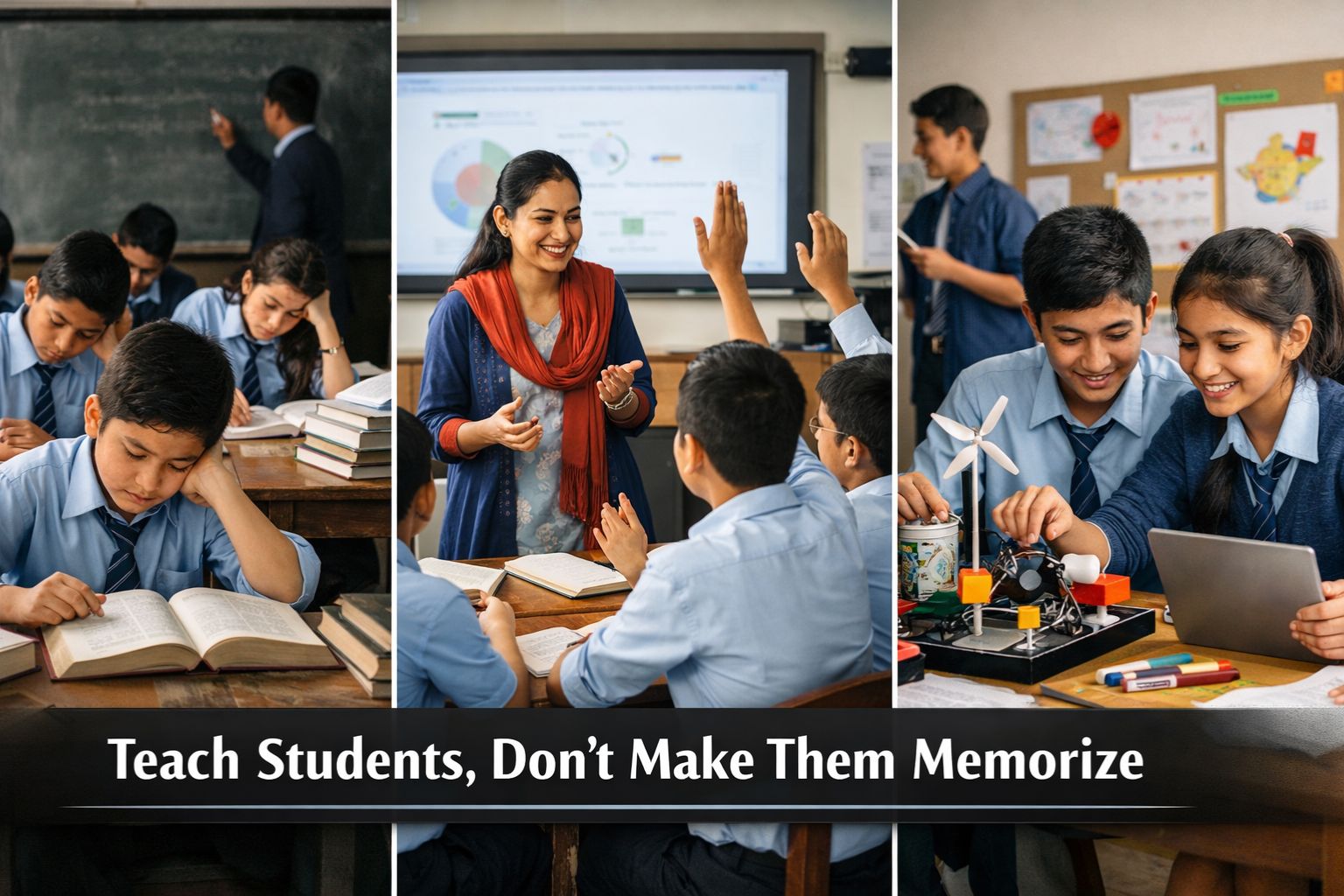
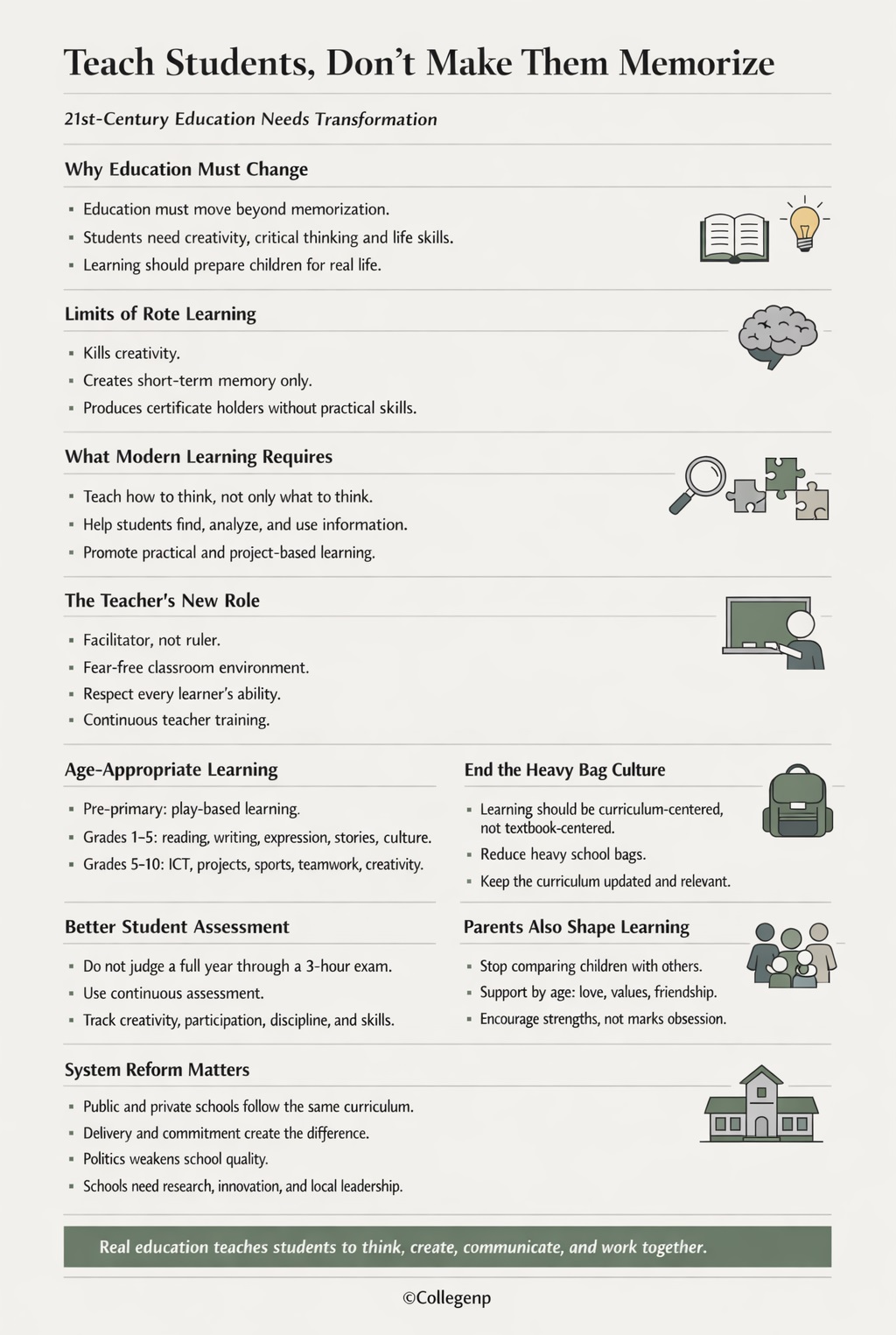
At a time when access to modern knowledge is available everywhere, a system based on memorizing facts and information no longer has meaning. Children today should not be turned into “robots” through bookish repetition. They must be shaped into creative and complete human beings through life-oriented skills. The core spirit of education now must be to teach students, not to make them memorize.
In this article, we present a detailed and evidence-based analysis of the current educational condition, the decline of rote learning, the changing roles of teachers and parents, practical learning, and the future direction of education.
Traditional Rote Learning and Its Limits
For a long time, our education system has remained based on memory power. The social practice still favors students who can memorize textbook content exactly and reproduce it word for word in examinations. But is the memorization of facts alone real education? Certainly not.
The main limitations of traditional rote learning are as follows:
-
Destruction of creativity: Rote learning destroys children’s critical thinking and creativity by discouraging them from thinking in their own way.
-
Temporary knowledge: What is memorized without understanding is often forgotten shortly after leaving the examination hall. This is not learning, but merely a mechanical process of recall.
-
A workforce without skills: Even with good grades and certificates, many young people remain unemployed or are forced to sell cheap labor abroad because they lack practical skills.
Therefore, the traditional mindset of teaching only for certificates and exams must now come to an end. Learning should not remain confined within the four walls of the classroom. It should become a tool that enables people to solve the challenges they face at every step of life.
The Digital Age: The Gap Between Students and the Education System
One of the most serious challenges today is the generational gap between teachers and students. In our schools, many teachers were trained and shaped in the 20th century, but the children they teach belong to the 21st century. They are digital natives who have grown up with the internet, artificial intelligence, and digital gadgets.
In the past, teachers were the sole source of knowledge. Today, students have access to the world’s knowledge with a single click on a mobile phone. In such a situation, if teachers continue to deliver information through the old lecture method, students naturally find it dull. What is needed now is not to tell students what to think, but to guide them on how to think.
When sources of information are abundant, the real learning lies in acquiring the skill to find the right information, analyze what is received, and apply it in practical life. This is also why digital education in Nepal deserves serious attention in present educational reform.
The Changing Role of the Teacher: Not a Ruler, but a Facilitator
In the modern learning system, the meaning of a teacher has changed completely. A teacher is no longer just a person who “delivers lessons” or rules the classroom. Teachers should now be established as trainers and facilitators.
A one-way classroom monologue cannot develop a genuine learning attitude in children. It is the teacher’s responsibility to create an environment where students participate and learn by doing. For this, several important elements are necessary:
1. Fear-Free Environment
In many of our schools, discipline is still maintained through fear and intimidation. But discipline created through fear is artificial. When students are afraid of teachers, hesitate to ask questions, and believe that mistakes will lead to punishment, the path of learning is blocked. The relationship between students and teachers must be friendly and respectful. Only in a joyful and fear-free environment can children become complete human beings.
2. Teacher Training and Professional Development
Being knowledgeable in one’s subject alone is not enough for a modern teacher. Continuous training in child psychology, technology-friendly learning methods, and innovative teaching practices is now the first requirement.
3. Respect for All
The tendency to favor high scorers and sideline weaker students lowers student morale. Every child possesses different kinds of ability, in line with the idea of multiple intelligences. Some may excel in mathematics, others in music, and others in sports. Bringing out those abilities is part of the teacher’s true skill.
Modern schooling should therefore move toward full learning and teacher support in Nepal, where student growth is seen more broadly than marks alone.
Practical and Age-Appropriate Education
Book-based knowledge alone is incomplete. Education must be connected to life. It should transform life by offering not only knowledge but also skills. Only practical and research-based education, including project-based learning, can help a person become physically, mentally, socially, and emotionally complete and productive. Learning must match the age and psychology of children.
Montessori and Pre-Primary Learning
For pre-primary children, especially those in Montessori systems, forcing them to recognize letters, write, and memorize is a serious wrong. Children at this stage should learn through play-based methods.
If children of this age are found being made to memorize complex subjects such as English grammar or difficult mathematics, the concerned school should face action from the regulatory authorities. This is the age for socialization and foundational cognitive development.
Basic Level (Grades 1 to 5)
For this age group, the burden of books should be reduced. Teaching should not be book-centered, but content-centered and story-based.
At this stage, children should learn to read, write, and express themselves properly. Along with that, they should also be introduced to art, their country’s culture, values, customs, traditions, and basic social norms.
To ensure a proper learning environment inside the classroom, it is not scientifically sound to place more than 26 students in one section at this level.
Secondary Level (Grades 5 to 10)
By this age, children are moving toward physical and mental maturity. Teaching them only through the traditional chalk-and-duster method is no longer sufficient.
Use of technology: The learning process should be made engaging through information and communication technology, projectors, and audio-visual tools.
Balanced subjects and extracurricular activities: After 4 or 5 periods of core subjects, the remaining time should be allocated to practical and extracurricular activities. Only through project work, yoga, meditation, sports, dance, music, and group activities can their all-round development be ensured.
Keeping fewer than 30 students in a class at this level falls within international practice for maintaining learning quality. Schools must understand that gathering large numbers of students does not automatically produce quality education.
Ending the Era of Heavy School Bags
In private schools, and sometimes even in government schools, children are still made to carry school bags so heavy that they are almost proportional to their body weight. This is not only unscientific, but also directly harmful to children’s physical health.
What we must understand is that it is not textbooks that teach children, but the curriculum. A book is only one small learning resource. Today, knowledge comes from many sources: newspapers, social media, online portals, and life itself.
The misconception that “more books and notebooks mean better study” must end. When classrooms adopt project-based and research-based teaching, the era of carrying excessive books naturally comes to a close.
For this, the curriculum must be timely and relevant. In developed countries, curricula are updated every year. In systems like ours, where old and outdated curricula remain in place for decades and even minor revisions take years, students cannot be made capable of competing in a changing world. To ensure quality education, the curriculum must be living, contemporary, and dynamic. This is where discussions around a skill-based curriculum in Nepal become especially relevant.
Parents’ Obsession with Marks and a New Direction for Evaluation
The responsibility of guiding students and preparing them for life does not belong to teachers alone. Parents share that responsibility equally. Yet, unfortunately, many parents focus only on marks.
Evaluating a child’s talent solely on the basis of exam scores or grades is harmful. The behavior of being happy when a child brings high marks and angry or insulting when the marks are low causes serious damage to a child’s self-respect.
There is no scientific or practical basis for believing that high scores alone make someone successful in life. Unless a child develops useful knowledge, vocational skills, and good character, even 90 percent or an A+ cannot sustain life.
Another dangerous parental behavior is comparison. Comparing one’s child with the neighbor’s child or another student in the class is almost like an offense. Every individual is different, and each has different strengths and interests. A child may be weak in mathematics but excellent in painting, sports, or literature. Parents should identify children’s interests and abilities and encourage them accordingly.
What Should Evaluation Look Like?
It is a flawed system to judge a student’s entire year of learning based on a 3-hour examination and divide them into “good” and “bad” students accordingly. Evaluation should be a continuous process.
A record file or portfolio should be maintained to document what creative work the child did throughout the year, how disciplined the child was, and what new skills were learned. Only then can learning be assessed in a complete and meaningful way.
How to Become a Successful Parent
Even now, there is still a serious lack of understanding and skill regarding proper parenting. Parents should treat a child’s psychology differently according to age.
-
Up to 5 years: Children need great affection, love, and care. At this age, they should not be scolded or frightened.
-
From 6 to 10/12 years: Children should be taught basic rules, values, discipline, and practical life habits. At this stage, they are observing how society works.
-
Above 15 years, after adolescence begins: Parents should behave like friends. Only when children’s feelings and thoughts are respected can they grow into good and responsible people. Otherwise, they may become emotionally distant from their parents and face risks such as depression, addiction, or other mental health problems.
The Gap Between Public and Private Schools: Myth and Reality
Many debates continue around public and institutional private schools. Among educationists and the wider public, there is a major concern that the country is producing two different kinds of human resources. But a factual analysis reveals some interesting truths.
Both public and private schools teach according to the same official curriculum prescribed and implemented by the government. Private schools are not teaching some separate or mysterious body of knowledge. If the curriculum is the same, why is there such a large difference in results and outcomes?
The main difference is not limited only to infrastructure or state investment. The real issue is work culture and commitment.
1. Timeliness and Upgrading
Private schools paid attention to how to produce the workforce needed by the global market and how to apply new methods suitable for the 21st century. They upgraded their models more quickly toward skill-based and practical education. As a result, parents’ trust in private schools became stronger.
2. The Declining Condition of Community Schools
The government invests a significant portion of the total budget, around 10 to 11 percent along with many local-level resources, in the education sector and public schools. Physical infrastructure has also expanded across the country. Yet the results remain very weak. Why?
3. The Wildfire of Politics
As long as more than 90 percent of community school teachers remain more engaged in political gatherings than in students’ classrooms, reform will not be possible. Many government school teachers and school management committee members have effectively become party loyalists. The bitter truth is that the culture of making “our own people” teachers or professors rather than choosing the best candidates has allowed politics to enter education. As a result, government investment has been wasted like water poured into sand.
Ultimately, it is the responsibility of community schools to use state resources properly and provide quality and equitable education to ordinary citizens. To improve this, political influence must be pushed outside the school boundary through leadership and social commitment. In that context, community school management in Nepal remains a critical area of reform.
Learning and Language: Mother Tongue or English?
Another serious misconception is widespread in our society: the belief that speaking good English means receiving good education. Knowledge, learning, and skills are much broader concepts than language alone.
It is true that language acts as a strong bridge for expressing ideas. In that sense, the mother tongue is considered the most scientific and effective medium for learning. Any concept is easier to understand in one’s own mother tongue than in a second or third language. Therefore, schools must protect and encourage the use of the mother tongue.
At the same time, we cannot ignore the reality that English has become an international contact language. It is an important gateway to the global market, technology, science, and the acquisition of knowledge. Because private schools emphasized English from the beginning, thousands of students today have been able to compete and study at top universities around the world. In a globalized world where people must enter international labor markets, English has also become a practical necessity.
Therefore, the real issue is not English versus the mother tongue. The deeper problem lies in the country’s limited opportunities and the lack of a research-friendly academic environment. The inability of the state to turn brain drain into brain gain by properly utilizing talented youth at home is a sign of state failure. Learning should stand on the roots of the mother tongue, while the branches of knowledge should expand through English and technology.
Education Policy, Local Government, and the Path to Change
We brought a new system, federalism, and republicanism to the country, but the thinking of rulers and educational leadership has still not transformed. The Constitution has granted full authority for the operation and management of school-level education to local governments.
But the main problem is that some elected representatives, chosen on the basis of political background, have not been able to understand the depth of education as a sensitive and technical field. A narrow understanding still exists at the local level that managing schools simply means constructing walls and roofs.
The government periodically issues national education policies, laws, and frameworks, but such policies are often prepared without broad study or deep consultation with independent education experts. It is dangerous to formulate 21st-century policy through a 20th-century lens. This sector needs a fully state-of-the-art system and a genuine paradigm shift.
Schools are centers that connect students and society. Today’s children are seeking dimensions of research, innovation, technology-friendly practice, logic, and humanity.
In the End, Life Learning Is Education
Viewed in this way, the overall educational condition and the path we seek become clear. It is already late to turn the slogan “Teach students, don’t make them memorize” into real practice.
Learning is a journey from the dark corners of the classroom into the open and bright field of social life. Developing critical thinking in students, improving their writing, speaking, and communication abilities, teaching teamwork, and making them creative should now be the only goal.
Children are not racehorses forced to run inside a trap designed by parents or teachers. They are birds of the open sky. Our duty is to teach them how to fly, show them direction, and support their wings, not cut them down or burden them with sacks of books.
Only if leadership, teachers, parents, and the state as a whole adopt new ideas, technology, and innovative methods in education in time will the coming generation be able to stand firmly in global competition.



Comments 0
No comments yet. Be the first to start the conversation.