




Table of Content
- IT Education in Nepal: Attraction, Internal Realities, and the Future Roadmap
- The Growing Rush for IT Education in Nepal and the Academic Landscape
- Theoretical Education: Memorized for Exams, Empty for the Future
- The Massive Gap Between Outdated Curricula and the Real Industry
- A “Digital” Subject, but an “Analog” System
- The Student’s Double Life: College Degree and Internet-Based Skills
- Work Requires Experience, and Experience Requires Work: The Internship Crisis
- The Severe Lack of Career Counseling
- Brain Drain and the Reality of the Nepali Market
- The Neglect of Soft Skills
- The Way Forward
- Conclusion
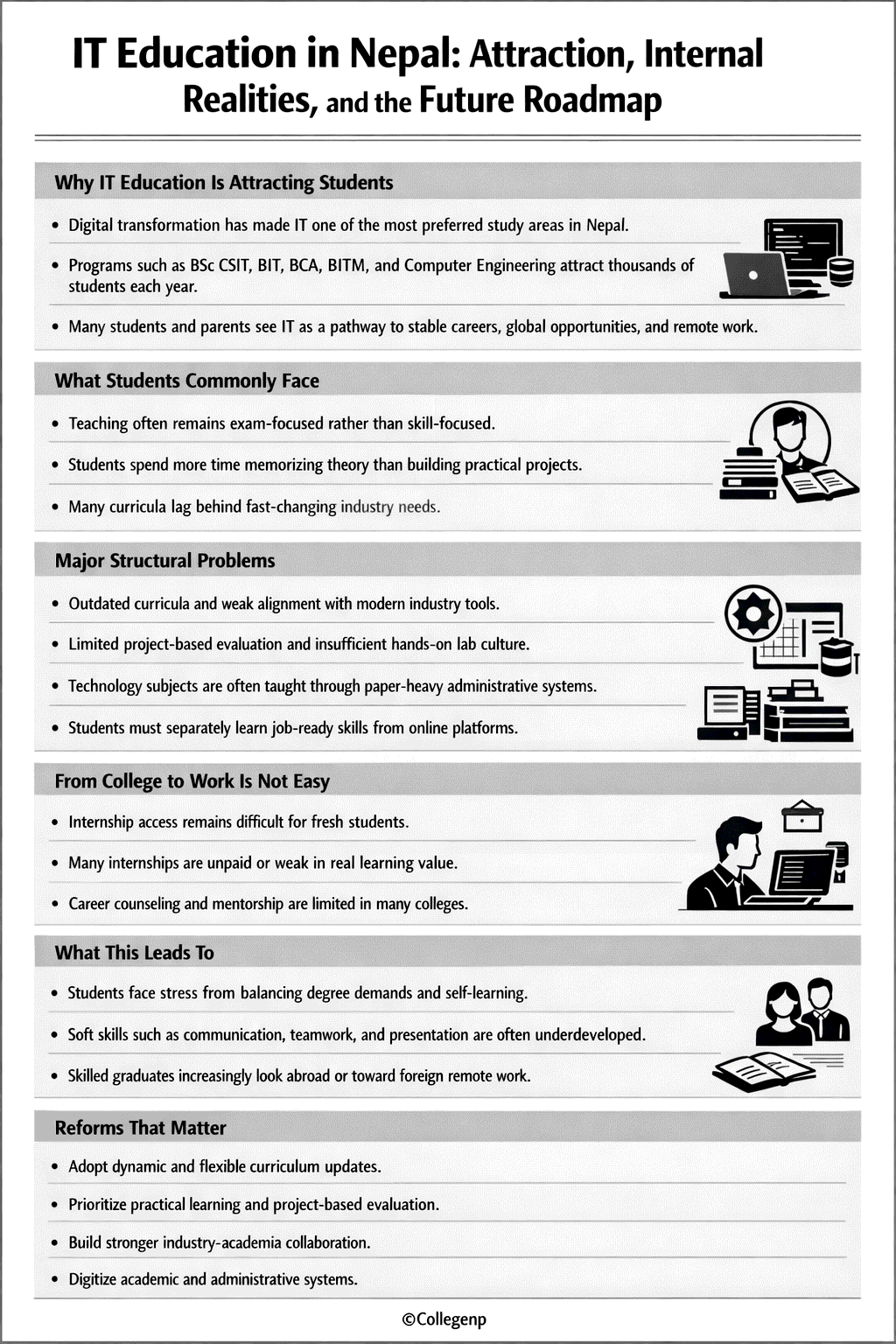
IT Education in Nepal: Attraction, Internal Realities, and the Future Roadmap
The biggest revolution of the twenty-first century is digital transformation. Along with the rapid global development of technology, Nepal too is gradually moving toward digitalization. Until about a decade ago, Nepali society largely viewed becoming a doctor or an engineer as the only marker of a successful career. That mindset has now changed significantly. Today, Information Technology (IT) has become the first choice of young people and a major center of attraction for parents.
Every year in Nepal, thousands of young people enroll in undergraduate IT programs such as BSc CSIT, BIT, and BCA, along with BITM and Computer Engineering, carrying big dreams and hopes for a secure future career.
From the outside, the IT sector appears highly attractive, well-paid, and glamorous. But once students enter college and complete a few semesters, the reality they experience is often very different and far more challenging.
This article presents a detailed factual analysis of the current state of IT education in Nepal, university curricula, the gap between theoretical and practical knowledge, industry demand, and the real problems students are facing.
The Growing Rush for IT Education in Nepal and the Academic Landscape
In Nepal, Tribhuvan University, Kathmandu University, Pokhara University, Purbanchal University, and dozens of colleges affiliated with foreign universities are offering IT education. Taking student interest and market demand into account, colleges have introduced IT courses under various names.
Students from science backgrounds have access to courses such as BSc CSIT and Computer Engineering, while students from management or humanities backgrounds can study programs such as BCA and BITM. In recent years, specialized subjects such as Software Engineering, Cybersecurity, and Cloud Computing have also started being taught under the affiliation of foreign universities.
At a glance, Nepal’s IT academic landscape appears broad and promising. However, the reality is that although the number of colleges and universities has increased, serious questions are now being raised about the quality of education and the capability of the workforce it produces.
Theoretical Education: Memorized for Exams, Empty for the Future
The core essence of any technical subject lies in its practical application. But in most colleges in Nepal, teaching is more focused on marks than on skills. Instead of spending time in computer labs building new software or solving coding problems, students are forced to focus on how to secure a good GPA in exams.
The classroom environment is still largely traditional. Teachers write on the board or show slides, students copy notes, collect past papers, memorize answers to important questions, and reproduce them in exams. Nepal’s IT education continues to revolve around this cycle. By the very next day after the exam, students have already forgotten what they memorized.
Prestigious global tech companies such as Google and Microsoft, as well as Nepal’s leading software companies, do not hire people by looking at mark sheets. They look for problem-solving skills and practical knowledge. But the university examination system is turning students into rote learners.
The Massive Gap Between Outdated Curricula and the Real Industry
IT is a field in which new technologies, new frameworks, and new programming languages emerge every six months. But the curricula of many universities in Nepal have not been revised for years.
In the global market today, subjects such as Artificial Intelligence (AI), Machine Learning, Blockchain, Cloud Computing, and Cybersecurity dominate. But our students are still being forced to memorize the theory of decades-old programming languages and technologies.
As a result, a major Industry-Academia Gap has emerged between the workforce produced by universities and the workforce required by the IT industry. Students spend four years in college, millions of rupees, and a significant portion of their lives earning a degree. But when they enter the job market, they realize that what they learned in college does not meet industry demand.
A “Digital” Subject, but an “Analog” System
The greatest irony in Nepal’s education system is that the institutions teaching technology are themselves not technology-friendly. An IT student studies modern subjects such as Software Engineering, Database Management, and AI. Yet that same student often still has to handwrite assignments in notebooks before submitting them.
In international universities, students upload their projects to platforms such as GitHub and are evaluated online. But here, the absurd situation still persists in which even programming code has to be handwritten in a notebook and submitted in a file.
That is not all. From filling out entrance exam forms to sitting semester exams, students have to stand in line for hours, go to banks and fill out vouchers instead of using digital payments, and fill OMR sheets with black ink instead of taking computer-based exams. While the outside world has already entered the age of AI, our educational administration remains trapped in ledgers and paper files.
The Student’s Double Life: College Degree and Internet-Based Skills
A conscious IT student in Nepal is always living a double life.
On one side, they have to attend college regularly, secure practical marks, pass exams, write lengthy assignments, and memorize outdated theories. On the other side, they know very well that college knowledge alone will not get them a job.
That is why, to compete in the real world, they are forced to spend their nights at home learning modern programming languages and frameworks from online platforms such as YouTube, Coursera, and Udemy.
This means that students are paying colleges hundreds of thousands of rupees mainly for a degree or certificate, while the real knowledge and skills are being acquired from the internet, either for free or at a minimal cost. Carrying these two different worlds together is pushing students into deep mental stress and exhaustion.
Work Requires Experience, and Experience Requires Work: The Internship Crisis
In the final year of IT study, students are expected to complete an internship to understand a real work environment. This stage is a crucial bridge from being a student to becoming a professional engineer. But in Nepal, securing an internship is itself like winning a major battle.
Most IT companies in Nepal hesitate to recruit freshers and train them on the job. Companies want experienced manpower that can deliver results immediately. More surprisingly, some companies even demand prior experience for internships. Where is a student who has just finished college supposed to get that experience?
Even when someone manages to get an internship, it is unpaid in most places. Students often complain that some companies use interns as free labor rather than giving them a genuine learning opportunity. Because there is no formal partnership between universities and the IT industry, students are left wandering in search of jobs after graduation.
The Severe Lack of Career Counseling
Information Technology is an ocean in itself. It includes dozens of fields such as Web Development, Mobile App Development, Data Science, Network Engineering, Cybersecurity, UI/UX Design, and Quality Assurance (QA).
But in most colleges in Nepal, there are no career counseling or mentorship programs to properly inform students about these different possibilities. There is no one to guide students on which field to build a future in, which skills they should learn for that path, or what the market trend looks like. In the absence of proper guidance, many students are forced to search for a path in the dark, wasting their energy, time, and talent.
Brain Drain and the Reality of the Nepali Market
Today, the biggest challenge facing IT education in Nepal is the outflow of top talent.
Young people who begin with the strong enthusiasm to build new software in Nepal, launch their own startups, or establish Nepal’s name in technology gradually become disillusioned. When they encounter the sluggishness of the education system, the barriers created by government policies, and the low salaries available in the early stage of the Nepali market, their dreams begin to die.
Although Nepal’s IT industry is gradually growing, the facilities and compensation available here remain far behind the international market. A skilled IT engineer can earn many times more by doing remote work from Nepal for a foreign company or by working abroad. That is why, in the name of higher education or in search of employment, the best talent continues to migrate to Australia, the United States, Canada, and European countries.
Such migration of skilled manpower is an irreparable loss to the country’s digital economy. If the government and private sector cannot create a proper working environment and ensure dignified compensation in time, Nepal will remain only an importer of technology.
The Neglect of Soft Skills
When people hear the term IT, many assume it simply means sitting in front of a computer and typing code all day. But in the real corporate world, soft skills are just as important as hard skills such as coding and programming.
These include communication skills, teamwork, critical thinking for problem-solving, and leadership ability. Foreign universities make these elements an integral part of their curricula. But our education system teaches students how to speak to computers, not to people.
As a result, many of our technical graduates may be able to write good code, but they often prove weak when it comes to presenting their projects or communicating effectively with clients.
The Way Forward
Problems cannot be solved merely by identifying a pile of weaknesses. To make Nepal’s IT education world-class and to secure the future of young people, the following strategic and institutional reforms are urgently necessary:
1. Dynamic and Flexible Curriculum
Universities must break the tradition of changing curricula only once every five or ten years. For a rapidly changing field like IT, a flexible policy is needed so that new technologies such as AI, Web3, and Cloud can be added every year or every semester as elective subjects.
2. Practical Learning and Project-Based Evaluation
Student assessment should not be based only on a three-hour written examination. Instead, project-based learning should be prioritized.
Colleges should regularly and mandatorily organize hackathons, coding bootcamps, and technical workshops.
3. Industry-Academia Collaboration
A bridge must be built between colleges and tech companies. Colleges should sign MoUs with companies to provide students with guest lectures, industry visits, and easier internship opportunities. Companies should also develop a culture of investing in university research.
4. Technology-Friendly Administrative Systems
Colleges that teach IT should operate at least their internal functions such as assignment submission, examinations, and information delivery fully through digital systems. This gives students practical exposure to the use of technology.
5. Encouraging Entrepreneurship and Startups
Incubation centers should be established in colleges so that students can turn their innovative ideas into business models. The government should also provide facilities such as collateral-free loans and tax exemptions to student IT startups.
Conclusion
The growing number of students studying IT in Nepal is a highly positive sign for the country’s digital future. But numerical growth alone cannot produce qualitative transformation. Today’s thousands of students are not merely searching for a certificate; they are waiting for skills and opportunities that can help them compete in the global market.
If the Government of Nepal, university policymakers, and private-sector IT companies work together to correct the flaws in the current education system, Nepal will not only export high-quality technical manpower to the world market, but also has full potential to become a strong IT hub in South Asia. For that, what is needed is not just speeches, but serious surgery in the curriculum and the way the system operates.







Comments 0
No comments yet. Be the first to start the conversation.