




King Birendra Bir Bikram Shah Biography
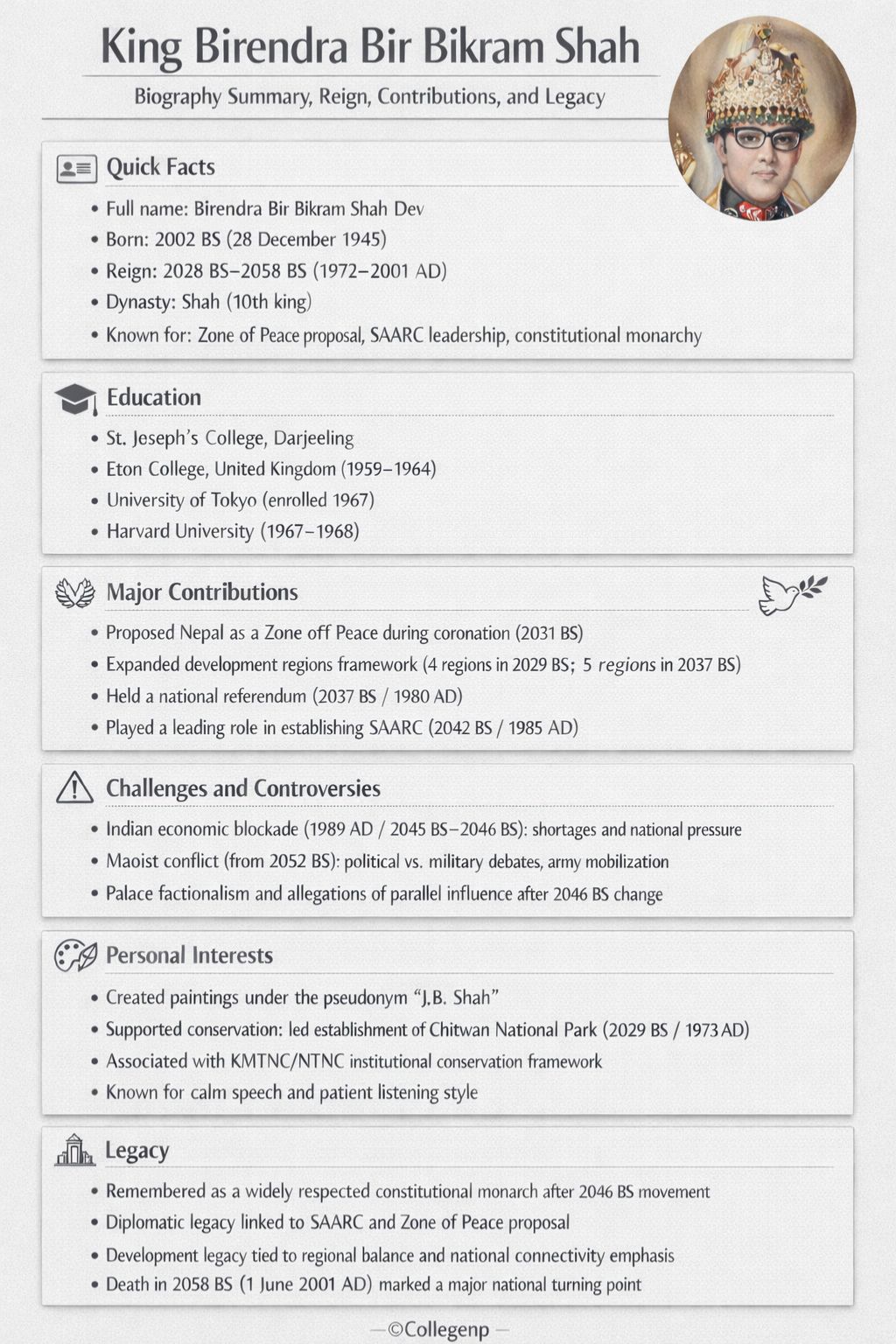
King Birendra Bir Bikram Shah is widely remembered in Nepal’s history as a liberal, peace-oriented, and development-focused ruler. He was the tenth monarch of the Shah dynasty and governed Nepal for nearly three decades, from 2028 BS to 2058 BS (1972 AD to 2001 AD).
During his reign, Nepal experienced a political transition from an absolute monarchy to a constitutional monarchy, with King Birendra leading this period of change.
Internationally, he is credited for proposing Nepal as a Zone of Peace and for playing a leading role in the establishment of South Asian Association for Regional Cooperation (SAARC).
Personal Identity
Full Name: Birendra Bir Bikram Shah Dev
Birth: 2002 BS Poush 14 (28 December 1945)
Reign: 2028 BS Magh 17 to 2058 BS Jestha 19 (1972 AD to 2001 AD)
Dynasty: Shah Dynasty (tenth king)
Father and Mother: King Mahendra and Indra Rajyalakshmi Devi
Known For: Proponent of the Zone of Peace, founding leader of SAARC, Nepal’s first constitutional king, and a “people’s king.”
Brief Profile: Birendra was a monarch shaped by modern education and liberal ideas. He initiated balanced regional development through the “development region” concept, accepted the political change of 2046 BS by embracing constitutional monarchy, and led a major diplomatic initiative to promote Nepal as a Zone of Peace.
Early Life and Family Background
King Birendra was born on 2002 BS Poush 14 (28 December 1945) in the Narayanhiti Royal Palace in Kathmandu. He was the eldest son of King Mahendra and Crown Princess Indra Rajyalakshmi Devi Shah.
His childhood unfolded during a transitional era marked by the final phase of the Rana system and the rise of democracy. Since his mother died in 2007 BS, he was raised under the care of his stepmother (Senior Queen) Ratna Rajyalakshmi Devi Shah. Inside the palace, he was brought up with traditional values, discipline, and royal etiquette.
Education and Personality Formation
King Birendra is often regarded as one of the most formally educated monarchs in Nepal’s royal history. His education blended Eastern cultural grounding with Western modern learning.
Early and School Education
-
St. Joseph’s College, Darjeeling (India): He completed his early education here and experienced disciplined residential school life.
Higher Education
-
Eton College (United Kingdom): He completed secondary and higher secondary education at Eton (1959 AD to 1964 AD), learning the Western education system, discipline, and leadership skills.
-
University of Tokyo (Japan): In 1967 AD, he enrolled to study Japan’s modernization, technology, and development model.
-
Harvard University (United States): In 1967 AD to 1968 AD, he studied political science and international relations, and had opportunities to interact with notable professors such as Henry Kissinger.
This world-class education broadened his understanding of development, diplomacy, and democratic governance.
Married Life and Family

In 2026 BS Falgun (1970 AD), then-Crown Prince Birendra married Aishwarya Rajyalakshmi Devi Shah from the Rana family. This wedding was widely considered a grand national ceremony at the time.
They had three children:
-
Crown Prince Dipendra Bir Bikram Shah (Born: 2028 BS)
-
Princess Shruti Rajyalakshmi Devi Shah (Born: 2033 BS)
-
Prince Nirajan Bir Bikram Shah (Born: 2035 BS)
Accession and Governance
Accession to the Throne
After King Mahendra died at Diyalo Bungalow in Chitwan, King Birendra became king at the age of 26 on 2028 BS Magh 17 (31 January 1972 AD).
Coronation
His formal coronation took place on 2031 BS Falgun 12 (24 February 1975 AD). Representatives and heads of state from more than 60 countries attended, reflecting the event’s significance for Nepal’s international diplomacy.
Key Phases of Governance
-
Direct rule (2028 BS to 2046 BS): He continued the partyless Panchayat system introduced by King Mahendra, while adopting a policy of “time-appropriate reforms.”
-
Constitutional monarchy (2047 BS to 2058 BS): Following the 2046 BS People’s Movement, he restored multiparty democracy and placed the monarchy within constitutional limits.
Major Contributions and Achievements
King Birendra’s reign included decisions and initiatives with long-term political, diplomatic, and development impacts.
(A) Zone of Peace Proposal
Proposal: During the coronation ceremony in 2031 BS, he presented the historic proposal that Nepal be declared a “Zone of Peace.”
Purpose: To protect Nepal’s geopolitical sensitivity by keeping the country free from external intervention and military conflict.
Outcome: The proposal received support from more than 116 countries, including members of the United Nations, although neighboring India did not support it.
(B) Development and Administration (Development Region Concept)
Guided by the belief that the benefits of development must reach all parts of the country, King Birendra divided Nepal into four Development Regions in 2029 BS. Later, in 2037 BS, he added Far Western Region and maintained five Development Regions.
Purpose: To ensure regional balance and decentralize development beyond Kathmandu’s concentration.
He also regularly traveled across the country (desh darshan) to hear public concerns directly.
(C) National Referendum (1980 AD)
After the student movement of 2036 BS, King Birendra organized a national referendum on 2037 BS Jestha 20. The public was given the choice between a “reformed Panchayat” system and a multiparty system. Although the result favored Panchayat, the referendum was presented as a rare example of democratic practice and reflected his liberal posture.
(D) Establishment of SAARC
King Birendra played a leading role in establishing SAARC by working with Ziaur Rahman of Bangladesh to promote regional peace and cooperation. SAARC was established in 2042 BS (1985 AD), and he succeeded in locating its secretariat in Kathmandu.
(E) The 2047 BS Constitution and Democracy
During the 2046 BS People’s Movement, he stated that the people’s mandate should be returned to the people. He then promulgated the Constitution of the Kingdom of Nepal 2047 BS (1990 AD). Many view his voluntary acceptance of a constitutional role, after exercising strong royal authority earlier, as a high standard of political culture.
Major Challenges, Controversies, and Crises
Although his three-decade reign appeared stable externally, it unfolded amid internal power struggles and external geopolitical pressure. He faced three broad challenges: the legacy of centralized monarchy, compromise with democracy, and the emergence of an armed insurgent movement.
(A) The 2045 BS to 2046 BS Indian Blockade and National Dignity
In 1989 AD (2045 BS Chaitra), India imposed an economic blockade on Nepal, widely described as the greatest test of King Birendra’s leadership and diplomacy.
Background: While technical reasons were cited such as non-renewal of treaties from the 1960s and 1970s, a key issue was Nepal’s “China card.” After Nepal decided to purchase anti-aircraft guns and other weapons from China to strengthen national security, India became dissatisfied.
King Birendra’s position: When India insisted that “trade and transit” be combined in a single treaty, he maintained that transit was a separate right for a landlocked country under internationally recognized principles.
Result: The blockade caused severe shortages of fuel, salt, and essential medicines. Daily life became difficult and deforestation increased. Despite this, the king did not compromise on national dignity. His implied stance, often summarized as a willingness to endure hardship without submission, strengthened his nationalist image. The economic crisis also contributed to the environment that led to the 2046 BS People’s Movement against the Panchayat system.
(B) Maoist Armed Conflict and Disputes Over Army Mobilization
The “People’s War” launched by the Communist Party of Nepal (Maoist) from 2052 BS created a complex test for his constitutional role.
Constitutional complexity: Under Article 118 of the 2047 BS Constitution, army deployment required the recommendation of the National Security Council and the king’s approval. Since the insurgents were Nepali citizens, he faced a moral and political dilemma regarding the use of the army.
King’s approach: He favored resolving the problem through political and development measures rather than a purely military solution, and reportedly encouraged informal internal dialogue to bring the Maoists into the mainstream.
Conflict with the government (Holeri incident): In 2058 BS, after Maoists held police personnel hostage in Holeri of Rolpa, Prime Minister Girija Prasad Koirala sought army mobilization. However, the palace and the army maintained that the army would not leave barracks without a clear mandate and long-term plan, contributing to a situation in which the prime minister resigned.
Criticism: Some analysts criticized the king’s stance as undermining the constitutional government and indirectly boosting insurgent morale. Others interpreted it as an attempt to prevent a deeper civil conflict.
(C) Underground Networks and Palace Factionalism
Historical documents suggest that although King Birendra was liberal by nature, he operated under pressure from palace hardliners and underground networks.
Accusations of dual governance: Even after the 2046 BS change, some powerful palace secretaries and relatives were accused of trying to run a parallel power structure to the elected government.
Role of Queen Aishwarya: Queen Aishwarya was considered more strict and assertive than the king. Political circles often claimed that her indirect influence and interventions sometimes overshadowed his liberal image. Despite being widely respected by the public, historians argue that he was not fully successful in breaking entrenched feudal culture within palace walls.
Interests, Personal Nature, and Creative Side
King Birendra’s personality extended beyond governance. He was described as sensitive, artistic, and deeply interested in nature.
(A) Art and “J.B. Shah”
He was a serious admirer of art and created paintings under the pseudonym “J.B. Shah,” described as referring to “Jagdish Bir Shah” (estimated). His paintings were often impressionistic and abstract rather than strictly realistic, using color combinations to express human emotion and nature’s mystery.
He was not only a patron of the Nepal Art Council, but also invited senior artists to the palace for long discussions on art, which was also seen as a way to manage stress.
(B) Environmental Protection and Helicopter Flying
National park concept: The protected areas model Nepal values today is described as rooted in King Birendra’s thinking. In 2029 BS (1973 AD), he led the establishment of Chitwan National Park, Nepal’s first national park.
KMTNC: Believing that government mechanisms alone were insufficient for long-term conservation, he established the King Mahendra Trust for Nature Conservation, now known as the National Trust for Nature Conservation.
Aviation experience: He was skilled in flying helicopters and often flew a Puma helicopter himself when traveling to remote areas for development inspection, helping him understand Nepal’s geography directly.
(C) Public Engagement Style
His strongest personal trait was described as politeness. He avoided aggressive rhetoric, spoke calmly and clearly, and listened patiently to opponents. His decision to hold a referendum in 2037 BS for the future of the Panchayat system he had continued is presented as evidence of this flexible and democratic temperament.
Narayanhiti Royal Palace Incident and a Tragic End
On the night of 2058 BS Jestha 19 (1 June 2001 AD), an unprecedented tragedy occurred in Nepal, leaving deep national shock.
Timeline of the Tragedy
A regular family gathering was being held at Tribhuvan Sadan inside Narayanhiti Palace, traditionally organized on the third Friday of each month.
Before dinner, accounts suggest that Crown Prince Dipendra was involved in a dispute with Queen Aishwarya and his grandmother regarding a personal relationship and marriage matter, including his relationship with Devyani Rana.
Later that evening, violence took place inside the gathering area. Reports commonly mention that firearms such as MP5 and M16 rifles were involved.
Losses
Those who died included King Birendra, Queen Aishwarya, Crown Prince Dipendra (who died later), Prince Nirajan, Princess Shruti, Prince Dhirendra, and four other royal relatives, totaling ten deaths.
Investigation and Controversy
A two-member high-level investigation committee was formed under Chief Justice Keshav Prasad Upadhyay and Speaker Taranath Ranabhat. Opposition leader Madhav Kumar Nepal was also proposed as a committee member, but he declined to participate.
The committee produced a report of about 2,000 pages and concluded that Crown Prince Dipendra was responsible for the incident, and that he died later that night.
Public distrust remained strong. Many people found it difficult to accept the official conclusion, and questions about how such an incident could occur within strict palace security remain unresolved for many. Conspiracy theories continue to allege possible involvement of foreign forces or internal political actors.
National Mourning and Funeral
King Birendra’s cremation at Aryaghat drew large public mourning in Kathmandu. Many people wept in the streets, and many youths shaved their heads in accordance with Hindu mourning traditions. The grief was described not only as respect for the king, but also as the pain of losing a national guardian figure.
Long-Term Legacy and Historical Significance
King Birendra’s death was not seen as the death of only one individual, but as the end of an era of stability and the beginning of uncertainty.
The People’s King
Kings are often viewed primarily as rulers, but Birendra was widely regarded by many as a guardian figure. During the 2046 BS movement, even with the option to preserve power through force, he chose to accept multiparty democracy. This decision is presented as protecting him from being remembered as authoritarian and securing respect as a constitutional monarch.
Diplomatic Balance
His most recognized diplomatic legacy includes SAARC and the Zone of Peace proposal. He sought to present Nepal as non-aligned and neutral, above the direct influence spheres of both India and China. By bringing SAARC headquarters to Kathmandu, he demonstrated the idea that even a small country can show leadership in regional politics.
Development Framework
The roots of Nepal’s later federal practice are described as traceable to the earlier five-development-region framework. Making Dipayal, Surkhet, Pokhara, and Dhankuta regional headquarters and accelerating the East-West Highway are described as elements of his physical development legacy, intended to extend Kathmandu-centered development toward rural areas.
The Decline of Monarchy
Ironically, King Birendra’s death is presented as a key turning point leading toward the end of monarchy in Nepal. While he lived, many people maintained trust in the institution. After his lineage ended, growing distance between King Gyanendra Shah and political parties contributed to the 2062 BS to 2063 BS movement and the path toward republic status on 2065 BS Jestha 15. Many historians argue that even if the monarchy ended formally in 2065 BS, it ended emotionally on the day of the 2058 BS palace incident.
Structures and Institutions Named After King Birendra
In King Birendra’s memory, many structures, institutions, and commemorative works have been created:
-
Birendra statue (Nepalgunj)
-
Birendra statue (Dang)
-
Birendra statue, Birendranagar (Surkhet)
-
Birendra statue, Swargadwari (Shivapuri)
-
Birendra statue, Jawalakhel (Lalitpur)
-
Birendra statue, Bindhyabasini Temple (Pokhara)
-
Shri Birendra Secondary School, Jhapa
-
Shri Birendra Public School, Morang
-
Birendra Secondary School, Baitadi
-
Birendra Secondary School, Syangja
-
Birendra Secondary School, Nuwakot
-
Birendra Secondary School, Parbat
-
Birendra Sainik Awasiya Mahavidyalaya, Bhaktapur
-
Birendra Memorial College, Dharan
-
Shri Birendra Hospital
-
Birendra Memorial Cup
-
Birendra Multiple Campus, Chitwan
-
Birendra Peacekeeping Training Centre
-
Birendranagar
-
Birendranagar, Chitwan
-
Birendranagar Jaycees
-
Birendranagar Airport
-
Birendra Chowk (Birendranagar)
-
Birendra Chowk, Kageshwori Manohara Municipality
-
Birendra Chowk, Phungling
-
Birendra Chowk, Dharan
-
Birendra Chowk, Tulsipur (Dang)
-
Birendra Tal, Gorkha
-
Birendra Museum, Kathmandu Durbar area
-
Birendra Beer, Zurich
Frequently Asked Questions
Why is King Birendra called a peace-loving king?
He proposed Nepal as a Zone of Peace and often sought peaceful solutions in internal and external disputes.
What were King Birendra’s major contributions?
Establishment of SAARC, division of Nepal into five development regions, the national referendum (2037 BS), and acceptance of constitutional monarchy through the 2047 BS constitution are presented as key contributions.
Who is J.B. Shah?
It is described as the pseudonym King Birendra used while creating paintings.
When did King Birendra die?
He died on 2058 BS Jestha 19 (1 June 2001 AD) in the Narayanhiti Palace incident.
Sources and Verification
This biography is based on the following sources considered reliable in the original text:
Government documents: Nepal Gazette and statements from the then Palace Secretariat.
Books and academic materials:
-
“King Birendra and Nepal’s Foreign Policy” (various academic journals)
-
A History of Nepal by John Whelpton, Cambridge University Press
-
Official reports related to the Royal Massacre in Nepal
Institutions: SAARC Secretariat archives and UN records.
Note: The details related to the palace incident are stated as based on the official investigation committee report, while acknowledging that differing public views exist on the subject.





Comments 0
No comments yet. Be the first to start the conversation.