Nagarik College of Health Sciences offers health-science education through bachelor-level nursing programs and the Proficiency Certificate Level in General Medicine. Its nursing programs are connected with Purbanchal University, while General Medicine follows the CTEVT academic system.
The college has three confirmed academic programs: Bachelor of Science in Nursing, Post-Basic Bachelor of Nursing Science, and PCL in General Medicine. These programs follow different academic and admission routes. BSc Nursing is a four-year undergraduate nursing program, PBNS is a three-year post-basic nursing program, and General Medicine is a three-year CTEVT program conducted under the yearly system.
Nursing admission follows the Medical Education Commission framework, while admission to General Medicine follows CTEVT requirements.
| Area | Details |
|---|---|
| Institution | Nagarik College of Health Sciences |
| Academic Focus | Nursing and General Medicine |
| University Affiliation | Purbanchal University for BSc Nursing and PBNS |
| CTEVT Program | PCL in General Medicine (Health Assistant) |
| BSc Nursing Duration | 4 years |
| PBNS Duration | 3 years |
| PCL in General Medicine Duration | 3 years |
| Nursing Admission | Based on MECEE-BL under the prevailing Medical Education Commission framework |
| Nursing Seats | Determined by MEC for the applicable admission cycle and may vary by year |
| General Medicine Admission | CTEVT entry requirements and entrance examination |
| Nursing Professional Council | Nepal Nursing Council |
| Health Assistant Professional Council | Nepal Health Professional Council |
| Practical Learning | Nursing practical components, clinical practicum, and community field practicum are included according to the respective curricula |
The academic focus of Nagarik College of Health Sciences is concentrated on nursing and general medicine. Its bachelor-level nursing programs operate within the Purbanchal University academic framework, while the General Medicine program follows the curriculum and academic system of CTEVT.
| Program | Academic Body | Duration |
|---|---|---|
| Bachelor of Science in Nursing | Purbanchal University | 4 years |
| Post-Basic Bachelor of Nursing Science | Purbanchal University | 3 years |
| PCL in General Medicine (HA) | CTEVT | 3 years |
The Bachelor of Science in Nursing is a four-year program under Purbanchal University and its Faculty of Medical and Allied Sciences.
The first year develops the scientific and nursing foundation through Anatomy and Physiology, Biochemistry, Microbiology/Parasitology, Pathophysiology, Pharmacology, Nutrition and Dietetics, Foundation of Nursing, and Community Health Nursing-I.
Second-year study moves into Nursing Concept and Theories, Medical-Surgical Nursing-I and II, Psychiatric Nursing, Community Health Nursing-II, Medical Sociology/Anthropology, and Geriatric Nursing.
The third year covers Pediatric Nursing, Midwifery-I, Midwifery-II, Midwifery-III, Community Health Nursing-III, Basic Epidemiology, and Gynaecology Nursing.
In the fourth year, students study Research and Biostatistics in Nursing, Educational Science, Leadership and Management, and Medical-Surgical Nursing-III (Advance). Theory and practical components are integrated across many clinical and nursing subjects.
The Post-Basic Bachelor of Nursing Science is a three-year Purbanchal University program.
The first year includes Anatomy and Physiology, Pharmacology, Pathophysiology, Microbiology/Parasitology, Biochemistry, Nutrition and Dietetics, Basic Science/Nutrition practical work, Medical-Surgical Nursing-I, Nursing Concept and Theories, Pediatric Nursing, Medical Sociology/Anthropology, and Professional English.
Second-year study includes Midwifery-I, Community Health Nursing-I, Psychiatric Nursing-I, Educational Science, Epidemiology, Geriatric Nursing, and Applied Computer Technology.
The third year includes Leadership and Management, Research and Biostatistics in Nursing, Oncology Nursing, and an elective subject. The available elective areas are Community Health Nursing-II, Midwifery-II, Medical-Surgical Nursing-II, and Psychiatric Nursing-II.
The curriculum includes both theoretical study and practical nursing components across the three years.
The PCL in General Medicine is a three-year CTEVT program conducted under the yearly system.
The curriculum covers clinical medicine, surgery, community health, diagnostic work, public health, and health-service management. Major areas include Medicine, Gynecology, General Surgery, Orthopedics and Physiotherapy, First Aid, Clinical Pathology, Clinical Pharmacology and Pharmacy, Environmental Health, Health Education, Primary Health Care and Family Health, Pediatrics, Neonatology, Psychiatry, Dermatology, ENT, Dentistry, Ophthalmology, Health Management, Epidemiology, and Community Diagnosis.
The program also includes comprehensive clinical practicum and comprehensive community field practicum.
Its academic objectives cover patient assessment, provisional diagnosis, referral, medication and treatment support, routine and special investigations, minor medical and surgical procedures, common emergency management, maternal and child health services, family planning, record keeping, health-program administration, and supervision within the intended level of practice.
Admission to the nursing programs is based on MECEE-BL and follows the prevailing rules, guidelines, code of conduct, scholarship provisions, seat allocation system, fee structure, and admission procedures set by the Medical Education Commission.
Seats for nursing programs are determined by MEC for the applicable admission cycle and may vary from one year to another. Fees, scholarship provisions, examination guidelines, seat allocation, matching procedures, and admission schedules are also subject to MEC decisions and the official MEC calendar.
Applicants to the PCL in General Medicine program follow CTEVT admission requirements. The stated entry qualifications include:
SLC, SEE, or equivalent with a minimum GPA of 2.0 and grades in compulsory Mathematics, English, and Science; or
CMA equivalent with a minimum of 68.33 percent; and
Passing the entrance examination administered by CTEVT.
The General Medicine curriculum has a maximum group size of 40 students and requires a minimum of 90 percent attendance in each subject for eligibility to appear in the respective final examination.
Completing an academic program and entering professional practice are separate stages in health education.
Graduates of the nursing programs must pass the licensing examination of the Nepal Nursing Council before entering the nursing profession under the applicable professional requirements.
For the Health Assistant pathway, the relevant professional council is the Nepal Health Professional Council. Students completing the program must meet the respective professional licensing requirements before entering professional practice.
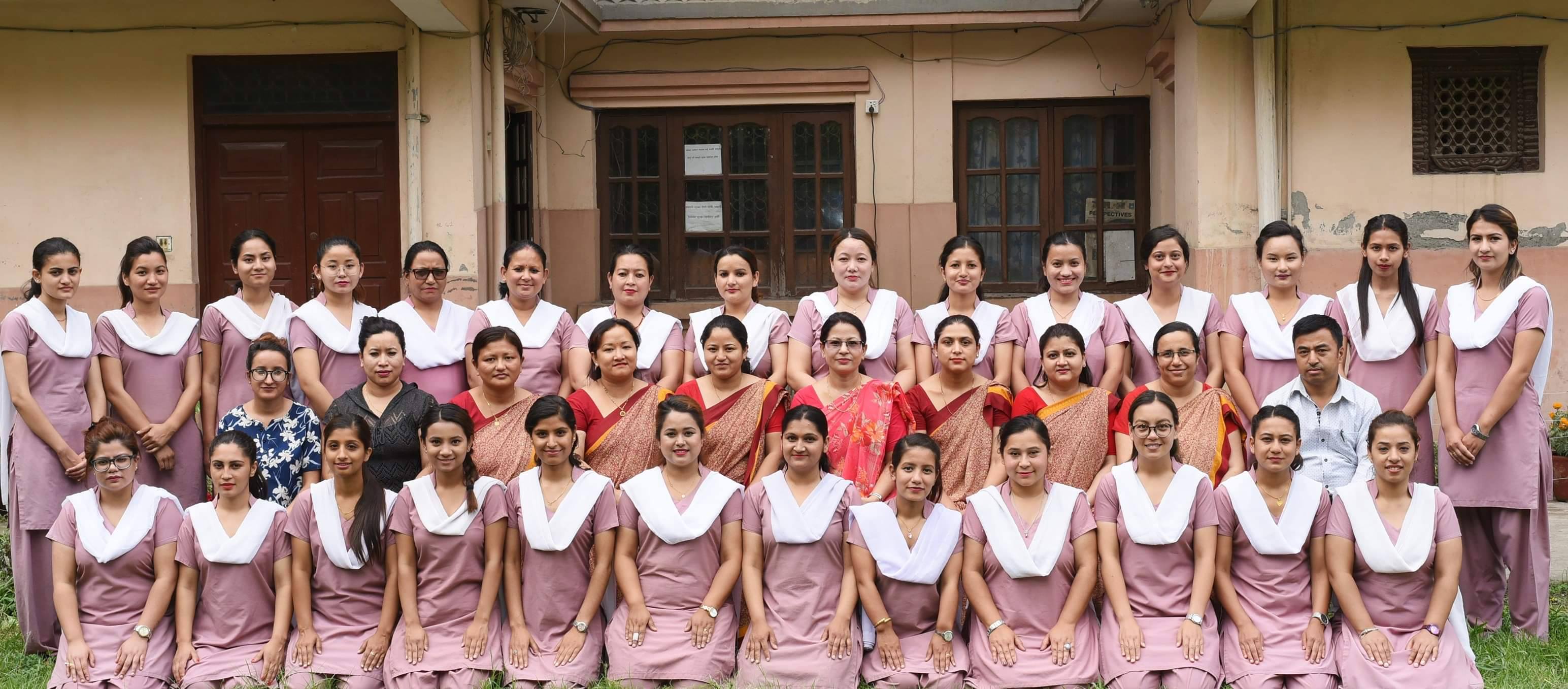
The three programs differ in both entry route and academic purpose.
BSc Nursing follows a four-year undergraduate nursing structure with scientific foundations, nursing theory, clinical subjects, community health, midwifery, research, leadership, and advanced medical-surgical nursing.
PBNS follows a three-year post-basic nursing structure. Its curriculum combines nursing science, medical-surgical nursing, pediatric nursing, community health, psychiatric nursing, midwifery, epidemiology, research, leadership, oncology nursing, and an elective nursing area.
PCL in General Medicine follows a three-year technical health curriculum with clinical medicine, surgery, diagnostics, primary health care, public health, emergency management, community practice, and field-based learning.
These differences make the applicant's previous qualification and intended academic pathway important when selecting a program.
The confirmed programs are Bachelor of Science in Nursing, Post-Basic Bachelor of Nursing Science, and PCL in General Medicine.
Bachelor of Science in Nursing and Post-Basic Bachelor of Nursing Science are under Purbanchal University.
The Bachelor of Science in Nursing program has a duration of four years.
The Post-Basic Bachelor of Nursing Science program runs for three years.
The PCL in General Medicine program runs for three academic years under the CTEVT yearly system.
Yes. Admission to the nursing programs is based on MECEE-BL and follows the prevailing Medical Education Commission admission framework.
Yes. Nursing seats are determined by MEC for the applicable admission cycle and may vary from one year to another.
Applicants must meet the stated CTEVT entry qualification and pass the entrance examination administered by CTEVT.
Yes. Nursing graduates must meet Nepal Nursing Council licensing requirements, while graduates of the Health Assistant pathway must meet the applicable Nepal Health Professional Council licensing requirements before entering professional practice.