



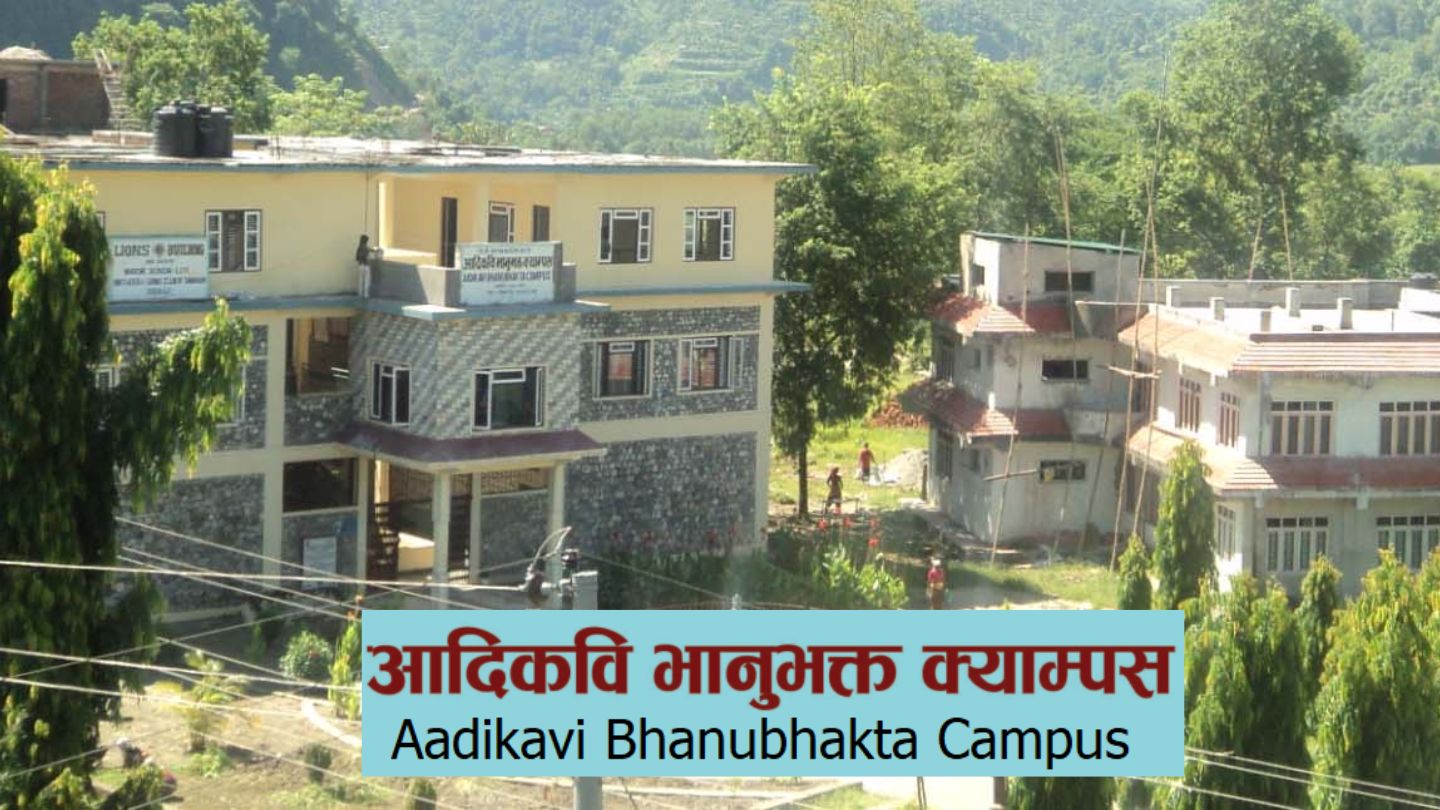
The MA in Sociology at Aadikavi Bhanubhakta Campus is a two-year postgraduate program affiliated with Tribhuvan University. It is offered within the humanities and social sciences environment of a publicly owned, community-based campus in Vyas Municipality-1, Bigyanchaur, Bhadgaun, Damauli, Tanahun. The campus offers study from +2 to master’s level and serves students from Tanahun and nearby districts.
For sociology students, the course is linked to a wider academic setting that includes library services, computer access, free internet on campus, extra classes, and faculty-student involvement in research. The humanities and social sciences stream is one of the older academic areas of the campus, which gives the program an established institutional setting.
Course: MA in Sociology
College: Aadikavi Bhanubhakta Campus
Affiliation: Tribhuvan University
Duration: 2 years
Academic System: 4 semesters
Study Level: Master’s
Location: Vyas Municipality-1, Bigyanchaur, Bhadgaun, Damauli, Tanahun, Gandaki, Nepal
Academic Area: Humanities and Social Sciences
Program Completion Component: Thesis in the final semester
Learning Support: Library facility, computer center, free internet access, extra classes, and research participation
The MA in Sociology follows a semester structure under Tribhuvan University. The course sequence combines sociological theory, research methods, statistics, development studies, gender studies, and thesis work.
Semester I: Introduction to Sociology, Qualitative Research Methods in Sociology, Structural-functional Approach, Caste and Class, Theories of Social Change and Development
Semester II: Marxist Perspective, Quantitative Research Methods in Sociology, Practice of Social Change and Development in Asia, Politics and Society: Interface between Nation, State and the Globe, Household and Family in Transition
Semester III: World-System Perspective, Basic Statistics in Sociological Research, Sociology of Gender, Migration, Social Network, Remittance and Development, Power Leadership, Governmentality and Development
Semester IV: Agency/Micro versus Structure/Macro Perspectives, Survey Research and Computer Data Analysis (Practical), Thesis, and optional areas including Gender, Power and Sexuality, Changing Livelihoods, Market and Society, Sociology of Education, Sociology of Tourism, and Research Design and Writing
Build advanced understanding of sociological theory and social analysis
Develop qualitative and quantitative research skills
Strengthen critical thinking through the study of society, culture, and development
Support independent academic work through practical research and thesis preparation
Prepare students for further academic, research, and public-facing roles linked to social issues
The MA in Sociology at Aadikavi Bhanubhakta Campus covers major areas of social inquiry, including caste and class, family change, migration, gender, development, politics, education, tourism, and market relations. This gives the program a broad academic base while keeping it connected to issues that shape society and public life.
Its scope is also shaped by the campus setting. Students study within a community-based institution in Damauli that serves Tanahun and surrounding districts. The program sits in a campus environment where humanities, education, management, and related fields are already active, giving sociology students access to a wider academic context.
Understand major sociological perspectives and social theories
Use qualitative and quantitative methods in academic work
Analyze social change, inequality, family transition, migration, gender, and development
Apply statistics and data analysis in sociological research
Complete thesis-based postgraduate study
Sociological analysis
Academic reading and writing
Qualitative research methods
Quantitative research methods
Statistical interpretation
Thesis writing
Social issue analysis
Research design and reporting
The available academic context links the MA environment with research-oriented study, discussion-based learning, and access to campus facilities that support postgraduate work. For sociology students, this fits a program built around theory, methods, data analysis, and thesis writing.
Research participation is part of the wider campus academic environment
Faculty members and students are involved in research
Extra classes are available
Students can use the library, computer center, and free internet on campus premises
Survey Research and Computer Data Analysis (Practical) is included in the final semester
Thesis is part of the academic structure
Lecturer or academic work
Research roles
NGO and INGO work
Social development projects
Policy analysis and advisory roles
Public administration
Social research and field-based study work
Writing and journalism related to social issues
The campus provides more than 400 scholarship quotas
Scholarships are available through tuition fee waivers and financial aid
Special consideration is available for talented students, students with weak financial backgrounds, disabled students, and members of deprived communities
Students scoring 80 percent and above receive a 100 percent tuition fee discount
Students scoring 70 to 80 percent receive a 50 percent tuition fee discount
Students scoring 60 to 70 percent receive a 25 percent tuition fee discount
First position holders receive a 50 percent tuition fee discount
Second position holders receive a 25 percent tuition fee discount
Disabled students receive a 50 percent tuition fee discount
Admission notice is published by the concerned campus, department, institute, or Dean’s Office
Eligible applicants submit the prescribed application form
Admission may include an entrance examination depending on program procedure
A merit list or selection result may be published by the concerned authority
Selected students submit the required documents and pay the prescribed admission fee
Final enrollment is completed according to TU rules and the campus schedule
Bachelor’s degree transcript or marksheet
Bachelor’s degree certificate or provisional certificate
Character certificate from the bachelor-level institution
Migration certificate, if the bachelor’s degree is from another university
Transfer certificate from the previous campus or college
Citizenship certificate or birth certificate copy
Passport-size photographs
Entrance examination scorecard, if required
Completed admission or application form
Admission fee payment receipt
Equivalence certificate, if applicable
The MA in Sociology follows the TU semester structure. Course curriculum, examinations, and results follow TU rules, guidelines, and the applicable academic calendar.
Semester-end examinations are conducted by the relevant Dean’s Office. Result publication follows the corresponding TU process for semester-based programs.
MA in Sociology at Aadikavi Bhanubhakta Campus is a TU-affiliated postgraduate program built around sociological theory, research methods, statistics, and thesis work. Its academic setting is shaped by the humanities and social sciences environment of the campus, together with research participation, library access, computer support, and internet access on campus.
For students seeking postgraduate sociology study in Tanahun, it offers a structured two-year route within an established community-based campus in Damauli.
The program runs for 2 years across 4 semesters.
The program is affiliated with Tribhuvan University.
Yes. Thesis is part of the final semester structure.
The course includes Qualitative Research Methods in Sociology, Quantitative Research Methods in Sociology, Basic Statistics in Sociological Research, Survey Research and Computer Data Analysis (Practical), and Thesis.
The curriculum includes caste and class, social change and development, politics and society, household and family transition, gender, migration, market and society, sociology of education, and sociology of tourism.
Students can use the library, computer center, free internet on campus premises, extra classes, and the wider research environment of the campus.






