Aadikavi Bhanubhakta Campus is a publicly owned community campus in Damauli, Tanahun. Established in 1987 AD (2044 BS), it was founded to extend access to higher education in the district and nearby areas. The campus is named after Aadikavi Bhanubhakta Acharya and has grown from a local initiative into a multi-level institution offering programs from +2 under the National Examinations Board (NEB) to master’s level programs affiliated with Tribhuvan University.
Its institutional development is closely tied to community participation, public support, and academic expansion across Humanities, Management, Education, and related departments. The campus also holds Quality Assurance and Accreditation recognition from the University Grants Commission (UGC), first received in 2013 and renewed in 2023.
Established in 1987 AD (2044 BS)
Located in Vyas Municipality-1, Damauli, Tanahun, Gandaki Province, Nepal
Publicly owned, community-based campus
Offers education from +2 to master’s level
+2 programs run under the National Examinations Board (NEB)
Bachelor’s and master’s programs are affiliated with Tribhuvan University
QAA accredited by the University Grants Commission (UGC) in 2013 and reaccredited in 2023
Enrolls more than 1,700 students each year
Serves students from Tanahun and nearby districts including Syangja, Kaski, Gorkha, and Lamjung
Provides more than 400 scholarship quotas and tuition support schemes
Reports facilities such as science and computer laboratories, library services, multimedia resources, computer center, and free internet access
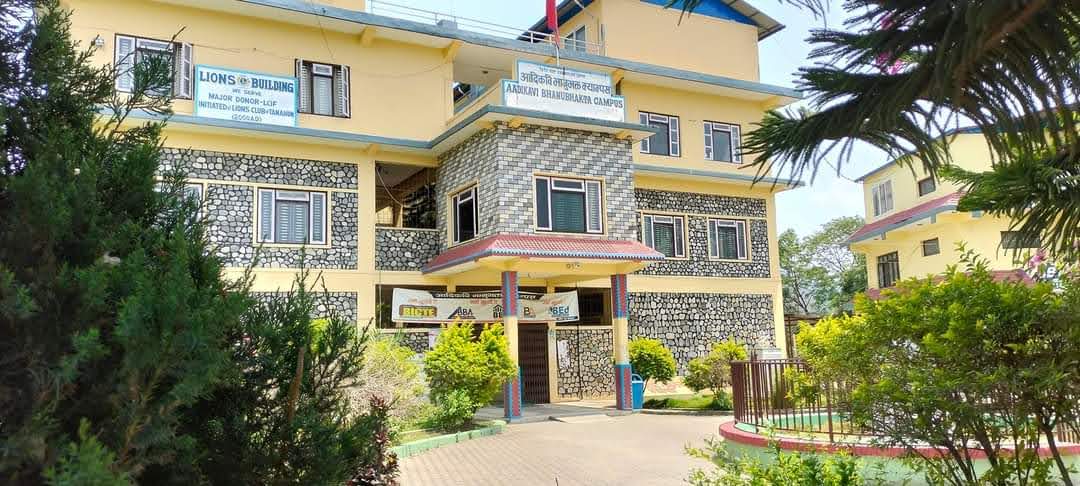
Aadikavi Bhanubhakta Campus was established in Damauli as a community effort to bring higher education within reach of local students. The campus emerged through the initiative of local intellectuals, social leaders, education supporters, and community contributors who identified the need for accessible post-secondary education in Tanahun. Its early growth was linked to land donation, public support, and collaboration from local bodies and donors.
The institution identifies itself as the oldest campus in the area and the largest higher education institution in Tanahun district. Its development has been shaped by a community-based model of governance through a Campus Management Committee and broad public participation. This structure reflects the campus motto, “Community Participation in Quality Education for Prosperity,” and continues to influence the campus’s academic and administrative direction.
Over the years, the campus expanded from limited early offerings to a broader academic range. It now delivers +2 education under the National Examinations Board (NEB) and higher education programs affiliated with Tribhuvan University. Students come not only from Tanahun but also from surrounding districts and from other parts of Nepal.
The campus reports a mission centered on expanding community access to higher education and a vision of improving social quality through educational opportunity. Its stated goals include widening access for talented and underprivileged students, strengthening research activity, improving the use of technology in teaching and administration, and broadening educational opportunities for women, Dalit, Indigenous, and other underrepresented communities.
Aadikavi Bhanubhakta Campus offers programs from +2 to master’s level. The available academic range in the source material includes the following levels and streams.
These programs operate within the NEB framework for Class 11 and Class 12.
Bachelor of Education (B.Ed.), including subject areas such as Mathematics, Science, Nepali, and English
Bachelor of Information and Communication Technology in Education (BICTE)
The source also identifies departments or academic areas including Management, Education, Humanities and Social Science, English, Nepali, Science, BBA, and BICTE.
M.A.
The Education department material also refers to bachelor- and master-level study in English and Nepali education, Mathematics in Education, Education Science, BICTE in Education, and EPM at master’s level.
The +2 level follows the NEB annual system. Bachelor’s and master’s programs follow the regulations of Tribhuvan University, with structure and examination arrangements determined by the relevant faculty and program. The BICTE material identifies BICTE as a four-year, eight-semester program under TU.
Admission to +2 programs generally begins after the publication of SEE results.
Students applying for Class 11 submit the required application form, academic records, photographs, and related documents through the campus under the NEB framework.
Depending on the stream and institutional practice, +2 admission may include an entrance examination, interview, or merit-based selection.
After selection and fee payment, the student is enrolled in Class 11 and subject registration is completed under the NEB system.
Admission to bachelor-level TU programs generally follows the rules of the concerned faculty, Dean’s Office, and campus.
Eligible applicants for TU bachelor’s programs submit the prescribed form with the required academic documents after the publication of the admission notice.
Depending on the program, TU bachelor admission may include an entrance examination, merit-based selection, or both.
Selected students complete admission by submitting documents and paying the prescribed fees.
Admission to TU master’s programs is announced by the concerned campus, department, institute, or Dean’s Office.
Eligible applicants for master’s programs submit the prescribed application form and required records.
TU master’s admission may include an entrance examination depending on the program.
Final enrollment is completed after selection, document submission, and fee payment according to TU rules and campus schedules.
The BICTE material specifically states that applicants must take a TU entrance examination as part of the admission process.
For NEB Class 11: SEE marksheet, SEE character certificate or school leaving certificate, transfer certificate, migration certificate if applicable, citizenship certificate or birth certificate copy, passport-size photographs, and the NEB Class 11 registration or subject registration form
For TU bachelor’s admission: Class 12 or +2 transcript, character certificate, migration certificate if the previous board or university is different, transfer certificate, citizenship certificate or birth certificate copy, passport-size photographs, entrance scorecard if required, completed admission form, admission fee receipt, and equivalence certificate if the prior qualification is from a foreign board or university
For TU master’s admission: bachelor’s transcript or marksheet, bachelor’s degree certificate or provisional certificate, character certificate, migration certificate if the degree is from another university, transfer certificate, citizenship certificate or birth certificate copy, passport-size photographs, entrance scorecard if required, completed admission form, admission fee receipt, and equivalence certificate if applicable
The campus reports a qualified teaching and non-teaching workforce and a departmental structure that supports instruction across multiple levels. Academic delivery includes regular classes from +2 through master’s programs, with separate classes for English-medium students and classes scheduled in different shifts.
The source material points to a teaching approach that combines classroom instruction with problem-based learning, practical subjects, field exposure, and research participation. Faculty members and students are described as being involved in research, and the campus highlights participative and experiential learning practices. The Education department material also refers to learner-centered pedagogy, ICT-based education, and the use of seminars, workshops, and trainings in support of academic development.
The BICTE section gives additional evidence of this academic approach. It presents a program structure that combines educational foundations with information technology, programming, database systems, web technology, digital pedagogy, research work, electives, and teaching practicum. This indicates that the campus supports both subject learning and applied instructional work in selected programs.
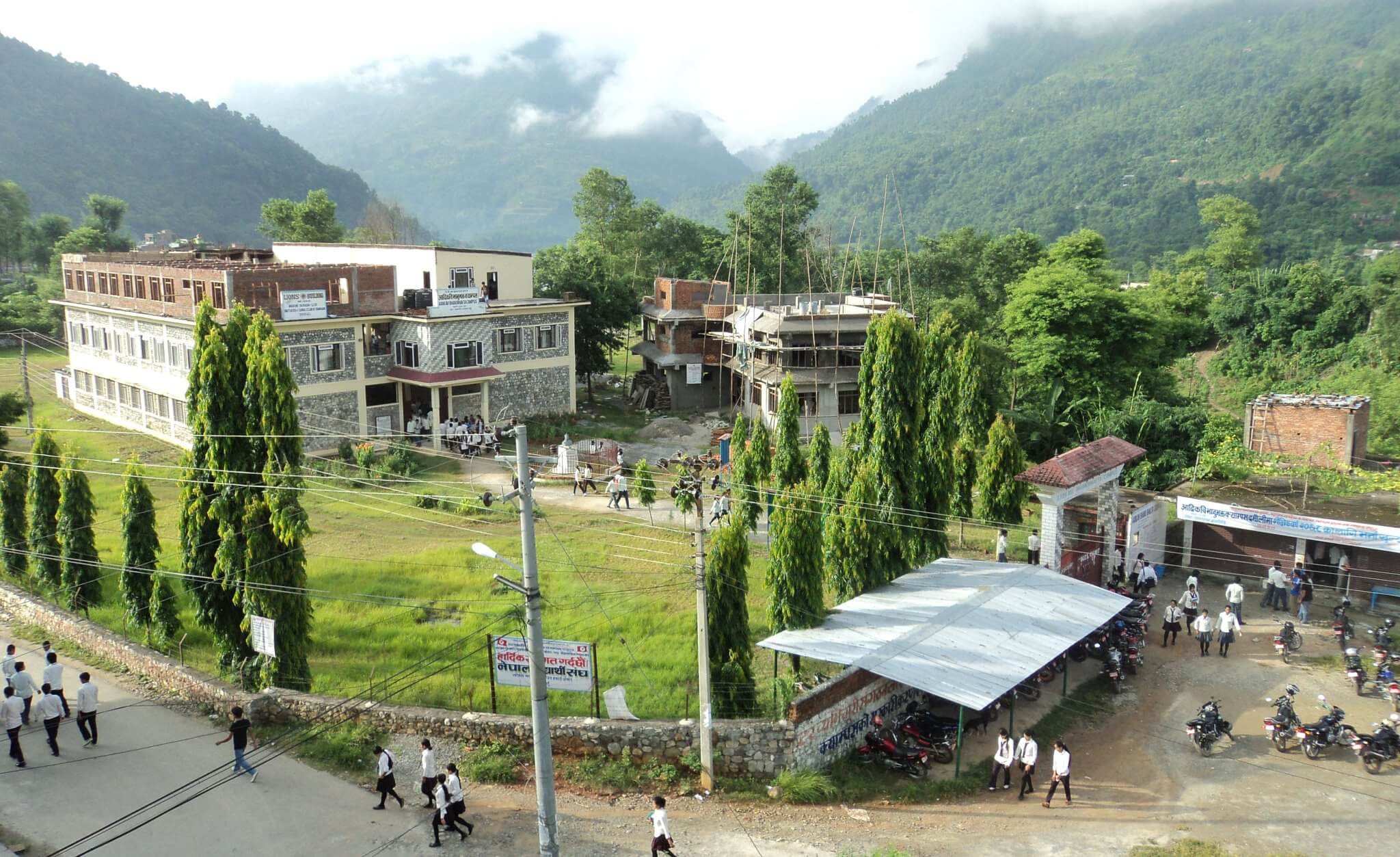
Science laboratories
Computer laboratories
Computer center for computer literacy classes
Library service, including an advanced and automated library facility
Multimedia resources
Free and unlimited internet access on campus premises
Environmental-friendly campus management
Space and support for extra classes
Facilities linked to field trips and excursion-based academic activities
Aadikavi Bhanubhakta Campus serves students from Tanahun and adjoining districts, which gives the campus a mixed student population drawn from both local and nearby communities. The institution has a stated commitment to widening access for students from marginalized, Indigenous, Dalit, economically disadvantaged, and other underrepresented backgrounds. This social role remains central to its campus identity.
Student life extends beyond formal classroom teaching. The message from Campus Chief Maha Prasad Hadkhale highlights cultural programs, extracurricular activities, and community service initiatives as part of campus life. These activities suggest that students are expected to take part in academic as well as social and community-oriented work.
The campus also reports excursion and field trip activities, additional academic support classes, and a research-oriented environment in which faculty members and students are involved in inquiry and departmental activity. Together, these features show a campus setting built around study, community connection, and participation.
Cultural programs
Community service initiatives
Excursions and field trips
Extra classes outside regular academic routines
Seminars, workshops, and training activities in relevant departments
Student participation in research-related activities
The campus reports more than 400 scholarship quotas
Scholarships are provided through tuition fee waivers and financial aid
Special consideration is mentioned for highly talented students, students from weak financial backgrounds, disabled students, and members of deprived communities
Scholarship categories include the brilliant student scholarship program
Scholarship categories also include support for backward, Indigenous, and Dalit students
A separate scholarship category is mentioned for disabled students
Students scoring 80 percent and above receive a full tuition fee waiver
Students scoring 70 to 80 percent receive a 50 percent tuition fee discount
Students scoring 60 to 70 percent receive a 25 percent tuition fee discount
First position holders receive a 50 percent tuition fee discount
Second position holders receive a 25 percent tuition fee discount
Disabled students receive a 50 percent tuition fee discount
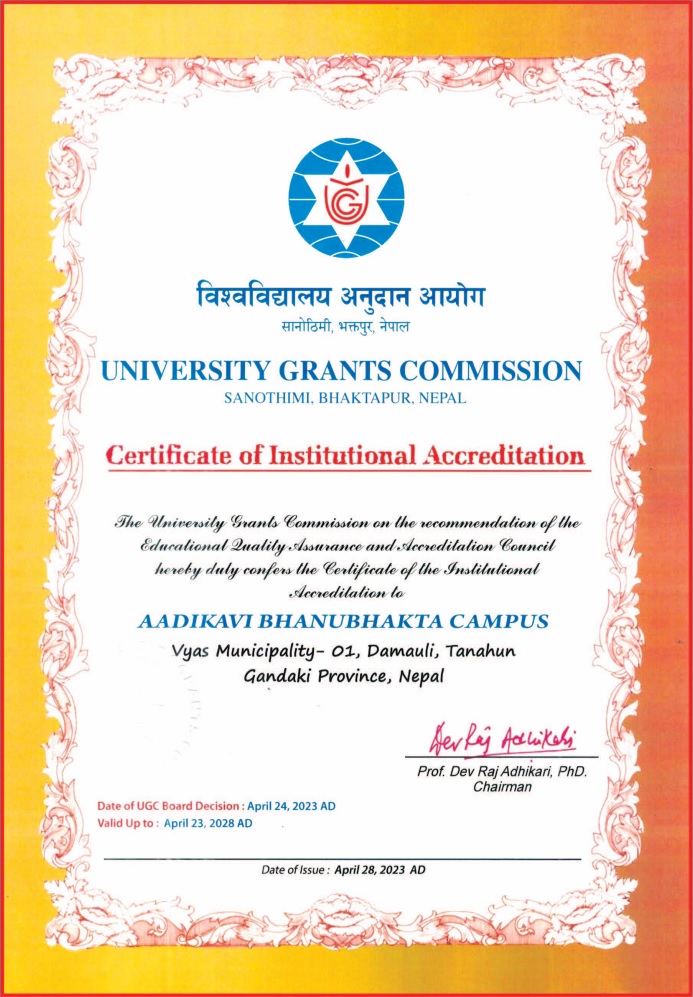
Established in 1987 AD (2044 BS)
Identified in the source as the oldest campus in the area and the largest higher education institution in Tanahun district
Expanded from local community initiative to a campus offering +2, bachelor’s, and master’s level study
Received Quality Assurance and Accreditation from the University Grants Commission (UGC) on 10 December 2013
Reaccredited in 2023
Enrolls more than 1,700 students annually
Built and expanded through community support, donations, and local participation
Reports the development of laboratories, library systems, multimedia resources, and internet access as part of campus growth
Maha Prasad Hadkhale, Campus Chief, presents the campus as an institution grounded in academic responsibility, public participation, and continuous institutional improvement. His message connects the identity of the campus to the legacy of Aadikavi Bhanubhakta Acharya and places emphasis on academic quality, community engagement, and social responsibility.
He also links recent institutional progress to the campus’s renewed QAA status in 2023 and points to extracurricular activity, cultural participation, and community service as part of the student experience. The message further notes ongoing efforts to expand academic offerings, strengthen research, and maintain close ties with the surrounding community.
Aadikavi Bhanubhakta Campus stands out as a long-established community campus in Tanahun with programs ranging from +2 to master’s level. Its institutional story is tied to public initiative, local support, and the goal of extending higher education opportunities beyond major urban centers.
The campus combines NEB and TU-linked education with scholarship support, academic departments across several disciplines, and a record of QAA recognition from the University Grants Commission (UGC). For students looking for a campus in Damauli with a broad academic range and a community-based foundation, it remains a significant option in the district.
College Name: Aadikavi Bhanubhakta Campus (आदिकवि भानुभक्त क्याम्पस, तनहुँ)
Location: Vyas Municipality-1, Bigyanchaur, Bhadgaun, Damauli, Tanahun, Gandaki, Nepal
Phone: +977-65-590096, +977-65-563946
Email: abcamus@gmail.com
Website: www.aadikavicampus.edu.np
Aadikavi Bhanubhakta Campus is a publicly owned, community-based campus established in 1987 AD (2044 BS).
The campus is located in Vyas Municipality-1, Bigyanchaur, Bhadgaun, Damauli, Tanahun, Gandaki, Nepal.
The +2 programs are run under the National Examinations Board, while bachelor’s and master’s programs are affiliated with Tribhuvan University.
The campus offers education from +2 level to master’s level.
The available program range includes +2 in Education, Humanities, and Management; bachelor’s programs such as BA, BBS, BBA, B.Ed., and BICTE; and master’s programs including MBS, M.A., and M.Ed. specializations in English, Nepali, and Education Planning and Management.
Yes. The campus reports more than 400 scholarship quotas and tuition support schemes for meritorious, financially disadvantaged, disabled, and deprived-category students.
Yes. The campus received QAA recognition in 2013 and was reaccredited in 2023 by the University Grants Commission.
Reported facilities include science and computer laboratories, an automated library facility, multimedia resources, a computer center, and free unlimited internet access on campus premises.
The source material refers to problem-based learning, practical and marketable optional subjects, research participation, extra classes, English-medium sections, and experiential academic activities such as field trips.