



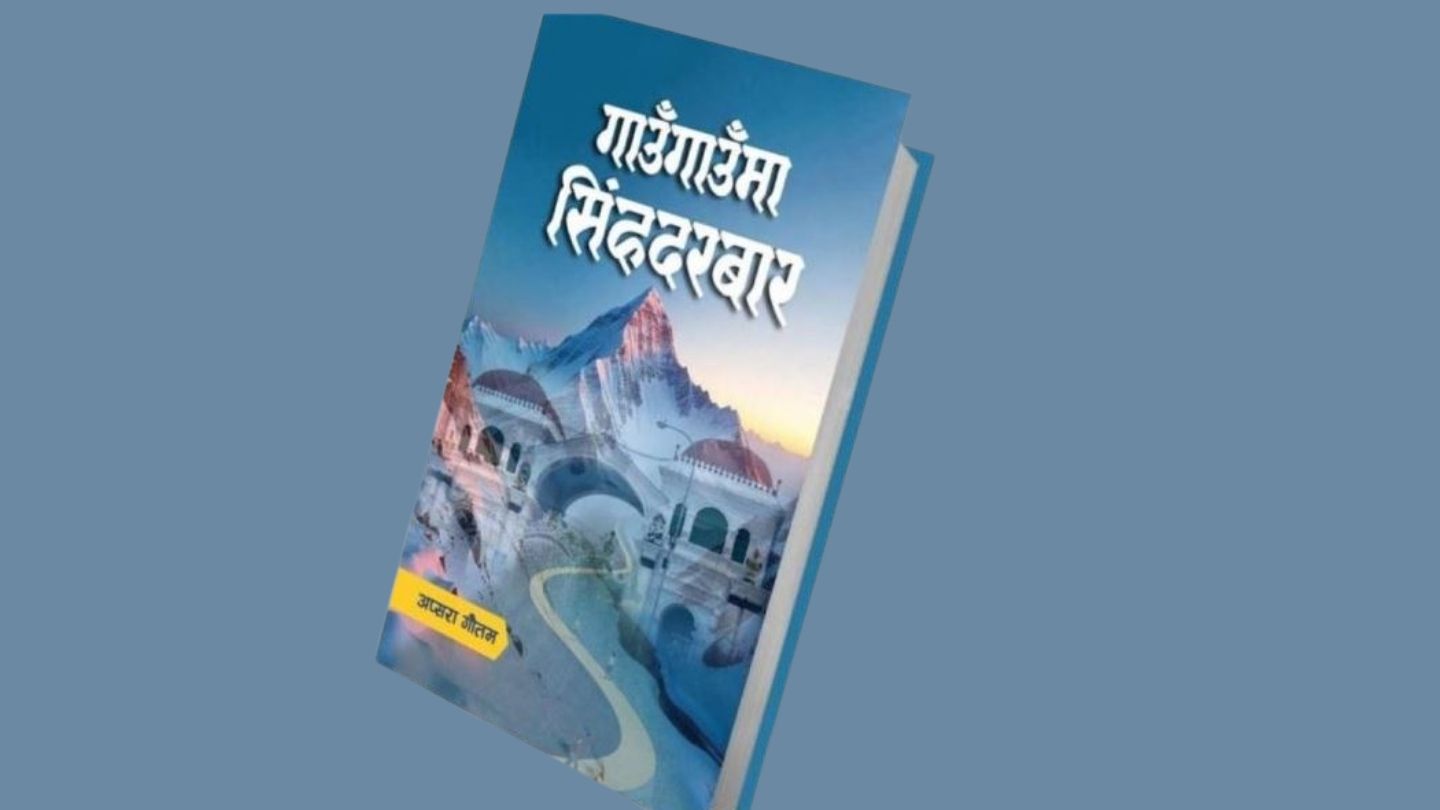
Samagra Media Pvt. Ltd. has recently published the book ‘Gaungau ma Singha Durbar’. While the government has been saying that Singha Durbar has been taken to every village, this book, edited by journalist Apsara Gautam on behalf of the media company, gives a sense that Singha Durbar has truly reached villages.
It can be said that the book has worked to connect the relationship between the village and Singha Durbar. When people raise grievances, there is also a significant number of critics who say that although Singha Durbar’s authority has reached villages, corruption and irregularities have also gone along with it.
This book also covers the grievances, possibilities, and challenges of local governments. The book compiles the experiences of ministers who run local governments from Singha Durbar, provincial chief ministers, provincial speakers, and provincial chiefs, along with incumbent and former representatives of local levels.
It can be said that the book has attempted, even if only slightly, to strengthen federalism and local levels.
In the book’s foreword, former Vice-Chair of the National Planning Commission Dr Pushparaj Kandel has written: “Yesterday’s local bodies were also strong, but they had to be accountable to the federal government. Local governments must pay attention to the aspects of good governance and coordination to properly fulfill the responsibilities given by the Constitution. They must focus on matters placed in the public interest and priority rather than private matters.”
Kandel has suggested that local governments should work with the people’s interest at the center. He has stated that representatives at the local level must work above personal interests.
Local governance expert Balananda Poudel has also written about the book: “Because ward chairpersons are members of the executive, ward members and ward chairpersons participate in the assembly, exercise executive authority, and also represent the ward in places where laws are made, the ward should be made an implementation unit rather than just a planning unit. It seems that the model of development plans needs to change slightly. The Constitution makers appear to have placed great trust in local governments.”
He has also mentioned that while drafting the Constitution, greater authority was given to local levels.
Regarding local levels and federalism, former National Assembly member and federalism expert Khimlal Devkota says: “Local level is the foundational pillar of democracy. Due to its closeness with the people, the local level is also called local government. Local governments deliver state-provided services and facilities to the people’s doorsteps. Local governments are under the people’s direct monitoring and control. The Constitution has empowered the local levels. The rights of local levels are in the schedules of the Constitution.”
As Devkota says, since local levels deliver services to citizens at their doorsteps, the local level is the government of that place. 9 Page 1110
Since the central government based in Singha Durbar alone cannot look after the wards there and cannot understand what inconveniences exist, local governments also work to solve problems there if possible, and if not, to bring them to the central government and initiate solutions.
Prepared by including 32 articles by various experts and the identification of provinces along with the names of their districts and local levels, the book is compiled in 312 pages.
In the editorial note, editor Gautam says: “Since the local level is the main foundational area of development for the Nepali people, we have presented diverse materials in the book related to local levels, including grievances, problems, possibilities, policy making, plans, budgets, employment, suggestions, and more.”
The book also includes articles by the then Minister for Federal Affairs and General Administration, chief ministers of provinces other than Madhesh and Karnali, the Speaker of Madhesh Province, and the Provincial Chief of Karnali, in an attempt to give the book diversity.
By including the views of those who run the government as well as those who implement the Constitution, one can easily understand what their perspectives and statements are after reading the book.
The views expressed in the book show that after being elected to local or any level of government, representatives must work above party lines. It appears necessary to develop a mindset among everyone from the doorstep to Singha Durbar that encourages mutual coordination and collective action.
If everyone can create employment opportunities within the country, the youth who have gone abroad may also feel an environment where they can sense that their future is guaranteed upon returning and that they can spend their future in Nepal.
It is emphasized that all must pay attention so that, due to a situation where those in power only distribute despair, citizens who wander thinking there is no future here do not cause the country to become like a senior citizens’ center after a few years.
In a decentralized system of governance, government representatives and development budgets have reached villages. It is wrong to talk about changing such a good system again through slogans.
The book seeks to highlight the fact that now local levels should be strengthened as much as possible, development budgets should reach the real places, budget programs should not be made leader-centric, and the practice of taking budgets to villages based only on recommendations should end.
In an article by former Government of Nepal Secretary Krishnahari Banskota, emphasis is placed on investing in youth employment and entrepreneurship development.
Now, local governments need to run campaigns focused on production, and municipalities should encourage such campaigns.
Since the outer cover of the book displays a symbolic image of Singha Durbar, it can be said that the materials presented with the book’s name have gained meaning.
By presenting ideas that connect not only local levels but also the federal and provincial governments, this ‘Gaungau ma Singha Durbar’ has become a medium to provide messages and information to every citizen.


.png)

Comments 0
No comments yet. Be the first to start the conversation.