Mahankal Rural Municipality is a local government area in the southern part of Lalitpur district in Bagmati Province, Nepal. It lies in hilly terrain and serves local communities through ward-level administration, civil registration, recommendations, revenue services, social security management, education, health, agriculture, livestock services, and infrastructure work.
The rural municipality was formed during Nepal’s state restructuring by merging six former Village Development Committees: Bukhel, Manikhel, Gotikhel, Kaleshwar, Chandanpur, and Thuladurlung. Its administrative center is Gotikhel. The local economy is mainly based on agriculture, livestock farming, small trade, cooperatives, and remittance.
| Field | Details |
|---|---|
| Official Name | Mahankal Rural Municipality |
| Nepali Name | महाङ्काल गाउँपालिका |
| Type | Rural Municipality |
| Province | Bagmati Province |
| District | Lalitpur |
| Established | 2017 AD, 2073 Falgun 22 BS |
| Center | Gotikhel |
| Total Area | 82.44 square kilometers |
| Number of Wards | 6 |
| Population | 8,122 |
| Households | 1,939 |
| Literacy Rate | 80.09% |
| Official Website | mahankalmun.gov.np |
| Official Email | mahankalmun2017@gmail.com |
Mahankal Rural Municipality is a rural local level under the constitutional and legal structure of Nepal. It operates under the Constitution of Nepal 2072 BS and the Local Government Operation Act 2074 BS.
The rural municipality functions as the local government for its area, with responsibilities related to policy execution, service delivery, local planning, revenue collection, public welfare, and ward-level administration.
Official Name: Mahankal Rural Municipality
Official Name in Nepali: महाङ्काल गाउँपालिका
Type: Rural Municipality
Province: Bagmati Province
District: Lalitpur
Established: 2017 AD, 2073 Falgun 22 BS
Rural Municipality Center: Gotikhel
Official Website: mahankalmun.gov.np
Official Email: mahankalmun2017@gmail.com
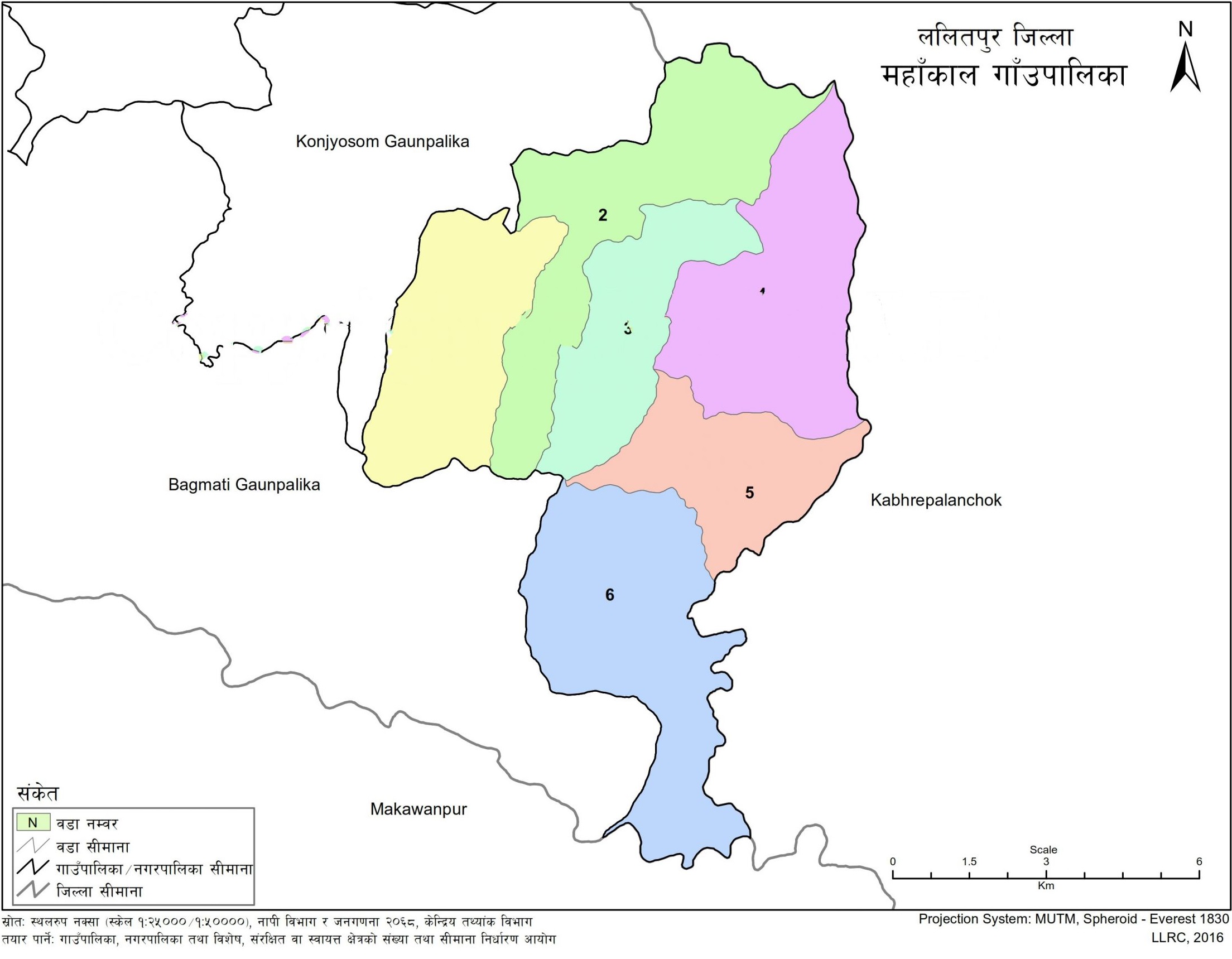
Mahankal Rural Municipality is situated in the southern part of Lalitpur district. During Nepal’s state restructuring, it was created by merging six former Village Development Committees.
The former Village Development Committees merged into Mahankal Rural Municipality were:
Bukhel
Manikhel
Gotikhel
Kaleshwar
Chandanpur
Thuladurlung
The rural municipality covers 82.44 square kilometers and is divided into 6 wards.
| Ward No. | Area |
|---|---|
| Ward No. 1 | Bukhel |
| Ward No. 2 | Manikhel |
| Ward No. 3 | Gotikhel |
| Ward No. 4 | Kaleshwar |
| Ward No. 5 | Chandanpur |
| Ward No. 6 | Thuladurlung |
Mahankal Rural Municipality lies in hilly terrain. Its geography affects road construction, settlement patterns, agriculture, drinking water access, and disaster risk.
The rural municipality shares boundaries with local levels and districts around southern Lalitpur.
| Direction | Boundary |
|---|---|
| East | Kavrepalanchok district |
| West | Konjyosom Rural Municipality and Bagmati Rural Municipality, Lalitpur |
| North | Konjyosom Rural Municipality |
| South | Bagmati Rural Municipality and Makwanpur district |
Official records mention a maximum temperature of around 26.4 degrees Celsius and a minimum temperature of around 2.3 degrees Celsius.
According to the final data of the National Census 2078 BS published by the National Statistics Office, Mahankal Rural Municipality has a total population of 8,122.
| Category | Number |
|---|---|
| Total Population | 8,122 |
| Male Population | 4,072 |
| Female Population | 4,050 |
| Total Households | 1,939 |
| Population Density | About 98 people per square kilometer |
| Literacy Rate | 80.09% |
Male residents account for 50.1 percent of the population, while female residents account for 49.9 percent.
The rural municipality has a presence of Tamang and Hill Brahmin communities, along with Chhetri, Damai, Kami, Magar, Newar, and other caste and ethnic groups. Nepali and Tamang are mainly spoken. Hinduism and Buddhism are the main religions practiced in the area.
Census data shows that the population has declined slightly compared to earlier figures, mainly because of migration toward urban areas for education and employment.
Mahankal Rural Municipality operates through the local government structure defined by the Local Government Operation Act 2074 BS.
The Rural Municipal Assembly is the policy-making and budget-approval body. The Rural Municipal Executive carries out policies and programs approved by the assembly. The chairperson leads the rural municipality, while the vice-chairperson serves as deputy chief.
Services are delivered through elected ward chairpersons and ward members across all 6 wards. Administrative work is led by the chief administrative officer.
The rural municipality provides services through sections related to:
Education
Health
Agriculture and livestock development
Infrastructure construction
Women and children
Disaster management
Civil registration
Mahankal Rural Municipality provides public services through the rural municipality office and ward offices.
Civil registration services include the registration of:
Birth
Death
Marriage
Migration
Divorce
Ward offices and the rural municipality provide recommendation services related to citizenship, land ownership certificates, relationship verification, and other legal needs.
Local revenue services include property tax, land tax, business registration, and business renewal.
The rural municipality manages social security allowance distribution and identity card-related work for senior citizens, single women, persons with disabilities, and Dalit communities.
The rural municipality coordinates primary relief and rescue work during natural disasters and emergencies.
Related local government service information is also available for Mahankal Rural Municipality local government services.
Mahankal Rural Municipality has public and institutional schools serving students at preschool, basic, secondary, and +2 levels.
| Category | Count |
|---|---|
| Total Schools | 27 |
| Public Schools | 26 |
| Private Schools | 1 |
| Pre-school | 26 |
| Basic Schools | 26 |
| Secondary Schools | 7 |
| Plus-2 Schools | 3 |
Schools such as Mahankal Secondary School and Buddha Bhagwan Secondary School provide education within the rural municipality. Some students travel to urban areas of Lalitpur or Kathmandu for higher education.
| Level | Grade | Number of Schools |
|---|---|---|
| Pre-school | ECD | 26 |
| Basic | Grades 1–8 | 26 |
| Secondary | Grades 9–12 | 7 |
| +2 | Grades 11–12 | 3 |
| School Name and Location | Type | Level |
|---|---|---|
| Mahankal Secondary School - Gotikhel, Mahankal-3, Lalitpur | Public | Nursery–12 |
| Buddha Bhagwan Secondary School - Katuwan, Mahankal-2, Lalitpur | Public | Nursery–10 |
| Kali Devi Secondary School Lalitpur - Bukhel, Mahankal-1, Lalitpur | Public | Nursery–10 |
| Shree Panch Mahendra Secondary School - Thuladurlung, Mahankal-6, Lalitpur | Public | Nursery–12 |
| Hillside English Secondary School - Gotikhel, Mahankal-3, Lalitpur | Private | Nursery–10 |
| Shree Bagh Bhairab Secondary School - Kaleshwor, Mahankal-4, Lalitpur | Public | Nursery–12 |
| Saraswati Bidyashram Secondary School - Namandanda, Chandanpur, Mahankal-5, Lalitpur | Public | Nursery–10 |
| Manikhel Basic School - Manichour, Mahankal-2, Lalitpur | Public | Nursery–8 |
| Bagmati Basic School - Kapiram, Mahankal-6, Lalitpur | Public | Nursery–8 |
| Gumarang Basic School - Thuladurlung, Gumarang, Mahankal-6, Lalitpur | Public | Nursery–8 |
| Saraswati Basic School - Mahankal-1, Lalitpur | Public | Nursery–5 |
| Balmukunda Basic School - Bhukhel, Uniuchaur, Mahankal-1, Lalitpur | Public | Nursery–8 |
| Kaleshwari Basic School - Chandanpur, Mahankal-5, Lalitpur | Public | Nursery–8 |
| Guru Basic School - Bimire, Mahankal-1, Lalitpur | Public | Nursery–8 |
| Bal Basic School - Khorbhangyang, Mahankal-2, Lalitpur | Public | Nursery–5 |
| Jwala Devi Basic School - Atibhanjyang, Mahankal-6, Lalitpur | Public | Nursery–5 |
| Gyan Chachhu Basic School - Laxabash, Mahankal-8, Lalitpur | Public | Nursery–3 |
| Kaleshwor Basic School - Chautari Danda, Mahankal-4, Lalitpur | Public | Nursery–5 |
| Seti Devi Basic School - Dhamidanda, Gotikhel, Mahankal-3, Lalitpur | Public | Nursery–3 |
| Namuna Basic School - Kaleshwar, Mahankal-4, Lalitpur | Public | Nursery–3 |
| Gotikhel Basic School - Gotikhel, Mahankal-3, Lalitpur | Public | Nursery–3 |
| Chandevi Basic School - Gotikhel, Mahankal-3, Lalitpur | Public | Nursery–3 |
| Nabodaya Basic School - Kaleshwar, Mahankal-4, Lalitpur | Public | Nursery–5 |
| Kalidevi Basic School - Chandanpur, Mahankal-5, Lalitpur | Public | Nursery–3 |
| Pita Basic School - Mahatgaun, Mahankal-1, Lalitpur | Public | Nursery–3 |
| Ringin Basic School - Manikhel, Ringindanda, Mahankal-2, Lalitpur | Public | Nursery–Nursery |
| Salghari Basic School - Mahankal-5, Lalitpur | Public | 1–2 |
Mahankal Rural Municipality has one community college.
| College Name and Location | Affiliation |
|---|---|
| Mahankal Campus - Gotikhel, Mahankal, Lalitpur | Tribhuvan University |
Health posts and basic health centers operate at the ward level in Mahankal Rural Municipality. These institutions support basic health needs through local health services.
Vaccination programs, safe motherhood services, and nutrition programs are conducted for maternal and child health. Social awareness and support programs are carried out for women, children, senior citizens, and persons with disabilities.
For treatment of serious illnesses, residents generally depend on major hospitals in the Kathmandu Valley.
The local economy of Mahankal Rural Municipality is mainly based on agriculture and livestock farming. Most households are involved in traditional agriculture, while local efforts are directed toward making farming more commercial.
Small shops and retail businesses operate in areas with road access. Foreign employment and study migration also influence the household economy, with remittance forming an important source of income for many families.
Farmers’ groups and cooperative institutions support savings and credit activities within the rural municipality.
Mahankal Rural Municipality is close to the Kathmandu Valley, but its hilly terrain creates difficulties for infrastructure work.
The rural municipality is about 15 to 20 kilometers from the urban area of Lalitpur. Dirt and gravel roads connect its wards, and road upgrading work is underway to make local roads usable throughout the year.
Most wards have access to electricity from the national transmission line. Drinking water is supplied through local sources. Telephone and mobile internet services have also expanded across the area.
Nearby local levels in Lalitpur include Lalitpur Metropolitan City, Godawari Municipality, Lalitpur, Mahalaxmi Municipality, Lalitpur, and Bagmati Rural Municipality, Lalitpur.
Mahankal Rural Municipality has a multicultural social setting. Local communities celebrate festivals such as Lhosar, Dashain, Tihar, and Makar Sankranti.
Kaleshwar Mahadev Temple and Baitarani Dham are important religious sites in the area. Simba Falls is a natural site that attracts domestic visitors.
The hilly terrain of Mahankal Rural Municipality creates environmental and disaster-related risks. During the monsoon, the area faces the risk of floods and landslides. Forest fires are possible during the dry season.
Tree plantation and environmental awareness activities are conducted to help prevent soil erosion, conserve watershed areas, and protect forests. Disaster preparedness and response planning are also part of local risk reduction work.
Mahankal Rural Municipality carries out local planning through annual policies, programs, and budgets. Priority areas include agricultural modernization, rural road construction and upgrading, drinking water projects, health services, and education.
Its income sources include internal revenue such as tax and non-tax revenue, along with equalization, conditional, matching, and special grants from the Government of Nepal and the provincial government.
The budget is allocated to infrastructure development, social development, economic development, and good governance. Annual income and expenditure are audited by the Office of the Auditor General.
Mahankal Rural Municipality uses its official website to publish notices, budgets, and programs. The official website is mahankalmun.gov.np.
An information officer has been designated to support citizens’ right to information, and official contact numbers are available through the website.
Mahankal Rural Municipality faces challenges related to migration, road access, and agricultural commercialization. Youth migration for education and employment has affected the availability of working-age manpower in villages.
Road upgrading remains challenging because of the hilly terrain. Traditional agriculture also faces limits linked with technical knowledge and irrigation facilities.
The area has opportunities in domestic tourism, commercial agriculture, and livestock farming. Sites such as Kaleshwar Mahadev, Baitarani Dham, and Simba Falls support local tourism potential. The rural municipality’s proximity to the Kathmandu Valley can help local producers access markets for vegetables, milk, and meat products.
Mahankal Rural Municipality is located in the southern part of Lalitpur district under Bagmati Province, Nepal.
The administrative center of Mahankal Rural Municipality is Gotikhel.
Mahankal Rural Municipality has 6 wards.
The rural municipality covers 82.44 square kilometers.
According to the National Census 2078 BS, Mahankal Rural Municipality has a total population of 8,122.
Bukhel, Manikhel, Gotikhel, Kaleshwar, Chandanpur, and Thuladurlung were merged to form Mahankal Rural Municipality.
Nepali and Tamang are mainly spoken in Mahankal Rural Municipality.
Mahankal Rural Municipality has 27 schools, including 26 public schools and 1 private school.
Mahankal Campus is located in Gotikhel, Mahankal, Lalitpur, and is affiliated with Tribhuvan University.
The official website of Mahankal Rural Municipality is mahankalmun.gov.np.

.jpg)