



Nepal Internet Access Reaches 144%, But Digital Divide and Cybersecurity Remain Key Challenges
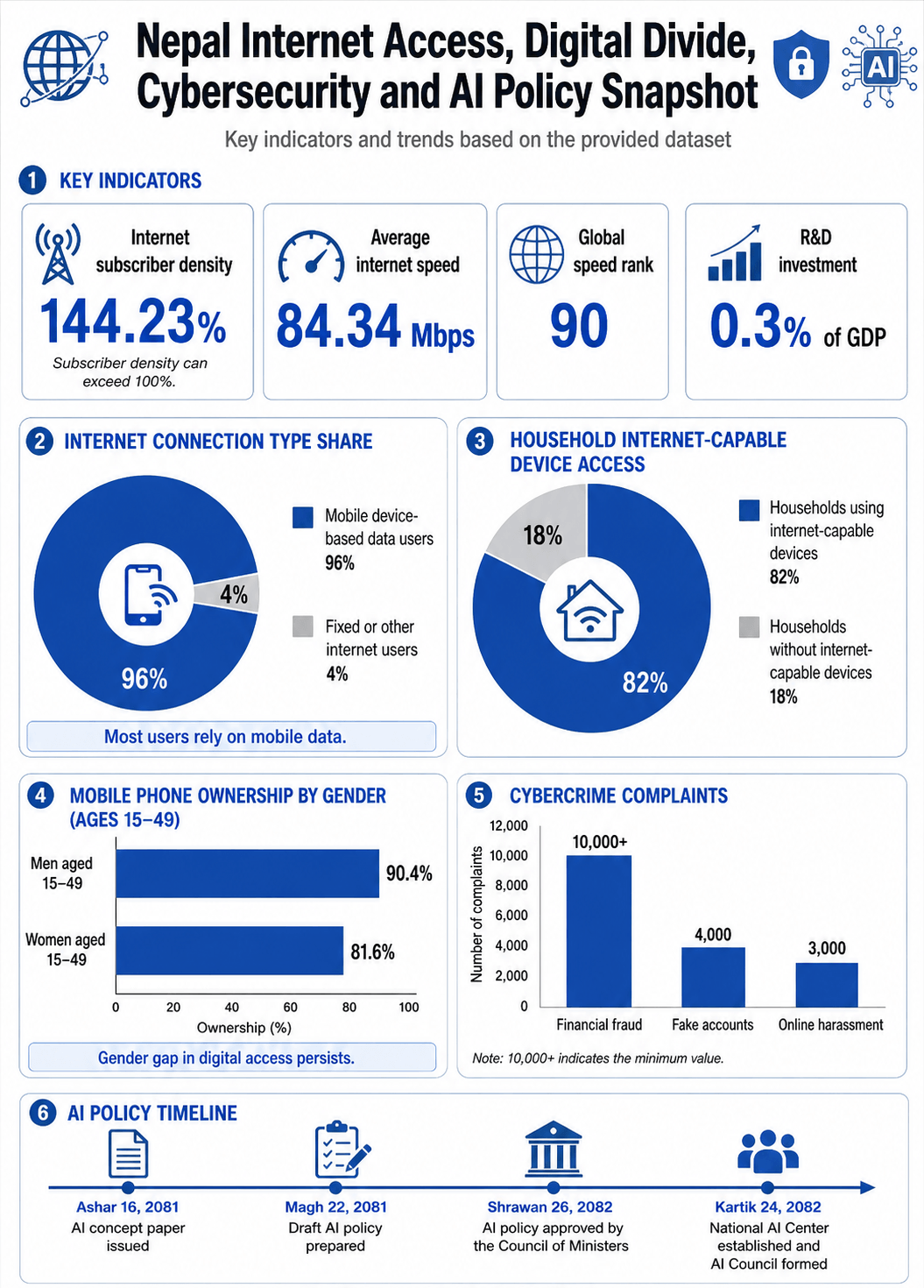
According to the latest data from the Ministry of Finance, internet subscriber density in Nepal has reached 144.23%. However, alongside rapid digital expansion, inequality in infrastructure, citizens’ data security, and rising cybercrime have become serious challenges for Nepal.
The “Nepal Current Economic Status Paper, 2083” issued by the Ministry of Finance has pointed to imbalance in digital expansion. Of the total internet users, around 96% depend on mobile device-based data. As high-speed fixed broadband services remain mainly limited to urban areas, both access to and quality of the internet appear weak in rural areas.
According to Ookla’s “Speedtest Global Ranking” for March 2026, Nepal ranks 90th in the world with an average speed of 84.34 Mbps. However, this progress is urban-centered. According to the National Statistics Office’s “Nepal Multiple Indicator Survey 2081/82,” 82% of households use devices with internet facilities. The survey also shows gender inequality in digital access: while 90.4% of men aged 15 to 49 have mobile phones, the figure for women is only 81.6%.
Due to the lack of digital literacy, the use of technology is more focused on entertainment than on productive sectors. Alongside the expansion of technology, the state of innovation remains very weak. According to the Ministry’s status paper, investment in research and development (R&D) is only 0.3% of the country’s gross domestic product.
Rising Cybercrime and Data Security Risks
As internet use has increased, cybercrime incidents have risen sharply. Police have stated that the failure of social media platforms operated by foreign multinational companies to register in Nepal has seriously affected crime investigations.
The cybercrime data presented by Inspector General of Police Dan Bahadur Karki at the meeting of the Federalism Strengthening and National Concerns Committee under the National Assembly on Baisakh 10 is as follows:
-
More than 10,000 complaints related to financial fraud
-
4,000 cases related to fake accounts
-
3,000 incidents of online harassment
According to Inspector General Karki, major networks under Meta, such as Facebook, Instagram, and WhatsApp, are not officially registered in Nepal, making it difficult to obtain data and remove harmful content. So far, only a few platforms such as TikTok, Viber, and We Talk have been registered.
Cybersecurity expert Rajanraj Pant has stressed the need to immediately introduce a law on “digital data privacy” to protect citizens’ sensitive data, such as passports, driving licenses, and banking details. He said clear legal provisions are necessary to impose fines if agencies that collect public data act negligently.
“No other law is above the law of any country. Social media companies must register and operate in the country concerned,” Pant said. He added that although the misuse of artificial intelligence (AI) could bring new types of cyber threats, its proper use could help identify the source of cyberattacks and support risk analysis.
Government Policy Initiatives and Digital Services
In recent years, the government has begun initiatives to bring policy clarity in information technology and AI and to centralize the service system.
The government’s recent key steps related to AI and technology are as follows:
-
Ashar 16, 2081: Concept paper on artificial intelligence (AI) issued
-
Magh 22, 2081: Draft AI policy prepared
-
Shrawan 26, 2082: AI policy approved by the Council of Ministers
-
Kartik 24, 2082: National AI Center established and AI Council formed
In addition, services such as Nagarik App, Integrated Office Management System, centralized email, e-attendance, integrated website management, and centralized SMS gateway have been brought into operation through the Department of Information Technology.
Chiranjeevi Adhikari, senior vice president of the Computer Association Nepal (CAN) Federation, said technology should be viewed not as a luxury but as an engine of development. He suggested that the government should remove policy barriers and increase investment to make the country prosperous through information technology.
Impact on the Communication Sector
Digital expansion has also directly affected the communication sector. At a program held in Kathmandu, communication expert Ujjwal Acharya said social media algorithms are having a major influence on public opinion formation. He pointed out that the growing trend of click-based content and misinformation has added challenges to the credibility of mainstream journalism.
Nepal is now standing at a decisive point in its digital transition. Although infrastructure and policy initiatives are moving forward, inclusive access, digital literacy, protection of citizens’ privacy, and effective regulation of major technology companies remain the main challenges ahead.
1. Key Digital Access Indicators
| Indicator | Value | Unit |
|---|---|---|
| Internet subscriber density | 144.23 | % |
| Mobile device-based internet users | 96 | % |
| Fixed/other internet users | 4 | % |
| Households using internet-capable devices | 82 | % |
| Households not using internet-capable devices | 18 | % |
| Average internet speed | 84.34 | Mbps |
| Nepal’s global speed rank | 90 | Rank |
| R&D investment | 0.3 | % of GDP |
2. Internet Use by Connection Type
| Category | Value (%) |
|---|---|
| Mobile device-based data users | 96 |
| Fixed/other internet users | 4 |
3. Household Internet-Device Access
| Category | Value (%) |
|---|---|
| Households using internet-capable devices | 82 |
| Households without internet-capable devices | 18 |
4. Gender Gap in Mobile Phone Ownership
| Group | Mobile Phone Ownership (%) |
|---|---|
| Men aged 15–49 | 90.4 |
| Women aged 15–49 | 81.6 |
5. Cybercrime Complaint Data
| Cybercrime Category | Complaints |
|---|---|
| Financial fraud | More than 10,000 |
| Fake accounts | 4,000 |
| Online harassment | 3,000 |
| Category | Minimum Complaints Used | Approx. Share |
|---|---|---|
| Financial fraud | 10,000 | 58.8% |
| Fake accounts | 4,000 | 23.5% |
| Online harassment | 3,000 | 17.6% |

.jpg)



Comments 0
No comments yet. Be the first to start the conversation.