



Certificate, Diploma, and Degree in Nepal: Key Differences
Choosing between a certificate, diploma, and degree in Nepal affects more than the name printed on a document. It can affect admission options, job eligibility, licensing, further study, and how employers assess a qualification.
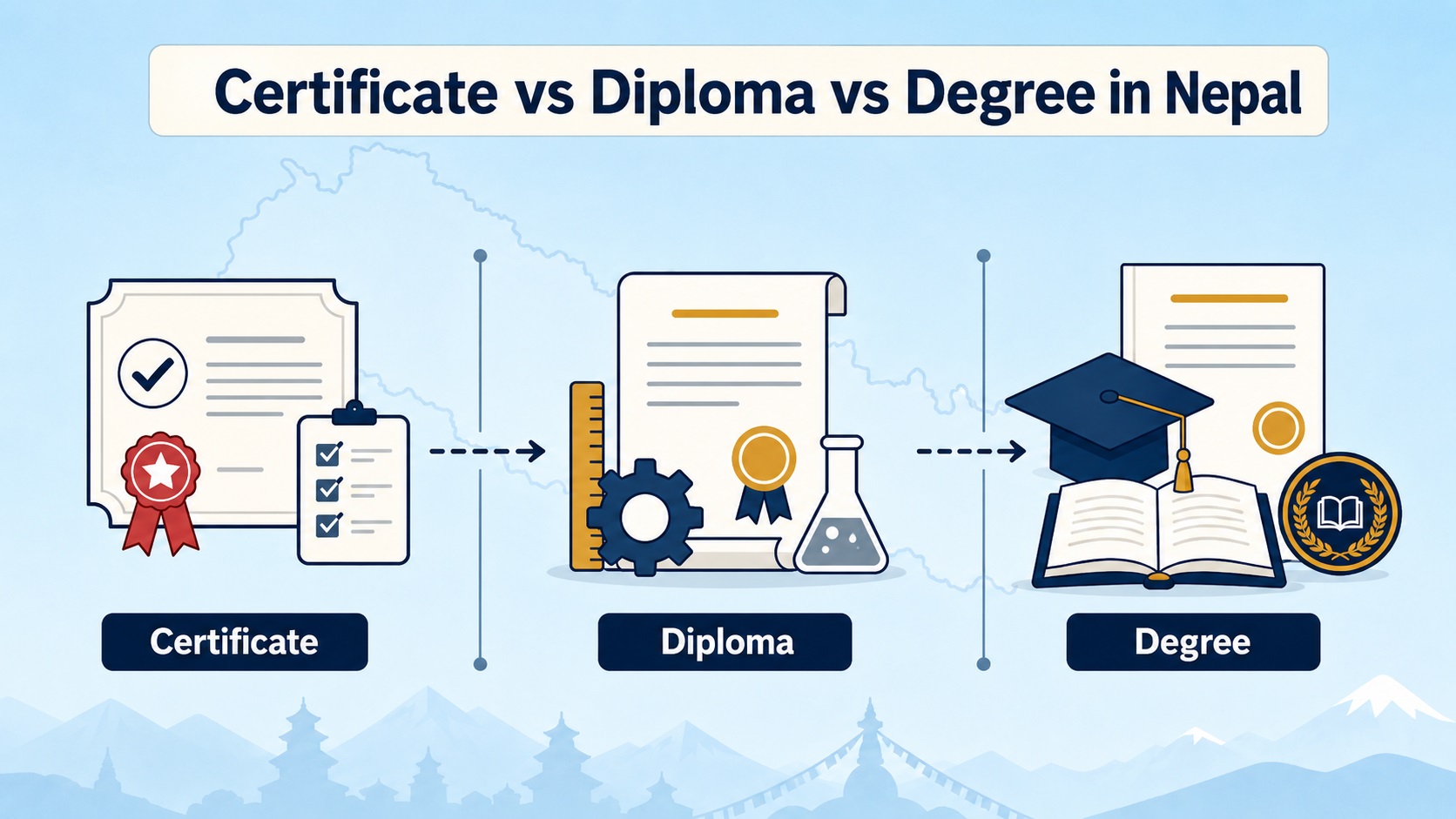
A certificate can refer to short training, skill testing, or certificate-level study. A diploma is usually a longer technical or applied program, often connected with the Council for Technical Education and Vocational Training (CTEVT). CTEVT lists certificate/diploma-level programs in several technical fields. UGC Nepal’s university page describes university programs at bachelor’s, master’s, MPhil, and PhD levels across Nepal’s higher education system.
Summary
In Nepal, a certificate usually shows training, skill assessment, or certificate-level study. A diploma usually refers to structured technical or applied education, often linked with CTEVT. A degree normally refers to university-level education. These credentials are not automatically equal. Their value depends on the awarding body, level, curriculum, assessment, recognition, and the purpose for which the learner uses them.
Table of Content
- Certificate, Diploma, and Degree in Nepal: Key Differences
- What Is a Certificate in Nepal?
- What Is a Diploma in Nepal?
- What Is a Degree in Nepal?
- Main Differences at a Glance
- Recognition and Equivalence
- Which Option Fits Which Learner?
- How to Check Quality Before Enrolling
- Common Mistakes to Avoid
- Practical Pathway Examples
- Conclusion
Key Takeaways
-
A certificate is not one fixed level in Nepal.
-
A diploma is usually technical and applied.
-
A degree is usually university-level study.
-
Recognition depends on the awarding body.
-
Transfer to higher study is not automatic.
-
Regulated fields need extra verification.
-
The right option depends on the learner’s goal.
What Is a Certificate in Nepal?
A certificate in Nepal can mean short training, skill certification, or formal certificate-level education. The term is broad, so learners should check the exact type of certificate before comparing it with a diploma or degree.
CTEVT’s short-term curriculum page lists training programs measured in hours, including examples such as 160, 390, 422, 520, 550, and 1680 hours. CTEVT’s National Skill Testing Board states that a skill test is a performance test based on occupational skill standards and leads to a National Skill Certificate when a person meets the requirements of a trade or occupation.
Certificates may be useful when the learner needs proof of a specific skill. For example, a worker may take a skill test to document practical competence, while a student may complete short training to learn a defined job task.
A certificate has limits. A short training certificate may not meet the requirement for a job, license, or higher education program that asks for a diploma, degree, or council-approved qualification.
What Is a Diploma in Nepal?
A diploma in Nepal usually refers to a structured technical or applied program. In many contexts, it is connected with CTEVT, especially in fields such as agriculture, engineering, health or medical science, hospitality, forestry, and technical trades.
CTEVT states that it runs diploma or proficiency certificate-level courses in health, engineering, agriculture, hospitality, forestry, and trades through constituent, partnership, TECS, and privately affiliated schools. It also states that the entry requirement for three-year certificate/diploma-level programs is SEE passed.
A diploma is usually deeper than a short certificate because it covers a wider curriculum and may include practical work, lab work, field exposure, or on-the-job training. CTEVT’s pre-diploma curriculum page lists TSLC and pre-diploma programs with duration and entry-qualification details.
A diploma should not be treated as equal to a university degree unless the relevant authority or receiving institution confirms that equivalence for a specific purpose.
What Is a Degree in Nepal?
A degree is usually a university-level qualification. Common examples include bachelor’s degree, master’s degree, MPhil, and PhD.
UGC Nepal’s university page lists Nepal’s universities and describes degree-level programs across several institutions, including bachelor’s, master’s, MPhil, and PhD examples.
A degree is usually the relevant pathway when a university, employer, professional council, scholarship body, or public-service notice asks for bachelor’s-level or higher education. The exact requirement depends on the field and the receiving authority.
Main Differences at a Glance
| Area | Certificate | Diploma | Degree |
|---|---|---|---|
| Main purpose | Skill proof or course completion | Technical or applied education | Academic or professional higher education |
| Usual provider | Training provider, NSTB, CTEVT, or institution | Often CTEVT or a technical institution | University or higher education institution |
| Study depth | Narrow to moderate | Moderate to deep | Broader academic study |
| Duration | Varies by course or test | Often longer and structured | Usually longer than diploma |
| Career use | Skill-based or supporting evidence | Technical and occupation-focused roles | Academic, professional, and higher-study pathways |
| Further study | Depends on recognition | Depends on receiving institution | Can lead to higher university study |
| Main risk | Not all certificates carry the same value | Not automatically equal to a degree | Degree alone may not prove job-ready skill |
Recognition and Equivalence
Recognition depends on the awarding body, qualification level, curriculum, assessment, and the rule used by the employer, university, or licensing body. A valid credential for one purpose may not be enough for another purpose.
Nepal’s National Qualifications Framework was approved by the Government of Nepal on May 3, 2020, according to the National Vocational Qualification System. NVQS says the framework is intended to support multiple pathways in general education and Technical and Vocational Education and Training.
This does not mean every certificate or diploma automatically transfers into a degree. Students should ask the receiving university, employer, professional council, or scholarship body for written confirmation when equivalence matters.
Which Option Fits Which Learner?
The suitable option depends on the learner’s current level, target job, time, cost, field, and further-study plan. No single credential is better for every student.
Certificate may fit when
A certificate may fit when the learner needs a specific skill, short training, skill-test proof, or supporting evidence for employment.
CTEVT’s short-term curriculum page shows that some training programs are built around defined hour-based training rather than full academic programs. NSTB skill testing is based on occupational skill standards and leads to a National Skill Certificate when a person meets trade or occupation requirements.
A certificate may be limited when the target role, license, or higher-study program asks for a formal diploma, degree, or specific recognized qualification.
Diploma may fit when
A diploma may fit when the learner wants technical, applied, or occupation-focused study after SEE. CTEVT lists certificate/diploma-level programs in agriculture, engineering, health or medical science, hospitality, forestry, and other areas.
This pathway may suit students who want practical training in a defined technical field. It may be less suitable when the target career or further-study plan clearly requires a university degree.
Degree may fit when
A degree may fit when the learner needs university-level education for further study, professional eligibility, academic work, research, or roles that require a bachelor’s or higher qualification.
International education classification separates education levels such as post-secondary non-tertiary education, short-cycle tertiary education, bachelor’s or equivalent level, master’s or equivalent level, and doctoral or equivalent level. This supports the point that credential level matters, not only the title.
How to Check Quality Before Enrolling
Learners should verify the credential before paying fees or committing time. The same title can have different value depending on provider approval, curriculum, assessment, and recognition.
Check these points:
-
Is the provider approved or affiliated?
-
Who awards the final certificate, diploma, or degree?
-
What is the exact qualification level?
-
What are the entry requirements?
-
What curriculum is followed?
-
How is assessment done?
-
Is there practical training, lab work, fieldwork, or on-the-job training?
-
Is the credential accepted by the target employer or university?
-
Is professional council approval required?
-
Can the transcript or certificate be verified?
-
Is equivalence needed for further study or migration?
For higher education institutions, UGC Nepal’s Quality Assurance and Accreditation list is a useful check because it records accredited higher education institutions, accreditation dates, expiry dates, and status.
Common Mistakes to Avoid
Students often make mistakes because they compare only the title of the credential. A better approach is to compare level, provider, recognition, and purpose.
Mistake 1: Assuming all certificates are equal
A short training certificate, a skill-test certificate, and a formal certificate-level academic program can serve different purposes. Learners should read the credential name, provider, level, and assessment method.
Mistake 2: Assuming a diploma equals a degree
A diploma may be valuable, especially in technical fields, but it is not automatically equal to a bachelor’s degree. Equivalence depends on the relevant authority.
Mistake 3: Ignoring regulated fields
Fields such as health, engineering, teaching, and other regulated professions may have licensing or council requirements. A program can be useful but still not enough for a regulated role if the required authority does not accept it.
Mistake 4: Choosing only by duration
A short course may be suitable for one skill, while a longer diploma or degree may be needed for another goal. Duration should be compared with curriculum depth, recognition, and career requirement.
Mistake 5: Not checking further-study options
Students who want to study further should confirm admission eligibility before enrolling. A pathway that works for employment may not automatically work for bachelor’s or master’s admission.
Practical Pathway Examples
A student after SEE who wants technical education may compare Grade 11–12, a CTEVT pre-diploma, or a CTEVT certificate/diploma program. The student should check entry rules, field fit, practical training, and further-study options.
A Grade 12 graduate who wants academic progression may need a bachelor’s degree. A certificate can still support skills, but it should not be treated as a replacement for a required university qualification.
A working person with trade experience may use skill testing to document competence. NSTB states that a skill test is based on occupational skill standards and leads to a National Skill Certificate when the certificate holder meets the requirements of a trade or occupation.
Conclusion
Certificate, diploma, and degree are not interchangeable terms in Nepal. A certificate may show short training, skill testing, or certificate-level study. A diploma usually refers to a structured technical or applied program, often connected with CTEVT. A degree usually refers to university-level education awarded through a university or higher education institution.
The safest decision is to match the credential with the learner’s goal. Before enrolling, check the awarding body, approval status, curriculum, assessment, recognition, verification process, and further-study pathway.




Comments 0
No comments yet. Be the first to start the conversation.