



Diploma Holder Study a Bachelor's Degree in Nepal
A diploma holder can study a bachelor’s degree in Nepal if the qualification is recognized and accepted by the specific university, faculty, and program. The answer is not automatic for every bachelor’s degree.
This question matters for students who complete a Council for Technical Education and Vocational Training (CTEVT) diploma or Proficiency Certificate Level (PCL) program and later want to enter university education. CTEVT lists certificate and diploma-level programs in fields such as agriculture, engineering, health and medical science, hospitality, social work, entrepreneurship, and forestry. CTEVT’s course page also states that diploma program entry requires SEE with specified GPA and subject-grade conditions, including separate conditions for health-related and other diploma programs.
A diploma is usually a technical or vocational qualification. A bachelor’s degree is a university-level undergraduate qualification. Moving from one to the other depends on equivalence, subject background, entrance exams, and professional council rules where applicable.
Summary
Yes, a diploma holder can study bachelor’s in Nepal when the target program accepts that diploma or PCL qualification. A recognized three-year diploma may support entry into selected bachelor programs, but students must verify equivalence, required subjects, minimum grades, entrance exams, and council or regulator rules before applying. Current admission notices should be treated as the final authority.
Table of Content
- Diploma Holder Study a Bachelor's Degree in Nepal
- Direct Answer
- What Counts as a Diploma in Nepal?
- How Equivalence Works
- Bachelor Options by Field
- Checklist Before Applying
- Benefits and Limits
- Practical Examples
- Verification Needed Before Applying
- Conclusion
Key Takeaways
-
A diploma does not qualify a student for every bachelor program.
-
CTEVT diploma and PCL routes may support bachelor entry in selected cases.
-
Subject requirements matter in science, IT, engineering, and health.
-
Entrance exams may still be required.
-
Health and engineering programs may involve council or regulator rules.
-
Current admission notices should be checked before any application or fee payment.
Direct Answer
Yes, diploma holders can study bachelor’s degrees in Nepal when the chosen program accepts their qualification. A recognized diploma can be a pathway, but it is not a general admission guarantee.
Nepal’s National Vocational Qualification System states that the Government of Nepal approved the National Qualifications Framework on 3 May 2020. NVQS describes the framework as supporting multiple pathways between general education and Technical and Vocational Education and Training.
When the Answer Is Yes
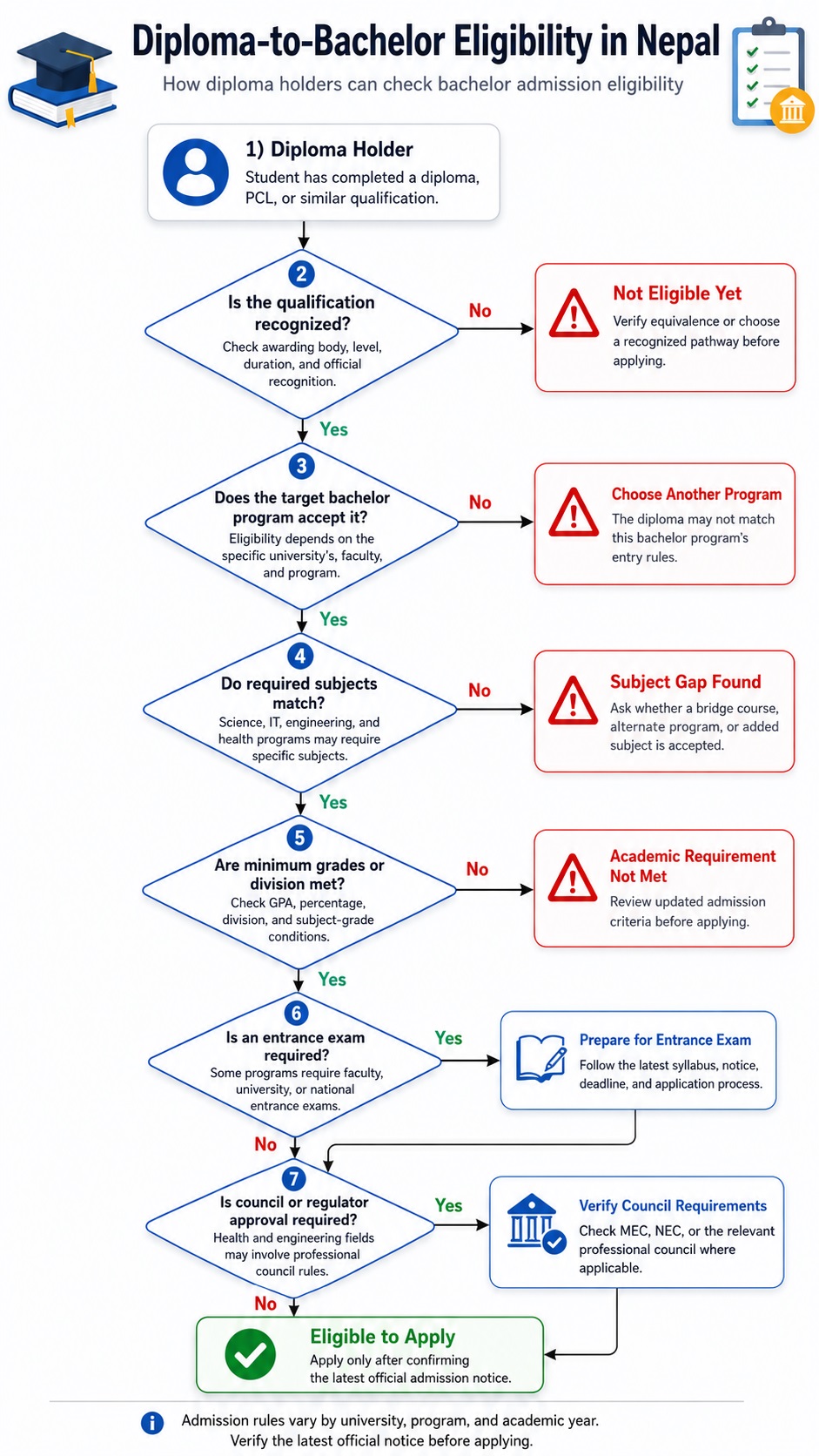
The answer is yes when the diploma is recognized, relevant, and accepted by the university program. The student must also meet the subject, grade, document, and entrance requirements.
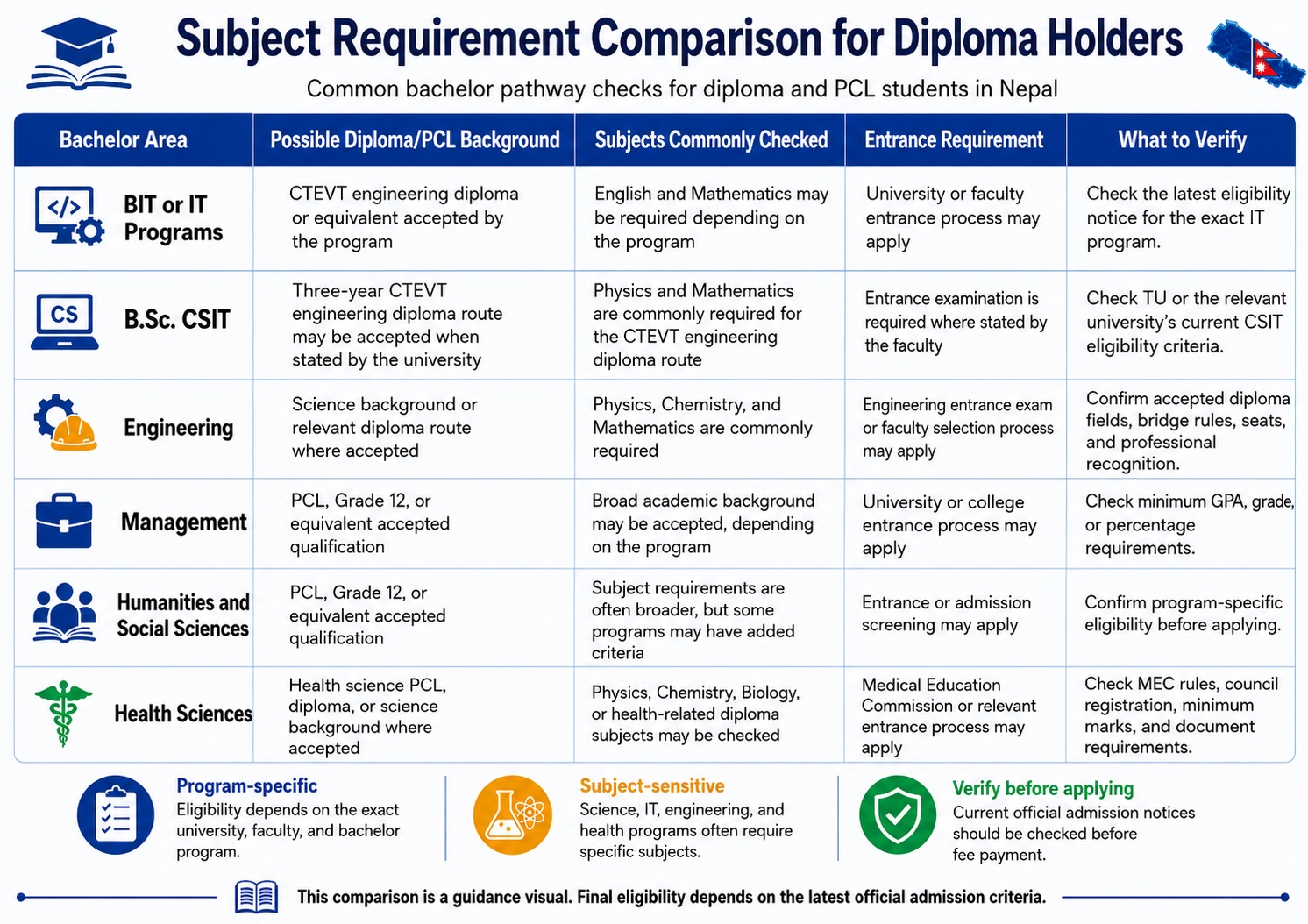
For example, Tribhuvan University’s Central Department of Computer Science and Information Technology lists students who passed a three-year diploma in engineering from CTEVT with English and Mathematics as eligible for BIT.
When the Answer Is No or Unclear
The answer is no or unclear when the diploma does not match the program’s required level, subject background, or professional conditions. A health diploma, engineering diploma, hotel management diploma, and agriculture diploma do not create the same bachelor options.
A student should not assume that one university’s rule applies to another university. Bachelor of Information Technology, B.Sc. CSIT, Bachelor of Engineering, Bachelor of Public Health, BBA, BCA, and B.Ed may follow different eligibility rules.
What Counts as a Diploma in Nepal?
For bachelor admission, the most relevant qualifications are usually CTEVT diploma and PCL programs. Short skills training, pre-diploma programs, and informal certificates should not be treated as equivalent to Grade 12 or PCL unless the target university or authority clearly accepts them.
CTEVT lists certificate and diploma-level programs across technical and vocational fields, including agriculture, engineering, health and medical science, hospitality, entrepreneurship, social work, and forestry.
Diploma, PCL, and Short Training Are Different
A three-year diploma or PCL qualification should be checked separately from short training or pre-diploma credentials. Bachelor programs usually name Grade 12, PCL, equivalent, or specific diploma routes in their admission criteria.
Students should check the exact title on their transcript and certificate. “Diploma,” “PCL,” “pre-diploma,” “TSLC,” and “short-term training” may have different meanings for admission.
How Equivalence Works
Equivalence means a qualification is accepted as comparable to the required entry background for a program. For bachelor study, the key question is whether the university accepts the diploma or PCL as equivalent or eligible for that specific degree.
The safest editorial rule is to treat equivalence as program-specific. Even when a qualification supports bachelor entry in principle, the university, faculty, or entrance body may still require specific subjects, grades, entrance scores, and documents.
Subject Requirements Still Apply
Subject requirements often decide eligibility. TU’s B.Sc. CSIT eligibility page states that the CTEVT route requires a three-year engineering diploma with Physics and Mathematics of 100 full marks each, minimum second division, and a passing score in the entrance examination conducted by the Institute of Science and Technology.
This means a diploma holder may be eligible for one IT program but not another. BIT and B.Sc. CSIT are both IT-related, but their entry rules are not identical.
Bachelor Options by Field
Diploma holders should evaluate bachelor options by field and program, not by the word “bachelor” alone. Admission rules differ across IT, engineering, management, humanities, health, education, agriculture, and other areas.
Nepal has multiple universities. The University Grants Commission Nepal lists universities including Tribhuvan University, Nepal Sanskrit University, Kathmandu University, Purbanchal University, Pokhara University, Lumbini Bouddha University, Far-western University, Mid-western University, Agriculture and Forestry University, Nepal Open University, Rajarshi Janak University, and Madan Bhandari University of Science and Technology.
IT and Computer Programs
IT may offer possible diploma-to-bachelor routes, but each program has its own conditions. TU lists a three-year CTEVT engineering diploma with English and Mathematics as an eligibility route for BIT.
For B.Sc. CSIT, TU gives stricter conditions for the CTEVT route, including an engineering diploma, Physics and Mathematics, minimum second division, and entrance examination requirements.
Engineering Programs
Engineering bachelor programs usually require strong preparation in Physics, Chemistry, and Mathematics. Pokhara University’s undergraduate eligibility page states that engineering candidates must have completed Grade 12 Science or equivalent and studied Physics, Chemistry, and Mathematics, with minimum subject-grade and GPA requirements.
Some diploma-holder-specific engineering routes may exist, but applicants should verify the current admission notice for accepted diploma fields, seats, bridge requirements, and entrance procedures.
Management and Humanities
Management and humanities programs may accept broader academic backgrounds, but they still require recognized qualifications and minimum academic standards. Pokhara University lists management eligibility as Intermediate, Higher Secondary Level, PCL, or equivalent from a recognized institution, with minimum academic conditions and an entrance test.
For humanities and social sciences, universities may accept +2, PCL, or equivalent backgrounds depending on the program. Students should confirm the latest admission criteria before choosing a route.
Health Science Programs
Health science bachelor programs need extra caution because they are tied to Medical Education Commission rules and professional council requirements. Pokhara University states that health science eligibility follows Medical Education Commission criteria for relevant programs.
The Medical Education Commission entrance portal tells applicants to check detailed eligibility before depositing the entrance application fee and states that the fee will not be refunded after submission.
Checklist Before Applying
A diploma holder should verify eligibility before paying application or entrance fees. The safest source is the current admission notice from the university, faculty, college, MEC, or relevant professional council.
Check these points:
-
Exact diploma or PCL title
-
Awarding body
-
Program duration
-
Transcript and marks
-
Equivalence status
-
Required subjects
-
Minimum GPA, grade, percentage, or division
-
Entrance exam requirement
-
Council registration requirement
-
Whether the program is recognized by the university or regulator
Questions to Ask the Admission Office
Ask these questions in writing where possible:
-
Does this bachelor program accept my exact diploma?
-
Is my diploma treated as equivalent or eligible for this program?
-
Which subjects are required?
-
What minimum grade, GPA, percentage, or division is required?
-
Is an entrance exam required?
-
Do I need a bridge course or added subject?
-
Will this bachelor degree support professional registration later?
Benefits and Limits
The diploma-to-bachelor route can be useful when the diploma field and bachelor field align. A student with relevant diploma coursework may already have exposure to labs, workshops, field practice, clinical settings, or technical projects.
The limit is that practical exposure does not remove academic requirements. A student may still need stronger Mathematics, Physics, Chemistry, Biology, English, research, or writing skills depending on the bachelor program.
Career Value
A diploma plus bachelor pathway can help students combine applied training with a university qualification. Its value depends on the field, degree recognition, employer requirements, licensing rules, and the student’s skills.
A diploma should not be treated as a shortcut around bachelor-level preparation. It is better viewed as one possible academic pathway when the diploma background and bachelor eligibility match.
Practical Examples
These examples explain how eligibility thinking works. They are not admission guarantees.
CTEVT Engineering Diploma to BIT
A student with a three-year CTEVT engineering diploma may be eligible for TU BIT if the student studied English and Mathematics, based on TU CDCSIT’s listed BIT eligibility route. The student still needs to follow the current admission process.
CTEVT Engineering Diploma to B.Sc. CSIT
A student with a three-year engineering diploma may consider B.Sc. CSIT only if the student meets TU’s Physics, Mathematics, minimum division, and entrance requirements.
Health Diploma to Health Bachelor
A health diploma or PCL student may have possible routes into selected health bachelor programs, but eligibility should be checked through MEC and the target university. MEC specifically warns applicants to check eligibility before depositing the entrance application fee.
Diploma to Management or Humanities
A diploma holder who does not meet science requirements may evaluate management, humanities, social sciences, or education programs if the qualification is accepted as PCL or equivalent by the target program. Pokhara University lists PCL or equivalent routes for management, with minimum academic and entrance conditions.
Verification Needed Before Applying
Admission rules can change by academic year. Before applying, verify the latest notice from:
-
Target university or faculty
-
Target college
-
CTEVT, if certificate verification is needed
-
Medical Education Commission for health programs
-
Nepal Engineering Council for engineering registration concerns
-
Relevant professional council for health or technical fields
Conclusion
A diploma holder can study a bachelor’s degree in Nepal when the qualification is accepted by the target program. The practical rule is to verify the exact diploma, equivalence, subjects, grades, entrance exam, and regulatory requirements before applying.
CTEVT diploma and PCL holders may have university pathways when their background matches the bachelor field. The pathway is most reliable when the diploma field, required subjects, entrance exam, and career goal align.




Comments 0
No comments yet. Be the first to start the conversation.