



Grade 11 Social Studies and Life Skills Education Book: Curriculum, Structure, and Content Overview
The Grade 11 Social Studies and Life Skills Education Book is a compulsory textbook for Class 11 students in Nepal. The book is officially titled सामाजिक अध्ययन तथा जीवनोपयोगी शिक्षा कक्षा ११ and is published by the Government of Nepal, Ministry of Education, Science and Technology, Curriculum Development Centre, Sanothimi, Bhaktapur.
The textbook connects social understanding with practical life skills. It covers social studies, social education, social science, digital literacy, research skills, decision-making, problem-solving, human society, geography, history, identity, citizenship, settlement, population, economy, health, and social development. This makes the book useful for both examination preparation and real-life learning.
Table of Content
- Grade 11 Social Studies and Life Skills Education Book: Curriculum, Structure, and Content Overview
- About the Grade 11 Social Studies and Life Skills Education Textbook
- Grade 11 Social Studies and Life Skills Education Unit List
- Structure and Content of the Book
- Learning Approach and Exercise Pattern
- Why This Book Is Important for Grade 11 Students
- PDF Use and Responsible Access
- Conclusion
- Download Book
About the Grade 11 Social Studies and Life Skills Education Textbook
The सामाजिक अध्ययन तथा जीवनोपयोगी शिक्षा कक्षा ११ textbook is designed to help students understand society, citizenship, culture, geography, history, economy, health, and development in a practical way. The book’s introductory section explains that education should help learners develop knowledge, skills, values, creative thinking, social awareness, national identity, and the ability to solve everyday problems.
This book is marked as first published in 2020 AD (पहिलो संस्करण: वि.सं. २०७७). The book is published by the Curriculum Development Centre and prepared with support from subject experts, editors, designers, and education specialists.
A major feature of this textbook is its practical structure. It does not present social studies only as a theory subject. It includes classroom dialogue, diagrams, activities, exercises, research tasks, digital-skill topics, and real-life examples. Students are encouraged to observe society, ask questions, discuss problems, use information responsibly, and connect lessons with their own community.
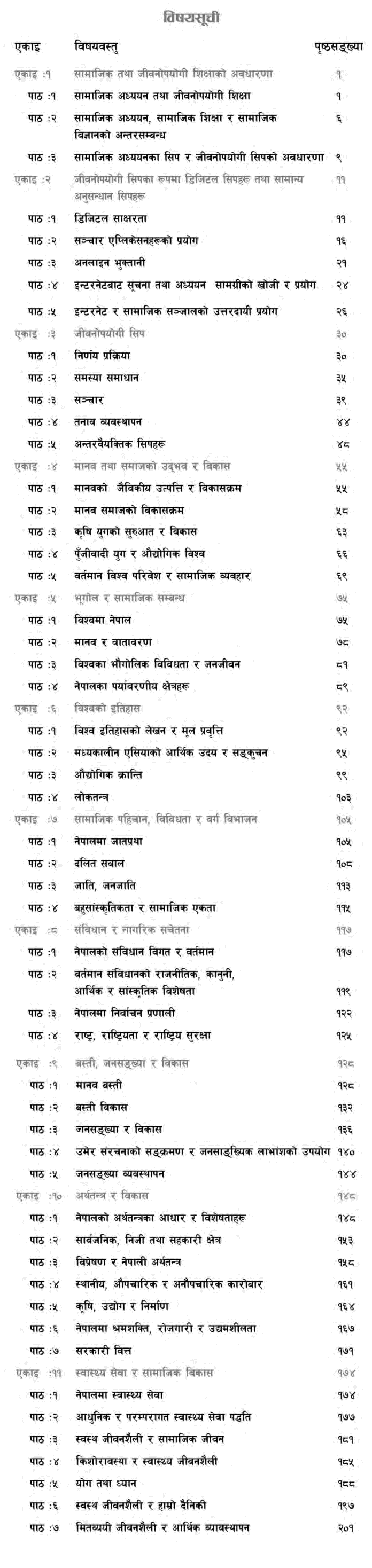
Grade 11 Social Studies and Life Skills Education Unit List
| Unit No. | Unit Name |
|---|---|
| 1 | सामाजिक तथा जीवनोपयोगी शिक्षाको अवधारणा |
| 2 | जीवनोपयोगी सिपका रूपमा डिजिटल सिपहरू तथा सामान्य अनुसन्धान सिपहरू |
| 3 | जीवनोपयोगी सिप |
| 4 | मानव तथा समाजको उत्पत्ति र विकास |
| 5 | भूगोल र सामाजिक सम्बन्ध |
| 6 | विश्वको इतिहास |
| 7 | सामाजिक पहिचान, विविधता र वर्ग विभाजन |
| 8 | संविधान र नागरिक सचेतना |
| 9 | बस्ती, जनसङ्ख्या र विकास |
| 10 | अर्थतन्त्र र विकास |
| 11 | स्वास्थ्य सेवा र सामाजिक विकास |
Structure and Content of the Book
The textbook contains 11 main units. The sequence begins with the concept of social studies and life skills education, then moves into digital literacy, research skills, life skills, human society, geography, history, identity, citizenship, settlement, economy, and health.
The first unit, “सामाजिक तथा जीवनोपयोगी शिक्षाको अवधारणा,” introduces the meaning and purpose of social studies and life skills education. It explains the relationship among social studies, social education, and social science. It also introduces basic skills needed in social studies and the concept of life skills. This unit builds the foundation for the rest of the textbook.
The second unit, “जीवनोपयोगी सिपका रूपमा डिजिटल सिपहरू तथा सामान्य अनुसन्धान सिपहरू,” is one of the most practical parts of the book. It covers digital literacy, use of communication applications, online payment, searching and using information from the internet, and responsible use of the internet and social media. These topics are directly useful for students because digital tools are now part of study, communication, research, payment, and information access.
The third unit, “जीवनोपयोगी सिप,” focuses on practical personal and social skills. It includes decision-making, problem-solving, communication, leadership management, and interpersonal skills. These lessons help students handle daily situations, work with others, make better choices, and communicate more clearly.
The fourth unit, “मानव तथा समाजको उत्पत्ति र विकास,” explains the origin and development of human beings and society. It includes human biological development, development of human society, the beginning and development of the agricultural age, the capitalist age and industrial world, and the present global context and social behaviour. This unit helps students understand how human society changed over time.
The fifth unit, “भूगोल र सामाजिक सम्बन्ध,” connects geography with society. It includes Nepal in the world, human beings and environment, geographical diversity and human life in the world, and Nepal’s ecological regions. This unit is especially relevant for Nepali students because geography directly influences settlement, occupation, lifestyle, culture, and development.
The sixth unit, “विश्वको इतिहास,” introduces students to major historical patterns. It includes the writing of world history and its main trends, the economic rise and contraction of medieval Asia, the Industrial Revolution, and democracy. This unit helps students understand how historical events, economic systems, and political ideas shaped the modern world.
The seventh unit, “सामाजिक पहिचान, विविधता र वर्ग विभाजन,” focuses on social identity, diversity, and social division. It includes Nepal’s caste system, Dalit issues, caste and ethnicity, multiculturalism, and social unity. This unit is important for developing awareness of inclusion, equality, dignity, and respect for diversity.
The eighth unit, “संविधान र नागरिक सचेतना,” introduces constitutional and civic knowledge. It includes Nepal’s constitutional development, the current Constitution, political, legal, economic and cultural features of the Constitution, Nepal’s election system, nation, nationality, and national security. This unit helps students understand citizenship, democratic practice, rights, duties, and national responsibility.
The ninth unit, “बस्ती, जनसङ्ख्या र विकास,” deals with settlement, population, and development. It includes human settlement, settlement development, population and development, age structure, demographic dividend, and population management. This section helps students connect population trends with planning, labour force, development, and social change.
The tenth unit, “अर्थतन्त्र र विकास,” focuses on Nepal’s economy and development process. It includes the bases and characteristics of Nepal’s economy, public, private and cooperative sectors, remittance and the Nepali economy, local, formal and informal transactions, agriculture, industry, construction, labour force, employment, entrepreneurship, and government finance. This unit connects economic concepts with livelihood, employment, and national development.
The eleventh unit, “स्वास्थ्य सेवा र सामाजिक विकास,” links health with social progress. It includes health services in Nepal, modern and traditional health service systems, healthy lifestyle and social life, adolescence and healthy lifestyle, yoga and meditation, healthy daily routine, economical lifestyle, and financial management. This final unit is practical because it connects personal health, social well-being, daily habits, and responsible financial behaviour.
Learning Approach and Exercise Pattern
The textbook follows an activity-based and discussion-oriented learning style. Many lessons begin with conversations, questions, examples, diagrams, or social situations. This helps students connect the lesson with real life before moving into formal explanation.
The book includes classroom dialogue, conceptual explanation, diagrams, visual charts, lesson-based activities, discussion questions, exercises, research and observation tasks, digital-skill activities, community-based examples, and project-style learning.
This structure is useful because social studies and life skills education cannot be learned only by memorizing definitions. Students need to observe society, understand social issues, compare ideas, use evidence, discuss solutions, and practise life skills in real situations.
The textbook also encourages students to understand the connection between individual life and society. Topics such as digital literacy, social media use, decision-making, leadership, identity, population, economy, health, and financial management are directly related to students’ present and future lives.
Why This Book Is Important for Grade 11 Students
The Class 11 Social Studies and Life Skills Education Book is important because it combines academic knowledge with practical life preparation. Students learn about society, geography, history, citizenship, economy, population, health, and development, while also practising skills needed for everyday life.
The book supports civic awareness. Students learn about the Constitution, election system, nationality, national security, diversity, equality, and social unity. These topics help students understand their role as responsible citizens.
It also supports digital and research literacy. Students learn how to use online information, communication applications, online payment, internet resources, and social media responsibly. These skills are useful in school, higher education, employment, and personal life.
Another important value of the book is its focus on life skills. Decision-making, problem-solving, communication, leadership, interpersonal skills, healthy lifestyle, yoga, meditation, and financial management help students prepare for real-life challenges beyond examinations.
For exam preparation, students should read each unit carefully, understand the key concepts, practise the exercises, and connect the lessons with current social issues. Short notes can help during revision, but the textbook itself should remain the main study resource.
PDF Use and Responsible Access
The PDF version of the Grade 11 Social Studies and Life Skills Education Book is useful for students who want to study from a mobile phone, tablet, laptop, or printed copy. It helps students access unit lists, lesson explanations, exercises, diagrams, and activities when the printed book is not available.
The book should be used responsibly. The copyright notice states that commercial reproduction, translation, adaptation, modification, publication, storage, or copying of full or partial content requires written permission from the Curriculum Development Centre. Students may use the PDF for study and reference, but websites should be careful while hosting or redistributing the file without proper permission.
Conclusion
The Grade 11 Social Studies and Life Skills Education Book is a complete textbook for Class 11 students in Nepal. It brings together social studies, civic awareness, digital literacy, life skills, geography, history, social identity, economy, population, health, and development.
From “सामाजिक तथा जीवनोपयोगी शिक्षाको अवधारणा” to “स्वास्थ्य सेवा र सामाजिक विकास,” the textbook helps students understand society and prepare for practical life. It is useful for examination preparation, but its value goes beyond exams. Students who read the lessons carefully, practise the activities, and connect the content with their community will gain stronger social understanding and better life skills.


Answer