



NEB Grade 11 Compulsory English Book: Curriculum, Structure, and Content Overview
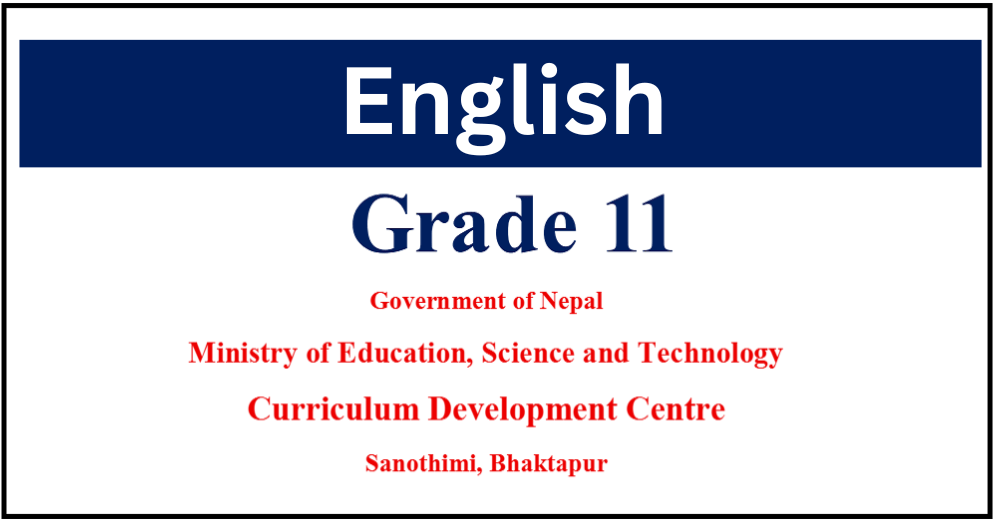
The NEB Grade 11 Compulsory English Book is a core textbook for Class 11 students in Nepal. The book is officially titled English Grade 11 and is published by the Government of Nepal, Ministry of Education & Sports, Curriculum Development Centre, Sanothimi, Bhaktapur.
The textbook follows the spirit of the National Curriculum Framework 2076 and the Secondary Level Curriculum 2076 for Grade 11 and Grade 12. It is designed to develop students’ English language ability through reading, writing, grammar, vocabulary, listening, speaking, project work, and literature. The book has two main sections: Language Development and Literature.
Table of Content
- NEB Grade 11 Compulsory English Book: Curriculum, Structure, and Content Overview
- About the Grade 11 Compulsory English Textbook
- NEB Grade 11 Compulsory English Book Structure
- Section One: Language Development Unit List
- Section Two: Literature Content List
- Structure and Content of the Book
- Literature Section Overview
- Learning Approach and Exercise Pattern
- Why This Book Is Important for Grade 11 Students
- PDF Use and Responsible Access
- Conclusion
- Download Book
About the Grade 11 Compulsory English Textbook
The English Grade 11 textbook treats English as both a language skill subject and a literature-based subject. It does not focus only on grammar or textbook questions. Instead, it combines reading texts, vocabulary activities, grammar practice, writing tasks, listening exercises, speaking functions, and project-based learning.
The uploaded edition is marked as 2080 BS (2024 AD). The textbook was compiled and written by Mohan Singh Saud and later improved and edited by subject experts. The preface explains that the book aims to develop all four language skills and prepare students to use English in academic, social, and practical situations.
A major strength of the textbook is its integrated structure. Each language unit connects reading with vocabulary, grammar, writing, listening, speaking, and project work. The literature section adds short stories, poems, essays, and one-act plays by Nepali and international writers. This combination helps students improve both language use and literary understanding.
NEB Grade 11 Compulsory English Book Structure
| Section | Focus Area |
|---|---|
| Section One | Language Development |
| Section Two | Literature |
The Language Development section builds practical English skills through 20 thematic units. These units cover education, communication, media, culture, health, environment, human rights, family, creativity, career, politics, peace, migration, tourism, science, and technology.
The Literature section introduces students to selected short stories, poems, essays, and one-act plays. These texts help students read creatively, interpret meaning, understand different cultures, and respond critically to human experiences.
Section One: Language Development Unit List
| Unit No. | Unit Name |
|---|---|
| 1 | Education and Humanity |
| 2 | Communication |
| 3 | Media and Society |
| 4 | History and Culture |
| 5 | Life and Love |
| 6 | Health and Exercise |
| 7 | Ecology and Development |
| 8 | Humour and Satire |
| 9 | Democracy and Human Rights |
| 10 | Home Life and Family Relationship |
| 11 | Arts and Creation |
| 12 | Fantasy |
| 13 | Career and Entrepreneurship |
| 14 | Power and Politics |
| 15 | War and Peace |
| 16 | Critical Thinking |
| 17 | Globalisation and Diaspora |
| 18 | Immigration and Identity |
| 19 | Travel and Tourism |
| 20 | Science and Technology |
Section Two: Literature Content List
| Literature Unit | Text Type | Included Texts |
|---|---|---|
| Unit 1 | Short Stories | The Selfish Giant, The Oval Portrait, God Sees the Truth but Waits, The Wish, Civil Peace, Two Little Soldiers, An Astrologer’s Day |
| Unit 2 | Poems | Corona Says, A Red, Red Rose, All the World’s a Stage, Who are you, little i?, The Gift in Wartime |
| Unit 3 | Essays | Sharing Tradition, How to Live Before You Die, What I Require from Life, What is Poverty?, Scientific Research is a Token of Humankind’s Survival |
| Unit 4 | One-Act Plays | Trifles, A Sunny Morning, Refund |
Structure and Content of the Book
The Grade 11 Compulsory English book is arranged around themes that are relevant to students’ academic and social lives. The first section contains 20 language development units, and each unit follows a skill-based pattern. Students read a text, learn vocabulary, answer comprehension questions, think critically, write their own responses, practise grammar, listen to spoken English, speak in a given context, and complete project work.
The first unit, Education and Humanity, begins with “Education First”, a speech by Malala Yousafzai at the United Nations Youth Assembly. This opening unit introduces education, equality, human rights, and the power of voice. It sets the tone for the book by showing that English is not only a subject for exams but also a medium for expressing ideas and social concerns.
The second unit, Communication, focuses on how people exchange ideas. It helps students understand communication as a practical skill needed in study, work, family, and society. The unit supports vocabulary development, paragraph writing, grammar practice, listening, and speaking.
The third unit, Media and Society, connects English learning with newspapers, digital media, public communication, and social influence. Students learn to read media-related texts and think about how information shapes public opinion.
The fourth unit, History and Culture, introduces students to historical and cultural content. It helps them use English to describe past events, cultural practices, identity, and heritage.
The fifth unit, Life and Love, deals with human emotions and relationships. It helps students read and respond to texts connected with affection, personal experience, and emotional expression.
The sixth unit, Health and Exercise, connects English with healthy living. Students learn to discuss health, lifestyle, exercise, and well-being while practising grammar and writing tasks.
The seventh unit, Ecology and Development, links English learning with environmental awareness. It supports chart and diagram interpretation, environmental vocabulary, and discussion on development-related issues.
The eighth unit, Humour and Satire, introduces students to indirect meaning, wit, and criticism. This unit helps learners understand how language can entertain and question society at the same time.
The ninth unit, Democracy and Human Rights, deals with rights, equality, justice, dignity, and public life. It supports critical thinking and persuasive expression.
The tenth unit, Home Life and Family Relationship, focuses on family, care, responsibility, and social behaviour. It helps students discuss personal and domestic experiences in English.
The eleventh unit, Arts and Creation, connects English with creativity. Students practise describing, reviewing, and responding to artistic work.
The twelfth unit, Fantasy, encourages imagination and creative thinking. It supports narrative writing and helps students express surprise, wonder, and possibility.
The thirteenth unit, Career and Entrepreneurship, is practical for Grade 11 students because it connects English with work, future planning, employment, innovation, and enterprise.
The fourteenth unit, Power and Politics, introduces students to leadership, authority, public decision-making, and political ideas. It supports argumentative and opinion-based writing.
The fifteenth unit, War and Peace, helps students understand conflict, suffering, peace, and social responsibility. It encourages reflective reading and discussion.
The sixteenth unit, Critical Thinking, directly supports reasoning and analysis. Students practise questioning, interpreting information, and preparing well-structured responses.
The seventeenth unit, Globalisation and Diaspora, connects English with global movement, migration, culture, and identity. It helps students understand how people and ideas move across borders.
The eighteenth unit, Immigration and Identity, focuses on belonging, memory, language, and cultural experience. It is useful for understanding migration and personal identity.
The nineteenth unit, Travel and Tourism, connects English with travel writing, tourism, and place-based description. This unit is especially relevant in Nepal’s tourism context.
The twentieth unit, Science and Technology, brings the course to a modern theme. Students learn to discuss scientific development, technology, robotics, innovation, and their effects on daily life.
Literature Section Overview
The literature section broadens students’ reading experience. It is divided into short stories, poems, essays, and one-act plays.
The short story unit includes works by Oscar Wilde, Edgar Allan Poe, Leo Tolstoy, Roald Dahl, Chinua Achebe, Guy de Maupassant, and R. K. Narayan. These stories introduce students to different cultures, conflicts, moral questions, character development, irony, and narrative style.
The poetry unit includes poems by Vishnu S. Rai, Robert Burns, William Shakespeare, E. E. Cummings, and Tran Mong Tu. Through these poems, students encounter themes such as pandemic awareness, love, human life, childhood perception, and the pain of war.
The essay unit includes reflective and argumentative prose by Frank LaPena, Steve Jobs, J. B. S. Haldane, Jo Goodwin Parker, and Vladimir Keilis-Borok. These essays help students engage with tradition, life choices, poverty, scientific research, and human survival.
The one-act play unit includes Trifles, A Sunny Morning, and Refund. These plays help students understand dialogue, character, humour, dramatic conflict, social tension, and stage-based storytelling.
Learning Approach and Exercise Pattern
The textbook follows an integrated approach to English learning. Students do not study reading, grammar, writing, listening, and speaking as separate blocks. Instead, each unit connects these skills through a central theme.
The exercises generally include pre-reading questions, reading texts, vocabulary tasks, dictionary use, comprehension questions, critical thinking questions, writing exercises, grammar practice, listening activities, speaking functions, and project work.
This pattern is useful because English learning requires regular practice across different skills. Students read a text, understand its meaning, learn new words, answer questions, write their own response, practise grammar, listen to spoken English, speak in a given situation, and complete a small project.
The project work also encourages students to use English beyond textbook reading. They may prepare posters, conduct interviews, collect information, write reports, or present findings. This makes the textbook more practical and classroom-friendly.
Why This Book Is Important for Grade 11 Students
The Class 11 Compulsory English Book is important because English is both an examination subject and a communication tool. Students need English for higher education, entrance exams, academic writing, scholarship applications, digital learning, employment, and public communication.
The book helps students develop reading comprehension, vocabulary, grammar accuracy, writing ability, speaking confidence, listening skill, and literary interpretation. Its themes are also relevant to modern learners. Students read about education, media, human rights, environment, family, technology, migration, tourism, career, and global issues.
For exam preparation, students should not depend only on summaries. They should read the textbook carefully, practise comprehension questions, revise vocabulary and grammar, write answers in their own words, and prepare writing formats such as paragraphs, essays, reports, emails, diaries, reviews, narratives, and argumentative texts.
The literature section also needs careful study. Students should understand the plot, theme, character, tone, setting, message, and literary features of each text. Short notes may help in quick revision, but they cannot replace reading the original text.
PDF Use and Responsible Access
The PDF version of the NEB Grade 11 Compulsory English Book is useful for students who want to study from a mobile phone, tablet, laptop, or printed copy. It helps students access reading texts, unit lists, vocabulary tasks, grammar exercises, writing activities, and literature content when the printed book is not available.
The book should be used responsibly. The copyright page states that the publication belongs to the publisher. Students may use the PDF for study and reference, but websites should be careful while hosting or redistributing the file without proper permission.
Conclusion
The NEB Grade 11 Compulsory English Book is a complete English textbook for Class 11 students in Nepal. It combines language development and literature in a structured way. The first section builds practical English skills through 20 thematic units, while the second section introduces students to short stories, poems, essays, and one-act plays.
The textbook is useful because it supports reading, writing, grammar, listening, speaking, vocabulary, project work, and literary interpretation. Students preparing for Grade 11 English should use it as a full learning resource, not only as an exam guide. Reading each unit carefully, practising writing tasks, learning vocabulary in context, revising grammar, and understanding literature will make English clearer, more practical, and more useful for further study.
Download Book
Class 11 Compulsory English Book (Page 1-116)

Comments 0
No comments yet. Be the first to start the conversation.