



Biology Grade 12 Book: Curriculum, Structure, and Content Overview
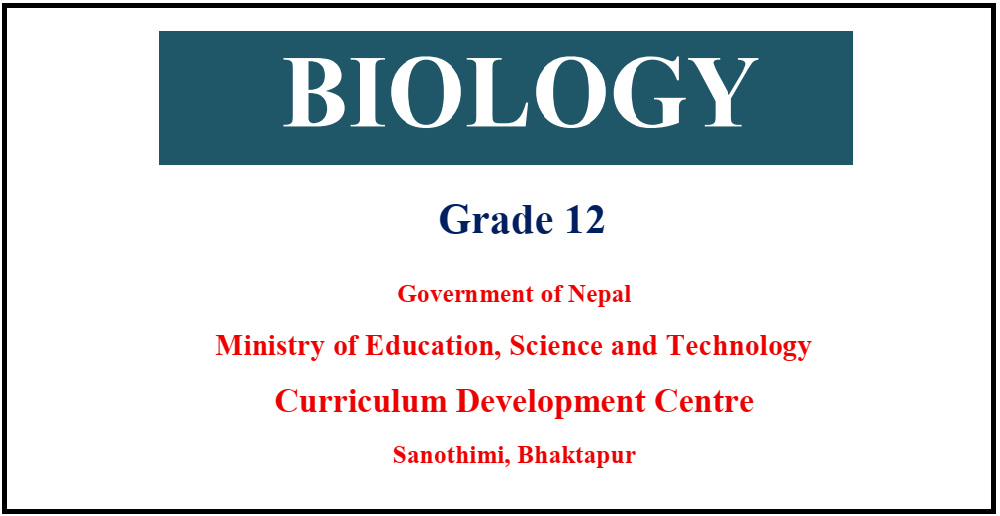
The Biology Grade 12 textbook, published by the Curriculum Development Centre, Government of Nepal, Ministry of Education and Sports, is a secondary-level textbook prepared for classroom teaching and student learning. The publication page identifies it as the First Edition, 2024, with the Curriculum Development Centre, Sanothimi, Bhaktapur, as the publisher.
The textbook has been prepared in line with the National Curriculum Framework for School Education, 2076 and developed according to the Secondary Level Class 11–12 Biology Curriculum, 2077.
Table of Content
- Biology Grade 12 Book: Curriculum, Structure, and Content Overview
- Curriculum Basis and Purpose
- Development and Contribution
- Structure of the Textbook
- Plant Anatomy
- Plant Physiology
- Genetics, Embryology, and Biotechnology
- Animal Tissue and Developmental Biology
- Human Biology
- Human Population and Health Disorder
- Applied Biology and Microbiology
- Learning Approach
- Conclusion
- Download Book
Curriculum Basis and Purpose
A curriculum works as the central guide for deciding what should be taught and learned. A textbook supports that purpose by presenting the intent and content of the curriculum in an organized and usable form. The Biology Grade 12 textbook follows this role by presenting biological knowledge through lessons, activities, diagrams, exercises, and project-based tasks.
The textbook is designed to provide relevant, practical, and useful knowledge for learners. It supports the overall development of students by helping them understand living organisms, biological processes, human body systems, health-related issues, population concerns, biotechnology, microbiology, and applied biology. It also encourages teachers to adapt the content and activities according to classroom needs and learner contexts.
The book is intended to be a major classroom resource, but not the only source of learning. Teachers are encouraged to use additional resources where needed to support the curriculum. This makes the textbook a structured guide for learning while still allowing flexibility in teaching.
Development and Contribution
The textbook was developed by a team consisting of Dr. Rakesh Prasad Bhagat, Mr. Suraj Babu Ghimire, Mr. Sumant Kumar Ranjit, Mr. Santosh Kumara Lamsal, and Mr. Lav Dev Bhatta.
The publication also acknowledges the contributions of Director General Mr. Yubaraj Paudel, Dr. Kamal Prasad Acharya, Mr. Umanath Lamsal, Mr. Keshar Bahadur Khulal, Mr. Heramba Raj Kandel, Ms. Mina Shrestha, Mr. Purushottam Ghimire, Prof. Dr. Jaya Prakash Hamal, Goma Karki, Trailokya Nath Joshi, and Mr. Sanjeev Bhandari.
These acknowledgements show that the textbook was prepared through the combined work of writers, subject experts, curriculum officials, and contributors involved in the publication process.
Structure of the Textbook
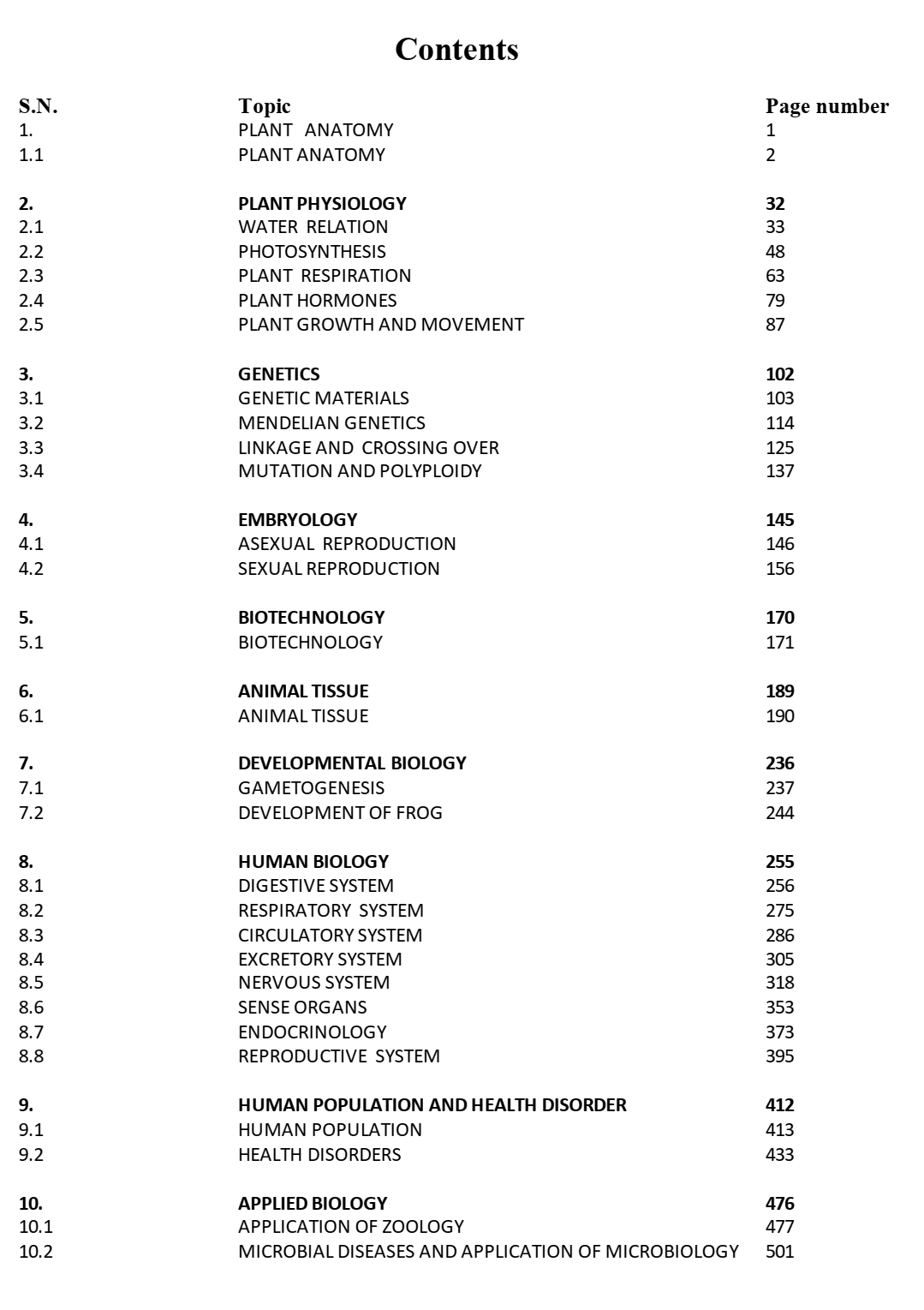
The textbook is organized into 10 main topics. These topics begin with plant structure and function, then move through genetics, reproduction, biotechnology, animal tissues, human biology, population, health disorders, and applied biology.
| S.N. | Main Topic | Subtopics |
|---|---|---|
| 1 | Plant Anatomy | Plant anatomy |
| 2 | Plant Physiology | Water relation, photosynthesis, plant respiration, plant hormones, plant growth and movement |
| 3 | Genetics | Genetic materials, Mendelian genetics, linkage and crossing over, mutation and polyploidy |
| 4 | Embryology | Asexual reproduction, sexual reproduction |
| 5 | Biotechnology | Biotechnology |
| 6 | Animal Tissue | Animal tissue |
| 7 | Developmental Biology | Gametogenesis, development of frog |
| 8 | Human Biology | Digestive system, respiratory system, circulatory system, excretory system, nervous system, sense organs, endocrinology, reproductive system |
| 9 | Human Population and Health Disorder | Human population, health disorders |
| 10 | Applied Biology | Application of zoology, microbial diseases and application of microbiology |
Plant Anatomy
The textbook begins with plant anatomy, which deals with the internal structure and function of plant parts. It introduces tissue as a group of cells with a common origin that performs a specific function. This helps students understand the biological organization from cells to tissues, organs, systems, and the whole organism.
The chapter explains different types of plant tissues. It covers meristematic tissue, which is responsible for growth, and permanent tissue, which performs functions such as storage, protection, support, secretion, and transport. Simple permanent tissues such as parenchyma, collenchyma, and sclerenchyma are discussed along with complex tissues such as xylem and phloem.
The section also explains vascular bundles and secretory tissues. Students study the anatomy of dicot and monocot roots, stems, and leaves. These comparisons help them understand how different plant groups vary in internal structure. The chapter also includes secondary growth in dicot stems, showing how plants increase in thickness through the activity of vascular cambium and cork cambium.
Plant Physiology
The plant physiology section focuses on the major life processes of plants. It includes water relation, photosynthesis, plant respiration, plant hormones, and plant growth and movement.
Through water relation, students learn how plants absorb and transport water. Photosynthesis explains how plants prepare food, while plant respiration shows how energy is released from food. The section on plant hormones introduces chemical control in plants. Plant growth and movement helps students understand how plants respond to internal and external conditions.
This section connects plant structure with plant function. It shows that plants are active living systems that absorb materials, produce food, release energy, grow, and respond to their surroundings.
Genetics, Embryology, and Biotechnology
The genetics section introduces heredity and variation. It includes genetic materials, Mendelian genetics, linkage and crossing over, mutation, and polyploidy. These topics help students understand how traits are passed from one generation to another and how genetic changes occur.
Mendelian genetics provides the foundation for understanding inheritance patterns. Linkage and crossing over explain how genes may behave during reproduction, while mutation and polyploidy introduce important sources of variation.
The embryology section covers asexual and sexual reproduction. These topics explain how organisms reproduce and how life continues from one generation to the next.
The biotechnology chapter connects biology with practical applications. It introduces the use of biological knowledge, organisms, and processes in useful fields. Its inclusion helps students see biology not only as a theoretical subject but also as a discipline with practical importance.
Animal Tissue and Developmental Biology
The animal tissue section explains how cells are organized into tissues in animals. It helps students understand how groups of specialized cells perform particular functions and contribute to the structure of animal bodies.
The developmental biology section includes gametogenesis and the development of frog. Gametogenesis explains the formation of reproductive cells, while frog development introduces students to important stages of animal development. This section links reproduction, cell division, and body formation in a clear biological sequence.
Human Biology
The human biology section is one of the major parts of the textbook. It covers the digestive system, respiratory system, circulatory system, excretory system, nervous system, sense organs, endocrinology, and reproductive system.
These chapters help students understand the structure and function of the human body. The digestive system explains nutrition and food processing. The respiratory system deals with breathing and gas exchange. The circulatory system explains transport within the body, while the excretory system focuses on waste removal. The nervous system, sense organs, and endocrine system explain coordination and control. The reproductive system introduces the biological basis of human reproduction.
Together, these chapters help students understand how different organs and systems work together to maintain life processes.
Human Population and Health Disorder
The textbook includes human population and health disorder as a separate topic. The human population chapter introduces population-related concepts, while the health disorders chapter deals with conditions that affect normal body structure or function.
This section connects biology with social and health-related concerns. It helps students understand that biology is closely related to public health, population issues, and quality of life. By including these topics, the textbook moves beyond the study of organisms and systems to show how biological knowledge applies to human society.
Applied Biology and Microbiology
The final section focuses on applied biology. It includes the application of zoology, microbial diseases, and the application of microbiology.
This section shows how biological knowledge is used in practical fields. The application of zoology connects animal biology with useful areas of study, while microbiology introduces students to microorganisms, diseases, and their practical importance. These topics help students understand the role of biology in everyday life, health, and applied science.
Learning Approach
The textbook uses explanations, activities, diagrams, exercises, and project work to support learning. This approach encourages students to observe, compare, discuss, draw, answer questions, and apply concepts. It also gives teachers opportunities to make classroom learning more interactive and practical.
Because all lessons are considered important, teachers are expected to use the textbook carefully while adapting tasks according to learner needs and classroom conditions. This makes the book useful for both structured instruction and flexible classroom practice.
Conclusion
The NEB Biology Grade 12 textbook provides an organized introduction to major areas of biology. It begins with plant anatomy and plant physiology, then covers genetics, reproduction, biotechnology, animal tissues, developmental biology, human biology, population studies, health disorders, and applied biology.
By combining curriculum-based content with diagrams, activities, exercises, and project work, the textbook supports students in developing a clear understanding of living systems. It also helps learners connect biological concepts with health, society, practical applications, and everyday life.
Note:
All rights reserved with the Curriculum Development Centre; no part of this publication may be reproduced, transmitted in any other forms or by any means without the written permission of the publisher. However, this does not prohibit making photocopies of its pages for teacher training or other non-profit-making purposes.


Comments 0
No comments yet. Be the first to start the conversation.